
Table of Contents
- Why Used Farm Tractors Are Holding Value in 2026
- 1. Match Tractor Size and Horsepower to Your Actual Work
- 2. Set a Realistic Budget Before You Shop
- 3. Research Makes, Models, and the Average Lifespan of a Farm Tractor
- 4. How to Check Tractor Engine Hours and Maintenance Records
- 5. Run a Used Tractor Inspection Checklist Before You Commit
- 6. Test the Transmission, Hydraulics, and PTO Under Load
- 7. Sort Out Financing, Insurance, and Transport Early
- Red Flags and Post-Purchase Maintenance
- Conclusion
- Frequently Asked Questions
Last Updated: September 16, 2026
Why Used Farm Tractors Are Holding Value in 2026
Sales of 100 HP and 4WD tractors fell by 10% to 20% in 2026, according to Farm Credit Canada's Farm Equipment Outlook 2026. That decline in new-machine sales has produced a counterintuitive result: used farm tractors have held their value, and in some categories, prices have barely moved at all.
So why use Ironmartonline as your equipment broker? Because in a market this tight, where a well-maintained machine sells fast and a misrepresented one sits for months, the difference between a good deal and an expensive mistake comes down to how the transaction is handled. Ironmartonline connects buyers and sellers of used machinery through nine specialized web-based selling platforms, giving listings reach to millions of potential buyers without contracts or hidden fees.
This guide covers 7 tips for buying used farm tractors in 2026, from matching horsepower to your actual workload to sorting out financing and transport before you commit. The stakes are real: the same Farm Credit Canada report notes that 40-100 HP tractors saw sales drop between 3.1% and 13.9%, which means dealers and private sellers are sitting on inventory and motivated to negotiate. That's good news for buyers who know what to inspect.
Below, we'll walk through each step, plus the red flags that separate a solid purchase from a money pit.
1. Match Tractor Size and Horsepower to Your Actual Work
The most common buying mistake is oversizing. A 150 HP utility tractor pulling a light mower wastes fuel and money; a 45 HP compact tractor trying to run a round baler will fail under load.
Start with your heaviest implement, not your average task. If you run a three-point hitch mower, a 40-60 HP compact tractor handles it. For row crop work or heavy tillage, you're looking at 100 HP and above. Write down every attachment you own or plan to buy, then match the PTO horsepower requirement to the tractor's rated output.
2. Set a Realistic Budget Before You Shop
A used tractor budget has three parts: purchase price, immediate repairs, and first-year maintenance. Buyers who only plan for the first number get caught short.
Budget for a pre-purchase inspection, fluid and filter changes, and at least one unexpected repair in the first season. Diesel engines, hydraulic systems, and transmissions are the three areas where surprise costs land hardest. Financing through a specialized lender can spread the purchase cost, but it won't cover a blown hydraulic pump.
Farm Bureau Financial Services' guide to buying a used tractor recommends evaluating total hours and maintenance history before price, because a cheaper machine with no service records often costs more over three years than a pricier one with full documentation.
3. Research Makes, Models, and the Average Lifespan of a Farm Tractor
The average lifespan of a farm tractor is 12,000 to 15,000 engine hours with consistent maintenance, which works out to roughly 20 to 30 years for most operations. That number matters because it reframes how you read the hour meter.
A tractor at 4,000 hours is barely broken in. One at 9,000 hours needs a closer look at the transmission and hydraulic system. Research the specific model's known weak points before you drive out to see it: some diesel engines have documented injector issues, others have articulation point wear that shows up past a certain hour count.
TractorByNet community forums are useful here. Real owners post about the failures they've actually experienced on specific models, which is information no dealer spec sheet will give you.
4. How to Check Tractor Engine Hours and Maintenance Records
How to check tractor engine hours starts with the meter itself, but the real answer is in the paperwork. A working hour meter tells you total operating hours; service records tell you whether those hours were maintained or neglected.
Ask for:
- Oil and filter change intervals with dates
- Hydraulic fluid service history
- Any transmission or engine repair invoices
- The serial number and VIN so you can verify the model year independently
A seller who can't produce records isn't necessarily hiding something, but you should price the machine as if it needs full service. According to a 2026 industry discussion on tractor valuation, hours of operation and documented upkeep matter more than the manufacturing year when assessing real value.
5. Run a Used Tractor Inspection Checklist Before You Commit
A used tractor inspection checklist turns a gut-feel purchase into a documented decision. The version below is built as a printable walk-around you can carry on a clipboard or phone. Work through it in order, score each item, and walk away if two or more major items fail.
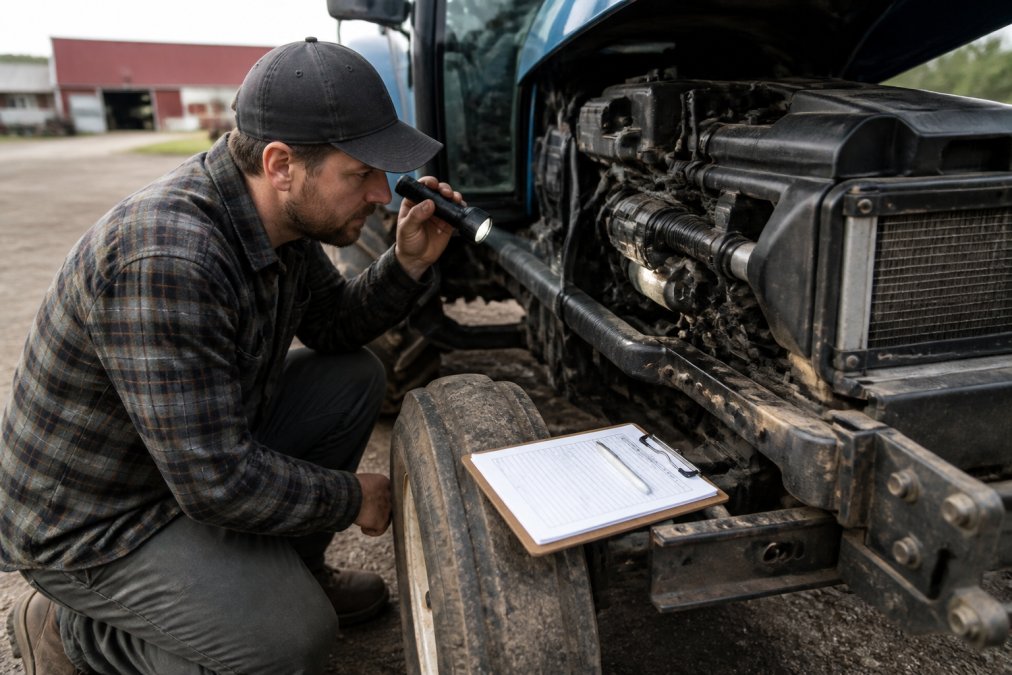
How to score it: Mark each item Pass, Fail, or Watch. A Fail on any item in the Critical tier ends the inspection. A Fail in the Standard tier is negotiable. A Watch means recheck after the engine reaches operating temperature.
Critical tier (walk away on a Fail)
- Cold start: Engine fires within 5 seconds without excessive cranking, white smoke, or stumbling. A healthy diesel may puff briefly, then clear.
- Frame and articulation point: No cracks, welds, or excessive play on articulated models. Rock the machine side to side and listen for clunks.
- Serial number and VIN: Stamped plate matches the paperwork and the model year. A missing or altered plate is a deal-breaker.
- PTO shaft: Spins true by hand with the engine off, no wobble, no metallic grinding. Engage at low idle and listen for hesitation.
- Hydraulic system: No weeping cylinders, no hose damage, no fluid pooling under the machine after 20 minutes of operation.
Standard tier (negotiate on a Fail)
- Engine compartment: No fluid leaks, clean oil on the dipstick, coolant at the correct level, no cracked belts.
- Tires: Tread depth even across the face, no sidewall cracks, correct inflation. Uneven wear points to alignment or ballast problems.
- Three-point hitch: Raises and lowers smoothly under load, holds position without drift.
- Operator station: All gauges, lights, and controls functional. Seat, steering wheel play, and pedal free travel within spec.
- Transmission: Every gear range engages without grinding, including reverse. No delayed engagement when cold.
Watch tier (recheck warm)
- Exhaust color: Blue smoke under load suggests oil consumption; black smoke suggests fuel delivery issues.
- Hydraulic temperature: Lines and cylinders should be warm but not hot to the touch after 20 minutes.
- Electrical: Alternator charging, battery holds voltage, all safety switches function.
Caterpillar's used equipment inspection guidance emphasizes checking the body and tires, engine compartment, articulation point, and PTO shaft as the four highest-priority areas on any used tractor.
6. Test the Transmission, Hydraulics, and PTO Under Load
A parking-lot test drive proves nothing. You need to run the transmission, hydraulics, and PTO under real load before you buy.
Engage the PTO with an implement attached if possible. Listen for metallic sounds or hesitation. Cycle through every gear range, including reverse, and watch for slipping or delayed engagement. Test the three-point hitch with a heavy implement to confirm the hydraulic system holds pressure. Check for fluid leaks after the machine has run for at least 20 minutes, once the system is warm and pressure is up.
Cold start behavior is your best single diagnostic. A diesel engine that fires cleanly from cold is usually healthy; one that cranks, smokes, or stumbles is signaling injector or compression problems that cost real money to fix.
7. Sort Out Financing, Insurance, and Transport Early
Most buyers treat financing, insurance, and transport as afterthoughts. That's backwards. Lining these up before you commit prevents a deal from collapsing at the last step, and it is the part of the buyer's journey most used-tractor guides skip entirely. Securing reliable logistics and financing used heavy equipment remains a universal necessity for any machinery acquisition, including the specialized considerations required when buying used cranes.
Financing a used tractor
Specialized agricultural lenders understand equipment valuation better than general banks. They typically look at three things: the machine's age and hours, the borrower's operating history, and whether the tractor has a documented service record. A conventional lender may decline a 15-year-old tractor with 8,000 hours; an ag lender may approve it if the maintenance trail is clean.
A common pattern is a down payment in the 10% to 20% range, with terms of 3 to 7 years depending on the machine's age. Ask whether the lender requires a formal appraisal or accepts a pre-purchase inspection report. Get a pre-approval letter before you shop so you can negotiate as a cash-equivalent buyer.
Insurance for used equipment
Insurance for a used tractor depends on replacement value, not purchase price. That distinction matters: a machine bought at a discount still costs full market value to replace. Document the machine's condition thoroughly with photos and the inspection checklist, and ask whether the policy covers the tractor while it is being transported home. Many standard farm policies exclude equipment in transit unless you add a rider.
Transport and logistics
Transport is the piece buyers forget most often. A utility tractor can weigh several tons, and moving it requires a trailer rated for the load plus a tow vehicle that can handle it. Check three numbers before you commit:
- Trailer GVWR must exceed the tractor weight plus the trailer's own weight.
- Tongue weight should fall within the tow vehicle's rated capacity, typically 10% to 15% of the loaded trailer weight.
- Tie-down points on the tractor must be rated for the load, and you need at least four chains or straps with working load limits above the tractor's weight.
For cross-region purchases, a commercial hotshot or heavy-haul carrier may be cheaper than renting a trailer and driving it yourself. Get quotes before money changes hands, and confirm the carrier carries cargo insurance.
If you're sourcing equipment through a brokerage, ask who manages logistics on cross-region purchases. Ironmartonline handles the buyer-to-seller connection and reach, so confirm transport arrangements before money changes hands.
Red Flags and Post-Purchase Maintenance
Red flags cluster around documentation and honesty. Walk away from a seller who won't allow a pre-purchase inspection, can't produce a serial number, or pressures you to decide the same day. A machine with mismatched paint on the engine block or chassis often signals accident repair. Excessive rust damage on the frame, not surface rust, is a structural problem.
Once you own the tractor, set a maintenance schedule and stick to it:
| Interval | Task |
|---|---|
| Every 50 hours | Check engine oil, coolant, hydraulic fluid levels |
| Every 250 hours | Change engine oil and filter, inspect belts |
| Every 500 hours | Service hydraulic system, check transmission fluid |
| Annually | Full inspection, grease all fittings, test PTO |
Documented post-purchase maintenance is also what protects resale value. Used farm tractors hold value when the next buyer can see a service trail, and that trail starts the day you take delivery.
Conclusion
Finding the right used tractor in a market where new sales are down but used prices are holding steady takes discipline: match horsepower to real work, verify hours against records, and inspect before you commit. Ironmartonline connects buyers and sellers of used machinery through nine specialized web-based selling platforms, with no contracts and no hidden fees, so you can source equipment with confidence. Join our email list to see fresh inventory and get first access to listings before they move.
Frequently Asked Questions
What is the most important thing to check when buying a used tractor?
The engine and maintenance records matter most. A diesel engine that starts cold without excessive smoke or metallic sounds is a good sign. Pair that with documented service intervals and you have a clearer picture of the tractor's real condition than the model year alone can give you. Farm Credit Canada notes that used prices are holding steady in 2026, so paying for a machine with verifiable upkeep is worth the premium.
How many hours is too many for a used farm tractor?
There is no fixed cutoff, but hours matter less than how they were accumulated. A 6,000-hour tractor used for light loader work may outlast a 3,000-hour unit that spent its life on heavy tillage. Industry consensus in 2026 says operating hours and documented upkeep outweigh the manufacturing year. Use the average lifespan of a farm tractor, typically 8,000 to 12,000 hours with proper service, as your benchmark.
Is it better to buy a used tractor from a private seller or a dealer?
Private sellers often list lower prices, but dealers and certified pre-owned programs provide inspection reports, warranty options, and verified maintenance records. If you are not comfortable evaluating a diesel engine, transmission, or hydraulic system yourself, a dealer or a brokerage that vets listings reduces your risk. The right choice depends on your mechanical confidence and how much time you can spend inspecting machines.
What are the common red flags when inspecting a used tractor?
Watch for fresh paint over rust damage, welds on the chassis or articulation point, fluid leaks under the tractor, tires with uneven tread depth, and a cold start that produces heavy smoke or metallic sounds. A seller who cannot produce maintenance records or a serial number that matches the listing is another warning sign. Walk away if the story behind the machine does not add up.
How do I determine the fair market value of a used tractor?
Compare recent sale prices for the same make, model, and horsepower range, then adjust for hours, tire condition, and attachments. New tractor sales fell 10% to 20% for 100 HP and 4WD units in 2026, according to Farm Credit Canada, which has kept used prices stable. Put new and used quotes on the same basis before you decide, and factor in transport and any immediate repairs.