
Table of Contents
- Why Consider Alternatives to Buying New Heavy Machinery
- Heavy Equipment Leasing vs Buying: Understanding Your Options
- Equipment Rental as a Short-Term Alternative
- Buying Used Equipment: Cost Savings and Considerations
- How to Price Used Construction Equipment
- Used Heavy Equipment Inspection Checklist
- Total Cost of Ownership: New vs Used vs Leased
- Equipment-as-a-Service and Modern Alternatives
- Connecting Buyers and Sellers Through Equipment Brokers
- Conclusion
- Frequently Asked Questions
Last Updated: September 3, 2026
Why Consider Alternatives to Buying New Heavy Machinery
Purchasing new heavy equipment represents one of the largest capital expenditures a construction company or fleet operator will make. A single excavator, articulated truck, or integrated harvester can cost hundreds of thousands of dollars. When you factor in financing costs, insurance, storage, and immediate depreciation, the total cost of ownership becomes staggering.
The market has fundamentally shifted. The global used industrial machinery market is projected to reach $813.99 billion in 2026, driven by infrastructure programs, long lead times for new equipment, and a structural shift toward capital discipline (peer-reviewed research). The equipment rental industry is projected to reach $83.5 billion in 2026 with a 3.6% year-over-year increase (peer-reviewed research).
Why consider a Heavy Equipment Broker when exploring alternatives to buying new heavy machinery? Because the alternatives, leasing, renting, buying used, or equipment-as-a-service models, each require different expertise to navigate successfully. You need a partner who understands market conditions, connects you to verified buyers or sellers, and handles logistics without hidden fees or long-term contracts. A Heavy Equipment Broker operates specialized web-based selling platforms, reaching millions of potential buyers globally and locally, making it easier to find the right equipment or connect with serious buyers when you're ready to sell.
The real question isn't whether alternatives exist. They do, and they're increasingly mainstream. The question is which alternative matches your cash flow, project timeline, and operational needs. Below, we'll walk through each option with the specifics that matter: total cost of ownership, hidden expenses, equipment condition verification, and how to execute each approach without getting burned.
Heavy Equipment Leasing vs Buying: Understanding Your Options
Leasing equipment means you pay for the right to use machinery for a fixed period without owning it. The lessor retains ownership, handles major maintenance, and assumes depreciation risk. You make monthly payments, return the equipment at lease end, and move on.
The choice between leasing and buying hinges on three variables: how long you need the equipment, whether your projects are predictable, and how much capital flexibility matters.
Leasing works best when:
- Projects are temporary or seasonal (6 months to 3 years)
- Equipment technology is evolving rapidly
- You lack capital for a down payment or prefer to preserve cash flow
- Your use is unpredictable
Buying (new or used) works best when:
- You'll operate equipment for 5+ years continuously
- You have specific customization needs
- Your projects are stable and predictable
- You want to build equity in the asset
One often-overlooked advantage of leasing: predictability. Your monthly payment is fixed. Maintenance is typically included. You avoid surprise repair bills that can derail project budgets.
The downside is cost accumulation. Lease a $200,000 excavator for seven years and you'll pay far more in total lease payments than purchasing used equipment outright. Leasing works for temporary needs; it's expensive for long-term operations.
Operating Leases vs Finance Leases
An operating lease is a short-term rental agreement where the lessor retains all ownership benefits and risks. You pay monthly, use the equipment, and return it. The lessor handles maintenance, insurance, and depreciation.
A finance lease is a long-term commitment where you assume most ownership risks and benefits. The lessor finances the equipment purchase, you make payments over the equipment's useful life, and at lease end, you typically have a buyout option.
Operating leases offer maximum flexibility. You get well-maintained equipment and predictable monthly costs with no obsolescence risk. The trade-off: you're paying premium rates for that flexibility and build no equity.
Finance leases are cheaper over time because you're gradually paying off the equipment purchase. However, you assume maintenance risk and are locked in for the full term. Breaking a finance lease early is expensive.
For most construction contractors, operating leases make sense for specialized equipment used occasionally. Finance leases work for core equipment you operate continuously and plan to own long-term.
Equipment Rental as a Short-Term Alternative
Equipment rental provides temporary access to machinery without ownership, typically for days, weeks, or months. You pay daily or weekly rates, the rental company handles maintenance and insurance, and you return the equipment when the project ends.
Rental is ideal for:
- Projects lasting weeks to a few months
- Seasonal or cyclical work with variable equipment needs
- Testing whether you actually need a specific machine before committing capital
- Handling peak demand without building permanent capacity
- Backup equipment when your owned fleet is at capacity
The rental market is strong. United Rentals and Sunbelt Rentals operate nationwide networks with thousands of locations. Specialized rental companies focus on niche equipment. Availability is usually good, delivery is fast, and support is professional.
For most short-term projects, rental wins decisively over ownership. However, renting equipment continuously for two years costs as much as purchasing used. Rental makes sense for genuinely temporary needs, not as a substitute for long-term ownership. Verify what's included: some rental agreements charge separately for delivery, fuel, damage waivers, and operator training.
Buying Used Equipment: Cost Savings and Considerations
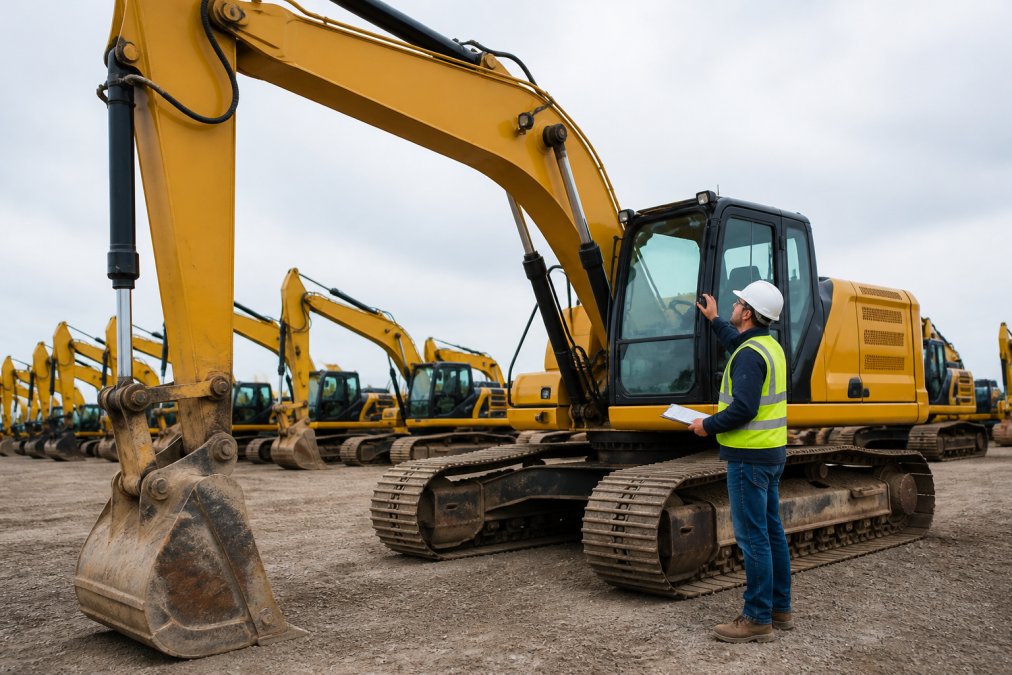
Buying used equipment means acquiring machinery with prior operating history at a fraction of new equipment cost. The used market includes equipment from rental fleets being rotated out, contractors upgrading, lease returns, and auction liquidations. Prices can be 40-60% below new equipment depending on age, condition, and market demand.
The appeal is obvious: you own the asset and avoid the steepest depreciation curve. A three-year-old excavator with documented service history is mechanically sound and costs significantly less than a new one.
The risk is equally obvious: you're buying someone else's wear and potential hidden damage. A $150,000 used loader that needs a $40,000 transmission rebuild isn't a bargain, it's a trap. Professional inspection and documentation verification are non-negotiable before buying used.
Used equipment works well when:
- You have capital available and want to own the asset
- You can verify condition through professional inspection
- You understand the equipment's service history
- You have maintenance capacity in-house or access to reliable repair shops
- You're comfortable with the remaining useful life (typically 5-10 more years)
Used equipment is risky when:
- You're buying sight-unseen from an unknown seller
- Service history is incomplete or undocumented
- You lack technical expertise to assess condition
- You're under time pressure and skip proper inspection
- You buy from sellers with no reputation or recourse
The used construction equipment market is projected to grow from $142.60 billion in 2026 to $243.00 billion by 2035, reflecting infrastructure programs and new-equipment delivery backlogs (peer-reviewed research). In early 2026, used equipment inventories have tightened, decreasing 11.05% year over year, signaling a shortage. This means prices are firm and selection is limited. Buyers who act decisively have an advantage.
How to Price Used Construction Equipment
Pricing used equipment requires three data points: current market value for the same model and year, condition assessment relative to market averages, and regional demand factors.
Step 1: Establish Baseline Comparable Sales
Start with completed auction results, not asking prices. IronPlanet, Ritchie Bros. Auctioneers, and Machinery Values publish historical auction results searchable by equipment model, year, and hours. Look for 5-10 recent sales (within the past 60-90 days) of the same equipment model. Record the sale price and hours for each comparable. Equipment typically depreciates predictably: a machine with 5,000 hours is worth more than an identical model with 12,000 hours.
Step 2: Apply Condition Adjustments
Adjust for condition using this framework:
- Excellent condition (full service history, low hours, no visible wear): Add 10-15% to baseline
- Good condition (documented maintenance, normal wear, minor cosmetic issues): Baseline price
- Fair condition (incomplete service records, moderate wear, some repairs needed): Subtract 10-20%
- Poor condition (deferred maintenance, high wear, major repairs pending): Subtract 25-40%
A hydraulic system rebuild costs $15,000-$40,000. If a machine needs that repair and the baseline price doesn't account for it, you're overpaying by that amount.
Step 3: Factor Regional and Seasonal Demand
Equipment prices vary by region and season. A backhoe loader sells faster and at higher prices in a booming metro area than in a rural market. Spring and early summer see peak demand; winter demand softens. In high-demand regions, expect to pay 5-10% more than the national average.
Step 4: Account for Telematics and Documentation
Modern used equipment with GPS and usage monitoring commands a premium because you can verify actual operating history. Equipment with complete service records, original purchase invoices, and maintenance logs sells faster and at higher prices.
Step 5: Verify Against Current Market Conditions
Check current inventory levels on major platforms. If the same model appears in only 2-3 listings nationwide, the market is tight and prices will be at the high end of your range. If 15-20 listings exist, the market is softer and you can negotiate down.
Real-World Pricing Example
Suppose you're pricing a used 2018 Komatsu PC200 excavator with 8,500 hours. You find five comparable sales from the past 90 days:
- 2018 PC200, 7,200 hours: sold for $185,000
- 2018 PC200, 8,100 hours: sold for $178,000
- 2018 PC200, 9,500 hours: sold for $172,000
- 2017 PC200, 10,200 hours: sold for $165,000
- 2018 PC200, 8,800 hours: sold for $176,000
Your target machine at 8,500 hours falls between the $178,000 and $176,000 sales, suggesting a baseline of approximately $177,000. If the machine has full service records and minimal wear, add 10% ($17,700) for condition, bringing it to $194,700. If it needs hydraulic work, subtract 15% ($26,550), bringing it to $150,450.
This framework is far more rigorous than guessing or relying on a single comparable sale.
Used Heavy Equipment Inspection Checklist
A thorough inspection is your only defense against catastrophic hidden costs. Never buy used equipment without a professional assessment. The inspection process takes 2-4 hours and costs $500-2,000 depending on equipment complexity.
Critical Inspection Areas
Start with the engine and transmission. Run the equipment under load and listen for knocking, grinding, or abnormal noise. Check compression ratios on all cylinders; low compression indicates worn rings or valve damage. Inspect transmission fluid color; dark or burned-smelling fluid suggests overheating or internal wear.
Hydraulic systems demand scrutiny. Inspect all hoses for cracks, leaks, or corrosion. Operate all hydraulic functions and confirm smooth, responsive movement. Jerky or delayed response indicates worn pumps or internal leakage. A hydraulic system rebuild costs $15,000-40,000, so this inspection matters.
Undercarriage condition determines remaining useful life. Inspect track or tire condition for uneven wear patterns. Check pins, bushings, and rollers for excessive wear. Undercarriage rebuilds cost $20,000-60,000.
Structural integrity requires visual inspection for cracks, bends, or welding repairs. Cracks in the boom, frame, or bucket indicate overstress or accidents.
Documentation and Service History
Verify service records. Request maintenance logs for the past 3-5 years. Consistent service intervals indicate an owner who cared for the equipment. Gaps in service records raise red flags.
Check ownership history. Equipment that changes hands multiple times in short periods often indicates problems. Confirm the seller owns the equipment and can provide clear title.
Obtain the equipment's serial number and verify it against any liens. A machine with a lien attached can't be legally transferred to you. Title search services cost $50-200 and prevent costly legal complications.
Document everything in writing. Get a written condition report from the inspector, take photos and video, and confirm all agreed-upon repairs or price adjustments in writing before payment.
Total Cost of Ownership: New vs Used vs Leased
Total cost of ownership (TCO) includes purchase price, financing costs, fuel, maintenance, repairs, storage, insurance, and depreciation.
For new equipment, TCO is predictable but high. A $300,000 excavator financed over five years at 7% interest costs roughly $70,000 in financing alone. Add $8,000 annually for insurance, $3,000 for fuel and maintenance, and $40,000-50,000 per year in depreciation for the first three years. Over five years, TCO easily exceeds $500,000.
For used equipment purchased outright, TCO is lower but less predictable. Buy a $150,000 used excavator with 8,000 hours and you avoid financing costs. However, you assume all maintenance and repair risk. If the machine needs $30,000 in repairs in year two, your actual cost jumps significantly.
For leased equipment, TCO is transparent. A three-year operating lease at $4,000 monthly costs $144,000 over three years. Maintenance is included. At lease end, you walk away with no residual value but also no repair surprises.
The comparison depends entirely on your situation:
- Temporary projects (6-24 months): Rental or short-term operating lease wins on TCO
- Stable operations (5+ years): Used equipment or finance lease typically wins
- Unpredictable demand: Operating lease provides cost certainty
- Capital constrained: Leasing preserves cash; used equipment requires upfront capital
Run the numbers for your specific equipment, project timeline, and expected use. TCO is the only metric that determines whether an alternative to buying new makes financial sense.
Equipment-as-a-Service and Modern Alternatives
Equipment-as-a-Service (EaaS) is an emerging model where you pay a fixed monthly fee for equipment access, maintenance, support, and upgrades, shifting all ownership and operational risk to the provider. Instead of owning equipment or renting it short-term, you subscribe to it like software: one monthly fee covers the machine, all maintenance, repairs, emergency replacement, and technology upgrades.
EaaS is gaining traction in construction and mining because it provides cost certainty, eliminates surprise repair bills, and allows quick equipment swaps as project needs change.
How EaaS Actually Works
When you subscribe to equipment through an EaaS provider, you:
- Define your needs: Specify equipment type, expected usage hours per month, and project duration
- Receive equipment: The provider delivers the machine, fully fueled and ready to operate
- Operate without worry: All maintenance, repairs, and replacements are the provider's responsibility. If the machine breaks down, the provider replaces it, often within 24-48 hours
- Pay one monthly fee: No surprise invoices, no separate maintenance contracts, no damage disputes
- Upgrade or swap: If your project needs change, the provider can swap equipment without penalty
- Return at contract end: Walk away with no residual value, no disposal responsibility
This structure eliminates the administrative burden of equipment ownership. Your team operates the machine; the provider handles everything else.
EaaS Pricing and Cost Structure
EaaS monthly fees are higher than traditional leasing because the provider assumes all operational risk and handles all maintenance. The all-inclusive structure eliminates hidden costs. Traditional leasing often charges separately for delivery, fuel surcharges, damage waivers, and maintenance beyond routine service. EaaS bundles these into one fee.
When EaaS Wins vs. Traditional Alternatives
EaaS is most valuable when:
- Project scope is uncertain and equipment needs may change mid-project
- You lack in-house maintenance expertise and want to avoid repair surprises
- You need rapid equipment replacement if a machine fails
- You want to test new equipment or technology without long-term commitment
- Your projects are short-term (6-18 months) and you want zero residual value risk
EaaS is less attractive when:
- You operate equipment continuously for 3+ years (traditional ownership becomes cheaper)
- Your projects are stable and predictable
- You have in-house maintenance expertise and can manage repairs cost-effectively
- You want to build equity in assets
- You need maximum cost control
Telematics Integration and Usage Monitoring
Modern EaaS providers integrate telematics (GPS, engine diagnostics, usage monitoring) into every subscription. Sensors alert the provider to maintenance needs before failure occurs, reducing downtime. Usage data shows actual operating hours and usage patterns, preventing disputes. For buyers, this transparency is valuable. You can verify that the equipment you're paying for is actually being used as expected.
Sustainability and Emission Compliance Through EaaS
One underappreciated advantage of EaaS is regulatory compliance management. As emission standards tighten, older equipment becomes non-compliant in certain jurisdictions. EaaS providers manage this risk by rotating equipment as regulations change. If your subscription includes a machine that becomes non-compliant, the provider swaps it for a current-standard model at no additional cost.
In contrast, if you own used equipment with older emission standards, you absorb the cost of retrofitting or replacement when regulations tighten.
EaaS Providers and Market Maturity
EaaS is still emerging, but several models exist:
- Equipment manufacturer programs: Caterpillar, Komatsu, and other OEMs offer subscription programs for their equipment
- Specialized EaaS platforms: Startups and regional providers offer subscription-based access to equipment with flexible swap policies
- Rental company hybrids: Major rental companies like United Rentals are experimenting with subscription-like products
The market is fragmented, and contract terms vary significantly. Before committing, verify what's included and what flexibility exists for equipment swaps or early termination.
EaaS vs. Buying Used: A Practical Comparison
Consider a contractor who needs a wheel loader for an 18-month project. Three options:
-
Buy used: $120,000 purchase price + $8,000 annual insurance + $4,000 annual maintenance + $15,000 in unexpected repairs = $147,000 total cost. At project end, the machine is worth $80,000, netting $67,000 actual cost.
-
Traditional operating lease: $3,500/month × 18 months = $63,000. Maintenance included. No residual value.
-
EaaS subscription: $5,000/month × 18 months = $90,000. Maintenance, repairs, and emergency replacement included. If the machine fails, replacement is guaranteed within 48 hours.
On pure cost, traditional leasing wins. But if the machine breaks down mid-project and you need it replaced urgently, EaaS's replacement guarantee has value that pure cost doesn't capture. If your project is time-critical and downtime is expensive, EaaS's premium is justified.
Connecting Buyers and Sellers Through Equipment Brokers
A Heavy Equipment Broker connects buyers and sellers, handles marketing, negotiates terms, and manages logistics, eliminating the friction of private transactions. Rather than listing equipment yourself and waiting for inquiries, or searching endlessly for the right machine, you work with a broker who has access to networks of potential buyers or sellers.
A Heavy Equipment Broker operates specialized web-based selling platforms designed to reach millions of potential buyers globally and locally. Instead of listing your equipment on a single marketplace, the broker distributes your listing across multiple channels simultaneously, maximizing exposure and accelerating sales.
The broker model works because:
- Reach: Brokers have established networks and platform access that individual sellers lack
- Credibility: Established brokers vet transactions and provide recourse if disputes arise
- Efficiency: Brokers handle marketing, negotiations, and logistics, freeing you to focus on operations
- Transparency: Professional brokers disclose fees upfront with no hidden charges
A Heavy Equipment Broker's no-contracts, no-hidden-fees approach addresses a core frustration with traditional brokers. You're not locked into long-term agreements or surprised by unexpected charges. The process is straightforward: list your equipment, the broker markets it across multiple platforms, you review offers, and you close the deal.
For buyers, brokers solve the discovery problem. Rather than searching multiple marketplaces, you work with a broker who understands your needs and surfaces relevant equipment. For sellers, brokers solve the marketing problem. Your equipment reaches far more potential buyers than you could reach alone.
Equipment brokers also handle logistics complexity. International sales require customs documentation, shipping coordination, and compliance verification. A Heavy Equipment Broker manages these details, eliminating the headache of arranging cross-border transactions yourself.
Conclusion
The choice between buying new heavy machinery, buying used, leasing, renting, or exploring equipment-as-a-service models depends on your project timeline, capital availability, and operational predictability. Each alternative has legitimate use cases. Temporary projects favor rental. Stable long-term operations favor ownership. Unpredictable demand favors leasing.
What matters most is running the actual numbers for your situation: total cost of ownership, not just sticker price. Factor in financing costs, maintenance risk, depreciation, and the cost of capital tied up in equipment. The alternative that looks cheapest at first glance often becomes expensive once hidden costs surface.
When you're ready to buy or sell used equipment, a Heavy Equipment Broker connects you with millions of potential buyers and sellers through specialized platforms. The no-contracts, no-hidden-fees approach ensures you get maximum reach and transparency without the friction of traditional brokers. Stay informed about market trends, equipment availability, and pricing insights that help you make better acquisition and disposition decisions.
=== FAQ ANSWERS (audit these too, same rules) ===
[1] Q: Should I buy new or used heavy equipment? A: The choice depends on your project timeline, budget, and equipment lifecycle needs. New machinery offers warranty coverage and the latest technology, but used equipment can reduce capital expenditure by 40-60% and still provide years of operational life. Used equipment is ideal if you need immediate availability, while new equipment suits long-term fleet building. Many contractors use both: new for core operations and used for overflow capacity.
[2] Q: What are the primary financial benefits of leasing heavy equipment? A: Leasing preserves cash flow by converting large capital expenditures into predictable monthly operating expenses. Lease payments are often tax-deductible, and you avoid depreciation risk and end-of-life disposal costs. Lessors typically handle maintenance, reducing your operational burden. For projects lasting 2-5 years, leasing often costs less than ownership when you factor in financing, maintenance, and resale hassles.
[3] Q: What should I look for when inspecting used heavy equipment? A: Inspect the engine and hydraulic systems for leaks, examine undercarriage wear on excavators and loaders, check tire or track condition, and verify all controls operate smoothly. Request complete service records and maintenance history. Use telematics data if available to confirm actual operating hours and usage patterns. Have a qualified mechanic perform a pre-purchase inspection. Look for signs of overuse, frame damage, or corrosion that may indicate hidden problems.
[4] Q: Is it better to rent or buy construction equipment for short-term projects? A: Rental is typically more cost-effective for projects under 6 months. Rental companies handle maintenance, delivery, and equipment management, eliminating ownership hassles. Buying makes sense for equipment you'll use repeatedly across multiple projects. The rental market reached $83.5 billion in 2026, growing 3.6% year-over-year, reflecting strong demand from contractors seeking financial flexibility and immediate capacity without long-term capital commitment.
Frequently Asked Questions
Should I buy new or used heavy equipment?
The choice depends on your project timeline, budget, and equipment lifecycle needs. New machinery offers warranty coverage and the latest technology, but used equipment can reduce capital expenditure by 40-60% and still provide years of operational life. Used equipment is ideal if you need immediate availability, while new equipment suits long-term fleet building. Many contractors use both: new for core operations and used for overflow capacity.
What are the primary financial benefits of leasing heavy equipment?
Leasing preserves cash flow by converting large capital expenditures into predictable monthly operating expenses. Lease payments are often tax-deductible, and you avoid depreciation risk and end-of-life disposal costs. Lessors typically handle maintenance, reducing your operational burden. For projects lasting 2-5 years, leasing often costs less than ownership when you factor in financing, maintenance, and resale hassles.
What should I look for when inspecting used heavy equipment?
Inspect the engine and hydraulic systems for leaks, examine undercarriage wear on excavators and loaders, check tire or track condition, and verify all controls operate smoothly. Request complete service records and maintenance history. Use telematics data if available to confirm actual operating hours and usage patterns. Have a qualified mechanic perform a pre-purchase inspection. Look for signs of overuse, frame damage, or corrosion that may indicate hidden problems.
Is it better to rent or buy construction equipment for short-term projects?
Rental is typically more cost-effective for projects under 6 months. Rental companies handle maintenance, delivery, and equipment management, eliminating ownership hassles. Buying makes sense for equipment you'll use repeatedly across multiple projects. The rental market reached $83.5 billion in 2026, growing 3.6% year-over-year, reflecting strong demand from contractors seeking financial flexibility and immediate capacity without long-term capital commitment.
This article was written using GrandRanker