
Table of Contents
- Why Use an Equipment Broker for Used Construction Machinery
- Lower Upfront Purchase Price When Buying Used Construction Equipment
- Avoid Steep Depreciation Rates on Heavy Equipment
- Immediate Availability vs. Long Lead Times for New Machinery
- How to Price Used Construction Equipment for Maximum ROI
- Used Construction Equipment Inspection Checklist
- Lower Insurance, Registration, and Operating Costs
- Section 179 Tax Deduction for Heavy Equipment Purchases
- Total Cost of Ownership: Used vs. New Equipment
- Conclusion
Last Updated: August 28, 2026
Why Use an Equipment Broker for Used Construction Machinery
When shopping for used construction equipment, you face a choice: hunt through scattered listings, negotiate directly with sellers, or work with an equipment broker. The difference is significant.
Purchasing second-hand equipment reduces procurement expenses by 30-50% compared to new machines, according to Fact.MR's 2025 market analysis. But finding the right machine at the right price requires time, expertise, and access to inventory most buyers never see. This raises a critical question: why use a Heavy Equipment Broker like Ironmartonline instead of handling it yourself?
The answer comes down to efficiency, reach, and risk reduction. A dedicated Heavy Equipment Broker operates across multiple platforms, Ironmartonline leverages nine specialized web-based selling platforms, to connect your equipment with millions of potential buyers worldwide. You're not limited to local markets or single-channel exposure. More importantly, a broker handles logistics, inspections, and transaction details that most owner-operators and fleet managers lack time to manage.
The global used construction equipment market is valued at USD 120 billion in 2025 and projected to reach USD 234 billion by 2035, according to Fact.MR's 2025 industry forecast. That growth reflects real demand, but also means competition for visibility. Without professional representation, your equipment sits among thousands of listings. With a broker, it gets positioned where serious buyers actually look.
Below, we'll walk through the concrete financial and operational benefits of buying used construction equipment and show you how to evaluate, price, and purchase machinery that delivers real ROI.
Lower Upfront Purchase Price When Buying Used Construction Equipment
A new mid-size excavator (20-30 ton class) typically runs $200,000-$350,000, while a comparable used unit with 3,000-5,000 hours costs $80,000-$160,000, according to Ironmartonline's equipment pricing data. That's $120,000-$190,000 in savings on a single machine.
For fleet managers needing three excavators, the difference is stark: $600,000-$1,050,000 for new machines versus $240,000-$480,000 for used ones with similar capabilities. Capital freed up by choosing used equipment can be redeployed into hiring, infrastructure upgrades, or cash reserves for unexpected downtime.
Lower upfront cost also means lower financing and insurance costs. Your capital stays flexible and your balance sheet healthier.
Avoid Steep Depreciation Rates on Heavy Equipment
New equipment loses significant value immediately. A brand-new excavator depreciates fastest in the first three to five years, exactly when contractors need cash most.
Used equipment that's already absorbed early depreciation hits maintains more stable residual value. A five-year-old excavator won't drop another 30% in two years the way a new one will. The value curve flattens.
This matters for true cost of ownership. A new machine costing $300,000 might be worth $150,000 in five years. A used machine costing $120,000 might be worth $90,000 in five years. On a percentage basis, the used machine holds value better. For contractors who rotate fleet inventory regularly, this predictability is a game-changer.
Immediate Availability vs. Long Lead Times for New Machinery
New equipment orders carry 12-18 month lead times. Used equipment is ready now, most brokers arrange delivery within days or weeks, not months. That speed translates directly to competitive advantage and lets you mobilize immediately for new contracts.
For owner-operators and rental managers, this speed is essential. You respond to market opportunities and scale operations without friction.
How to Price Used Construction Equipment for Maximum ROI
Start with recent sales data. Look at what similar machines with comparable hours and condition sold for in the last 30-60 days. Online marketplaces and broker networks provide this, though prices vary by region and transportation costs.
Next, adjust for condition. An excavator with full service records and recent hydraulic work is worth more than an identical model with unknown maintenance history. Document everything: engine hours, major repairs, remaining useful life on wear components, and any structural damage.
Finally, calculate your breakeven point. If buying equipment for a specific project, price it against project revenue and equivalent rental costs. If the used equipment pays for itself within 18-24 months through avoided rental fees, it's likely sound.
Used Construction Equipment Inspection Checklist
Before committing, inspect thoroughly. Visual assessment catches obvious problems; mechanical inspection reveals real condition.
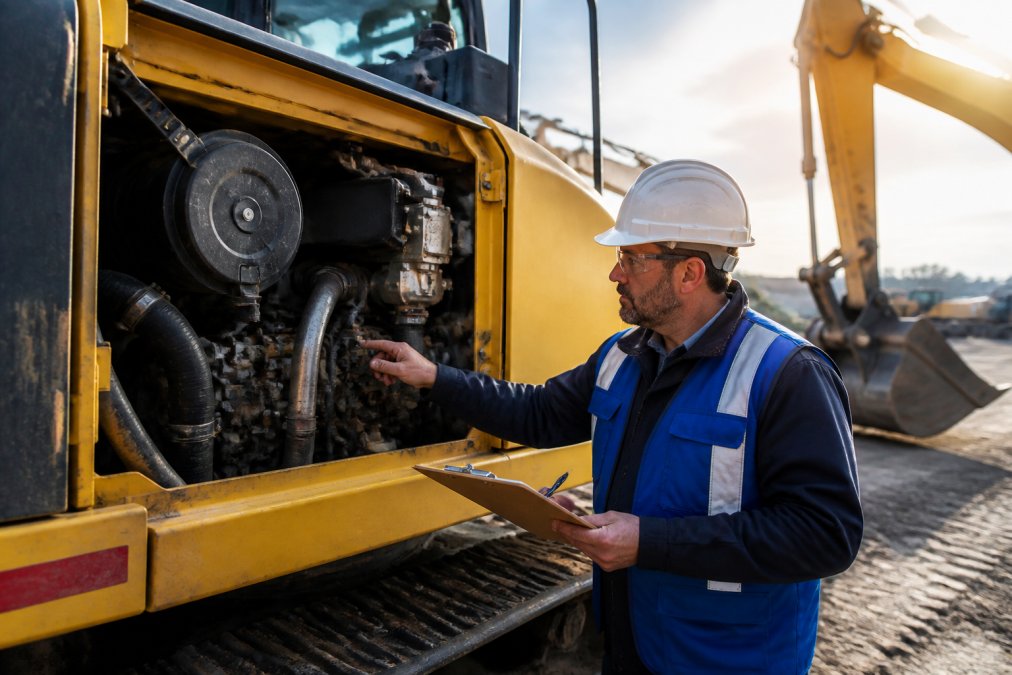
Engine and Hydraulics:
- Fluid leaks: A few drops is normal; active seeping indicates worn seals. Pooling fluid suggests $2,000-$8,000 in seal replacement costs.
- Startup noise: Knocking suggests bearing wear. Squealing indicates belt issues ($200-$500). Loud clunking points to internal hydraulic damage ($5,000+).
- Oil condition: Fresh oil is amber or light brown. Dark oil means incomplete changes or overheating. Milky oil indicates water contamination. Request an oil analysis ($100-$200) if uncertain.
- Hydraulic pressure under load: A drop of more than 10% under full load suggests pump wear or internal leakage.
Structural and Wear Components:
- Bucket and teeth: Worn teeth reduce efficiency and cost $1,500-$3,000 to replace. Measure tooth height; less than 50% remaining needs replacement.
- Tracks or tires: Inspect tread depth and wear patterns. Tracks with less than 30% tread need replacement within 500-1,000 hours ($4,000-$12,000). Tires cost $2,000-$5,000 per set.
- Frame and boom cracks: Small surface cracks are cosmetic; deep cracks at weld points are structural red flags. Walk away from machines with structural damage.
- Corrosion: Surface rust is cosmetic. Deep pitting indicates years of salt or moisture exposure and accelerates failure.
Operational Systems:
- Controls and functions: Operate bucket curl, arm extension, and boom raise through full range. Sluggish response indicates low pressure or worn cylinders.
- Electrical systems: Test all warning lights, backup alarms, and safety features. Non-functional alarms may violate OSHA requirements.
- Cab condition: Check mirrors, windows, and wipers. Cracks or missing mirrors are safety issues.
- Gauges: Verify fuel, coolant, and hydraulic fluid indicators work.
Service History:
- Request complete maintenance records: Machines serviced every 250-500 hours are significantly more reliable.
- Major services on schedule: Verify transmission fluid, final drive fluid, and bearing lubrication followed manufacturer intervals.
- Evidence of major repairs: Understand what was replaced and why.
- Recurring issues: Ask directly about chronic problems.
A thorough inspection takes 2-4 hours and costs $500-$1,500 with a certified inspector. That investment prevents a $50,000 mistake.
Lower Insurance, Registration, and Operating Costs
Used equipment costs less to insure. Insurance premiums scale with replacement value. A $120,000 used excavator has significantly lower insurance costs than a $300,000 new one.
Registration and licensing fees also scale with equipment value in many jurisdictions, reducing annual compliance costs.
Certified Pre-Owned vs. Uncertified Used Equipment
Certified pre-owned (CPO) programs create measurable value. A well-maintained used machine with known service history may have lower operating costs than a new machine under warranty. Routine maintenance costs the same regardless of age, but risk profiles differ dramatically.
CPO equipment typically includes:
- Manufacturer inspection and reconditioning: The machine has been inspected and rebuilt to documented standards. Major wear components are replaced or refurbished.
- Verified service history: Dealers maintain complete records proving on-schedule service.
Where CPO Saves the Most:
- Downtime avoidance: Warranty-covered repairs are fixed quickly, often with loaner equipment. Uncertified machine failures can sideline you for days, costing $500-$1,500 per day in lost productivity.
- Predictable maintenance: CPO machines come with dealer-backed maintenance schedules. Uncertified machines are a mystery.
- Resale value: CPO machines with clean service records resell faster and at higher prices.
Insurance and registration savings for used equipment are 30-50% lower than new equipment and accrue automatically based on assessed value.
Section 179 Tax Deduction for Heavy Equipment Purchases
The IRS Section 179 deduction allows businesses to deduct the full purchase price of qualifying equipment in the year it's placed in service. The 2026 limit is $1,160,000.
Used equipment qualifies as long as it's placed in service in your business. For a contractor buying a $150,000 used excavator, that's a $150,000 deduction against business income. At a 25% effective tax rate, that's $37,500 in tax savings in a single year.
This tax advantage is one reason used equipment purchases often make more financial sense than leasing.
Total Cost of Ownership: Used vs. New Equipment
Real comparison isn't purchase price, it's total cost of ownership (TCO) over the equipment's useful life. TCO includes purchase price, financing, insurance, maintenance, repairs, downtime, and residual value.
New Excavator Scenario (5 years):
- Purchase price: $300,000
- Financing cost (5% APR): $41,500
- Insurance: $12,500
- Maintenance: $8,000
- Repairs: $2,000
- Residual value (50% retention): -$150,000
- Total 5-year cost: $114,000
Used Excavator Scenario (5 years):
- Purchase price: $120,000
- Financing cost (6% APR): $16,200
- Insurance: $6,000
- Maintenance: $15,000
- Repairs: $12,000
- Residual value (60% retention): -$72,000
- Total 5-year cost: $97,200
The used equipment scenario costs $16,800 less over five years, a 15% savings, despite higher maintenance and repair costs. That gap widens with Section 179 tax deductions.
The benefits of buying used construction equipment extend far beyond initial price. Lower upfront costs, avoided depreciation, immediate availability, and favorable tax treatment create a compelling financial case. Add operational advantages, proven performance history, stable residual value, and lower insurance costs, and the case strengthens further.
The challenge is finding the right machine at the right price from a trustworthy source. That's where working with a Heavy Equipment Broker makes the difference. Ironmartonline connects you to millions of potential buyers and sellers across nine specialized platforms, eliminating friction from scattered listings and unverified transactions. Explore our platform and discover how to maximize your equipment investment today.
Frequently Asked Questions
What are the tax benefits of buying used construction equipment under Section 179?
Section 179 allows businesses to deduct the full purchase price of qualifying used construction equipment in the year it's placed in service, rather than depreciating it over several years. This accelerates your tax deductions and improves cash flow. Used equipment qualifies equally with new equipment under Section 179, making it an attractive option for contractors and fleet managers. Consult a tax professional to confirm your equipment qualifies and to maximize your deduction strategy.
How much can you save by buying used construction equipment instead of new?
Purchasing second-hand equipment can reduce procurement expenses by 30-50% compared to new machines. A comparable used mid-size excavator with 3,000-5,000 hours can be found for $80,000-$160,000, while a new equivalent typically costs $200,000-$350,000. These savings allow contractors to acquire multiple machines, invest in fleet expansion, or maintain stronger cash reserves for unexpected operational needs.
What should you inspect before purchasing used heavy machinery?
Conduct a thorough inspection covering engine hours, maintenance records, visible wear and tear, fluid levels, hydraulic system function, structural integrity, and tire or track condition. Request service records to understand the equipment's maintenance history and reliability. Check for rust, corrosion, or signs of abuse. Many buyers use digital inspection checklists to standardize the evaluation process. If you're unfamiliar with heavy equipment, hire an independent inspector to assess the machinery's actual condition.
Is it more cost-effective to rent or buy used construction equipment?
For short-term projects, renting may be practical. For ongoing operations or projects lasting several months, buying used equipment typically delivers better economics. Used equipment avoids the steep depreciation curve that new machinery experiences in its first years, protecting your capital investment. Additionally, ownership provides flexibility to redeploy equipment across projects and resell it when no longer needed, whereas rental locks you into fixed monthly costs regardless of utilization.
This article was written using GrandRanker