

Table of Contents
- Why Heavy-Duty Truck Engine Selection Matters for High Mileage
- Most Reliable Heavy-Duty Diesel Engines
- Cummins vs. PACCAR Engine Reliability: Which Lasts Longer
- Gas vs. Diesel Engines for High-Mileage Trucks
- Engine Longevity: What 500,000 Miles Really Means
- Used Semi Truck Engine Inspection Checklist
- High-Mileage Diesel Truck Maintenance Requirements
- Real-World Repair Costs and Total Ownership at High Mileage
- Finding and Acquiring High-Mileage Trucks Through Professional Brokerage
- Frequently Asked Questions
Last Updated: October 16, 2026
Why Heavy-Duty Truck Engine Selection Matters for High Mileage
When you're evaluating the best heavy duty truck engines for high mileage, why does it matter where and how you source your equipment? The answer goes beyond picking any reliable diesel engine. When you're investing in a heavy-duty truck built to run 500,000 miles or more, the engine you choose determines whether you'll face catastrophic repair bills at year three or smooth operations through a decade of service. The difference between a truck that holds its value and one that becomes a money pit often comes down to understanding which engines have proven track records in real-world, high-mileage scenarios.
At Ironmartonline, we help buyers and sellers navigate heavy equipment decisions with clarity and confidence. Whether you're a fleet manager acquiring used semi trucks, an owner-operator looking to upgrade, or a broker matching buyers with the right equipment, understanding engine reliability at scale matters. Working with a Heavy Equipment Broker gives you access to transparent market data, comparable pricing, and detailed maintenance histories that inform smarter purchasing decisions.
The best heavy duty truck engines for high mileage aren't always the newest or the most powerful. They're the ones with documented service histories, proven maintenance protocols, and real-world evidence of reaching six figures on the odometer without major overhauls. This guide breaks down the engines that consistently deliver, the maintenance requirements that get them there, and how to evaluate a used truck's engine before you commit capital.
Most Reliable Heavy-Duty Diesel Engines
Diesel dominates the heavy-duty truck market for a reason: torque, fuel efficiency over distance, and the ability to accumulate massive mileage when properly maintained. The most reliable heavy duty truck engines for high mileage share common traits: strong fuel injection systems, proven cooling architecture, and parts availability that spans decades.
Cummins X15
The Cummins X15 appears consistently in discussions of long-lasting Class 8 truck engines. This engine has built a reputation for handling high-mileage applications, particularly in long-haul trucking where engines routinely exceed 500,000 miles. The X15 generates substantial torque, which appeals to operators moving heavy loads over extended distances.
What makes the X15 relevant for high-mileage buyers is its modular design. Components can be serviced or replaced without a full engine rebuild, which keeps repair costs lower than engines requiring complete teardowns for routine maintenance. The fuel system is straightforward compared to newer emissions-controlled engines, meaning fewer electronic failures and easier troubleshooting.
Real-world operators report that X15 engines respond well to preventive maintenance schedules. Oil changes, coolant flushes, and fuel filter replacements at manufacturer intervals tend to prevent the catastrophic failures that plague neglected engines. The aftermarket support for Cummins engines is extensive, which means replacement parts are available quickly and at reasonable cost.
Detroit DD15
The Detroit DD15 is another engine frequently mentioned alongside the best heavy duty truck engines for high mileage. This engine powers a significant portion of Class 8 trucks on the road, particularly those built between 2008 and 2016. The DD15 was engineered for durability in demanding applications: port drayage, construction hauls, and cross-country linehaul.
The DD15's strength lies in its thermal management. Heavy-duty engines fail prematurely when cooling systems can't dissipate heat efficiently. Detroit's design prioritizes coolant flow and radiator sizing that handles sustained high-load operation. Operators who maintain proper coolant levels and replace filters on schedule report strong longevity.
One consideration: the DD15 integrates emissions systems that can complicate repairs if not handled by experienced technicians. However, the core engine block itself is strong. The real failure points tend to be peripheral systems rather than internal engine damage.
PACCAR MX-13
The PACCAR MX-13 powers Peterbilt and Kenworth trucks and represents a newer generation of heavy-duty diesel. This engine emphasizes efficiency without sacrificing reliability. For buyers looking at trucks from 2015 onward, the MX-13 appears in many listings and has accumulated enough service hours to provide meaningful reliability data.
The MX-13 benefits from advanced fuel injection and turbocharging that optimizes combustion efficiency. This translates to better fuel economy than older engines, which matters when calculating total cost of ownership over 500,000 miles. The engine also integrates more sophisticated emissions controls, which means it meets current regulatory standards without retrofitting.
Volvo D13
The Volvo D13 engine powers Volvo and Mack trucks and competes directly with Cummins and Detroit in the high-mileage segment. This engine is known for smooth power delivery and strong mid-range torque. Volvo's engineering emphasizes longevity through integrated systems, engine, transmission, and driveline are tuned to work as one unit rather than independent components.
The D13 has proven itself in European markets for years before gaining significant adoption in North America. That track record provides confidence in durability. Operators report that D13 engines handle sustained high-load operation without the thermal stress that affects some competitors.
| Engine | Primary Use | Fuel Type | Torque Focus | Best For |
|---|---|---|---|---|
| Cummins X15 | Long-haul, heavy loads | Diesel | High torque | Owner-operators, fleets prioritizing parts availability |
| Detroit DD15 | Port drayage, construction | Diesel | Moderate to high | Operators in established service networks |
| PACCAR MX-13 | Modern linehaul | Diesel | Efficient torque | Buyers of newer trucks (2015+) |
| Volvo D13 | Long-haul, specialized | Diesel | Balanced | Buyers seeking integrated system design |
Cummins vs. PACCAR Engine Reliability: Which Lasts Longer
Comparing Cummins and PACCAR engines directly reveals different philosophies about reliability. Cummins engines, particularly the X15, prioritize simplicity and thermal robustness. The design philosophy emphasizes components that can withstand sustained stress without electronic intervention. This approach appeals to operators who value predictability and who have access to independent repair shops.
PACCAR engines, represented by the MX-13, integrate more electronic controls and emissions management. This design prioritizes efficiency and regulatory compliance. The trade-off is that repairs often require dealer-level diagnostics and specialized software. However, the MX-13's fuel economy advantage compounds over 500,000 miles, potentially offsetting higher repair costs.
For high-mileage scenarios, the question isn't which is objectively superior, it's which aligns with your maintenance infrastructure. Cummins engines tend to reach high mileage more reliably when maintained by independent shops with experience on older powertrains. PACCAR engines perform well when serviced by authorized dealers who can manage their electronic systems.
Documentation matters here. When evaluating a used truck, a Cummins X15 with complete service records from a reputable shop signals reliability. A PACCAR MX-13 with dealer maintenance records and diagnostic reports carries equal weight, just different evidence.
Gas vs. Diesel Engines for High-Mileage Trucks
The gas versus diesel decision fundamentally shapes high-mileage economics, and the right answer depends on duty cycle, annual mileage, and how long you plan to keep the truck. Diesel dominates long-haul and heavy-load applications, but gasoline engines have a legitimate place in lighter heavy-duty work. A like-for-like comparison by fuel type and duty cycle is the clearest way to decide.
Fuel economy and operating cost math
Diesel engines generate more torque from smaller displacements, so they move heavy loads without working as hard. A diesel Class 8 tractor might return roughly 6.0 to 7.5 miles per gallon in long-haul service, while a comparable gasoline-powered heavy-duty truck often returns roughly 4.5 to 6.0 MPG under similar loads. The gap widens under heavy loads and in stop-and-go duty.
Over 500,000 miles, that efficiency compounds. At an assumed diesel price of $4.00 per gallon and gasoline at $3.50 per gallon, a diesel truck averaging 6.5 MPG would consume about 76,900 gallons (roughly $307,700 in fuel), while a gasoline truck averaging 5.0 MPG would consume about 100,000 gallons (roughly $350,000). The diesel advantage in this example is roughly $42,000 over 500,000 miles, before accounting for diesel's higher maintenance and emissions-system costs. These are illustrative figures; actual prices and fuel economy vary by route, load, and driving style.
Duty cycle thresholds
Gasoline engines make sense when annual mileage is lower, loads are lighter, and the truck operates in local or regional service. A heavy-duty pickup or medium-duty truck running 15,000 to 25,000 miles per year on relatively light loads may never recover the diesel's higher purchase price and maintenance burden through fuel savings. Diesel becomes the clear choice when annual mileage exceeds roughly 50,000 miles, when gross vehicle weight ratings climb above Class 7, or when the truck routinely pulls heavy trailers over long distances.
Maintenance and repair trade-offs
Gasoline engines are simpler mechanically, with fewer emissions systems to malfunction and lower repair complexity when failures occur. Diesel engines carry higher routine maintenance costs because of larger oil capacities, more frequent fuel-filter service, diesel exhaust fluid consumption, and emissions-system components such as diesel particulate filters and selective catalytic reduction systems. Those emissions components are a common source of high-mileage repair expense on 2010-and-later diesel trucks.
Model-year guidance
For buyers shopping high-mileage trucks, model year matters as much as fuel type. Pre-2007 diesel engines avoided the most complex emissions controls but face tightening local restrictions in some areas. 2007 to 2009 diesels introduced diesel particulate filters, and 2010-and-later engines added selective catalytic reduction and diesel exhaust fluid. Later model years generally deliver better fuel economy and lower emissions but carry more complex and costly emissions-system repairs at high mileage. Gasoline heavy-duty trucks have fewer model-year-specific emissions pitfalls, which simplifies used-truck evaluation.
Bottom line
For maximum mileage potential in long-haul and heavy-load applications, diesel remains the standard. For lower annual mileage, lighter loads, and simpler maintenance, a gasoline heavy-duty engine can be the better value. Buyers should match fuel type to duty cycle rather than defaulting to diesel, and should factor emissions-system repair risk into any high-mileage purchase.
Engine Longevity: What 500,000 Miles Really Means
Reaching 500,000 miles isn't random. It requires an engine designed for sustained high-load operation, a maintenance protocol that anticipates wear patterns, and operator discipline about service intervals. Understanding what 500,000 miles actually demands helps buyers evaluate whether a used truck engine can deliver that longevity.
Heavy-duty diesel engines accumulate mileage through years of consistent operation, not occasional use. A truck driven 100,000 miles per year over five years experiences different wear patterns than one driven 50,000 miles per year over ten years. The first scenario stresses cooling and lubrication systems continuously. The second allows components to rest between service cycles. Proper maintenance remains the only way to mitigate these distinct mechanical stresses, which requires a reliable set of heavy-duty mechanic tools to ensure every bolt and fitting remains within factory specifications.
Engines that reach 500,000 miles typically show wear in predictable places: turbocharger bearings, fuel injector tips, and valve seats. These components can be replaced or reconditioned without rebuilding the entire engine. Buyers evaluating a truck with 350,000 miles should ask specifically about turbocharger service history and fuel injector maintenance. These details predict whether the engine will reach 500,000 miles or fail at 450,000.
The best heavy duty truck engines for high mileage are those where parts replacement is modular and straightforward. Compare a Cummins X15, where fuel injectors can be pulled and serviced individually, to an engine where fuel system work requires removing the entire head. The modularity difference directly impacts whether an engine reaches its potential lifespan.
Used Semi Truck Engine Inspection Checklist
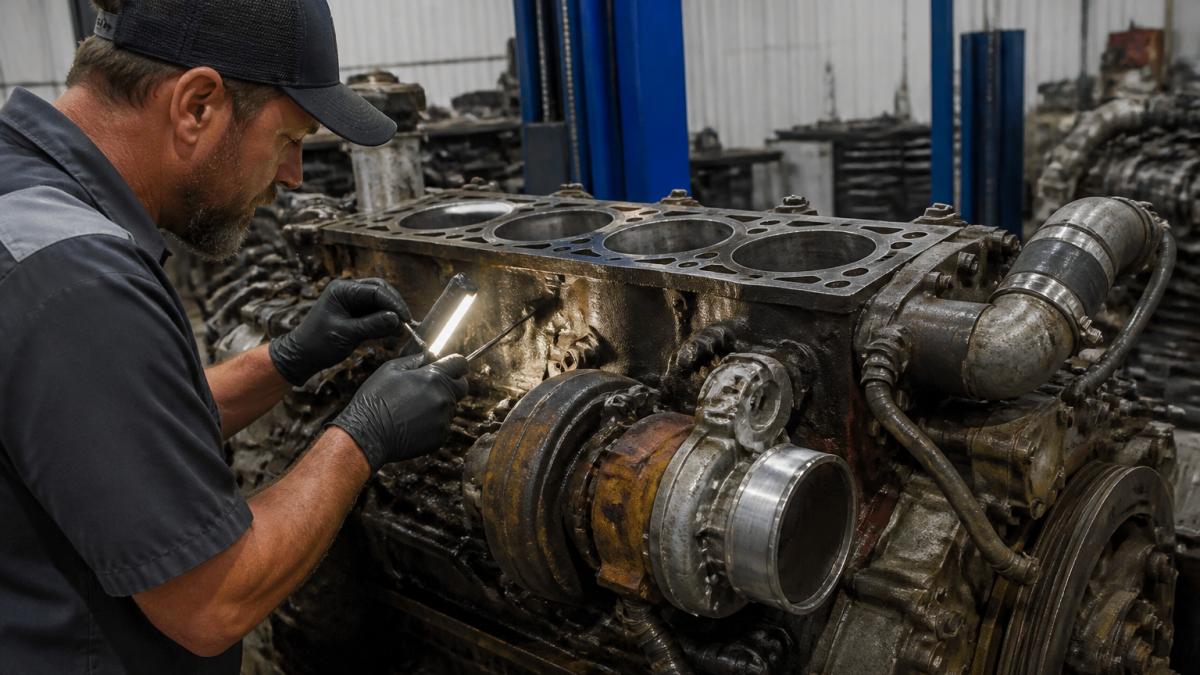
Buying a used truck with high mileage requires systematic engine evaluation. Visual inspection catches obvious problems. Listening to the engine running reveals internal issues. Requesting service records confirms maintenance history.
Start with the exterior. Look for oil leaks around the valve covers, turbocharger housing, and oil pan. Minor seepage is normal on high-mileage engines. Significant pooling under the truck indicates deteriorating gaskets that will need replacement soon. Check the coolant level and condition. Cloudy or discolored coolant suggests internal corrosion.
Listen to the engine at idle and under load. A healthy diesel engine produces a steady, rhythmic knock. Loud clatter or irregular knocking signals internal wear, possibly piston slap or bearing looseness. Start the engine cold and listen for rough running.
Request the complete maintenance log. The best heavy duty truck engines for high mileage are those with documented oil changes every 10,000 to 15,000 miles, coolant flushes every 30,000 miles, and fuel filter replacements every 15,000 miles.
Check the engine oil level and condition. Pull the dipstick and examine the color and viscosity. Dark oil is normal. Milky or foamy oil indicates coolant contamination. Gritty oil suggests metal particles from internal wear. Smell the oil. Fuel-scented oil means fuel injectors are leaking into the crankcase, a problem that needs addressing.
Ask about turbocharger service history. Turbochargers typically need replacement or reconditioning every 300,000 to 400,000 miles. A truck at 380,000 miles with original turbocharger is a concern. A truck at 380,000 miles with a recently rebuilt turbocharger is a positive signal.
Inspect the air filter and intake system. A clogged air filter restricts airflow and stresses the turbocharger. Clean filters indicate the truck has been maintained consciously. Look at the fuel filter housing. Corrosion or leaks suggest the fuel system needs attention.
Request a compression test. A mechanic can measure cylinder pressure to detect wear in rings and valves. Compression should be relatively even across all cylinders. Significant variation between cylinders indicates uneven wear or damage.
High-Mileage Diesel Truck Maintenance Requirements
Reaching 500,000 miles requires maintenance discipline that many owner-operators underestimate. The best heavy duty truck engines for high mileage are supported by maintenance protocols that prevent the wear patterns that cause failure.
Oil changes form the foundation. Heavy-duty diesel engines accumulate metal particles from normal wear. Regular oil changes remove those particles before they cause additional damage. Most manufacturers recommend oil changes every 10,000 to 15,000 miles for high-mileage operation. Some operators extend intervals to 20,000 miles, which increases the risk of accelerated wear.
Coolant management is equally critical. Diesel engines generate intense heat, and coolant systems that fail allow temperatures to spike. A failed thermostat or clogged radiator can cause catastrophic overheating in minutes. Flushing and replacing coolant every 30,000 to 40,000 miles removes corrosion inhibitors that degrade over time.
Fuel system maintenance prevents injector fouling and fuel contamination. Water in fuel tanks causes corrosion and injector damage. Fuel filters should be replaced every 15,000 miles, and fuel tanks should be inspected for water accumulation every season. Some operators add fuel additives to clean injectors and improve combustion efficiency.
Air intake systems need regular cleaning. Dust and debris clog air filters, reducing airflow and stressing the turbocharger. Check air filters every 5,000 miles and replace when visibly dirty. Inspect the intake manifold for carbon buildup, particularly on engines over 400,000 miles.
Turbocharger maintenance extends engine life significantly. Turbochargers spin at extreme speeds and rely on clean oil for bearing lubrication. Using quality oil and changing it on schedule protects turbocharger life. Many operators budget for turbocharger reconditioning around 350,000 miles as preventive maintenance.
Real-World Repair Costs and Total Ownership at High Mileage
Understanding repair costs at high mileage helps buyers evaluate total cost of ownership. A truck with a lower purchase price but higher repair costs might be more expensive over time than a truck with higher upfront cost but lower maintenance burden.
Common repairs on high-mileage engines include fuel injector replacement, turbocharger rebuilds, and gasket replacements. Fuel injector sets for a Cummins X15 cost several hundred dollars for parts and labor. Turbocharger rebuilds range from several hundred to over a thousand dollars depending on damage severity. Valve cover gasket replacement typically costs a few hundred dollars in parts and labor.
The key variable is whether repairs are modular or require major disassembly. Engines where components can be accessed without removing the head or crankshaft are cheaper to repair. Engines requiring full disassembly for routine maintenance become expensive quickly at high mileage.
When evaluating a truck, calculate expected repair costs for the next 100,000 miles. If the truck is at 400,000 miles, budget for at least one major service: likely a turbocharger rebuild and fuel injector replacement. Factor in seal and gasket replacements. A realistic estimate might be $3,000 to $5,000 in repairs over the next 100,000 miles, depending on the specific engine and maintenance history.
Compare that to the truck's purchase price and remaining useful life. A truck purchased at a discount because it has high mileage might make financial sense if repair costs are manageable and the engine is known for reliability. A truck at lower mileage with poor maintenance history might be a worse value despite the lower odometer reading.
Finding and Acquiring High-Mileage Trucks Through Professional Brokerage
Acquiring the right high-mileage truck requires access to inventory, expertise in evaluating engine condition, and confidence that you're getting fair market value. This is where professional brokerage becomes valuable. When you're searching for the best heavy duty truck engines for high mileage, you need a partner who understands which specific models deliver longevity and which carry hidden risk.
At Ironmartonline, we connect buyers and sellers of used heavy equipment through nine specialized web-based selling platforms, giving you access to millions of potential buyers and sellers globally. Whether you're acquiring a single truck or managing fleet acquisitions, our marketplace reaches inventory you won't find on local listings. Working with a Heavy Equipment Broker through our platform means you gain transparency into comparable pricing, maintenance histories, and engine specifications that inform smarter decisions.
The advantage of professional brokerage is expertise and transparency. Rather than evaluating trucks in isolation, you see comparable units, pricing trends, and maintenance histories side by side. Our platforms allow you to filter by engine type, mileage, model year, and service records, the exact criteria that predict high-mileage reliability.
When selling high-mileage trucks, our broker network ensures you reach buyers who specifically value engines with proven longevity records. A Cummins X15 at 450,000 miles with complete maintenance documentation appeals to a specific buyer segment. Our platforms connect you to those buyers directly, without the friction of traditional dealership sales.
The process is straightforward: list your equipment on our marketplace, provide detailed specifications and maintenance records, and let our network of millions of potential buyers find your inventory. No contracts, no hidden fees, just efficient connection between buyers and sellers who understand the value of quality used equipment.
Selecting the best heavy duty truck engines for high mileage isn't about picking the newest technology or the most powerful option. It's about understanding which engines have proven track records in real-world, high-mileage scenarios, what maintenance protocols actually deliver that longevity, and how to evaluate a used truck before committing capital.
Frequently Asked Questions
What is the most reliable engine for heavy-duty trucks?
The Cummins X15, Detroit DD15, PACCAR MX-13, and Volvo D13 are among the most widely used Class 8 truck engines recognized for reliability. Each has a strong track record in heavy-duty applications. Reliability depends on maintenance history, model year, and operating conditions as much as engine design. A well-maintained engine from any of these manufacturers can reach very high mileage when proper service intervals are followed and repair issues are addressed promptly.
Which is better: Cummins or PACCAR engine reliability?
Both Cummins and PACCAR engines are proven performers in heavy-duty trucking. Cummins engines are known for widespread availability of parts and service support, while PACCAR engines are engineered for efficiency and integrated closely with their host trucks. Real-world longevity depends more on maintenance discipline, operating conditions, and repair history than on brand alone. Owner-operators and fleet managers report success with both platforms when maintenance is consistent.
What should I inspect before buying a high-mileage truck?
Examine compression readings, oil condition and level, coolant system integrity, turbocharger function, and fuel injector performance. Check for leaks around gaskets, seals, and the engine block. Review complete service records to confirm regular oil changes, filter replacements, and major repairs. Have a trusted technician perform a pre-purchase inspection that includes a load test and visual assessment of wear. High mileage alone doesn't disqualify a truck, maintenance documentation and current mechanical condition matter far more.
How many miles can a heavy-duty diesel truck engine last?
Heavy-duty diesel engines are engineered to reach 500,000 miles or more when maintained properly. Some Class 8 truck engines have documented service lives well beyond one million miles. Achieving high mileage requires consistent preventive maintenance, timely repair of worn components, quality fuel and oil, and conservative operating practices. Real-world outcomes vary based on load, driving conditions, driver habits, and how quickly mechanical issues are addressed.