

Table of Contents
- Why Buy Construction Machinery Online in 2026?
- Start With Project Requirements and Equipment Application
- Match Machine Size and Type to Job-Site Conditions
- The Used Construction Equipment Inspection Checklist
- How to Verify Heavy Equipment Ownership and History
- Questions to Ask When Buying Used Equipment
- Seller Reputation and Fraud Prevention Online
- Secure Payment and Digital Documentation
- Heavy Equipment Transport and Delivery Planning
- Total Cost of Ownership and Financing Options
- Frequently Asked Questions
Last Updated: October 20, 2026
Why Buy Construction Machinery Online in 2026?
Seventy-eight percent of contractors polled by Equipment World's 2026 purchase survey said they plan to buy construction equipment in 2026, and 47% expect to purchase one to three machines. That is a lot of buying activity, and a growing share of it now starts with a search bar rather than a dealer lot. Best practices for buying construction machinery online come down to one idea: replace the walkaround you would do in person with a documented, verifiable process.
At Ironmartonline, we broker used heavy equipment between buyers and sellers across nine web-based selling platforms, so we see both sides of these transactions. Below, we'll show you exactly how to evaluate a machine you may never see until it arrives on your lowboy.
So why use Ironmartonline as an equipment broker instead of browsing listings alone? Because a broker vets the seller, documents the machine, and keeps the transaction on the record. Most guides get this wrong: they treat online buying as a search problem when it is really a verification problem.
The Shift Toward Online Equipment Marketplaces
The catalog moved online faster than the inspection habits did. Buyers now compare specs, hours, and photos across multiple marketplaces before they ever call a seller. That convenience cuts travel and widens the pool of machines. It also means the burden of proof shifts to you. A listing photo is a claim, not evidence. Treat every online purchase as a due-diligence project with a paper trail.
Start With Project Requirements and Equipment Application
Write down the job before you shop. Equipment application drives every other decision: the machine type, the size class, the attachments, and the condition you can tolerate. A buyer who skips this step ends up comparing excavators that were never built for the same work.
Answer these before you open a single listing:
- What tasks will the machine perform, and for how many hours per week?
- What is the required load capacity or digging depth for your typical job?
- Which attachments are mandatory, and are they included in the price?
- What is your timeline, and can you wait for transport?
- What is your total budget, including freight and immediate repairs?
Contractors in the Equipment World poll ranked technology, specifications, and brands among their top purchase criteria. Specifications belong first on that list. A machine that fits the application at 80% condition usually beats a pristine machine that fits at 60%.
Match Machine Size and Type to Job-Site Conditions
Job-site conditions eliminate more machines than any other factor. Access width, ground bearing, overhead clearance, and transport routes all constrain what you can actually deploy. A larger machine that cannot reach the work area is a liability with an engine.
Match the machine to the site in this order:
- Access: Can a transport truck and trailer reach the drop point, and can the machine enter the work area?
- Ground conditions: Soft ground may demand wider tracks or different undercarriage.
- Work cycle: Dig depth, reach, and cycle time should match the production you need.
- Transport weight: Confirm the machine and attachments fit your hauling plan.
Machine size also affects operating cost. A machine rated well above your typical load will burn fuel and wear parts faster than the job requires. Buy for the work you do most weeks, not the biggest job you might win.
The Used Construction Equipment Inspection Checklist
A used construction equipment inspection checklist turns a visual walkaround into a repeatable record. Whether you inspect in person or through a remote agent, work through the same categories every time and photograph each one.
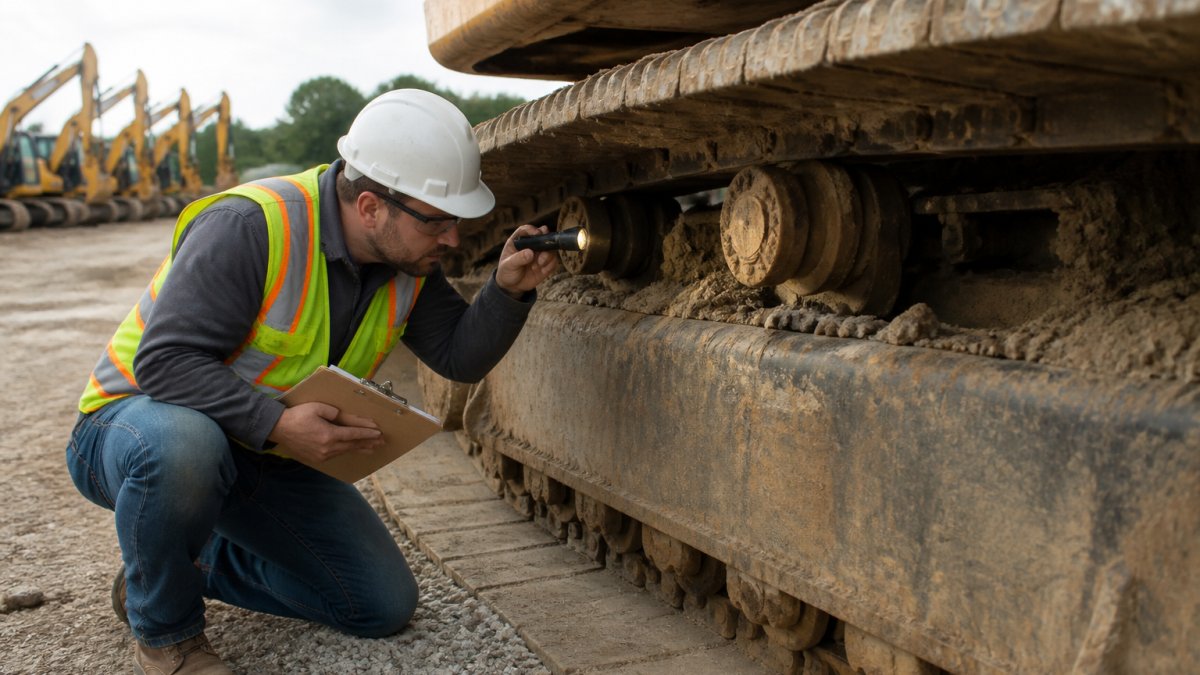
Cover these areas in order:
- Undercarriage: track wear, pad condition, roller and idler play
- Hydraulics: cylinder rods, hose condition, seepage at fittings
- Engine: fluid levels, leaks, exhaust color under load
- Structure: cracks, prior weld repairs, bent guards
- Cab and controls: function of every lever, monitor codes, safety features
- Hour meter: reading matches the stated usage history
Wear and tear is expected. What you are hunting for is undisclosed damage and mechanical condition that contradicts the listing.
Remote Inspection Workflow for Online Purchases
Remote inspection works when you assign it to someone accountable. Hire an independent inspector or a local mechanic, send your checklist, and require dated photos and a short video of the machine running through its functions. Ask for close-ups of the hour meter, the data plate, and any repaired areas.
Confirm the machine's serial number in the video matches the listing. Then review the report against the seller's claims line by line. Any gap between the two is a negotiating point, not a reason to walk automatically.
How to Verify Heavy Equipment Ownership and History
Verifying heavy equipment ownership means confirming that the person selling the machine has the right to sell it. Ask for the serial number, the title or ownership documentation where applicable, and a bill of sale history. A legitimate seller will provide these without friction.
Then research equipment history: service records, prior owners, and any reported damage or theft. A machine with a clean paper trail is easier to finance, insure, and resell. If the seller cannot explain a gap in the ownership history, treat that gap as a real risk.
Questions to Ask When Buying Used Equipment
Questions to ask when buying used equipment should cover usage, maintenance, and the transaction itself. Ask them in writing so the answers become part of your records.
- How many hours are on the meter, and what work did the machine perform?
- Can you share maintenance records and service history?
- Has the machine had any major repairs, and who performed them?
- Are there any active fault codes or known issues?
- What attachments and spare parts are included?
- Why is the machine being sold?
- What are the payment terms, and who arranges transport?
Vague answers to maintenance and repair questions are a signal. Clear answers, backed by records, tell you the seller has nothing to hide.
Seller Reputation and Fraud Prevention Online
Seller reputation is the first filter in online buying, and fraud prevention is the second. The problem is that most marketplace profiles are self-reported. A seller can claim a decade of experience, upload a logo, and collect a handful of reviews without any of it being independently verified. Your job is to convert claims into evidence before money moves. Rigorous verification protocols serve as a universal safeguard for high-value transactions, mirroring the due diligence required when buying used vehicles.
How to Verify a Seller's Identity and Business Standing
Start with the entity, not the listing. Ask for the legal business name, the state of registration, and a business license or resale certificate where applicable. Cross-check that name against your state's secretary of state business search and, for dealers, any state dealer licensing database. A legitimate dealer will have a verifiable registration and a physical business address, not just a mailbox or a cell number.
For private sellers, request a government-issued ID and confirm the name matches the ownership documents. A common pattern in fraudulent listings is a seller who is "selling for a friend" or "handling the sale for the owner." Treat any third-party seller who cannot produce a power of attorney or written authorization as a red flag.
Confirming Listing Authenticity
Fake listings often recycle photos and descriptions from real listings. Run a reverse image search on the machine photos. If the same images appear on another marketplace under a different seller name, you have found a cloned listing. Check the listing's creation date and whether the seller has other active listings with inconsistent locations or contact details.
Ask the seller for a photo of the machine's data plate and serial number next to a piece of paper with today's date and the seller's name. This is a low-cost way to confirm the seller has physical access to the machine. A seller who cannot or will not provide a timestamped photo is a seller you should not send money to.
Reading Reviews and Transaction History Critically
Reviews are useful only when they are specific and verifiable. Look for reviews that mention the machine, the delivery, and the outcome, not generic five-star ratings posted in clusters. On marketplaces that show transaction history, confirm the seller has completed deals in the same equipment category. A seller with a long history of selling attachments who suddenly lists a 40-ton excavator deserves extra scrutiny.
Fraud Prevention Rules That Actually Work
- Keep communication on the marketplace's platform where possible, and save every message.
- Use secure payment methods with a payment trail, not untraceable transfers.
- Be skeptical of prices far below market value for the stated condition, especially when the seller pressures you to move fast.
- Confirm the seller's identity and business details before any deposit.
- Never send funds to a third party the seller introduces late in the deal.
- Be wary of sellers who refuse a live video walkaround or an independent inspection.
Boom & Bucket's guidance on de-risking online heavy equipment purchases makes the same point: verify the seller, review independent inspection reports, and confirm details before money moves. The difference between a safe online purchase and a loss is usually a few hours of verification work done before the first payment, not after.
Secure Payment and Digital Documentation
Secure payment protects both sides, and digital documentation is what makes that protection enforceable. The mistake buyers make online is treating payment and paperwork as separate steps. They are the same step. Every dollar you send should be tied to a document you already hold.
Payment Methods Ranked by Buyer Protection
Not all payment methods carry the same recourse. From strongest to weakest for a buyer:
- Escrow through a licensed escrow agent. Funds are held until the seller delivers the machine and the title documents. The escrow agent releases payment only when both sides confirm the conditions. This is the gold standard for online equipment purchases, especially across state lines.
- Platform payment systems with buyer protection. Some marketplaces hold funds or offer dispute resolution. Confirm the protection terms in writing before you rely on them.
- Verified wire transfer against a signed purchase agreement. A wire leaves a trail, but once sent it is difficult to reverse. Use it only when the seller is verified and the documents are in hand.
- Credit card or ACH with chargeback rights. Useful for deposits, less practical for full machine payments due to limits.
- Untraceable transfers and peer-to-peer apps. Avoid for anything beyond a small hold deposit, and even then only after verification.
A common pattern in equipment fraud is a request to wire a deposit to a "shipping agent" or "escrow company" the seller introduces. Verify any escrow agent independently, check its licensing and call a number you found yourself, not one the seller provided.
Documents to Obtain Before Payment
Do not release funds until you have these in hand, in digital form, and reviewed:
- Bill of sale with the machine's make, model, year, serial number, hour meter reading, and the legal names of buyer and seller.
- Title or ownership documentation where the state requires it, or a lien check confirming no outstanding financing.
- Inspection report from an independent inspector, with dated photos and a video of the machine running.
- Warranty terms, if any, in writing, including what is covered, for how long, and who performs the work.
- Return conditions, if the seller offers them, spelled out in the contract rather than promised verbally.
- Payment confirmation and a receipt that references the bill of sale.
Contract Terms That Protect You
The purchase agreement should state the machine's condition as represented, the delivery date and location, who bears risk of loss in transit, and the remedy if the machine arrives materially different from the listing. Include a clause that makes the seller's representations about hours, condition, and ownership part of the contract. If the seller resists putting these terms in writing, that resistance is information.
Store the entire package, bill of sale, title, inspection report, photos, serial number record, payment confirmation, and contract, in one folder. When you finance or insure the machine, or resell it later, that file is your proof of a clean purchase.
Heavy Equipment Transport and Delivery Planning
Heavy equipment transport and delivery planning should start before you commit to buy. Confirm the machine's transport weight and dimensions, then get freight quotes from carriers who handle oversize loads. Ask who loads the machine, who secures it, and who is responsible if it arrives damaged.
Build the delivery plan into the deal:
- Get at least two freight quotes with pickup dates.
- Confirm permits and route restrictions for oversize loads.
- Photograph the machine at pickup and at delivery.
- Inspect on arrival before signing the delivery receipt.
If you buy across state lines, confirm the paperwork the carrier and the seller require. Delivery is the last chance to catch a problem, so inspect the machine the day it lands.
Total Cost of Ownership and Financing Options
Total cost of ownership decides whether a cheap machine is actually cheap. Purchase price is the entry fee. Maintenance costs, replacement parts, fuel efficiency, downtime, and resale value determine what the machine costs you over its life.
Cleveland Brothers' 2026 analysis of renting versus buying frames equipment acquisition as a decision about costs, cash flow, and strategy rather than price alone. Financing options change that math. Compare lender terms, down payment requirements, and how quickly you need the machine in service.
| Cost Category | What to Check | Why It Matters |
|---|---|---|
| Purchase price | Comparable listings, condition | Sets your starting basis |
| Immediate repairs | Inspection findings | Adds to day-one cost |
| Maintenance | Parts availability, service intervals | Drives annual spend |
| Fuel | Consumption at your workload | Recurring operating cost |
| Downtime | Dealer support, parts lead time | Lost production |
| Resale value | Brand demand, hours, condition | Protects your exit |
A machine with strong dealer support and available parts usually wins on total cost even when the sticker is higher. Reliability and resale value are financial variables, not just comfort features.
Buying construction machinery online rewards preparation over speed. The buyers who get burned are the ones who skip verification, pay before inspecting, and treat a listing photo as proof. The ones who do well run a documented process every time.
That process is exactly what Ironmartonline is built around. We connect buyers and sellers of used machinery through nine web-based selling platforms, with no contracts and no hidden fees, so listings reach millions of potential buyers and transactions stay straightforward. Whether you are sourcing a machine or moving surplus equipment, our brokerage team handles the match.
Join our email list to get new listings and equipment buying guidance delivered directly to you.
Frequently Asked Questions
How can you verify the condition of used construction equipment before buying online?
Request a third-party inspection report and a walkaround video that shows the hour meter, fluid levels, leaks, and wear on high-stress components like undercarriage and pins. Ask for close-up photos of the serial plate and any repaired areas. Cross-check the reported operating hours against service records. If the seller cannot provide independent documentation, treat the listing as unverified and budget for a hands-on inspection before payment. For high-value machines, a remote inspection service can confirm mechanical condition without you traveling to the site.
What documents should you check when buying used heavy equipment?
Ask for the certificate of title or manufacturer statement of origin, a bill of sale with the serial number, and maintenance and service history. Confirm the seller's identity and ownership trail through the serial plate and prior transaction records. Check for any outstanding liens or financing claims. Keep a complete payment trail and transaction records for your files. If the machine was previously used in another state, verify that any required transfer documents are in order before you arrange heavy equipment transport and delivery.
How do you avoid scams when buying construction machinery online?
Verify the seller's reputation and transaction history before sending funds. Use secure payment methods with escrow or verified transfer rather than wiring money to an individual. Insist on independent inspection reports and confirm the machine's location matches the listing. Be wary of prices far below market value and sellers who pressure you to skip documentation. Request a video call walkaround of the machine and serial plate. A reputable brokerage or marketplace will support verification and provide clear transaction records.
What should you inspect before purchasing used construction equipment?
Use a used construction equipment inspection checklist that covers hour meter readings, fluid levels, visible leaks, undercarriage wear, hydraulic hoses, pins and bushings, tires or tracks, and safety features. Start the machine and watch for unusual smoke or sounds. Check the mechanical condition of the engine and hydraulics through an independent inspection. Review maintenance records and service history to confirm the machine was serviced on schedule. Confirm warranty coverage or after-sales support and replacement parts availability before finalizing the purchase.