
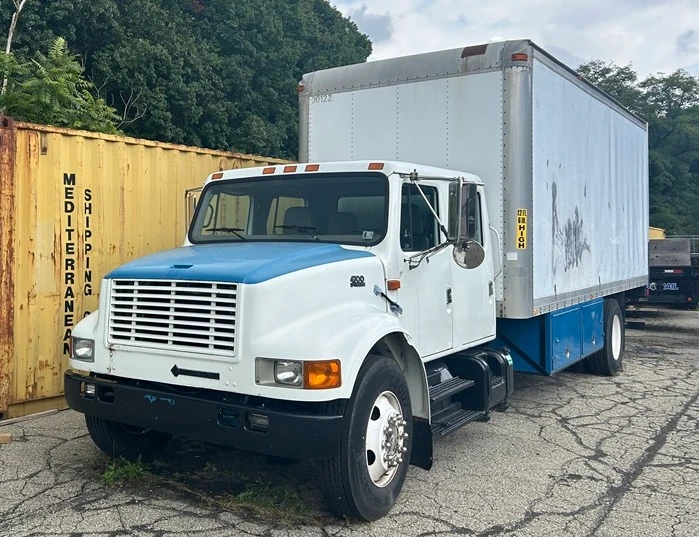
1999 International 4700 26' Box Truck
The 1999 International 4700 26' box truck is a medium-duty (Class 6) commercial vehicle built on International's 4700 chassis, typically powered by a DT466 diesel engine rated between 175-230hp. At 25+ years old, buyers should prioritize engine hours over mileage, verify recent transmission and brake service, and inspect the box body for rust and floor rot before negotiating price. A well-maintained unit with documented service history is worth significantly more than a cheaper truck with no paperwork.
A 26-foot box truck built in 1999 is old enough to have outlived its original owner, its original engine, and possibly its original transmission. That doesn't make it a bad buy. Fleet-spec trucks like the International 4700 were engineered to run for decades when maintained properly, and plenty of them are still hauling freight today. But age changes what you should be looking for, and it changes how you should negotiate.
This guide breaks down what the 1999 International 4700 26' box truck actually offers, what tends to fail on trucks this age, and how to inspect one before you hand over a deposit.
See 1999 INTERNATIONAL 4700 26' Box Truck.
What is the International 4700, and why was it built for box truck work?
The International 4700 is a medium-duty truck chassis produced by International (Navistar) primarily through the 1990s and early 2000s. Its Class 6 GVWR rating — typically in the 25,999-26,000 lb range — made it a popular platform for box trucks, bucket trucks, and delivery vehicles that needed more capacity than a Class 4 truck but didn't require a CDL for most drivers under FMCSA's 26,001 lb threshold.
On a 1999 model, you're most likely to find:
-
Engine: International DT466 diesel (7.6L), commonly rated 175-230hp depending on configuration. Some units may carry the T444E (International's version of the Ford 7.3L Power Stroke).
-
Transmission: Manual (Eaton Fuller 5- or 6-speed) or automatic (Allison), depending on original spec.
-
GVWR: 25,999-26,000 lbs, placing it right at the non-CDL threshold.
-
Box length: 26 feet, typically aluminum or fiberglass-reinforced plywood (FRP) construction.
Choose a manual-transmission unit if you're prioritizing rebuild cost and long-term durability. Choose an Allison automatic if your drivers rotate frequently and ease of operation matters more than repair cost.
How many miles or hours is too many on a 1997 international 4700 model?
There's no universal cutoff, but context matters more than the odometer number alone. A DT466 with proper maintenance routinely runs past 300,000 miles before needing major engine work. The real question isn't how many miles are on the truck — it's how those miles were accumulated and documented.
A truck with 220,000 miles and a stack of oil change and DOT inspection records tells a better story than a truck with 150,000 miles and no paperwork at all. For example, a 1999 International 4700 box truck priced at $7,995 with 149,550 miles still needs records to mean much beyond the odometer reading. Missing service history is a red flag regardless of the number on the dash, because you have no way to verify what's actually happened inside that engine.
Ask the seller for:
-
Oil change and fluid service records
-
Any transmission or clutch replacement history
-
DOT annual inspection reports
-
Records of major repairs (turbo, injectors, head gasket)
If none of this exists, budget for a pre-purchase inspection instead of taking the seller's word for it, especially if an older unit is selling as is due to age.
What parts of a 26-year-old box truck fail first?
On a truck this age, certain failure points show up more often than others. Knowing where to look shortens your inspection and protects you from surprise repair bills after purchase.
The box body: rust and floor rot
Box trucks live outside, in all weather, often loaded and unloaded daily. If the cargo body is structurally sound, that’s a good box, but you should still check the floor for soft spots or rot, especially near the rear door threshold where water and debris collect. Even a nice box still needs careful inspection of the floor and roof seams. At the rear threshold, make sure the truck has good doors and note whether it uses a roll-up rear door. Inspect the roof seams and corner posts for rust bleed-through, which signals water intrusion that's been happening for years, not weeks, and a lift gate, if present, should operate smoothly and be checked for rust at its mounting points.
The engine: turbo, injectors, and head gasket
The International DT466 is valued for exceptional longevity and rebuildability, but injectors and turbos wear out over time and use. Listen for excessive smoke on startup or under load, ask when the injectors were last serviced, and note that common 1999 specs put international horsepower at a maximum of 230 HP. A head gasket failure on a truck this age isn't automatically a dealbreaker, but it should significantly affect your offer.
The transmission and clutch
Manual transmissions in this era typically hold up well, and on older trucks the manual transmission manufacturer details matter, with Spicer being another name buyers may see alongside Eaton Fuller, but the clutch is a wear item that most trucks will need replaced at least once by 25 years old. Ask directly: has the clutch been replaced, and if so, when and at what mileage, and if a listing claims a specific manual gearbox, confirm the Spicer number or other model tag, since these trucks commonly came with practical speeds for the job?
Brakes and suspension
Commercial trucks see heavier stopping loads than passenger vehicles, which accelerates brake wear. Check for uneven rotor wear, and note that International 4700 trucks commonly came with either hydraulic brakes or air brakes, so inspect the fitted system for leaks or other issues. Also check the spring description, as these trucks commonly used leaf-spring suspension or air-ride suspension, and look for spring or leaf suspension sag from years of loaded runs, especially on single or tandem rear axles used for heavier loads.
How much should you expect to pay for a 1999 4700 box 26' truck?
Pricing on used International 4700 trucks this old varies widely from one listing to the next based on condition, mileage, and service history, and no fixed number applies across the board. What matters more than a target price is understanding the tradeoffs behind different price points.
A lower-priced unit with high mileage and no maintenance records might save you money upfront but expose you to a $10,000-$15,000 engine or transmission rebuild within the first year. A higher-priced unit with documented service history, low mileage, and a recently replaced clutch or brakes carries a smaller risk of unplanned downtime. Choose the cheaper truck if you have in-house mechanical capability and can absorb repair costs. Choose the documented, higher-priced unit if downtime directly costs you revenue.
Whatever price range you're considering, get a written quote for a pre-purchase inspection from a diesel mechanic before finalizing any deal. That inspection typically costs a few hundred dollars and can save you from inheriting someone else's deferred maintenance. Strong examples can disappear quickly, and some listings are already sold out by the time buyers call.
Making the decision
A 1999 International 4700 26' box truck can still be a solid working vehicle in 2025 and beyond, provided you know its history and inspect it properly before you buy. A well-maintained International 4700 is better viewed as a durable work tool than a luxury vehicle, and age alone doesn't disqualify a truck built on a platform known for durability. What disqualifies a truck is a lack of documentation, visible rust or floor damage, and an engine or transmission with no service record behind it.
Before you make an offer, get the maintenance records, schedule a diesel mechanic's inspection, and price the truck against its documented condition — not its age alone. Ask the right questions now, and you avoid paying for someone else's deferred maintenance later, especially since used International 4700 trucks often have parts that are widely available and easy to repair, making an older unit more practical if it's ready.
Frequently Asked Questions
Do you need a CDL to drive a 1999 International 4700 26' box truck?In most cases, no. The International 4700 typically carries a GVWR of 25,999-26,000 lbs, which falls just under the FMCSA's 26,001 lb threshold requiring a Commercial Driver's License. The 26-foot box is also commonly the largest setup paired with a non-CDL International 4700 at 26,000 pounds GVWR. Always verify the specific GVWR plate on the truck you're considering, since some configurations may differ.
What engine came in a 1999 International 4700?The most common engine is the International DT466 diesel, typically rated between 175-230hp. Some 1999 trucks also used the T444E, International's 7.3L V8 diesel engine. Confirm the exact engine by checking the International VIN or engine tag rather than relying on the listing description alone.
Is a manual or automatic transmission better for a box truck this age?A manual transmission (commonly Eaton Fuller 5- or 6-speed) generally costs less to rebuild and has fewer complex components to fail. An Allison automatic, a common automatic transmission manufacturer, is easier for less experienced drivers to operate. Choose based on your driver pool and your tolerance for repair costs versus training time.
What's the biggest risk when buying a used box truck this old?The biggest risk is buying a truck with no maintenance history and discovering hidden engine, transmission, or floor damage after the sale. Mitigate this risk with a pre-purchase inspection from a diesel mechanic and by requesting service records before you commit to a price.
Are parts still available for a 1999 International 4700?Yes. The DT466 engine and 4700 chassis were produced in high volume for years, and parts availability remains strong through both OEM and aftermarket suppliers. The chassis also supported many body configurations, which helps explain the broad parts and service familiarity that still exists today. This is one reason these trucks remain a practical option despite their age.