
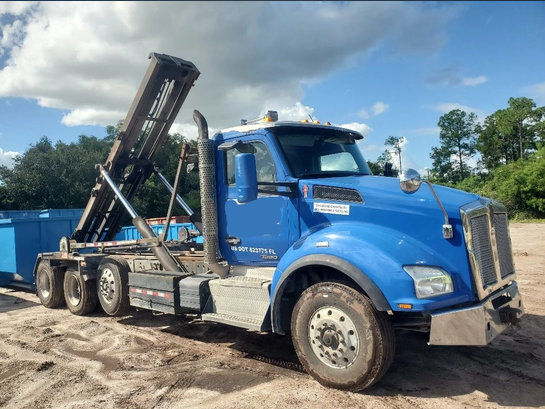
Buying a 2018 Kenworth T880 TriAxle Roll Off: What to Check Before You Sign
TL;DR: A 2018 Kenworth T880 TriAxle Roll Off is a Class 8 vocational truck built for hauling roll-off containers in waste, recycling, and construction debris hauling. Before buying one, verify engine hours, hoist cycle history, axle ratings, and PM records. A well-documented unit with moderate hours beats a low-hour truck with no paperwork every time.
The 2018 Kenworth T880 TriAxle Roll Off is one of the most common platforms you'll find in the roll-off and demolition hauling market. Fleet buyers like it for a reason: the T880 chassis was purpose-built for vocational work, and the tri-axle configuration adds the payload capacity that a tandem-axle setup can't match when you're running heavy debris boxes day after day.
But popularity in a market segment doesn't guarantee you're looking at a good truck. A 2018 model year puts this unit squarely in the "mid-life" category for most vocational fleets — old enough that major components may be approaching rebuild thresholds, new enough that it should still have years of productive life left if it was maintained correctly. The gap between those two outcomes comes down to documentation, not appearance.
This guide walks through what actually separates a sound 2018 T880 TriAxle Roll Off from an expensive mistake.
See 2018 KENWORTH T880 TriAxle Roll Off
What makes the Kenworth T880 a common choice for roll-off work?
The Kenworth T880 is a set-forward or set-back front axle vocational truck designed for heavy-duty applications, including roll-off, dump, mixer, and refuse work. Kenworth builds the T880 around a reinforced frame rail and offers it with engine options from PACCAR (the MX-13) and Cummins (the X15), both of which are common in 2018-model-year vocational specs.
For roll-off work specifically, buyers favor the T880 for three reasons:
- Frame strength. The T880's frame is rated to handle the stress of hoist cycling and uneven debris loads without the flex issues seen in lighter-duty chassis.
- Tri-axle payload. A tri-axle configuration spreads weight across three axles instead of two, increasing legal payload capacity — critical for hauling construction debris, which is often denser than general municipal waste.
- Serviceability. PACCAR's dealer network and parts availability make the T880 easier to keep running than some competitor platforms, especially outside major metro areas.
None of that matters if the specific truck in front of you has been run hard with no maintenance records to prove otherwise.
What should you check on the engine and drivetrain before buying?
Engine hours tell you less than engine history. A 2018 T880 with 400,000 miles and a complete service record is a safer buy than one with 250,000 miles and no paperwork.
Check these items specifically:
- Engine make and hours/miles. Confirm whether the truck runs the PACCAR MX-13 or Cummins X15, and pull the actual mileage from the ECM — not just the dash readout.
- DPF and aftertreatment history. 2018 trucks run EPA2017-compliant aftertreatment systems. Ask when the DPF was last cleaned or replaced, since a neglected aftertreatment system is one of the most expensive surprises on a used vocational truck.
- Transmission type and condition. Roll-off trucks are commonly spec'd with Allison automatics for repeated stop-start cycling, or manual/automated manual transmissions for fleets that prioritize fuel economy. Confirm which one you're buying and ask for shift-quality documentation or a test drive under load.
- Rear axle ratio and tri-axle configuration. Verify the GVWR and GCWR match your intended payload. A tri-axle truck spec'd for lighter work will underperform compared to one built from the start for heavy debris hauling.
Choose the Cummins X15 if your fleet already runs Cummins power and values parts commonality. Choose the PACCAR MX-13 if you want a tighter integration with the Kenworth chassis and simpler warranty administration through the Kenworth dealer network.
What's unique to inspecting a roll-off hoist versus other truck bodies?
The hoist system is the single most overlooked component in a roll-off truck inspection, and it's the most expensive thing to repair if it's worn out.
Here's what to check:
- Hoist cylinder condition. Look for leaks, scoring, or uneven extension. A hoist cylinder rebuild can run into the thousands of dollars depending on the manufacturer.
- Cable and chain wear. Roll-off hoists use either cable or chain systems to pull containers onto the bed. Frayed cables or stretched chains signal a system nearing replacement.
- Hoist cycle count, if available. Some fleets track hoist cycles the way others track engine hours. If the seller has this data, ask for it — it's a direct measure of wear that mileage alone won't show you.
- Subframe and body mounting. Roll-off bodies place repeated stress on the frame mounting points. Inspect for cracked welds or elongated mounting holes, especially near the rear axle group.
A truck with low mileage but heavy hoist cycling can be more worn than a high-mileage truck used for longer hauls with fewer load/unload cycles. Mileage alone won't tell you that story — only the hoist inspection will.
How do you verify maintenance history on a used 2018 T880?
Ask for the complete service file before you negotiate price, not after. A legitimate seller will have:
- Oil analysis reports showing engine wear trends over time
- DOT inspection records, including any violations and how they were resolved
- PM (preventive maintenance) schedules and whether they were followed on interval
- Any warranty claim history, which can reveal recurring component issues
A 2018 unit with a complete dealer service binder tells a far better story than a newer truck with no paperwork at all. If a seller can't produce maintenance records, treat that absence as a red flag, not a minor inconvenience. Walk the price down accordingly, or walk away.
What's a fair price range for a 2018 Kenworth T880 TriAxle Roll Off?
Pricing on a 2018 T880 TriAxle Roll Off depends heavily on mileage, hoist condition, and regional demand, so there's no single number that applies across the market. What you can do is build a comparison framework:
- Compare trucks with similar mileage, engine type, and hoist system side by side — not trucks of different configurations.
- Factor in any deferred maintenance you uncovered during inspection as a direct subtraction from the asking price.
- Get a written quote for any component that showed wear during inspection — DPF service, hoist cylinder work, tire replacement — before you finalize an offer.
If a listing price seems unusually low for the mileage and condition described, that's a signal to inspect more carefully, not a reason to move faster.
Buy with the data, not the paint job
A clean exterior tells you almost nothing about what's happening inside a 2018 Kenworth T880 TriAxle Roll Off. Engine hours, hoist cycle history, and documented maintenance records tell you everything. Pull the ECM data, inspect the hoist system in person, and request the full service file before you negotiate.
If the seller can produce that documentation and the numbers check out, you're looking at a solid working truck with years of productive life left. If they can't, treat every gap in the paperwork as a gap in your negotiating leverage — and price accordingly.
Frequently asked questions
How many miles is too many for a 2018 Kenworth T880 TriAxle Roll Off?
There's no fixed mileage cutoff. A well-maintained unit with 500,000 miles and documented service history can outperform a neglected truck with half that mileage. Judge the truck by its maintenance record and component condition, not the odometer alone.
What engine options came in the 2018 Kenworth T880?
The 2018 T880 was commonly spec'd with the PACCAR MX-13 or the Cummins X15, both EPA2017-compliant engines. Confirm which engine is in the specific unit you're evaluating, since parts availability and fleet compatibility differ between the two.
How much does a roll-off hoist rebuild typically cost?
Costs vary by manufacturer and the extent of the damage, but hoist cylinder and cable system repairs can run into the thousands of dollars. Always inspect hoist condition before purchase rather than after, since this cost isn't always visible from the outside.
Is a tri-axle configuration necessary for roll-off work?
It depends on your typical load weight. Tri-axle configurations add payload capacity over tandem-axle setups, which matters most for hauling dense construction debris. If you're primarily hauling lighter materials, a tandem-axle truck may be sufficient and less expensive to maintain.
What documentation should I request before buying a used roll-off truck?
Request ECM mileage verification, oil analysis reports, DOT inspection history, PM schedules, and any warranty claim records. Treat missing documentation as a negotiating point, not a minor detail.