
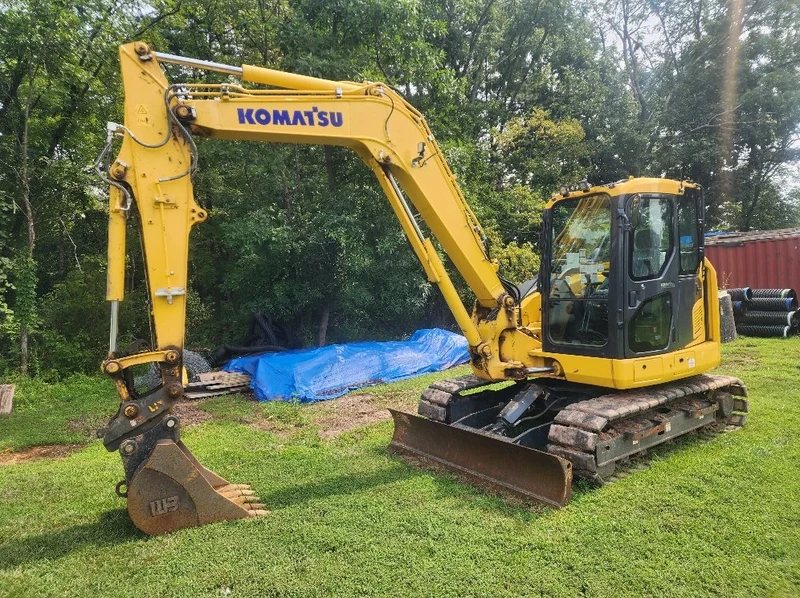
2023 Komatsu PC88MR-11 Midi Excavator: Buyer's Guide
Quick answer: The Komatsu PC88MR-11 is an 8-ton class reduced-tail-swing midi excavator built for tight job sites — think residential lots, utility work, and urban demolition where a full-swing machine can't operate safely. A 2023 model in good running condition, with verified hours and service records, is a strong buy for contractors who need excavation power without giving up maneuverability. Before you commit, verify hours, undercarriage wear, and hydraulic performance in person.
Buying a midi excavator sits in a strange middle ground. It's too big a purchase to guess on, but too specific a machine class for generic buying advice to help much. The PC88MR-11 occupies a specific niche — reduced tail swing, sub-10-ton weight class, backhoe-replacement power — and that niche comes with its own set of questions buyers need answered before they sign anything.
This guide breaks down what the PC88MR-11 is built for, what specs actually matter when you're comparing units, and what red flags separate a fair deal from an expensive mistake.
See 2023 KOMATSU PC88MR-11 Midi Excavator.
What Is the Komatsu PC88MR-11 Built to Do?
The PC88MR-11 is Komatsu's midi-class excavator designed for confined job sites. "MR" stands for minimal (reduced) tail swing — specifically, a short tail swing that lets the machine work close to obstacles, with the counterweight staying within (or nearly within) the width of the tracks so the rear of the machine doesn't swing out into traffic, walls, or adjacent equipment when you rotate the upper structure.
This matters more than most spec sheets let on. On a standard excavator, tail swing radius determines how close you can work to a building, a trench wall, or another machine. A reduced tail swing design lets operators work in alleys, backyards, and utility corridors where a full-swing 8-ton machine simply can't fit, and it is built for maneuverability in tight spaces and confined areas. If your work involves residential excavation, sewer and water line repair, urban street work, utility installation, or site work inside existing structures, this is the feature that decides whether the PC88MR-11 belongs on your job or not.
The machine sits in the 8-ton operating weight class, powered by a Komatsu SAA4D95LE-6 engine — a four-cylinder diesel rated at roughly 68 horsepower, with an 11 ft 2 in boom. That puts it above compact excavators in digging force and lift capacity, while staying light enough for standard trailer hauling without special permits in most states.
What Specs Actually Matter When Comparing PC88MR-11 Units?
Spec sheets list dozens of numbers. Most don't affect your buying decision. The important details are the specs and details that affect real job performance and ownership costs. These do:
-
Operating weight — Confirm the exact configuration (blade, counterweight, tracks), but as a reference point the published operating weight is 19,224 lbs; attachments and options can still shift total weight by hundreds of pounds.
-
Bucket digging force — Determines how the machine performs in compacted soil, clay, or rocky ground versus loose fill.
-
Max digging depth and reach — Critical for utility and trenching work; the published maximum digging depth is about 14.9 feet, so verify it against your typical trench specs, not just the sales sheet.
-
Hydraulic flow rating — Determines what attachments the machine can run at full power; the published hydraulic flow rate is 36.5 GPM for hammers, augers, compactors, or grapples.
-
Undercarriage type — Steel or rubber tracks change your use case. Rubber tracks protect finished surfaces (driveways, lawns) but wear faster under heavy abrasive use.
-
Hours and service history — The single biggest factor in resale value and remaining service life, more important than the model year alone.
A 2023 model with 800 hours and a documented maintenance log tells a far better story than a 2023 model with unknown history and a suspiciously clean undercarriage. When records are available, the remote monitoring system can also help verify machine performance and maintenance needs. Hours plus paperwork beat model year every time, and published engine output is 65.5 HP with fuel consumption reduced by up to 13% versus prior models.
Is the PC88MR-11 the Right Machine for Your Job Site?
Choose the PC88MR-11 if your work regularly happens in confined spaces — backyards, alleys, tight utility easements — where tail swing clearance decides whether you can even set up the machine. It's also the right call if you need more digging depth and lift capacity than a compact excavator delivers, but don't need the horsepower of a full 10-ton-plus unit. Its versatility comes from six working modes and high-flow auxiliary hydraulics for running different attachments, while the climate-controlled cab helps operators stay comfortable on longer shifts.
Skip it if your work is primarily large-scale earthmoving, mass excavation, or long-reach demolition. In those cases, the reduced tail swing design doesn't buy you anything, and you're better served by a standard-swing excavator with a longer arm and higher bucket capacity.
For fleet buyers, the calculation shifts. A single PC88MR-11 added to a mixed fleet gives you flexibility for the jobs your larger machines can't reach. Contractors running multiple confined-space sites simultaneously often find owning two midi units more efficient than renting a compact machine every time a tight-access job comes up.
How Does the PC88MR-11 Compare to Renting or Buying a Compact Excavator?
This decision comes down to utilization, not preference. If you need a midi-class excavator for more than 60–90 days a year, buying typically beats renting on cost. On the used equipment market, price hours comparisons vary widely because used units can show anywhere from 35 to 4,829 hours. Below that threshold, renting protects you from depreciation and maintenance costs on a machine that sits idle most of the year.
Compared to a compact excavator (under 6 tons), the PC88MR-11 gives up some maneuverability in exchange for meaningfully more digging depth, lift capacity, and hydraulic power. Choose the compact class if your jobs are strictly residential landscaping or small utility repairs. Choose the PC88MR-11 if you're regularly hitting the depth or lift limits of a compact machine, but still need reduced tail swing clearance.
What Financing and Warranty Questions Should You Ask?
Ask the seller directly whether the machine carries any remaining factory or extended warranty coverage — a 2023 model may still fall within Komatsu's original coverage window depending on in-service date and hours. Confirm this in writing, not verbally, before you finalize a price, and keep in mind that current sale pricing for a Komatsu PC88MR-11 can range from about $60,769 to $140,000.
On financing, get quotes from at least two lenders before accepting dealer financing outright. A 2023 model may be listed at $119,000 while another is available at $89,500, so compare condition, hours, and service records before accepting a quote. Equipment-specific lenders often beat general commercial loan rates for construction machinery, particularly on units under five years old with documented service history.
Buy With the Facts, Not the Sales Pitch
The Komatsu PC88MR-11 earns its place on tight job sites where tail swing clearance and digging power both matter. A 2023 model with verified hours, a clean service history, and large service access doors that simplify routine upkeep, plus an inspected undercarriage is a sound investment for contractors working confined utility, residential, and urban sites.
The mistake buyers make isn't choosing the wrong machine — it's skipping the verification steps that separate a fair deal from an expensive one. Pull the records, inspect the undercarriage, confirm grouped service points with ground level access, cycle the hydraulics, and confirm attachment compatibility before you negotiate price. That layout makes periodic maintenance more accessible and efficient. Then negotiate from the facts you've verified, not the numbers on the listing.
Frequently Asked Questions
What does "MR" mean in Komatsu PC88MR-11?"MR" stands for minimal (reduced) tail swing. The rear counterweight stays close to the width of the tracks, letting the machine rotate without swinging into obstacles beside it — a key feature for confined job sites.
How many tons is the Komatsu PC88MR-11?The PC88MR-11 falls in the 8-ton operating weight class, positioning it between compact excavators and full-size midi units in both power and footprint. Its maximum digging depth is 15 ft 0 in.
What engine powers the PC88MR-11?It runs on a Komatsu SAA4D95LE-6 diesel engine, a 68 HP Komatsu 4-cylinder diesel with four cylinders.
Is a reduced tail swing excavator less stable than a standard model?Not inherently. Stability depends on counterweight design, ground conditions, and load within rated lift capacity — not swing radius alone. Reduced tail swing machines are engineered to maintain stability while operating in tighter clearances.
What's the biggest risk when buying a used PC88MR-11?Buying without verified service history. Hours on the meter don't tell you about maintenance quality — undercarriage wear, hydraulic condition, and engine service records do. Always request documentation before finalizing a purchase.