
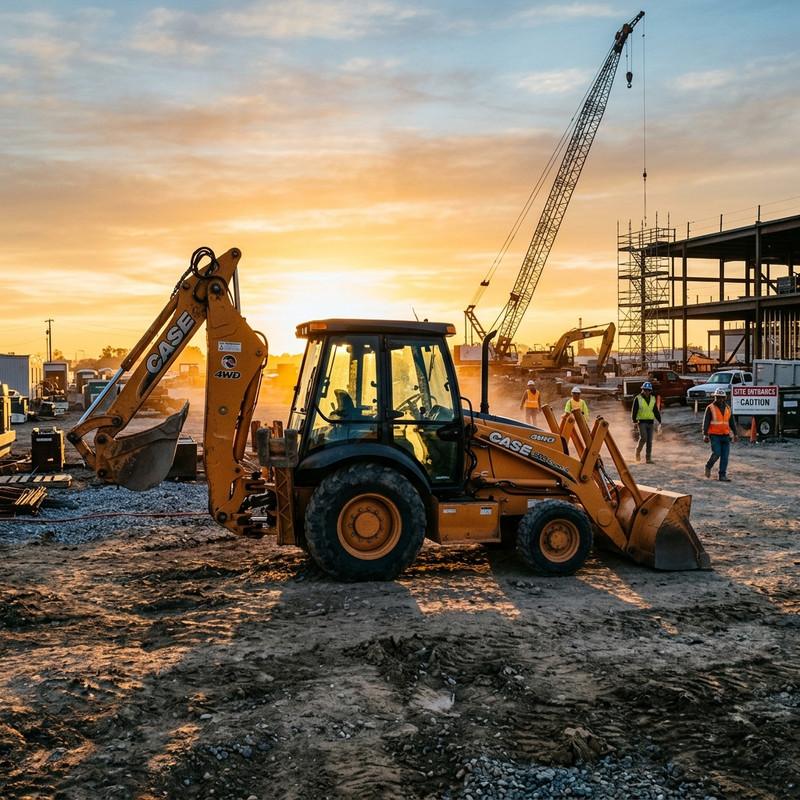
Case 580 Super M Backhoe: Why This 4-Stick Machine Still Dominates Job Sites
Quick answer: The Case 580 Super M backhoe loader remains the top choice for contractors, municipalities, and utility crews because it delivers proven reliability, unmatched service support, and real-world versatility in one machine. The 4-stick control configuration gives operators precise, fatigue-reducing control that decades of competing designs have failed to beat.
The Case 580 Super M is not a machine that needs hype. It has been earning its reputation on job sites for decades — digging trenches, loading trucks, and doing the kind of daily work that separates reliable iron from expensive regrets.
Contractors in every corner of North America run these machines hard. Municipalities depend on them. Rental yards stock them. That kind of staying power does not happen by accident. It happens because a machine performs, holds together, and comes back to work the next morning without drama.
This post covers exactly what makes the Case 580 Super M the standard by which every other backhoe loader is measured — the 4-stick controls, the engine, the specs, the service network, and why buying a used 580 Super M is still one of the smartest moves you can make in the used equipment market.
What Is the Case 580 Super M Backhoe Loader?
The Case 580 Super M is a full-size backhoe loader produced from 2001 to 2008 by Case Construction Equipment, a brand with over 180 years of manufacturing history behind it. The Super M sits at the top of the 580 series lineup — a series that began reshaping the backhoe market in the 1960s and never stopped evolving.
Key specs, base configuration:
-
Engine: Case Family III 445T/M 4-cylinder turbocharged diesel, 97 net hp
-
Loader lift capacity: 7,704 lbs at full height
-
Backhoe dig depth: up to 14 ft 8 in (standard stick), 17 ft 8 in (extendahoe)
-
Extendahoe dig depth: up to 18.25 ft
-
bucket dig force: 12,821 lb
-
Hydraulic system fluid capacity: 31.5 gal
-
Operating weight: approximately 15,000 lbs depending on configuration
-
Transmission: PowerShift or standard
-
transport length: 22.83 ft
The machine is available in 2WD and 4WD configurations, with common rear tires in 17.5L x 24 or 19.5L x 24 depending on setup, and front tire size varying by drive configuration. The 4WD version with extendahoe is the workhorse most contractors reach for when conditions get demanding. Many units were also equipped with a full factory cab with HVAC.
Why the 4-Stick Control Configuration Still Wins
The 4-stick configuration is the defining feature of the Case 580 Super M for experienced operators — and it is a legitimate competitive advantage, not a marketing claim.
Four-lever control means each function — swing, crowd, bucket, and boom — operates on its own dedicated stick. There is no pilot-hydraulic joystick system requiring you to adapt to multi-function inputs. Every movement is direct and mechanically intuitive. Operators who have run 4-stick machines for years know exactly where their hands are and what each input does. Muscle memory builds fast. Fatigue drops.
Switch to a pattern-controlled joystick system and experienced 4-stick operators lose productivity, at least temporarily. That is a real cost on a working job site.
The 4-stick configuration also simplifies troubleshooting. Fewer hydraulic pilot circuits mean fewer potential failure points. When something does need service, the system is straightforward to diagnose and repair — no proprietary software required, no dealership exclusive to read fault codes.
For fleets running multiple operators of varying experience levels, the 4-stick machine is the safest default. The controls make sense. New operators learn them faster than most alternatives.
The Engine That Keeps Showing Up to Work
The Case 4T-390 turbocharged diesel is not the flashiest powerplant in the industry. It does not need to be. At 97 net hp, it generates enough torque to handle aggressive digging, full bucket loads, and extended duty cycles without strain.
The engine is Tier 3 emissions-compliant — relevant for anyone buying used equipment and factoring in regional emissions regulations. Tier 3 certification keeps the machine legal across most U.S. jurisdictions without requiring DEF fluid, DPF regeneration cycles, or SCR system maintenance. That simplicity has a dollar value. Ask any operator who has dealt with Tier 4 Final aftertreatment failures.
Fuel efficiency is competitive in its class. Properly maintained, a Case 580 Super M running production work typically burns 2.5 to 3.5 gallons per hour depending on load intensity. Over a 2,000-hour year, the difference between a fuel-efficient backhoe and a thirsty one can run $8,000 to $12,000 annually at current diesel prices.
What Makes the Case 580 Super M the Industry Standard?
Three things keep the 580 Super M at the top: parts availability, service infrastructure, and operator familiarity.
Parts availability is not a small advantage. The 580 series has been in continuous production long enough that the aftermarket for wear items, hydraulic components, and structural parts is deep and competitive. You are not calling one distributor and waiting three weeks. Parts are available from multiple vendors, often at prices far below OEM.
Service infrastructure covers the Case dealer network, independent mechanics with decades of Super M experience, and an enormous base of service documentation. The machine has been torn down and rebuilt thousands of times. Known issues are well-documented. Repair procedures are understood.
Operator familiarity is a direct hiring advantage. The Case 580 Super M is the machine most experienced backhoe operators already know. Posting a job for a 580 Super M operator returns more qualified applicants than posting for most competing models. Reduced onboarding time is real money.
Case 580 Super M vs. Competing Backhoe Loaders: Where Does It Stand?
The primary competitors in the full-size backhoe loader segment are the John Deere 310 series, Caterpillar 420 series, and JCB 3CX series.
Here is what the comparison actually looks like in practical terms:
Case 580 Super M vs. John Deere 310SL: The Deere runs a comparable engine and has a strong dealer network. The Case has deeper aftermarket support for used buyers and a lower average acquisition cost for equivalent-hour machines. If you are buying new, the Deere is a legitimate alternative. If you are buying used, the Case 580 Super M typically delivers more for the dollar.
Case 580 Super M vs. Cat 420: The Cat carries a premium brand premium — you pay for the name as much as the machine. The 580 Super M matches Cat performance in most backhoe applications and costs less to acquire and service in the used market. Choose Cat if your fleet is already standardized on yellow iron. If you are starting fresh, the Case math works out better.
Case 580 Super M vs. JCB 3CX: The JCB uses a side-shift design that excels in urban and roadside applications where clearance is tight, but the Case still offers high maneuverability in tight work zones. The Case wins in raw dig depth, breakout force, and loader capacity. For general utility and construction work, the Case is the more versatile machine.
How to Buy a Used Case 580 Super M Without Getting Burned
The used market for the 580 Super M is active. That means good deals exist — and bad ones do too.
The fastest way to overpay or buy a money pit is to skip the inspection process. Do not do it.
Follow this sequence:
1. Confirm the build date and configuration. Super M production ran through multiple refinements. Know whether you are looking at an early Super M or a Super M+ with the improved hydraulic system. Confirm 2WD vs. 4WD, standard stick vs. extendahoe.
2. Pull the hour meter and compare it to the condition. A 580 Super M with 5,000 hours and documented service history is a better buy than a 3,000-hour machine with no paperwork. Hours tell part of the story. Maintenance records tell the rest.
3. Check the loader pins and bushings. These are high-wear components. Excessive slop in the loader arms costs $1,500 to $3,000 to rebuild correctly. Price that into your offer.
4. Inspect the backhoe bucket teeth and curl cylinder seals. Worn teeth are cheap to replace. Leaking seals on a backhoe cylinder can signal deferred maintenance across the hydraulic system.
5. Run the machine through full cycles. Swing the backhoe left and right at full speed. Listen for hesitation, chatter, or sluggish response. Crowd the bucket against resistance. Full hydraulic performance should be immediate and consistent.
6. Check the transmission under load. Shift through all ranges with the loader bucket carrying a load. PowerShift units should shift cleanly without slipping or hunting between gears.
A machine that passes all six checks at a fair price is worth buying. One that fails multiple checks at a "great price" is not.
Applications Where the Case 580 Super M Outperforms
The 580 Super M is a general-purpose machine by design, but it is particularly strong in:
-
Utility trenching: Dig depth and breakout force are purpose-built for utility installation. The extendahoe option reaches depths most competing machines cannot match without purpose-built excavators.
-
Site preparation and grading: The loader carries a full bucket at height without the nose-dive that plagues lighter machines. Grade control is precise.
-
Municipal operations: DPW crews run these machines for roadwork, storm drain maintenance, and emergency dig-ups. The service infrastructure makes downtime rare.
-
Residential and light commercial construction: The 4WD version navigates soft and uneven terrain that stops 2WD machines. The compact footprint fits where larger equipment cannot work.
The Long-Term Cost Case for the Case 580 Super M
Run the numbers over a 5-year ownership period and the 580 Super M justifies its reputation.
-
Average used acquisition cost (2,000–4,000 hours, good condition): $30,000–$55,000
-
Annual maintenance budget (fluids, filters, wear items): $4,000–$7,000
-
Expected major repair interval with proper maintenance: 6,000–8,000 hours
That budget should also account for hydraulic service, since the hydraulic system fluid capacity is 31.5 gallons. Routine ownership costs also include cooling system service and rear axle fluid checks as part of scheduled upkeep.
That is a machine that works for years before demanding significant investment — provided you do not skip service intervals and you buy one that was maintained by its previous owner.
Compare that to a lighter-duty machine that costs less upfront but faces more frequent structural repairs, limited parts availability, and a shorter productive life. The 580 Super M holds value in the resale market because buyers know what they are getting. Machines with documented maintenance histories sell faster and at higher prices.
The Case 580 Super M Still Sets the Standard
Decades of production. Millions of hours worked. A parts network that has not dried up. An operator base that knows the controls by instinct. The Case 580 Super M backhoe loader does not need to reinvent itself — it needs to keep doing what it has always done, and it does.
If you are in the market for a backhoe loader, start here. If you are already running one, maintain it right and it will outlast machines that cost twice as much.
Browse available Case 580 Super M listings, verify the hours, inspect before you buy, and put it to work.
Frequently Asked Questions About the Case 580 Super M
What does "4-stick" mean on a Case 580 Super M?The 4-stick configuration refers to four individual control levers — one each for swing, crowd, bucket, and boom. Each function is controlled by a dedicated mechanical input rather than a multi-function joystick. The result is direct, intuitive control that experienced operators prefer for productivity and precision, especially when managing backhoe movement through the swivel range.
What is the dig depth on a Case 580 Super M?Standard stick configuration reaches 14 ft 8 in. With the extendahoe option, dig depth increases to 17 ft 8 in — competitive with machines in a larger class. Many buyers also compare bucket capacity and bucket dig force when matching the machine to trenching and loading work.
How many hours can a Case 580 Super M last?A well-maintained 580 Super M can reach 8,000 to 12,000 hours before requiring major drivetrain or structural work. Machines with documented service histories regularly sell in the 5,000 to 7,000-hour range and continue working productively for years.
What is the difference between the Case 580 Super M and the 580 Super M+?The Super M+ received updates to the hydraulic system, loader geometry, and operator station ergonomics. Both are reliable platforms; the Super M+ offers incremental improvements in loader performance and operator comfort.
Is the Case 580 Super M a good used equipment buy?Yes — for buyers who inspect properly and buy from documented maintenance histories. Parts availability is strong, service knowledge is widespread, and resale value holds well relative to comparable machines in the market.
What are the most common repair items on a used Case 580 Super M?Loader pins and bushings, backhoe cylinder seals, and transmission filter service are the most frequent maintenance items. The number of forward gears and reverse gears is four in each direction on commonly referenced transmission specs. None are unusual for a machine of this duty cycle. Budget accordingly and price deferred items into any purchase negotiation.