
Selling Used Heavy Equipment Internationally: How to Sell Used Heavy Equipment Internationally
Quick answer: Selling used heavy equipment internationally means pricing in USD, verifying buyer funds before shipping, using export documentation (bill of lading, certificate of origin, commercial invoice), and choosing a freight method — RoRo, container, or flat rack — based on machine size and destination port. The biggest risk isn't finding a buyer. It's getting paid before the equipment leaves your yard.
International buyers pay more for used heavy equipment than domestic buyers in most categories. Demand from Africa, Southeast Asia, and Latin America has pushed export prices on mid-life dozers, excavators, and wheel loaders above what most U.S. auctions produce. But every extra dollar of margin comes with an extra layer of risk: currency exchange, freight logistics, customs paperwork, and buyers you'll likely never meet in person.
Sellers who treat an international deal like a domestic one get burned. Wire fraud, incomplete paperwork, and shipping disputes cost more than any commission an exporter or broker would have charged. This guide breaks down exactly how to sell heavy equipment overseas — pricing, payment, documentation, and freight — so the deal that looks good on paper actually closes clean.
Why Do International Buyers Pay More for Used Heavy Equipment and Agricultural Machinery?
Export demand outpaces domestic supply in several equipment categories, and that imbalance drives price. Older dozers, wheel loaders, and articulated haul trucks — machines many U.S. buyers consider outdated — remain in active demand in developing markets where parts availability matters less than raw capability and price point.
Three factors consistently push export prices higher:
-
Currency-driven purchasing power. Buyers in markets with strong local currencies against the dollar can outbid domestic buyers without straining their budget.
-
Limited local supply. Many countries have no domestic manufacturing base for heavy equipment, so used imports fill a gap that has no local competition.
-
Lower regulatory barriers. Emissions standards (Tier 4, EPA restrictions) that limit resale value domestically often don't apply overseas, making pre-Tier 4 machines — which U.S. buyers avoid — highly sellable abroad.
A 2015 wheel loader with 8,000 hours might struggle to find a domestic buyer above scrap-adjacent pricing. The same machine, listed for export to West Africa or Southeast Asia, can bring 20-40% more. The tradeoff: a longer sales cycle, more documentation, and payment risk that a local buyer would never introduce.
How Do You Verify an International Buyer Before Shipping Equipment?
Verify payment before the equipment leaves your possession — not before you sign a contract, not after the buyer promises a wire. Payment verification is the single most common failure point in international equipment sales.
Follow this sequence:
-
Require payment terms upfront. Letter of credit (LC), wire transfer with funds confirmed in your account, or escrow through a licensed third party. Never accept a partial deposit with "balance on delivery" from a first-time overseas buyer.
-
Confirm the wire, not the confirmation email. Wire fraud in international equipment sales typically involves a spoofed email with fake bank confirmation. Call your bank directly to confirm funds have cleared — not the number on the buyer's email signature.
-
Use a documentary letter of credit for deals over $50,000. An LC issued through a reputable international bank guarantees payment once you present the agreed shipping documents. It costs more in bank fees but removes buyer default risk entirely.
-
Run the buyer's company through a trade verification service. Dun & Bradstreet, or a freight forwarder's in-house verification, can confirm the buyer is a real operating business, not a shell used for fraud.
The fastest way to lose a machine and the money is to release title or bill of lading before funds clear your account. Hold every document until the wire is confirmed by your bank, not the buyer.
What Paperwork Do You Need to Export Used Heavy Equipment?
Export documentation determines whether your equipment clears customs — both leaving the U.S. and entering the buyer's country. Missing paperwork stalls shipments at port, can delay customs clearance significantly, and demurrage fees accrue daily while it sits.
Exporting used equipment requires a specific documentation package, and international buyers prefer machines with complete documentation. Standard documentation for exporting used heavy equipment includes:
-
Commercial invoice — states sale price, buyer/seller details, and equipment description (make, model, serial number, hours).
-
Packing list — outlines the shipment contents and supports customs handling and verification.
-
Bill of lading — issued by the freight carrier, this is the legal title document for the shipment and proof of ownership transfer.
-
Certificate of origin — confirms the equipment was manufactured or last substantially modified in the U.S., often required for the buyer's customs clearance.
-
Export declaration (EEI) — filed through the Automated Export System (AES) for shipments valued over $2,500, required by U.S. Customs and Border Protection.
-
Title and lien release — proof you hold clear title, with any liens satisfied before sale.
-
Bill of sale — helps prove the machine is not stolen during export.
-
Harmonized System codes — classify the machine correctly for heavy equipment exports to avoid filing and customs issues.
If you're exporting to a country with import restrictions on older equipment (some Gulf states and EU countries restrict machines over a certain age or emissions tier), verify export eligibility before you finalize price to avoid customs seizures, not just failed import clearance. A buyer who can't clear customs on their end isn't a buyer — they're a liability with a signature. Some destination countries also require imported machinery to meet strict cleanliness standards before entry.
Which Freight Method Should You Use to Ship Heavy Equipment Overseas?
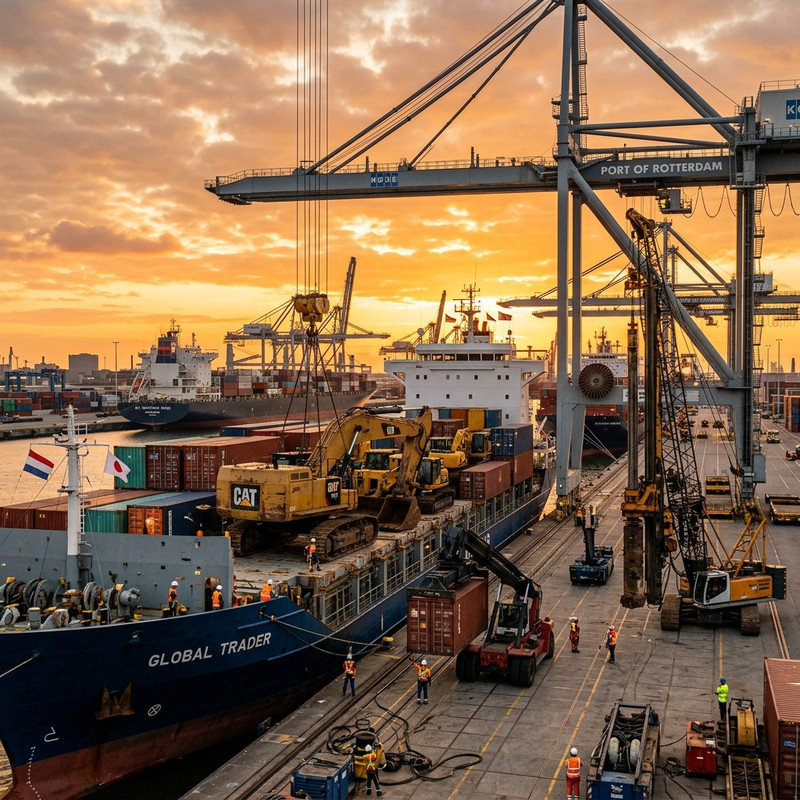
Freight method depends on machine size, destination port, and how much handling risk you're willing to accept. Choose RoRo if the machine is self-propelled and time isn't critical. Choose flat rack or container if the machine is smaller, non-operational, or higher-value and needs protection from the elements. The right freight company can save thousands on shipping costs by matching the best international shipping and transportation plan, including inland transport by truck when needed.
-
RoRo (Roll-on/Roll-off): Best for towable or self-driving machines. Cheapest option for operational equipment — excavators, dozers, wheel loaders, graders. Exposure to salt air and handling damage is the tradeoff.
-
Flat rack container: The machine is secured to an open-top container frame. Better protection than RoRo, moderate cost increase, works for equipment too large for a standard container but still needs handling care.
-
Standard or open-top container: Full enclosure protects equipment parts and non-running machinery from weather and theft. Highest cost per cubic foot, but necessary for high-value or non-operational machines.
A 40-ton excavator shipped RoRo from Houston to Lagos might cost $3,500-$5,000 in freight. The same unit in a flat rack container with full lashing and weatherproofing can run $7,000-$9,000. The extra cost is worth it when the buyer is paying a premium and expects the machine to arrive in the same condition it left — undercarriage protected, cab sealed, no corrosion from a six-week ocean crossing.
Should You Use an Export Broker or Sell Directly in International Sales?
Use a broker if you're new to international sales or lack an existing overseas buyer network. Sell directly if you already have a repeat buyer or in-country contact and can absorb the documentation workload yourself.
Export brokers typically charge 3-8% commission but bring three things most first-time exporters lack: a dedicated team, vetted buyer networks, and freight forwarder relationships; trusted wholesalers and broker networks can also access better equipment deals. They often act as a trusted partner for clients through the sales process, reducing hassle and helping maximize returns while avoiding auction risks or poorly vetted auction companies. For a $150,000 excavator, an 5% commission ($7,500) is inexpensive insurance against a fraudulent wire or a customs hold that costs more in demurrage than the commission would have.
Exporting used equipment can become a full-time job if you handle every step yourself. Trustworthy partners are essential for successful international sales. Selling directly makes sense once you've completed a few international deals and understand the documentation flow. At that point, the commission you'd pay a broker is better kept as margin — provided you're still following the same verification steps a broker would use.
Sell Equipment the First Time, Correctly
International buyers pay more for used heavy equipment because global demand outpaces domestic supply in nearly every mid-life category. But that premium only holds if the deal actually closes and the seller provides clear transparency to remote buyers — funds clear, documentation is complete, and the machine arrives in the condition the buyer paid for.
Verify payment before you release any title document. Match your documentation to both U.S. export requirements and the buyer's country import rules so both sides know what to expect. International buyers usually cannot inspect heavy equipment in person before purchase. Choose freight based on the machine's value, quality, and condition, not just the lowest quote. Comprehensive high-resolution photos are essential when marketing machinery and other used machines online to overseas buyers. Detailed maintenance logs help build trust with remote buyers and support the agreed price. Every step above exists because a seller before you skipped it and paid for the mistake.
List the equipment. Verify the buyer. Get paid before it ships.
Frequently Asked Questions
How long does it take to sell heavy equipment internationally?
A typical international sale takes 30-60 days from listing to shipment, longer than a domestic sale's 1-2 week average. The extended timeline comes from buyer financing arrangements, letter of credit processing (7-14 days), and freight booking, which can add another 2-4 weeks depending on vessel schedules.
What's the biggest risk when selling used equipment overseas?
Payment fraud is the biggest risk — specifically, releasing the bill of lading or title before a wire transfer is confirmed by your own bank. Spoofed payment confirmation emails are the most common fraud method targeting international equipment sellers.
Do I need an export license to sell heavy equipment internationally?
Most used heavy equipment does not require an individual export license, but you must file an Electronic Export Information (EEI) declaration through AES for shipments over $2,500. Equipment with military applications or destined for sanctioned countries may require additional licensing through the Bureau of Industry and Security.
Is it better to price in USD or the buyer's local currency?
Price in USD. Pricing in a buyer's local currency exposes you to exchange rate fluctuation between contract signing and payment clearing, which can shrink your margin on a deal that takes weeks to close.
Can I sell equipment that still has a lien on it internationally?
No. You must satisfy the lien and obtain clear title before finalizing an international sale. Buyers and their banks will require a clean title document as part of the letter of credit or wire transfer conditions, and most freight forwarders won't process a shipment without it.