
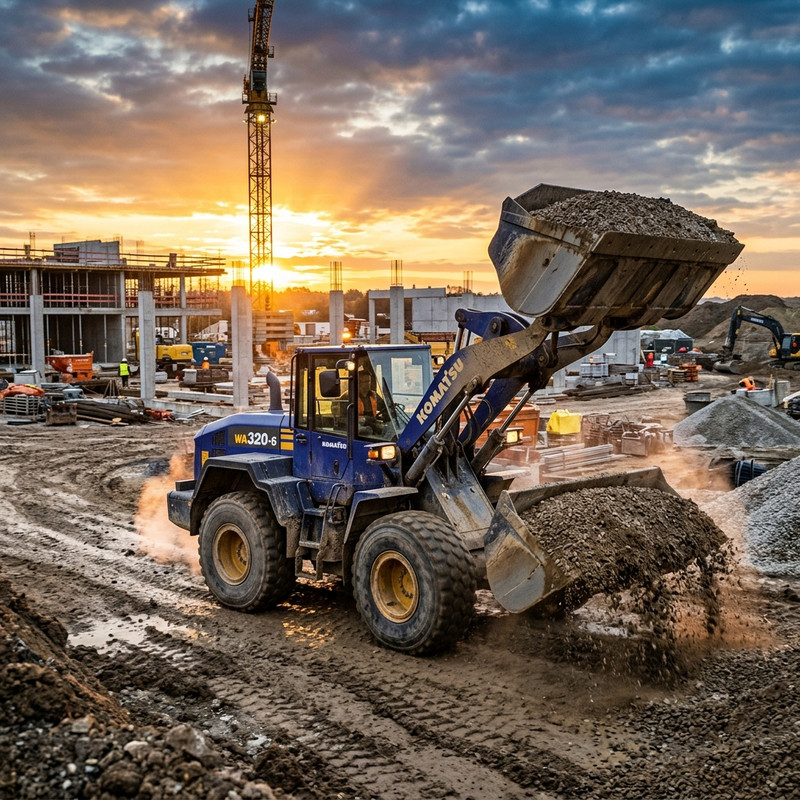
Komatsu WA320-6 Price: What Buyers Pay in 2026
Introduction
The Komatsu WA320-6 wheel loader> is one of the most widely traded mid-size loaders in North America, and used machines typically sell for $65,000 to $135,000 depending on hours, condition, and configuration. That kind of spread is exactly why buyers overpay: without a clear read on what moves Komatsu WA320-6 price—service history, attachments, tire condition, seller type, and hour range—a machine listed at $95,000 can be either a solid buy or an expensive mistake.
This guide is built for equipment owners, fleet managers, contractors, and used heavy equipment buyers who need real pricing context before they call, bid, or wire a deposit. You’ll see current price ranges by condition tier, the WA320-6 specs that actually justify a premium, how this loader compares with competing models, what raises the used wheel loader cost beyond fair market value, and what to verify before you commit. If you’re trying to value a WA320-6 accurately and avoid paying retail for a worn machine, this is the information that gives you a usable buying benchmark.
Body Sections
What Does a Komatsu WA320-6 Wheel Loader Cost Right Now?
-
Lead with the number: used WA320-6 units are currently trading between $65,000 and $135,000 depending on hours, year, and configuration. New or near-new examples with low hours and full dealer service records sit at the top end.
-
Break the range into three condition tiers:
-
-
Work-ready / High hours (8,000–12,000 hrs): $65,000–$80,000
-
Mid-life / Maintained (4,000–7,999 hrs): $80,000–$105,000
-
Low hours / Dealer certified (<4,000 hrs): $105,000–$135,000+
-
Note that year alone does not determine value — a 2016 unit with 3,500 hours and a full service binder outperforms a 2019 unit with 9,000 hours and no paperwork.
-
Remind the reader: list price is not transaction price. Negotiation room is wider on private-party sales than dealer listings.
Komatsu WA320-6 Specs That Move the Price: Fuel Consumption and More
-
Buyers pay more for specific configurations. Know what you're looking at before you assess a price.
-
Core specs to reference in the post:
-
-
Engine: Komatsu SAA6D107E-1, Tier 4 Interim, ~158 net HP
-
Operating weight: ~18,500 kg (approx. 40,785 lbs)
-
Bucket capacity: 3.0 to 4.2 yd³ (2.3 to 3.2 m³)
-
Breakout force: 29,000.36 lbs
-
Transmission: CLSS hydraulic, 4F/4R
-
HST with dynamic braking supports single-pedal operation to help extend brake life and reduce periodic service needs.
-
Tipping load (full turn): ~9,500 kg
-
Travel speed (max): ~35 km/h (4th gear)
-
Highlight which specs command a premium: high-flow hydraulics, quick-coupler setup, cold-start package, and 3rd/4th function lines. SmartLoader logic helps reduce fuel consumption.
-
Note: a machine spec'd for aggregate handling differs meaningfully in wear profile from one used in light earthmoving. Ask the seller for the primary application. That single question tells you more than the hour meter. Designed for easier upkeep, it also features gull-wing engine doors and a hydraulically driven cooling fan that simplify cleaning and access.
-
Operator comfort is also worth noting near the end of your review: a ROPS/FOPS-certified cab, adjustable controls, a heated air-suspension seat, and a color LCD display help support longer shifts.
Why the Komatsu WA320-6 Multi Function Mono Lever Outperforms the Competition
-
This section drives the comparative SEO angle and delivers the sales argument. Back every claim with a spec or operational fact — not adjectives.
-
WA320-6 vs. CAT 930M:
-
-
CAT 930M offers comparable lift capacity but comes at a higher purchase price (new and used). Parts and dealer support pricing tends to run higher. The WA320-6 carries a lower total cost of ownership over a standard 5-year work cycle. Its parallel-lift linkage combines z bar breakout force with parallel-lift characteristics for better material retention and loader performance.
-
WA320-6 vs. John Deere 524K:
-
-
The 524K matches on horsepower but trails on hydraulic efficiency in tight-cycle applications. CLSS on the Komatsu reduces fuel burn by up to 10% in repetitive load-and-carry work, and traction control helps prevent tire spin in slippery working conditions, improving stability and supporting tire life.
-
WA320-6 vs. Volvo L60H:
-
-
Volvo L60H is a capable machine but parts availability in North America runs longer lead times than Komatsu. Downtime cost matters more than purchase price on a working machine.
-
WA320-6 vs. Case 821G:
-
-
Case 821G is priced aggressively new, which makes used examples competitive — but resale retention on the Komatsu WA320-6 runs stronger over time, protecting your asset value.
-
Close with a direct statement: across fuel efficiency, parts availability, resale value, and hydraulic performance in mid-size applications, the WA320-6 holds a measurable edge and maintains control in virtually all working conditions. The numbers make the argument.
What Drives Price Up — and What Should Make You Walk Away
-
Factors that justify a higher ask:
-
-
Complete service records from a Komatsu dealer
-
Recent undercarriage inspection / tire life over 60%
-
Factory quick-coupler and high-flow kit installed
-
Single-owner, documented application history
-
Under 5,000 hours with no major component rebuilds
-
Red flags that should reset your offer — or end the conversation:
-
-
No service records past the first 500 hours
-
Frame cracks or weld repairs on the boom
-
Oil leaks at the boom cylinders or hydraulic lines
-
Excessive slop in the steering or loader linkage pins
-
Hours that don't match the wear on pedals, seat, and controls
-
Inspection checklist — 5 things to verify in person before committing:
-
Cold start behavior and exhaust smoke
-
Transmission response through all ranges
-
Max reverse travel speed in operation, not just on the spec sheet
-
Brake feel and steering response under load
-
Bucket, coupler, and hydraulic function operation
-
Attachment changes matter too: the HST system and linkage help the machine handle attachments quickly, so missing couplers or hydraulic functions should lower your offer.
New vs. Used WA320-6: Where the Math Points
-
New WA320-8 (current generation) lists in the $200,000–$230,000 range, depending on attachments and dealer.
-
A well-maintained used WA320-6 at $90,000–$105,000 with 5,000–6,000 hours delivers the same production capability at roughly half the capital outlay.
-
Break-even analysis: if the machine earns $40/hr and works 1,200 hrs/year, the cost difference between new and used is recovered in under 3 years — before factoring depreciation.
-
Financing note: used equipment financing rates are higher than new (typically 1–2 points), but the lower principal more than compensates in most applications. Run the numbers on your specific financing terms before deciding.
Where to Buy a Komatsu WA320-6
-
Komatsu dealer network: Higher price, more accountability, often certified pre-owned options with limited warranty.
-
Independent dealers: Mid-range pricing, variable inspection standards. Ask for a pre-purchase inspection from a third party.
-
Auctions (IronPlanet, Ritchie Bros., Proxibid): Competitive pricing, compressed due diligence window. Know your ceiling before the bidding opens.
-
Private party: Lowest price potential, highest buyer risk. No recourse if undisclosed issues surface post-sale.
Typical use cases include construction, agriculture, material handling, and waste handling.
It’s also a practical option for snow removal thanks to its heavy-duty power and traction control.
-
Repeat the directive: define your inspection checklist before you browse listings, not after. This helps customers find the right fit and keep the process in order.
Confirm transport dimensions before purchase: length 27 ft 3 in, transport width 8 ft 0 in, transport height 10 ft 6 in, and wheelbase 9.95 ft.
Shipping costs depend on route, trailer type, permits, and other logistical factors, so confirm those dimensions before you order transport.
How to Negotiate the Right Price on a WA320-6
-
Start with verified comparable sales, not asking prices. Asking prices are marketing; transaction prices are reality.
-
Build your offer from the bottom up: current tier pricing minus cost of any deferred maintenance you can document.
-
Get a third-party inspection. A $500–$800 inspection fee that uncovers a $12,000 hydraulic pump issue is the most efficient money you'll spend.
-
Use hours and documentation asymmetry as your primary leverage. A seller without records has a weaker negotiating position — use it.
-
Set your walk-away number before you make the first offer. The fastest way to overpay is to negotiate without a ceiling.
Conclusion: Know the Number Before You Make the Call
-
Recap the price ranges by condition tier — give the reader the data one more time in compressed form.
-
Reinforce the core buying logic: the WA320-6's specs, resale strength, and parts availability make it the strongest mid-size wheel loader value in its class. But a strong machine at the wrong price is still a bad deal.
-
Provide clear next steps:
-
-
Pull current WA320-6 listings and filter by hours and year
-
Build your inspection checklist from the red flags outlined above
-
Contact a Komatsu dealer for certified pre-owned options
-
Visit our inventory or contact page to discuss current availability
-
Close with a short, action-oriented line: See current WA320-6 listings — browse now.
SEO Suggestions
-
Title: "Komatsu WA320-6" leads the title and appears within the first five words. Keep it under 70 characters.
-
Introduction: Place "Komatsu WA320-6 price" and "WA320-6 specs" within the first 150 words.
-
Headings: Include "Komatsu WA320-6" in at least two H2 subheadings and "WA320-6 cost" in one.
-
Keyword variations: Rotate in "WA320-6 for sale," "used Komatsu wheel loader," "Komatsu WA320-6 specs," and "mid-size wheel loader price" to capture long-tail search volume without stuffing.
-
AEO (Answer Engine Optimization): Add a concise FAQ section with direct-answer formatting targeting queries like "How much does a Komatsu WA320-6 cost?", "What engine does the WA320-6 have?", and "WA320-6 vs CAT 930M — which is better?" — these surface in AI-generated answers and featured snippets.
-
GEO (Generative Engine Optimization): Write the comparison section (WA320-6 vs. competitors) with structured, factual language and specific data points. AI models and generative search engines prioritize attributable, verifiable content for citation.
-
Meta description: Include "Komatsu WA320-6," a price figure, and a call to action within 155 characters.
-
URL slug: /komatsu-wa320-6-price — clean, keyword-leading, no filler words.
-
Image alt text: Tag any machine images with "Komatsu WA320-6 wheel loader [year/hours/condition]" for image search visibility.
-
Internal linking: Link to related pages — financing options, attachment listings, and any WA380 or WA250 pages — to build topical authority.