
What Is a Landscape Truck — and Do You Need One?
Quick answer: A landscape truck is a work vehicle configured to haul equipment, materials, and crews for landscaping jobs. The right configuration depends on your job size, payload needs, and whether you're running a solo operation or a full crew. Buying the wrong one costs more than the sticker price.
Landscaping is a equipment-heavy business. You're moving mowers, blowers, edgers, trimmers, mulch, sod, stone, and crew — often in the same day, sometimes to multiple sites. A standard pickup handles light residential work. Once your jobs scale up, you need a purpose-built landscape truck.
The problem is "landscape truck" isn't a single product. It's a category that spans half-ton pickups fitted with toolboxes all the way to heavy-duty cab-overs with dovetail ramps and 14-foot flatbeds. Buy too small and you're making two trips where one should do. Buy too big and you're burning fuel, paying higher registration fees, and parking a machine that's harder to maneuver in tight residential neighborhoods.
This guide covers what a landscape truck is, the configurations that actually work in the field, what to look for when buying used, and how to avoid the most expensive mistakes buyers make.
What Makes a Truck a "Landscape Truck"?
A landscape truck is any commercial vehicle modified or purpose-built to support landscaping operations. The modification is what separates it from a general-purpose work truck.
Common configurations include:
- Flatbed with side boards — open deck, easy loading from three sides, good for bulk material
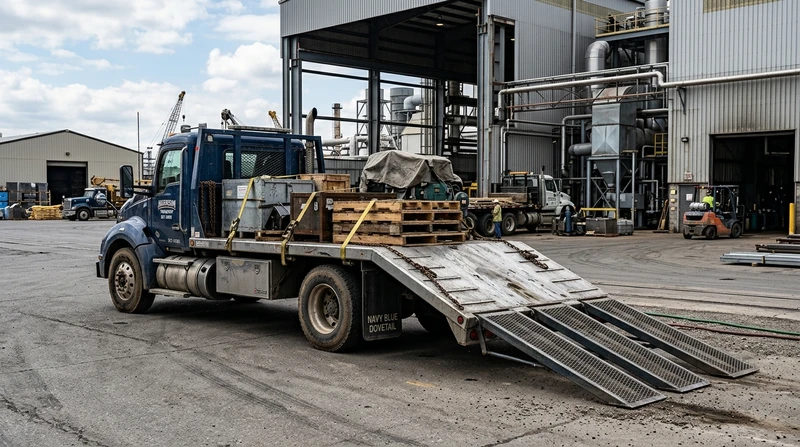
- Dovetail flatbed — angled rear section lets you drive equipment on without a ramp; standard for zero-turn mowers
- Dump insert or dump body — hydraulic lift for mulch, stone, soil, or debris removal
- Enclosed box body — lockable, weather-protected storage for tools and equipment
- Combo bodies — flatbed deck up front, dump section in the rear; common on larger landscape rigs
The chassis matters as much as the body. Most landscape operations run on one of three platforms:
- Class 2–3 (½-ton to ¾-ton) — Ford F-250/F-350, Ram 2500/3500, Chevy Silverado 2500/3500. Handles smaller crews and lighter equipment loads.
- Class 4–5 (14,000–19,500 lb GVW) — Ford F-450/F-550, Ram 4500/5500, Isuzu NPR. The workhorse tier for mid-size landscape companies.
- Class 6–7 (19,501–33,000 lb GVW) — Medium-duty trucks like the Isuzu FTR, Hino 258, or Ford F-750. Built for large crews, heavy equipment, and multi-stop commercial routes.
Know your GVW requirement before you look at a single listing. Overloading a Class 3 truck voids warranties, accelerates frame wear, and creates liability on public roads.
What Are the Most Common Landscape Truck Configurations in the Field?
Flatbed Landscape Trucks: High Versatility, Easy Loading
Flatbeds dominate the landscape market because they're flexible. You can haul a zero-turn mower, a pallet of sod, and a crew's gear in the same load. Side boards keep loose material contained. Remove them and you have a full open deck.
A dovetail rear is worth the premium if you're loading ride-on equipment daily. The angle eliminates the steep ramp angle that damages low-clearance machines and slows loading time.
Typical spec at the Class 4–5 tier: 12-ft or 14-ft flatbed body, 2-inch receiver hitch, integrated tie-down rails, side toolboxes, dovetail with fold-down ramps.
Dump Trucks and Dump Inserts: Built for Material Handling
If your operation moves bulk materials — mulch, topsoil, gravel, debris — a dump body saves hours of hand-shoveling. A hydraulic insert drops into a standard pickup bed; a purpose-built dump body on a Class 4–5 chassis handles heavier payloads and cycles faster.
The cost difference is significant. A hydraulic dump insert on an F-350 runs $3,000–$6,000 installed. A dedicated dump body on an F-550 starts at $8,000–$12,000 for the body alone.
Enclosed Landscape Trailers vs. Enclosed Box Trucks
Some operators prefer a box truck over a trailer setup. Box trucks eliminate the trailer licensing requirement in many states, maneuver better in residential cul-de-sacs, and reduce theft risk with a full lockable body.
The tradeoff: you can't unhitch and leave the equipment on-site. If your crews need to split off during the day, a truck-and-trailer setup gives more flexibility.
How Do You Buy a Used Landscape Truck Without Overpaying?
Define the Spec Before You Browse Listings
The fastest way to overpay is to start with price and work backward to the spec. Do it the other way around. Write down the minimum GVW, body length, body type, and required features before you open a single listing. This prevents chasing a "good deal" on a truck that's wrong for your operation.
Check the Frame, Hydraulics, and Body — In That Order
Used landscape trucks accumulate hard wear. Priorities when inspecting:
- Frame and subframe — Look for rust, cracks, and prior welding repairs. A compromised frame is not a negotiation point; it's a disqualifier.
- Hydraulic system (on dump trucks) — Cycle the dump body three times. Slow lift, drift, or fluid leaks signal a pump or cylinder issue. Repairs run $1,500–$4,500.
- Body condition — Surface rust on a steel flatbed is cosmetic. Rotted floor boards or cracked aluminum are structural. Price accordingly.
- Engine and transmission — Pull the service records. A 2017 unit with 120,000 miles and a full service binder tells a better story than a 2020 truck with 80,000 miles and no paperwork.
Understand What the Hours or Miles Actually Mean
A landscaping truck running residential routes puts on frequent short trips — hard on transmissions and exhaust systems, easier on engines than highway miles. A highway-spec truck with 200,000 miles may have less drivetrain wear than a route truck with 120,000.
Ask how the truck was used. Route work, long-haul delivery, and construction site duty all age a truck differently.
Know the Refurbishment Cost Before You Negotiate
A truck priced $8,000 below market isn't a deal if it needs a hydraulic rebuild ($3,000), new tires ($2,400), and a DOT inspection repair ($800). Run those numbers before you make an offer, not after. Sellers expect negotiation from prepared buyers; they don't expect itemized cost breakdowns. The itemized list is your leverage.
What Does a Landscape Truck Cost in 2025?
Prices vary sharply by class, configuration, and condition. General ranges for used trucks in serviceable condition:
- Class 3 flatbed (F-350 or equivalent): $25,000–$55,000
- Class 4–5 flatbed or dump (F-450/F-550, NPR): $35,000–$75,000
- Class 6–7 medium-duty landscape rig: $55,000–$120,000+
New Class 4–5 trucks with body upfitting start above $70,000 and can exceed $110,000 fully configured. The used market at 2–4 years old with 40,000–80,000 miles typically saves 30–45% off new — with most of the mechanical life still ahead.
Financing terms on commercial vehicles generally run 48–72 months. Factor monthly payment against revenue per truck to confirm the unit pencils out before you commit.
New vs. Used Landscape Truck: Which One Is Right for You?
New makes sense if you need a manufacturer warranty to protect cash flow, your operation depends on zero downtime, or you're financing and want to match depreciation to a tax strategy.
Used makes sense if you're scaling a fleet and need to manage cost-per-unit, your in-house mechanic can handle routine repairs, or you're buying a proven platform with known parts availability.
A three-year-old truck with full service records and under 60,000 miles gives you most of the reliability of new at 60–65 cents on the dollar. That's the sweet spot for most growing landscape operations.
Make the Right Call on Your Next Landscape Truck
The landscape truck market has more options than it did five years ago — more platforms, more body configurations, more financing paths. That's good for buyers. More options also means more ways to land on the wrong unit.
Nail down the spec first. Inspect methodically. Price in refurbishment before you negotiate. Those three steps separate buyers who build efficient fleets from buyers who cycle through trucks every two years.
Browse current landscape truck listings, or get pre-qualified for commercial vehicle financing. Both take less time than one bad purchase.
Frequently Asked Questions About Landscape Trucks
What is the best truck for a landscaping business?
The best landscape truck depends on your operation size. Solo operators and small crews running residential accounts typically work well with a Class 3 truck (F-350, Ram 3500) with a flatbed or dump insert. Mid-size companies with multiple crews and equipment hauls benefit from a Class 4–5 unit (F-550, Isuzu NPR). Match the GVW to your actual payload needs — not your projected ones.
What size truck do I need for landscaping?
Calculate your payload first: crew weight, equipment weight, and any material you haul simultaneously. Add 20% margin. That number determines your minimum GVW rating. Most two-person crews with a zero-turn mower and hand tools fall between 8,500–14,000 lb GVW. Crews running larger equipment or bulk materials need 19,500 lb GVW or above.
Is a landscape truck the same as a dump truck?
Not necessarily. A landscape truck can include a dump body, but many landscape trucks are flatbeds, box trucks, or combo bodies without dump capability. A dump truck is one configuration within the broader landscape truck category. Whether you need dump capability depends on whether your jobs involve bulk material delivery or debris removal.
How many miles is too many on a used landscape truck?
Mileage alone is a poor indicator. How the truck was used matters more. A Class 5 truck with 150,000 highway miles in good mechanical condition may outperform a 90,000-mile route truck with deferred maintenance. Always prioritize service records, frame condition, and a pre-purchase inspection over the odometer reading.
What body length do I need on a landscape truck?
For a single zero-turn mower plus hand equipment, a 12-ft flatbed typically works. For two mowers or combined equipment and material loads, move to 14 ft. Class 5 and above trucks commonly run 14-ft to 16-ft bodies. Longer bodies increase maneuverability challenges in tight residential streets — factor in where you work, not just what you haul.