
A Complete Guide to the Different Types of Trucks
Quick answer: There are seven main types of trucks—light-duty pickups, medium-duty trucks, heavy-duty semis, flatbeds, dump trucks, box trucks, and specialty vehicles. The right choice depends on payload, haul distance, road type, and whether you need a CDL. Match the truck to the job before you shop.
Buying or operating the wrong truck is expensive. You either overpay for capacity you don't use, or you underbuy and damage your cargo, your vehicle, or both. The truck market is dense — dozens of configurations, weight classes, and body types — and manufacturers rarely make it easy to compare apples to apples.
This guide cuts through that. Each major truck type is broken down by what it does, what it costs to operate, and who actually needs it. Whether you're hauling materials across a job site, managing a delivery fleet, or deciding whether to lease or buy your first semi, the information below tells you what matters before you commit.
What Are the Federal Weight Classes for Trucks — and Why Do They Matter?
The U.S. Department of Transportation divides trucks into eight classes based on Gross Vehicle Weight Rating (GVWR). Class 1–2 covers light-duty vehicles under 10,000 lbs. Class 3–6 covers medium-duty. Class 7–8 covers heavy-duty, with Class 8 starting at 33,001 lbs GVWR.
Weight class determines more than just what a truck can carry. Truck classes and truck classifications define capability and compliance, including licensing requirements, fuel tax obligations, maintenance intervals, and insurance categories. They also shape payload and towing decisions, and buying more capability than needed can lead to higher operating costs. A Class 7 truck requires a commercial driver's license (CDL) in most states. A Class 3 does not. Get this wrong and you're looking at fines, voided insurance, or a failed DOT inspection.
Know your GVWR requirements before you browse a single listing.
Light-Duty Pickup Trucks (Class 1–2): What Can They Actually Handle?
Light-duty trucks — Ford F-150, Chevy Silverado 1500, Ram 1500 — sit in Classes 1 and 2, and this group includes some of the most common compact trucks, compact pickups, and full size trucks on the market. GVWR runs from roughly 6,000 to 10,000 lbs. Payload capacity typically lands between 1,500 and 2,300 lbs depending on cab, bed, and engine configuration.
These trucks are built for versatility, not volume. They handle landscaping equipment, construction materials for smaller jobs, and towing trailers up to 10,000–13,000 lbs when properly configured. Buyers should compare towing capacity, passenger capacity, and cab configurations because those choices change what a pickup can realistically do. The mistake most buyers make is assuming a half-ton truck can do a three-quarter-ton job. It can't — not without accelerating wear on the suspension, frame, and transmission.
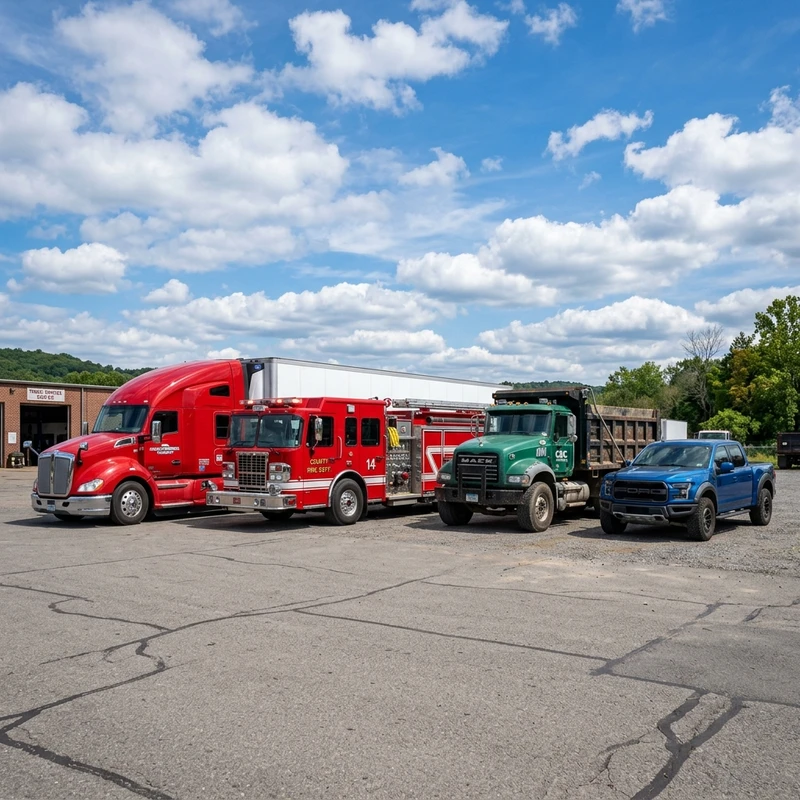
Pickup trucks use an open cargo bed or truck bed for flexible hauling, which is why they are common as work trucks for tools, equipment, and building materials. Light-duty pickups are the right call for:
-
Solo contractors hauling tools and materials to residential job sites
-
Farmers managing lighter equipment and feed loads
-
Small business owners who need a workhorse vehicle for daily use
Newer gas, hybrid, and diesel trucks may offer better fuel economy depending on spec and workload.
They're the wrong call the moment your load exceeds the listed payload. Check the door jamb sticker, not the marketing sheet.
Medium-Duty Trucks (Class 3–6): The Most Versatile Working Trucks
Medium-duty trucks cover a wide range — Ford F-350 through F-650, Chevy 4500–6500, International MV Series. GVWR runs from 10,001 to 26,000 lbs. This is where commercial work begins in earnest.
Box Trucks and Cargo Vans
Box trucks — also called straight trucks or cube trucks — put a fully enclosed cargo area on a medium-duty chassis, making them a common commercial truck in broader fleets of commercial vehicles. Common GVWR configurations run from 12,500 to 26,000 lbs. You'll see them everywhere: last-mile delivery, furniture, moving companies, food distribution. Box trucks are especially common for urban deliveries because their enclosed body and maneuverability suit city routes and tight loading areas.
The 26,000 lb GVWR cutoff matters because it's the threshold below which a CDL is not federally required. Many fleet operators specifically spec their box trucks at or under that number to keep drivers non-CDL. If you're managing a delivery fleet, that's a meaningful labor cost variable.
Flatbed Trucks
Flatbeds offer what enclosed bodies can't: unrestricted loading from the top and sides, no height limitations, and compatibility with oddly shaped cargo, which is why they're often used to move heavy equipment, heavy machinery, and oversized cargo that cannot fit inside enclosed bodies. They’re also common for oversized loads that need top or side loading and more securement flexibility. Steel coils, lumber, machinery — flatbeds handle loads that box trucks and vans can't touch.
The tradeoff is weather exposure. Cargo needs to be secured and tarped, or it's at risk. Factor that into operating cost if you're running flatbeds in a multi-climate region.
Dump Trucks (Medium-Duty)
Medium-duty dump trucks — Class 5 and 6 — are the standard for landscaping companies, smaller excavation contractors, and municipal maintenance crews, handling large volumes of loose material efficiently. Payload capacity typically runs 5 to 10 tons. Dump trucks use hydraulic lifts to unload quickly, which is why they’re common for hauling materials in landscaping, municipal work, and smaller site prep. They're less expensive to operate than Class 8 dumps and don't require a CDL in most configurations.
If your jobs consistently exceed 10-ton loads, you've already outgrown this class.
Heavy-Duty Semi-Trucks (Class 7–8): What Separates a Good Unit From a Money Pit?
Class 8 semi-trucks — GVWR 33,001 lbs and above — are heavy duty trucks used for long distance transportation of freight. A semi truck may also be called a tractor trailer or one of the common semi trailer trucks used in freight fleets. Freightliner Cascadia, Kenworth T680, Peterbilt 579, Volvo VNL. These are high-dollar assets with high operating costs. A new Class 8 tractor runs $180,000–$250,000. A quality used unit in the 2019–2022 range trades for $80,000–$140,000 depending on mileage, spec, and service history.
The tractor unit is the powered front section that pulls the trailer, and these combinations move consumer goods, raw materials, and industrial equipment over long distances.
Used mileage tells part of the story. Engine hours, transmission condition, and maintenance records tell the rest. A 2020 Cascadia with 500,000 miles and a complete dealer service history is a far better buy than a 2021 unit with 350,000 miles and no paperwork.
Key specs to evaluate before you commit:
-
Engine: Cummins X15, Detroit DD15, PACCAR MX-13 — know the horsepower rating and whether it's been reprogrammed
-
Transmission: 10-speed manual, 12-speed automated manual (AMT), or 18-speed — AMTs now dominate new spec orders; used manuals are cheaper upfront but harder to staff
-
Axle configuration: 6x4 standard, 6x2 for fuel efficiency on flat terrain, 4x2 for regional/last-mile
-
Sleeper vs. day cab: Long-haul requires a sleeper; regional and local work runs day cabs
The fastest way to overpay on a Class 8 truck is to focus on the purchase price without calculating cost-per-mile. A cheaper truck with higher fuel consumption and a deferred engine rebuild will cost more over 24 months than a more expensive unit with a verified recent overhaul.
Specialty Trucks: When Standard Configurations Don't Fit the Job
Several truck types don't fit neatly into the above categories but represent major segments of the market.
Cement Mixer Trucks
Concrete mixer trucks mount a rotating drum on a Class 7 or 8 chassis. The drum keeps concrete agitated during transport, preventing early setting. Standard capacity runs 8–10 cubic yards per load. These trucks have a narrow use case but an irreplaceable one — no contractor pours a large foundation without access to one.
Tanker Trucks
Tanker trucks are specialized vehicles built to carry liquids safely in bulk, including fuel, chemicals, milk, water, and liquid food products. They often serve specialized industries where liquid cargo handling and contamination control are critical. Configuration matters enormously here. A food-grade tanker and a petroleum tanker are not interchangeable. Regulatory compliance under DOT and, for hazmat loads, PHMSA adds another layer of operating cost and certification requirements.
Refrigerated Trucks (Reefers)
Reefer trucks — refrigerated trailers or straight trucks with integrated cooling units — handle temperature-sensitive cargo. Pharmaceuticals, produce, dairy, meat. The refrigeration unit is a separate maintenance line item from the truck itself. Thermo King and Carrier Transicold are the dominant unit manufacturers. Factor annual maintenance costs of $3,000–$8,000 per unit into your operating budget.
Tow Trucks and Wreckers
Tow trucks range from light-duty wheel-lifts for passenger cars to heavy-duty rotators handling Class 8 recovery. Car carrier variants are built to transport multiple vehicles with ramps and tie-down systems for securing multiple vehicles in transit. Heavy tow and recovery equipment may also use advanced braking systems when working with extremely heavy loads. Operating a tow truck commercially requires state-specific permits and, at heavier classes, a CDL with appropriate endorsements.
How to Choose the Right Truck Type for Your Operation
Start with payload and load type. Different truck categories suit different cargo, routes, and business needs, and matching the right truck improves operational efficiency. If you don't know your maximum payload requirement, you'll either overbuy or underbuy. Both cost money.
Work through these four questions before you look at a single listing:
-
What is your maximum payload in pounds? Add a 15% buffer for variable loads.
-
What type of cargo? Liquid, bulk, oversized, temperature-sensitive, and enclosed loads each point toward different body types.
-
What is your primary haul distance? Local (under 100 miles), regional (100–500 miles), and long-haul (500+ miles) have different fuel, maintenance, and driver licensing implications.
-
Do you need CDL-qualified drivers? If yes, factor that into your total cost of operation. If you want to avoid the CDL requirement, stay under 26,000 lbs GVWR.
Some jobs also require heavy haul equipment to transport extremely heavy loads or freight that exceeds standard weight limits.
Once you have answers to those four questions, you've eliminated most of the market. What's left is a manageable shortlist.
The Right Truck Doesn't Cost More — It Costs Less Over Time
Mismatched trucks are expensive. A light-duty pickup pushed past its payload limit degrades faster and fails sooner. A Class 8 semi running regional routes at low volume burns operating costs you'll never recover in revenue.
The trucks that generate the best return are the ones spec'd precisely for the job — right payload class, right body type, right drivetrain for the terrain and distance. That precision starts before you open a dealer listing or browse a used equipment marketplace.
Define your job requirements first. Then shop.
Frequently Asked Questions About Types of Trucks
What is the most common type of truck used commercially in the United States?
Class 8 semi-trucks are the most common heavy commercial trucks by freight volume. For medium-duty commercial use, box trucks and flatbeds dominate last-mile delivery and construction logistics.
What type of truck do I need a CDL to drive?
A CDL is federally required for any vehicle with a GVWR over 26,001 lbs, any vehicle towing a trailer over 10,001 lbs, and any vehicle transporting hazardous materials requiring placards. State-level rules vary slightly, but the 26,000 lb threshold is the standard commercial cutoff.
What is the difference between a semi-truck and a heavy-duty pickup truck?
Heavy-duty pickups are larger work-oriented pickups with higher towing capacity than light-duty models, built for demanding hauling and towing tasks. Large trucks in this category are commonly chosen when operators need more towing and payload than standard light-duty pickups can provide. A semi-truck (Class 8, GVWR 33,001+ lbs) is purpose-built for high-volume freight over long distances. They share a chassis category in name only.
How many miles is too many on a used semi-truck?
Mileage alone is not a reliable disqualifier. A Class 8 diesel engine — Cummins X15, Detroit DD15, PACCAR MX-13 — is built for 1,000,000+ miles with proper maintenance. A 700,000-mile truck with verified service records and a recent engine overhaul outperforms a 400,000-mile truck with no documentation. Always request the maintenance history.
What is the cheapest type of truck to operate per mile?
For long-haul freight, modern aerodynamic Class 8 day cabs with AMT transmissions and low-rolling-resistance tires deliver the lowest cost-per-mile in fuel and maintenance. For short-haul and local work, a well-spec'd Class 5–6 straight truck typically offers the best cost balance without CDL overhead.
What type of truck is best for a small construction business?
A Class 3–4 pickup (F-350 or equivalent) paired with a utility body or flatbed handles most small-to-mid-size residential and commercial construction needs. If you regularly haul over 4,000 lbs of materials or need to move equipment weighing more than 10,000 lbs, step up to a Class 5 or 6 chassis.