
What Paperwork Should a Used Backhoe or Tag Trailer Seller Actually Have?
Quick answer: A credible seller provides inspection records (dated, itemized), load rating documentation matching the trailer's axle and GVWR specs, a verifiable serial/VIN number matching the title, and maintenance logs showing service dates, hours or mileage, and parts replaced. Missing any of these four categories is a red flag — walk away or negotiate the price down to cover the risk.
Buying used heavy equipment without paper trails is how buyers end up with surprise repair bills. A backhoe with no maintenance history could be hiding a failing hydraulic pump. A 20-ton tag trailer with no load rating documentation could put you in violation of DOT regulations the first time you haul near its limit. The paperwork isn't a formality — it's the only evidence standing between you and an expensive mistake.
This guide breaks down exactly what documentation to demand before you hand over a check, why each document matters, and what it means if a seller can't produce it.
What inspection records should a backhoe or trailer seller provide?
Ask for the most recent inspection report, dated within the last 90 days if possible. The report should cover hydraulics, undercarriage or tires, brakes, structural welds, and any attachments included in the sale.
For a backhoe, that means a documented check of the boom and stick cylinders, the swing mechanism, and the backhoe bucket pins and bushings. Pin and bushing wear is one of the most common hidden costs in used backhoes — a worn bucket pin can cost $500–$1,500 to replace, and sellers rarely mention it unless the inspection report forces the issue.
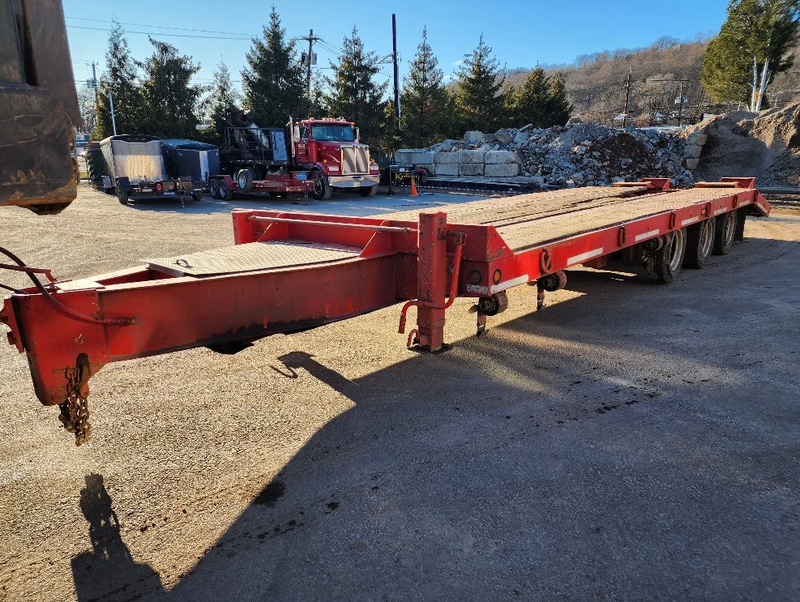
For a 20-ton tag trailer, the inspection should cover axle alignment, brake pad thickness, tire tread depth, and the condition of the deck and ramps. A trailer with uneven tire wear often signals an axle alignment problem — a $300–$800 fix if caught early, a $2,000+ fix if ignored until the tires fail on the road.
If the seller has no inspection report, ask them to schedule one before the sale or have your own mechanic inspect it. Never buy based on a visual walkaround alone.
Why does the load rating documentation matter for a 20-ton tag trailer?
Load rating documentation proves the trailer can legally and safely carry what you intend to haul. This includes the GVWR (Gross Vehicle Weight Rating), axle rating, and tire load index — all of which should be stamped on the VIN plate and match the manufacturer's original specifications.
A seller advertising a "20-ton tag trailer" should be able to produce documentation confirming the actual rated capacity, not just a marketing label. Some sellers round up: a trailer sold as 20-ton might carry a manufacturer rating closer to 18 tons once axle and tire limits are factored in. Hauling over the rated capacity isn't just a mechanical risk — it's a DOT compliance violation that can result in fines or impoundment at a weigh station.
Choose a trailer with documented load ratings that match or exceed your heaviest anticipated load if weight margin matters more to you than price. Choose a lower-rated trailer only if your loads are consistently light and the price difference is substantial.
How do you verify a serial number or VIN on used equipment?
Cross-check the serial number or VIN stamped on the machine against the number listed on the title or bill of sale. For backhoes, the serial number is typically stamped on the frame near the engine compartment or on a manufacturer's plate riveted to the chassis. For trailers, the VIN is stamped on the frame near the tongue and also appears on a federal certification label.
A mismatch between the physical serial number and the paperwork is a dealbreaker. It can indicate a stolen machine, a title for a different unit entirely, or a frame swap that hides accident damage. Run the serial number or VIN through the manufacturer's lookup tool or a third-party equipment history service before finalizing any purchase — this takes five minutes and can save you from buying a machine with a lien still attached.
What maintenance records prove a machine was properly cared for?
Request a complete maintenance log showing service dates, hours or mileage at each service, parts replaced, and who performed the work — a dealer service department carries more weight than a handwritten note from the previous owner.
A 2018 backhoe with 4,000 hours and a complete dealer service binder tells a far better story than a 2020 model with 2,000 hours and zero paperwork. Hours alone don't tell you how a machine was treated. Service history does.
Specifically, look for records of:
- Hydraulic fluid and filter changes (every 500–1,000 hours on most backhoes)
- Engine oil and filter changes (per manufacturer interval, typically every 250 hours)
- Undercarriage or tire replacement dates
- Brake system service, especially on trailers hauling near their rated capacity
- Any major repairs, including hydraulic cylinder rebuilds or axle replacements
If a seller provides hours but no service intervals to match, assume the worst-case maintenance schedule and price your offer accordingly.
What should you do if a seller can't provide this paperwork?
Missing documentation doesn't automatically mean walk away, but it does mean you take on more risk than the asking price should reflect. Here's how to handle each gap:
- No inspection report — Hire an independent inspector before purchase. Budget $150–$400 for a thorough mechanical inspection.
- No load rating documentation — Contact the manufacturer directly with the VIN to confirm specs. Do not rely on the seller's verbal claim.
- No maintenance log — Negotiate the price down by the estimated cost of a full fluid and filter service, plus a contingency for unknown wear items.
- Serial number mismatch — Stop the transaction. Verify the title chain with your state's DMV or equivalent agency before proceeding further.
A seller who hesitates or gets defensive when asked for this paperwork is telling you something important. Credible sellers expect these questions and have answers ready.
Buy with the paperwork, not the pitch
The used heavy equipment and trailer market rewards buyers who ask for documentation before they ask for a price. Inspection records, load ratings, serial numbers, and maintenance logs aren't bureaucratic extras — they're the evidence that separates a fair deal from an expensive mistake.
Before your next purchase, request all four document categories in writing. Compare what the seller provides against what's outlined here. Walk away from any deal where the paperwork doesn't add up.
Frequently Asked Questions
How much should I expect to pay for an independent equipment inspection?
An independent mechanical inspection for a backhoe or heavy trailer typically costs $150–$400, depending on your region and the inspector's credentials. This cost is far lower than the average hidden repair bill on equipment with undisclosed problems.
What's the risk of buying a trailer with a load rating I can't verify?
You risk hauling over the legal capacity, which can result in DOT fines, impoundment, or — in a worst-case scenario — a structural failure on the road. Always confirm the GVWR and axle rating directly with the manufacturer using the VIN.
Are dealer maintenance records more trustworthy than owner-kept logs?
Yes. Dealer records are time-stamped, itemized, and tied to a business that can be contacted for verification. Owner-kept logs are useful but should be treated as supplementary, not primary, evidence.
What if the seller only has partial paperwork?
Partial paperwork isn't a dealbreaker, but it should lower your offer. Fill the gaps yourself — independent inspection, manufacturer verification, title search — and subtract that cost from your purchase price.
Is it worth buying equipment with no paperwork at all if the price is low enough?
Only if the discount exceeds your worst-case repair and compliance risk, and only after you've independently verified the serial number against the title. Unverified equipment with no documentation carries the highest risk of hidden liens, misrepresented specs, or stolen property.