
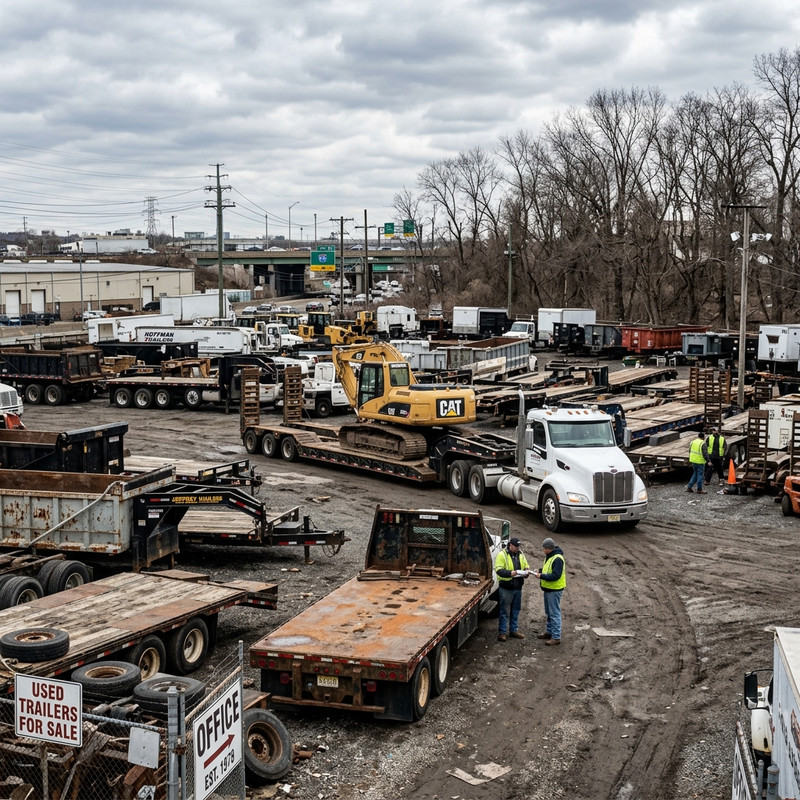
How to Find Used Heavy Equipment Trailers in NJ
Quick answer: Finding used heavy equipment trailers in New Jersey means knowing where to look, what to inspect, and how to avoid overpaying. The best sources include local dealers, auction houses, and private sellers — each with distinct tradeoffs on price, condition, and paperwork. Define your trailer specs before you browse.
New Jersey sits at the center of one of the most active construction and transportation corridors on the East Coast. That geographic reality creates steady demand for heavy equipment trailers — and a legitimate used market to match. But a busy market cuts both ways. Motivated sellers move inventory fast, and underprepared buyers absorb the deals that look good on paper and fall apart in the field.
This guide tells you where to find used heavy equipment trailers in NJ, what to verify before you buy, and which mistakes cost buyers the most money.
What Types of Heavy Equipment Trailers Are Available in New Jersey?
Before you contact a single seller, lock down your specs. The used trailer market in NJ includes several distinct categories, and they are not interchangeable.
- Lowboy trailers — Designed for oversized loads like excavators and bulldozers. Deck heights typically range from 18 to 24 inches. Fixed-neck vs. detachable-neck configurations carry different payload and permit implications.
- Flatbed trailers — Common for equipment under 48,000 lbs. Simpler to load and transport, lower upfront cost.
- Step-deck trailers — Two deck levels. Handles taller loads that exceed standard flatbed legal height limits without requiring special permits in most cases.
- Hydraulic detachable gooseneck (RGN) trailers — The standard for heavy haul. Deck lowers to ground level for loading. Most expensive category; used units start around $30,000–$60,000 depending on capacity and condition.
Buying the wrong trailer type for your loads adds permit costs, operational delays, and resale problems. Know your heaviest load, widest load, and tallest load before you look at a single listing.
Where to Find Used Heavy Equipment Trailers for Sale in NJ
Local Heavy Equipment Dealers
NJ-based dealers are the most straightforward starting point. They inspect and recondition inventory before selling, they can facilitate financing, and they carry documentation on units they've serviced. The tradeoff: dealer pricing runs 10–20% higher than private party, because you're paying for that accountability.
Search dealers in northern and central NJ — Bergen County, Morris County, and the Route 1 corridor between Trenton and New Brunswick — where construction activity concentrates demand and dealer inventory.
Regional Auction Houses
Ritchie Bros. Auctioneers operates a major facility in Marlboro, NJ. IronPlanet lists NJ inventory online with inspection reports. Both platforms move significant trailer volume.
Auctions create genuine price opportunity. They also create risk. You are typically buying as-is, with limited time to inspect. Commission fees add 5–10% to the buyer's side. Go in with a hard ceiling — the number above which the deal stops making sense — and do not move it.
Private Sellers and Online Marketplaces
MachineryTrader, Equipment Trader, and Facebook Marketplace all carry NJ trailer listings. Private sellers often price below dealer retail, but the burden of due diligence falls entirely on you. No dealer inspection, no warranty, and in some cases, limited service history.
The upside: negotiating room. A private seller motivated to move inventory will often come down 10–15% from the asking price if you show up prepared and ready to close.
Government and Fleet Liquidations
State agencies, municipalities, and utility companies in NJ regularly liquidate equipment, including trailers, through GovPlanet and state surplus programs. Fleet-maintained units often carry complete service records and consistent maintenance histories. Watch NJ State surplus auction listings — they surface periodically and attract less competition than commercial auctions.
What to Inspect Before You Buy a Used Trailer in NJ
Price is irrelevant if the trailer fails inspection or carries hidden repair costs. These are the five areas that matter most.
1. Frame and structure
Look for cracks at stress points — around the gooseneck, crossmembers, and rear axle mounts. Surface rust is cosmetic. Structural rust is a deal-breaker. Bring a flashlight and get underneath.
2. Axles and suspension
Check for bent axles, worn leaf springs, and uneven tire wear (which signals alignment problems). A suspension rebuild on a heavy-duty trailer runs $3,000–$8,000 depending on axle count.
3. Deck condition
Cracked or rotted wood decking is a straightforward fix — roughly $500–$1,500 for materials. Bent steel decking or compromised deck supports are more serious and more expensive.
4. Brakes and electrical
Verify the brake system functions on every axle. Check all lighting — brake lights, turn signals, running lights. Electrical issues on older trailers are common and can be surprisingly labor-intensive to chase down.
5. Title and registration
Confirm the seller holds a clean NJ title in their name. Lien searches are public record. A trailer with an unresolved lien transfers that debt to you at closing.
A pre-purchase inspection from an independent mechanic or trailer shop costs $150–$300. On a $25,000 purchase, that's cheap insurance.
How Much Do Used Heavy Equipment Trailers Cost in NJ?
Prices vary by type, age, and condition. Current used market ranges in the NJ region:
- Used flatbed trailers: $8,000–$22,000
- Used step-deck trailers: $12,000–$30,000
- Used lowboy trailers: $20,000–$55,000
- Used RGN hydraulic trailers: $30,000–$80,000+
High-hour units with deferred maintenance can fall below these ranges. Treat a price well below market as a signal to inspect harder, not an automatic win.
NJ Regulations You Need to Know Before You Haul
New Jersey enforces federal weight limits — 80,000 lbs gross vehicle weight on interstate highways — with additional state-specific restrictions on select roads and bridges. Oversized and overweight loads require NJ DOT permits, which you apply for through the state's online permitting system.
If you're hauling across state lines from NJ into PA or NY, each state requires its own permit. Factor permit costs and lead time into your operational planning before you finalize the trailer purchase.
Financing a Used Heavy Equipment Trailer in NJ
Most NJ dealers offer in-house financing or connections to equipment lenders. For private-party purchases, commercial equipment lenders — including Crest Capital, Currency, and regional banks with commercial lending divisions — finance used trailers, typically requiring 10–20% down on units over $25,000.
Strong financials and clear title documentation accelerate approval. Bring both.
Frequently Asked Questions
What is the best place to buy a used heavy equipment trailer in NJ?
Local dealers offer the most accountability and financing options. Auctions offer the lowest prices with higher risk. Private sellers fall between both. The best source depends on how much due diligence you're willing to do yourself.
How many miles or years of use is too much for a used trailer?
Age matters less than maintenance history and structural condition. A 10-year-old trailer with documented service and clean frame welds outperforms a 5-year-old unit with deferred maintenance and stress cracks. Always inspect before using age as a disqualifier.
Do I need a special license to haul heavy equipment in NJ?
A standard CDL (Class A) covers most heavy trailer combinations. Oversized or overweight loads require NJ DOT permits regardless of license class. Confirm your specific combination against NJ permit requirements before your first haul.
Can I register a used trailer in NJ if the previous owner was out of state?
Yes. You'll need the out-of-state title, a bill of sale, and a completed NJ MVC title application. If the trailer is over 26,000 lbs GVWR, commercial registration applies. The NJ MVC website outlines current fees and documentation requirements.
What is an RGN trailer and do I need one?
RGN stands for removable gooseneck. The hydraulic neck drops to ground level, allowing wheeled or tracked equipment to drive directly onto the deck. If your heaviest loads include excavators, dozers, or other tracked equipment, an RGN is the most efficient loading option. If your loads are primarily wheeled and under height limits, a step-deck or lowboy may suffice at lower cost.