
Table of Contents
- Why Use an Equipment Broker When Buying or Selling Excavators
- Buying Used Excavators vs. Renting: The Core Comparison
- Upfront Costs and Long-Term Investment in Used Excavators
- Understanding Total Cost of Ownership for Excavators
- Equipment Utilization Rates and Break-Even Analysis
- Tax Benefits of Buying Heavy Equipment
- How to Inspect a Used Excavator Before Buying
- Flexibility for Project-Specific Needs
- Financing, Leasing, and Renting: Which Path Fits Your Business
- Conclusion: Making Your Buy vs. Rent Decision
Last Updated: August 24, 2026
Why Use an Equipment Broker When Buying or Selling Excavators
When you're deciding between buying used excavators and renting equipment, you're facing a choice that shapes your cash flow, operational flexibility, and long-term profitability. But before you settle on either path, there's a critical question worth asking: why use a Heavy Equipment Broker when buying or selling excavators? The answer lies in access and efficiency. A Heavy Equipment Broker connects you to millions of potential buyers or sellers across nine specialized web-based platforms, eliminating the friction of traditional sales channels. Instead of listing your equipment on a single marketplace and hoping the right buyer finds it, a broker amplifies your reach. For sellers, this means faster sales and competitive pricing. For buyers, it means access to a broader inventory without the legwork of hunting across fragmented listings.
The construction equipment market moves fast. According to Sandhills Global market reports on used equipment trends, used equipment inventory levels continue to shift based on rental demand and project cycles. Having a broker who understands these market dynamics, and who can position your equipment competitively, changes the equation. A professional brokerage handles the marketing, vetting, and logistics coordination, removing the operational burden from your plate. This is especially valuable if you're moving multiple pieces of equipment or working with tight project timelines.
Now, the core decision remains: should you buy or rent? That depends on use rates, project duration, capital availability, and depreciation tolerance. This guide walks through both paths systematically, helping you understand the financial and operational trade-offs so you can make the right call for your business.
Buying Used Excavators vs. Renting: The Core Comparison
The choice between buying used excavators and renting equipment isn't theoretical, it's a financial decision with real consequences. According to FieldFix Blog's 2026 equipment analysis, the break-even point where owning a mid-size excavator costs the same as renting occurs at approximately 130-160 rental days per year (roughly 6-7 months of continuous use). Below that threshold, renting typically costs less. Above it, ownership becomes economically rational.
But the decision extends beyond simple math. Renting offers flexibility, you can swap equipment between projects, avoid maintenance headaches, and dodge the depreciation trap. Buying offers control, you keep the machine on your terms, build equity, and avoid rising rental rates. The right choice depends on your specific situation: project pipeline, capital position, and operational preferences.
Consider these factors side by side:
- Capital commitment: Buying requires upfront cash or financing; renting spreads costs across project duration
- Maintenance burden: Owners handle repairs and servicing; renters rely on the rental company
- use flexibility: Renters can scale equipment up or down; owners are locked into ownership costs regardless of use
- Resale complexity: Selling used equipment requires finding a buyer; ending a rental is a phone call
- Tax treatment: Ownership offers depreciation deductions; rentals are fully deductible as operating expenses
The global construction equipment rental market is projected to reach $159.39 billion in 2026, up from $151.61 billion in 2025, indicating strong demand for flexible equipment access. Yet used equipment sales remain strong for contractors with predictable, sustained workloads. Neither path is universally "better", context determines the winner.
Upfront Costs and Long-Term Investment in Used Excavators
Buying used excavators requires substantial upfront capital, but the cost structure differs meaningfully from new equipment. Used construction equipment is available at purchase prices 30% to 50% lower than those of new machines, according to 2026 Market Trends for Used Construction Equipment Rental Growth, offering a shorter payback period without the initial sticker shock.
A used excavator might cost $60,000 to $120,000 depending on size, hours, and condition. Renting the same machine typically runs $200-$400 per day, $800-$1,600 per week, or $2,000-$5,000 per month. The math becomes clear quickly: at 130 rental days per year, renting costs $26,000-$52,000 annually. Over three years, that's $78,000-$156,000 in rental fees, potentially exceeding the purchase price of a used unit.
However, upfront cost is only the beginning. You must also account for:
- Transportation and delivery: Moving equipment to your yard or job site
- Initial inspection and certification: Ensuring the machine is operational
- Insurance and registration: Ongoing administrative costs
- Storage or parking: Space to keep equipment when not in use
- Financing costs: If you borrow to purchase, interest accrues over the loan term
Renting eliminates most of these secondary costs. The rental company handles insurance, maintenance, transportation logistics, and equipment certification. You pay one monthly or weekly fee and that's it. For short-term projects or seasonal work, this simplicity has real value.
The decision hinges on whether your equipment sits idle between projects. If an excavator runs 200+ days per year, ownership makes financial sense. If it runs 80 days per year, renting is almost certainly cheaper.
Understanding Total Cost of Ownership for Excavators
Total Cost of Ownership (TCO) is the metric that separates emotional decisions from sound financial ones. TCO includes every expense tied to equipment ownership: purchase price, financing, maintenance, repairs, insurance, storage, fuel, registration, and eventual resale value. Calculating TCO forces you to confront the true cost of ownership, not just the sticker price.
Depreciation and Resale Value
Heavy equipment typically loses 20-30% of its value in the first year and 10-15% annually thereafter. A $120,000 excavator could be worth $72,000 after three years, representing a $48,000 depreciation. This isn't a one-time loss, it's an ongoing drag on your asset base that compounds over time.
Resale value depends on several factors: machine hours, maintenance history, model year, market demand, and condition. Equipment with documented service records and verified hours commands higher prices. Poorly maintained machines or those with hidden damage sell at steep discounts or don't sell at all.
When calculating TCO, use conservative resale assumptions. If you plan to own for five years and expect the machine to be worth 40% of its original purchase price, factor that into your analysis. Many contractors underestimate depreciation and overestimate resale value, inflating the apparent ROI of ownership.
Maintenance and Repair Responsibilities
As the owner, you're responsible for all maintenance and repairs. Routine servicing, oil changes, filter replacements, hydraulic fluid checks, runs $500-$2,000 annually depending on usage. Major repairs, engine overhaul, transmission replacement, hydraulic system rebuild, can exceed $15,000-$30,000.
Older used equipment carries higher maintenance risk. A machine with 8,000 hours may need significant work soon; one with 3,000 hours might run trouble-free for years. This uncertainty is a hidden cost of used equipment ownership. Renters avoid this entirely, the rental company absorbs maintenance costs and equipment risk.
Track maintenance expenses carefully. If repairs consume 15-20% of your annual project revenue, ownership economics deteriorate fast. Conversely, if a machine runs reliably with minimal service, ownership becomes increasingly attractive.
Equipment use Rates and Break-Even Analysis
use rate is the percentage of available working days your equipment actually operates. If you own an excavator and use it 150 days per year out of 250 potential working days, your use rate is 60%. This metric is crucial because it determines whether ownership makes financial sense.
Ownership of construction equipment generally becomes economical at 60% to 70% of working days annually, roughly 150 to 180 days. Below this threshold, rental usually costs less when factoring in depreciation, maintenance, insurance, and storage. Above it, ownership increasingly makes financial sense.
For mini excavators, the break-even point is around 120 rental days per year (5-6 months). For skid steers and compact track loaders, it's 100-130 rental days per year (4-5 months). For mid-size excavators, it's 130-160 rental days per year (6-7 months).
To calculate your break-even point:
- Determine your annual equipment costs (depreciation, maintenance, insurance, storage, financing)
- Divide by the daily rental rate for equivalent equipment
- The result is your break-even use in days per year
Example: A used excavator costs $80,000. Assume 25% annual depreciation ($20,000), $2,000 annual maintenance, $1,500 insurance, $1,000 storage, and $5,000 financing costs. Total annual cost: $29,500. If daily rental rates are $250, your break-even is 118 days per year. If you'll use the machine 150+ days annually, buying makes sense. If usage is 100 days or fewer, renting is cheaper.
Tax Benefits of Buying Heavy Equipment
The tax code favors equipment ownership in several ways. Understanding these benefits can meaningfully improve the financial case for buying.
Depreciation Deductions: Equipment depreciation is tax-deductible. Using MACRS (Modified Accelerated Cost Recovery System) depreciation, you can deduct a portion of the equipment's cost each year. For heavy construction equipment, the recovery period is typically 5 years. This means you deduct roughly 20% of the equipment cost annually, reducing your taxable income.
Section 179 Deduction: Under Section 179 of the Internal Revenue Code, you can immediately deduct the full purchase price of qualifying equipment in the year it's placed in service, up to the annual limit (currently $1,160,000 for 2026). This accelerates tax benefits and improves cash flow in the purchase year.
Bonus Depreciation: Bonus depreciation allows you to deduct 100% of the cost of qualifying property in the year it's placed in service. This provision has been extended through 2026 and provides significant tax relief for equipment purchases.
Interest Deduction: If you finance the equipment purchase, the interest paid on the loan is tax-deductible as a business expense.
These deductions reduce your taxable income, lowering your tax liability. For a contractor in the 25% tax bracket purchasing an $80,000 excavator, the tax savings from depreciation and bonus deductions could exceed $20,000 in the first year alone.
Rental payments, by contrast, are fully deductible as operating expenses, but they don't provide the accelerated deductions available to equipment owners. This tax advantage tilts the financial case toward buying, especially for profitable contractors seeking to reduce tax liability.
Consult a tax professional to understand how these deductions apply to your specific situation. Tax law changes annually, and your circumstances may affect which strategies provide the greatest benefit.
How to Inspect a Used Excavator Before Buying
Inspecting used excavators before purchase is non-negotiable. A thorough inspection reveals hidden damage, maintenance issues, and operational problems that affect long-term reliability and resale value. Never buy used equipment without a hands-on evaluation.
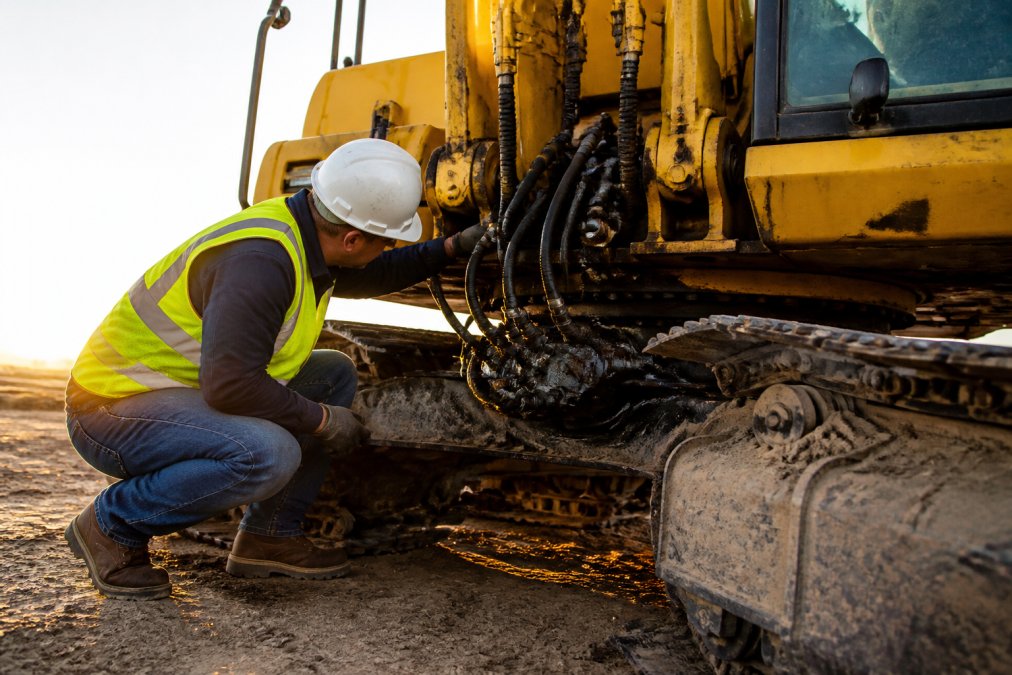
Start with the exterior. Look for rust, dents, cracks, or signs of welding repairs. Check the paint for inconsistencies, heavy overspray or mismatched colors suggest accident damage or poor maintenance. Inspect the undercarriage for cracks, bent frames, or misaligned tracks. Undercarriage damage is expensive to repair and often indicates hard use or operator abuse.
Move to the hydraulic systems. Hydraulic leaks are common in used equipment and signal imminent failure. Look for fluid stains on hoses, fittings, cylinders, and the engine block. Trace any leaks to their source. Small weeps are normal; active drips mean repair costs. Test all hydraulic functions: arm extension, bucket rotation, boom lift. Sluggish or jerky movement indicates worn cylinders or valve problems.
Hydraulic Systems and Undercarriage Wear
Hydraulic systems are the heart of an excavator. Failure is expensive and downtime is costly. During inspection, pay close attention to:
- Hose condition: Cracks, bulges, or hardening indicate age and degradation
- Cylinder operation: Smooth, responsive movement is good; slow or hesitant response suggests internal wear
- Fluid color and clarity: Dark, opaque fluid indicates contamination or overheating; clear, amber fluid is healthy
- Pressure relief systems: Test the relief valve by applying load; it should engage smoothly without chattering
Undercarriage wear is often overlooked but critically important. Tracks, rollers, sprockets, and idlers wear with use. Replacing a full undercarriage can cost $8,000-$15,000. During inspection:
- Measure track tension: Excessive slack indicates worn components
- Check roller and sprocket teeth: Worn or missing teeth require replacement
- Look for bent or cracked frame members: These are permanent damage
- Inspect the final drive: Leaking seals or grinding sounds indicate failure risk
If undercarriage work is needed soon, factor the cost into your offer. A $60,000 excavator with a $12,000 undercarriage job is really a $72,000 purchase.
Machine Hours and Operating History
Machine hours are the most important indicator of remaining useful life. An excavator with 3,000 hours is fundamentally different from one with 12,000 hours. Request the service records and verify hours with the seller.
Typical heavy excavators run 1,500-2,000 hours per year under normal use. A machine with 8,000 hours represents 4-5 years of operation. One with 15,000 hours represents 7-10 years. Age and hours together tell the story: a 10-year-old machine with 8,000 hours was lightly used; one with 20,000 hours was worked hard.
Service history matters enormously. A well-maintained machine with documented oil changes, filter replacements, and major service is worth significantly more than a neglected one with the same hours. Request receipts and maintenance logs. If the seller can't provide records, assume the worst and price accordingly.
Run a pre-purchase inspection with a qualified technician. Many sellers offer "as-is" terms, but a professional inspection, costing $500-$1,500, can prevent a $20,000 mistake. It's insurance against hidden problems.
Flexibility for Project-Specific Needs
Renting excels when your equipment needs are temporary, project-specific, or uncertain. If you're bidding on a six-month excavation job and won't need the machine afterward, buying makes no sense. Renting provides exactly what you need for exactly as long as you need it, without capital commitment or residual risk.
Temporary Project Deployment: Suppose you win a three-month site-prep contract. Renting a mid-size excavator at $250-$350 per day costs roughly $15,000-$21,000 for 60-90 working days. Buying a used machine for $80,000 and then selling it six months later (accounting for 10-15% depreciation) costs $8,000-$12,000 in value loss, plus transportation, insurance, and storage, easily $12,000-$18,000 total. Renting is cheaper and eliminates resale hassle.
Equipment Variety and Attachment Flexibility: Rental companies offer a range of equipment sizes and attachments. Need a mini excavator (1.5-3 tons) for tight urban spaces one month and a full-size machine (20-25 tons) for open-site work the next? Rent both. Owned equipment locks you into one machine with one set of capabilities. Specialty attachments, thumb grapplers, compactors, breakers, hydraulic shears, can be rented separately. Owning equipment means either buying attachments you might not use frequently or renting them when needed, which defeats the ownership advantage. A contractor managing multiple project types benefits from rental flexibility.
Compliance and Emissions Standards: Equipment standards evolve. Tier 4 final emissions compliance became mandatory for off-road diesel engines in 2015. Older used equipment may not meet current emission standards for certain job sites or jurisdictions. Some states and municipalities restrict non-compliant equipment on public projects or in sensitive areas. Rental companies maintain modern fleets that comply with current standards. This compliance advantage alone can justify renting, especially for contractors working across multiple jurisdictions with varying requirements or bidding on government contracts that mandate Tier 4 compliance.
Project Pipeline Uncertainty: If your pipeline is unpredictable, some months fully booked, others slow, renting lets you scale equipment with demand. Owned equipment sits idle during slow periods, generating no revenue while still costing money (depreciation, insurance, storage, financing). A contractor with 40% project variance month-to-month should rent. One with stable, predictable work should own or lease.
Operator Skill and Training Costs: Renting often includes operator support or the flexibility to hire equipment-specific operators without long-term commitment. Buying equipment means training your crew on that specific model, or hiring experienced operators and keeping them on payroll even during slow periods. A contractor with a stable crew can amortize training costs over years of ownership. A contractor with variable staffing should rent to avoid training overhead and operator retention costs.
Decision Framework for Flexibility:
Use this checklist to evaluate whether flexibility justifies renting over buying:
- Is this project duration less than 6 months? → Rent
- Will you need multiple equipment types or sizes for different projects? → Rent
- Does your project pipeline vary by more than 30% month-to-month? → Rent
- Are you bidding on government contracts requiring Tier 4 compliance? → Rent (unless your fleet is already compliant)
- Do you lack trained operators for this equipment? → Rent
- Is this a one-time or occasional need? → Rent
If you answer yes to two or more, renting is likely the better choice. If you answer no to most, buying or leasing becomes more economical.
Financing, Leasing, and Renting: Which Path Fits Your Business
You have three primary paths: buy outright with cash, finance the purchase, lease equipment, or rent. Each has distinct advantages and drawbacks, and leasing, often overlooked in buy-versus-rent discussions, deserves serious consideration as a middle ground.
Buying with Cash: This preserves your credit line for operating expenses and emergencies. You own the asset, control its use, and avoid interest payments. The downside is capital depletion. Tying up $80,000 in equipment reduces your working capital and operational flexibility. For contractors with strong cash reserves, this is viable. For those with tight cash flow, it's risky.
Financing the Purchase: Equipment financing spreads the cost over 36-72 months, preserving cash for operations. Monthly payments are predictable and tax-deductible (the interest portion). The downside is interest costs, typically 6-10% annually, adding $15,000-$25,000 to the total cost of an $80,000 machine over five years. Financing also requires qualification and documentation. For contractors with strong credit and stable revenue, financing makes sense.
Leasing: Leasing is the overlooked middle ground. Unlike renting (short-term, no maintenance), a lease is typically a 24-60 month agreement where you use equipment with maintenance often included by the lessor. Lease payments are fully tax-deductible as operating expenses. You avoid depreciation risk and major repair costs. The operational advantage over renting is predictability and lower monthly cost for sustained use; the advantage over buying is no ownership burden or residual value risk.
However, leasing has trade-offs. You build no equity, at lease end, you return the equipment with nothing to show. Early termination often incurs penalties. Lease terms may restrict usage (e.g., maximum annual hours), and you're locked into the lessor's maintenance schedule and service standards. For contractors with 100-150 projected annual use days, leasing often costs less than renting and avoids the ownership complexity of buying.
Renting: Renting is maximum flexibility. No long-term commitment, no maintenance responsibility, no depreciation risk. You pay only for what you use. The downside is that rental costs accumulate over time and never build equity. For short-term projects or variable use, renting is ideal. For sustained, predictable use, it's expensive.
Comparative Framework:
- Cash flow impact: Buying (large upfront) > Financing (moderate monthly) ≈ Leasing (moderate monthly) > Renting (variable, pay-as-you-go)
- Tax benefit: Buying (depreciation + interest deduction) > Leasing (full deduction) ≈ Renting (full deduction)
- Maintenance burden: Buying (owner responsible) > Renting (lessor responsible) ≈ Leasing (lessor responsible) > Financing (owner responsible)
- Flexibility: Renting (highest) > Leasing (moderate, early-exit penalties) > Financing (low, locked into loan) > Buying (lowest)
- Break-even use: Leasing typically makes sense at 80-120 annual use days; financing/buying at 130+ days
The right choice depends on your financial position, project pipeline, and risk tolerance. A contractor with unpredictable work should rent. One with a stable, multi-year pipeline and 150+ annual use days should buy or finance. One with 100-150 annual use days and moderate capital should lease. A contractor in growth mode should rent or lease to avoid capital commitment while building the business.
Conclusion: Making Your Buy vs. Rent Decision
The choice between buying used excavators and renting equipment is fundamentally a cash flow and risk decision. If you'll use the equipment 150+ days per year for multiple years, buying or financing makes financial sense. If usage is sporadic or project-specific, renting is cheaper and smarter.
Start by calculating your break-even use rate. Map your project pipeline for the next 24 months. Estimate realistic machine hours and use. Then compare the total cost of ownership against projected rental expenses. Add tax benefits to the ownership column and flexibility value to the rental column. The math will guide you.
If you decide to buy, work with a professional Heavy Equipment Broker who understands market pricing, equipment condition, and fair value. When you're ready to sell or acquire equipment, a Heavy Equipment Broker connects you to millions of buyers and sellers across nine specialized platforms, ensuring you get competitive pricing and maximum reach without contracts or hidden fees.
Frequently Asked Questions
When does buying a used excavator make more financial sense than renting?
Buying a used excavator becomes economical when you'll use it 150-180 days per year (60-70% of working days). For a mid-size excavator, the break-even point is approximately 130-160 rental days per year. Below this threshold, renting typically costs less when you factor in depreciation, maintenance, insurance, and storage. Used equipment priced 30-50% lower than new machines shortens your payback period, but only if utilization justifies the ownership commitment.
What are the main tax benefits of buying heavy equipment?
Owners can deduct depreciation as a business expense, reducing taxable income. Section 179 deductions allow you to deduct the full purchase price in the year of acquisition for equipment under $2.7 million (2026 limit). Bonus depreciation may also apply, letting you deduct a percentage of the cost immediately. Maintenance and repair expenses are fully deductible. Consult a tax professional to maximize these benefits for your specific situation.
How much do used excavators typically depreciate each year?
Heavy equipment loses 20-30% of its value in the first year, then 10-15% annually thereafter. A $120,000 excavator could be worth $72,000 after three years, representing $48,000 in depreciation. This depreciation accelerates for older machines and those with high operating hours. Understanding this curve helps you calculate total cost of ownership and determine whether renting makes more sense for your project timeline.
What should I check when inspecting a used excavator?
Inspect hydraulic systems for leaks, check undercarriage wear on tracks or wheels, verify operating hours on the meter, review maintenance records, test all hydraulic functions, and examine the bucket and attachments for damage. Look for rust, corrosion, or signs of poor storage. Request a pre-purchase inspection from a qualified technician. Machines with documented service history, verified condition, and immediate mobilization capability command higher prices and provide better long-term value.
Is renting equipment more cost-effective for short-term projects?
Yes, renting makes financial sense for projects under 4-6 months or when utilization stays below 60% annually. Rental eliminates depreciation, maintenance, insurance, and storage costs. The global construction equipment rental market reached $159.39 billion in 2026, reflecting strong demand from contractors avoiding large capital expenditures. However, rental costs accumulate quickly on long-term projects, potentially exceeding purchase cost. Compare your specific project duration against break-even utilization rates before deciding.
Buying used excavators vs. renting equipment isn't a one-size-fits-all decision. The right path depends on your specific utilization patterns, capital position, and project timeline. Whether you choose to buy, finance, or rent, make the decision based on data, not emotion. And when you're ready to transact, work with a broker who has the reach and expertise to get you the best deal.
This article was written using GrandRanker