
Table of Contents
- Why the Right Tools Matter for Tractor Maintenance
- Your Tractor Maintenance Checklist: Tools by Task
- Building a Farm Tractor Tool Kit That Covers the Basics
- Tractor Repair Tools for Common Field Fixes
- How a Tractor Service Manual Guides Every Repair
- Safety Equipment and Safe Tool Use Around Tractors
- Diagnostic and Electrical Tools for Modern Tractors
- Tool Sizing, Compatibility, and Budget Planning
- Conclusion
- Frequently Asked Questions
Last Updated: October 17, 2026
Why the Right Tools Matter for Tractor Maintenance
According to research on tractor maintenance and replacement strategies, how you maintain a tractor directly affects its economic life. That finding sounds obvious until you look at what actually happens on most farms: a machine gets serviced with whatever wrench is within reach, a hydraulic leak gets ignored for a week, and a filter change gets pushed to "next weekend."
The right set of essential tools for farm tractor maintenance changes that pattern. It turns maintenance from a scramble into a routine. This guide from Ironmartonline breaks down exactly which tools you need, organized by the task they handle, so you can build a kit that fits your operation instead of guessing at the hardware store.
But first, here's the question worth asking: why use Ironmartonline as a heavy equipment broker at all? Because a well-maintained tractor holds its value, and when you're ready to sell or trade up, you want a partner who puts that machine in front of serious buyers. We run nine web-based selling platforms with no contracts and no hidden fees. That reach matters whether you're moving one tractor or a whole fleet.
Below, we'll show you the tools that cover daily checks, seasonal service, and common field repairs. We'll also cover what most guides skip: sizing, safety, and how to build a kit in stages without overspending.
Your Tractor Maintenance Checklist: Tools by Task
A practical tractor maintenance checklist starts with the tools each task requires. Match the tool to the job, and you stop buying things you never touch.
Here's how we group them:
| Task | Core Tools | Frequency |
|---|---|---|
| Daily walk-around | Tire gauge, flashlight, rag, gloves | Every use |
| Oil and filter service | Socket set, oil-filter wrench, drain pan, funnel | Per service interval |
| Air intake cleaning | Screwdriver set, compressed air, soft brush | Weekly in dusty seasons |
| Hydraulic checks | Wrenches, rags, catch pan, inspection light | Weekly |
| Belt and hose inspection | Flashlight, mirror, pry bar | Monthly |
| Grease points | Grease gun, couplers | Per service interval |
| Battery and electrical | Multimeter, terminal brush, wrench set | Monthly |
Print this table. Tape it inside the shop. It's the fastest way to keep a seasonal maintenance rhythm without memorizing a manual.
Seasonal and Daily Inspection Tools
Daily checks catch small problems before they become breakdowns. Keep a small grab-and-go bag on the machine: a tire gauge, a flashlight, a rag, and work gloves. That's it for the walk-around.
For seasonal maintenance, MaintainX's farm equipment maintenance checklist organizes work into three phases: pre-season commissioning, daily in-season checks, and post-season storage prep. Each phase needs a slightly different tool set:
- Pre-season: torque wrench, grease gun, filter wrenches, multimeter
- In-season: tire gauge, flashlight, rags, basic wrenches
- Post-season: cleaning brushes, rust inhibitor, drain pans, storage covers
Match your kit to the phase and you'll never be caught short mid-season.
Building a Farm Tractor Tool Kit That Covers the Basics
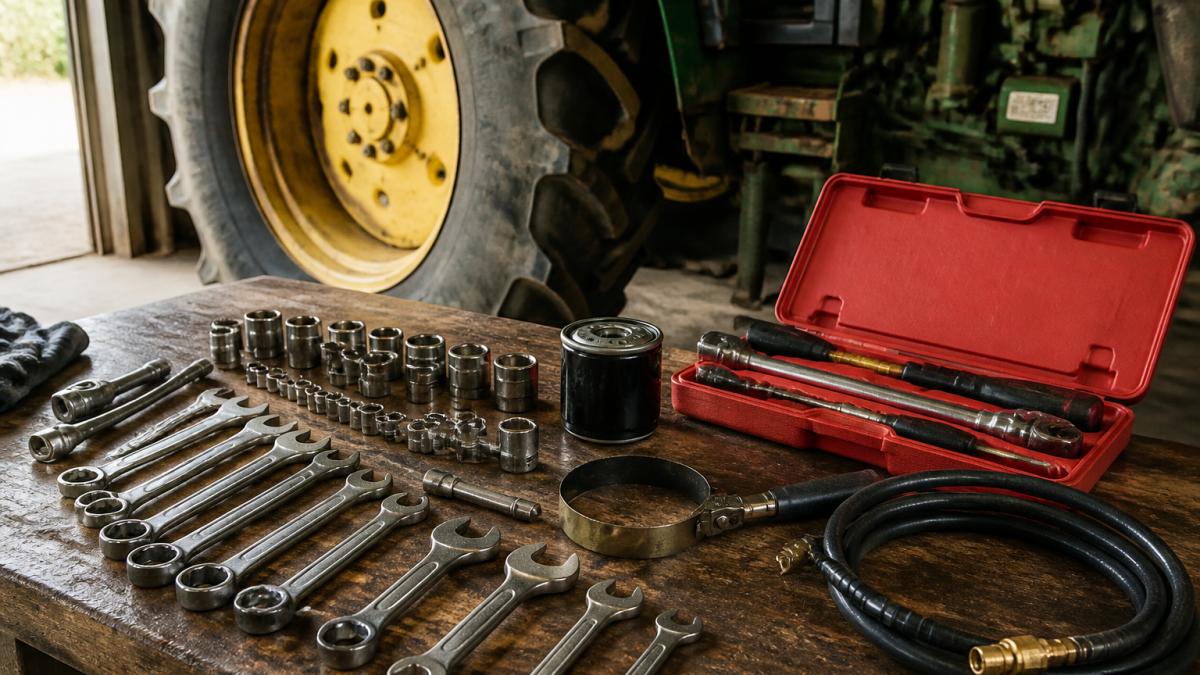
A solid farm tractor tool kit covers the basics without overspending on tools you'll never use. Start with these categories and add as needed.
The core list:
- Combination wrench set (standard and metric)
- Socket set with ratchet and extensions
- Oil-filter wrench
- Screwdriver set (flathead and Phillips)
- Pliers (standard, needle-nose, locking)
- Claw hammer
- Adjustable wrench and pipe wrench
- Grease gun with couplers
- Drain pan and funnel
- Wire brush
- Duct tape and baling wire
- Toolbox with a locking lid
What most guides miss: buy a mid-range wrench and socket set, not the cheapest. A stripped bolt in the field costs far more in downtime than the price gap between a cheap set and a decent one. Skip the drill press and bench grinder at first. Those are shop tools, not field tools.
Tractor Repair Tools for Common Field Fixes
Field repairs need tools that travel well, work fast, and keep you safe. The tractor repair tools you carry should handle the most common failures: loose fittings, cracked hoses, dead batteries, and minor electrical faults. But a tool is only useful if you know which failure it addresses and how to use it without turning a small fix into a major injury.
Here is a task-mapped field kit that goes beyond a generic list:
| Failure | Tools to carry | Safety note |
|---|---|---|
| Loose hydraulic fitting | Combination wrenches (SAE and metric), adjustable wrench, rags, catch pan | Depressurize the system before loosening; fluid can inject under skin |
| Cracked hose or clamp failure | Spare hose clamps, screwdriver, locking pliers, utility knife | Wear gloves; hose clamps can slip and cut |
| Dead battery or corroded terminals | Jumper cables, terminal brush, wrench set, safety glasses | Remove jewelry; sparks near battery gas can ignite |
| Blown fuse or faulty sensor | Test light, multimeter, fuse puller, electrical tape | Disconnect battery before probing wiring |
| Loose belt or pulley | Pry bar, socket set, flashlight or headlamp | Never pry against a running engine; shut off and remove key |
Keep this kit in a sealed, organized box on the machine. When a hose clamp fails mid-job, you want to fix it in minutes, not drive back to the shop. A common mistake is carrying too much: a forty-pound toolbox rides rough and slows you down. Trim to what actually fixes problems in the field, and leave the rest in the shop.
How a Tractor Service Manual Guides Every Repair
Every serious tractor service manual belongs in your toolbox alongside the wrenches. The manual tells you torque specs, fluid types, and the order of operations for each repair. Without it, you're guessing.
Here's how to use it well:
- Look up the task before you start, not after something goes wrong.
- Note the torque values and fluid types for your specific model.
- Follow the service intervals the manual lists, not a generic schedule.
- Keep a printed copy in the shop and a digital copy on your phone.
Model-specific manuals matter most. A procedure that works on one tractor can damage another. HarvestYield's equipment maintenance guidance recommends tracking checks digitally, and pairing that habit with the manual keeps your records and your repairs aligned.
Skipping the manual and guessing at torque values is the fastest way to strip a bolt or crack a housing. A stripped drain plug means a tow to the shop, not a quick fix.
Safety Equipment and Safe Tool Use Around Tractors
Safety gear is not optional equipment. Before you pick up a wrench, put on the right protection.
The essentials:
- Safety glasses for any work under the machine or near the battery
- Heavy work gloves
- Steel-toe boots
- Hearing protection when running the engine
- Wheel chocks and proper jack stands
Never work under a tractor held up only by a jack. Use rated jack stands on firm ground, chock the wheels, and shut off the engine before you reach underneath. These habits prevent the worst accidents, and they cost almost nothing to build into your routine.
Diagnostic and Electrical Tools for Modern Tractors
Modern tractors run on electronics as much as diesel. A basic electrical kit saves hours of guesswork.
What to carry:
- Digital multimeter
- Test light
- Terminal brush
- Fuse puller
- Wire strippers and crimpers
A multimeter tells you whether a battery, alternator, or wiring harness is the real problem. Without one, you're swapping parts and hoping. With one, you diagnose in minutes.
This is where most older guides fall short. They assume mechanical-only machines. Today's tractors need a diagnostic layer in the kit, and skipping it leaves you stuck when a sensor or fuse fails.
Tool Sizing, Compatibility, and Budget Planning
Tool sizing and tractor compatibility decide whether your kit actually works. A metric-only socket set won't help on a machine built with standard fasteners, and vice versa. Most late-model tractors mix both: engine and hydraulic components often use metric fasteners, while some implements and older attachments use SAE. Check your tractor's service manual for the fastener standard before you buy.
Drive size matters too. A 1/4-inch drive set handles small fasteners and interior work; 3/8-inch is the all-around choice for most maintenance; 1/2-inch drive is for higher-torque jobs like lug nuts and suspension components. For torque accuracy, a click-type torque wrench in the range your manual specifies, often 10-150 ft-lb for general maintenance, covers most tasks. Never guess at torque values; the manual lists them for a reason.
For budget planning, build in tiers and buy in priority order:
- Starter kit (first purchase): combination wrenches (SAE and metric), 3/8-inch socket set, screwdrivers, pliers, hammer, grease gun, drain pan, funnel. This covers daily checks and basic service.
- Mid-tier (add as jobs demand): 1/2-inch torque wrench, oil-filter wrench, multimeter, test light, air hose and blow gun, pry bar set. These unlock electrical diagnostics and more involved service.
- Full shop (only when needed): bench grinder, drill press, specialty pullers, pressure gauges. These are shop tools, not field tools, skip them until a specific job requires them.
Buy the starter tier first. Add mid-tier tools as specific jobs demand them. This keeps cash free and avoids a drawer full of tools you never touch. A common pattern among experienced mechanics is to buy the best wrench and socket set you can afford, stripped bolts and rounded nuts cost far more in downtime than the price gap between cheap and decent tools.
Conclusion
Keeping a tractor in working order takes the right tools, a real checklist, and the discipline to use both. The payoff shows up in fewer breakdowns and stronger resale value when you're ready to sell. Ironmartonline helps you capture that value, with nine selling platforms, no contracts, and no hidden fees reaching millions of buyers. Join our email list to get practical equipment guidance and market updates delivered straight to your inbox.
Frequently Asked Questions
What tools do you need for basic tractor maintenance?
A basic tractor maintenance kit should include a socket set, combination wrenches, an oil-filter wrench, pliers, screwdrivers, a claw hammer, a wire brush, a drain pan, and a grease gun. Add an air filter and hydraulic fluid for routine service. Keep a tractor service manual on hand for torque specs and fluid capacities. For field repairs, include baling wire, duct tape, and a portable toolbox so you can handle minor fixes without returning to the shop.
What size socket set is best for tractor repairs?
Most farm tractors use fasteners that a 3/8-inch drive socket set covers well for routine work, while 1/2-inch drive handles larger bolts on implements and wheel hardware. A set spanning roughly 8 mm to 24 mm plus standard sizes covers common tractor repair tools. Check your tractor service manual for specific fastener sizes before buying. A deep-well set helps with recessed nuts on hydraulic lines and engine components.
How do you safely lift a tractor for maintenance?
Use a jack rated for the tractor's weight and place it under a manufacturer-approved lift point, then support the machine with heavy-duty jack stands before going underneath. Never work under a tractor held only by a jack. Chock the wheels, lower any loader or bucket to the ground, and engage the parking brake. A tractor service manual identifies safe lift points. Inspect jacks and stands before each use and replace any that show cracks or leaks.
How often should you inspect and maintain farm tractor tools?
Inspect your farm tractor tool kit before each major service interval and at the start of every season. Check sockets and wrenches for wear, test the grease gun, and confirm the air compressor and hoses hold pressure. Sharpen or replace wire brushes and check torque wrenches for calibration once a year. A simple tractor maintenance checklist that includes tool inspection keeps small problems from turning into field breakdowns during planting or harvest.