

Last Updated: November 11, 2026
Quick Summary
Export trailer inspections are documented safety checks covering brakes, tires, lights, coupling, and structure, plus the certifications a destination country requires before shipment. Sellers should complete a pre-shipment checklist, keep the inspection report with the title or certificate of origin, and confirm destination requirements in writing before booking freight.
- In the 2026 International Roadcheck, 81% of inspected vehicles had no out-of-service violations.
- Brake violations made up 39.1% of vehicle out-of-service findings across 54,575 CVSA inspections.
- A certificate of origin proves build details and VIN, while a title proves current legal ownership.
- After a failure, get it in writing, fix safety items first, then book a reinspection and keep both reports.
- Confirm the inspector is credentialed and the certificate carries a traceable report number before paying.
Table of Contents
- Why Export Trailer Inspections Decide Whether Your Sale Closes
- DOT Trailer Inspection Requirements Every Seller Should Expect
- The Semi Trailer Pre-Shipment Inspection Checklist
- Brakes, Tires, and Lighting: Where Trailers Fail Inspection
- Trailer Certificate of Origin vs. Title: Which One the Buyer Needs
- Trailer Export Documentation: The Full Paper Trail
- How Destination Country Requirements Change the Inspection
- When a Trailer Fails: Corrective Actions and Reinspection
- Verifying Your Inspector and Certification Body
- Selling an Export-Ready Trailer Through Ironmartonline
- Frequently Asked Questions
Why Export Trailer Inspections Decide Whether Your Sale Closes
A buyer in another country cannot walk around your trailer. They cannot pull a brake chamber apart or check a tire sidewall. So they rely on paperwork, and export trailer inspections and certifications are the paperwork that decides whether the deal closes or stalls at the port.
This guide from Ironmartonline covers what sellers actually face: DOT trailer inspection requirements, a pre-shipment checklist, the certificate of origin question, and what happens when a trailer fails.
Here is the uncomfortable truth. Most sellers treat inspection as a final box to tick after a buyer is found. In practice, it should come first. A trailer with a clean inspection file sells faster and defends its price. A trailer without one invites renegotiation, delays, and canceled orders.
The data backs that up. In the 2026 International Roadcheck, CVSA reported that 81% of inspected vehicles had no out-of-service violations, and 94.2% of drivers were clean too. Most equipment passes. But that leaves a meaningful slice that does not, and brake problems drive most of those failures.
So why use Ironmartonline as your equipment broker for this? Because we put your trailer in front of buyers across nine web-based selling platforms, with no contracts and no hidden fees. We work with owner-operators as well as fleet managers and rental companies. The inspection file you build is what those buyers read before they ever contact you.
Below, we break down exactly what inspectors look for, what documents travel with the trailer, and how to fix a failure without losing the sale.
DOT Trailer Inspection Requirements Every Seller Should Expect
DOT trailer inspection requirements are not one rulebook. They are a patchwork of state and federal safety checks, and the U.S. Department of Transportation's research on trailer safety oversight identifies tires, brakes, and lights as the core inspection areas.
That matters for sellers because it means "it passed last time" is not a guarantee. Different inspectors, different states, different focus areas.
What a typical inspection covers:
- Brake system condition and adjustment
- Tire tread, pressure, and sidewall damage
- Wheels, rims, and lug integrity
- Lighting and electrical connections
- Coupling, kingpin, and safety chains
- Frame, chassis, and structural welds
- Identification plates and markings
A common mistake is assuming a trailer that runs fine locally will sail through. In practice, the trailer that sits for months between jobs is the one that fails on brakes and lights.
The Semi Trailer Pre-Shipment Inspection Checklist
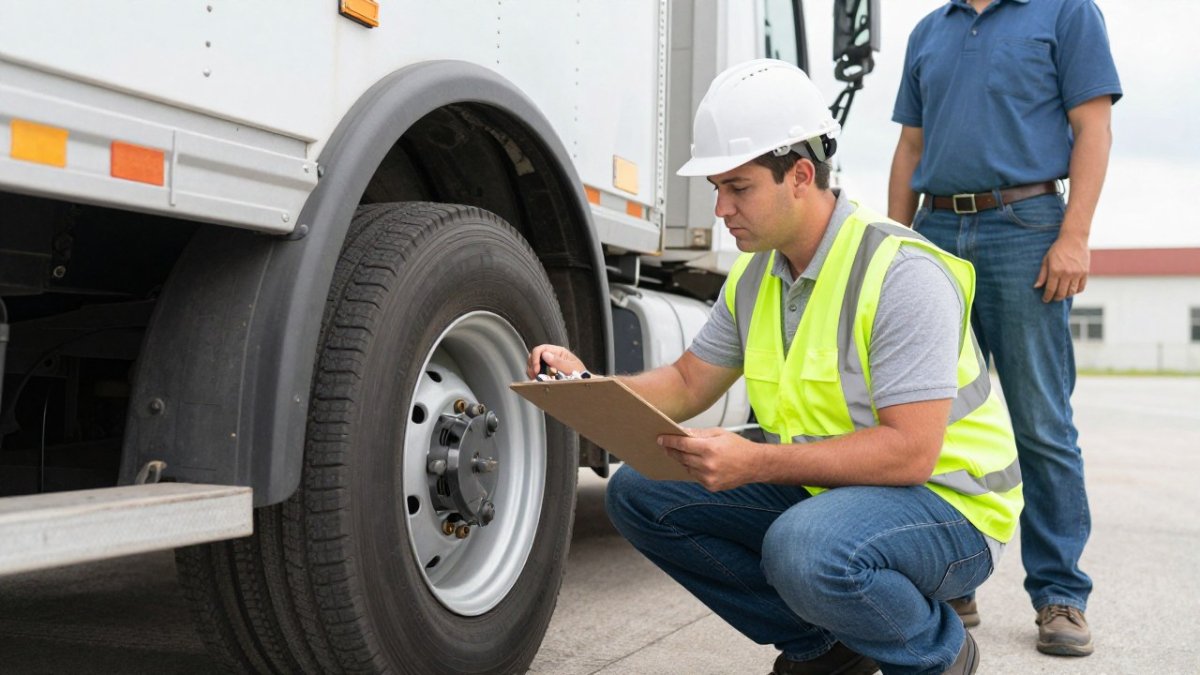
A semi trailer pre-shipment inspection checklist is a written record of condition, taken before the trailer leaves your yard. Build it in two parts: structural checks and functional tests.
Structural and Running Gear Checks
Start with what you can see and touch.
- Frame rails free of cracks, bends, or heavy rust
- Cross members and floor deck sound
- Landing gear cranks freely and holds height
- Kingpin wear within spec, no gouging
- Suspension springs, hangers, and bushings intact
- Tire tread depth measured and recorded
- Wheels free of cracks; lug nuts torqued
- Mud flaps and side guards in place
Photograph every item. A dated photo set is worth more to a remote buyer than a paragraph of description.
Functional Tests: Brakes, Lights, and Coupling
Now test the systems under load.
- Air brake build-up and leak-down within limits
- Slack adjusters move correctly on each chamber
- All clearance, marker, brake, and turn lights work
- Seven-way cord and receptacle clean and dry
- Coupling locks securely with no play
- Safety chains rated and attached
Record the results on a simple form: item, pass or fail, notes, inspector initials, date. If you want a fuller buyer-side view of what gets checked on tag trailers, our guide to used 20 tag trailers in NJ walks through the same points from the purchasing side.
Brakes, Tires, and Lighting: Where Trailers Fail Inspection
Brakes are the single biggest failure point. According to The Brake Report's coverage of 2026 Roadcheck results, brake violations made up 39.1% of vehicle out-of-service findings across 54,575 CVSA inspections. That high failure rate makes routine brake checks essential before export, and Venice Truck Service can help sellers keep annual inspection requirements in view.
That is not a small edge case. It is the leading reason equipment gets pulled from service.
Where trailers specifically go wrong:
- Brakes: seized chambers from sitting, out-of-adjustment slack adjusters, air leaks at fittings
- Tires: flat spots from skidding, sidewall cracking from UV exposure, mismatched sizes
- Lighting: corroded grounds, cracked lenses, wires rubbed through at frame contact points
Many of these fixes are inexpensive compared with the discount a buyer may demand when they find the problem themselves.
Watch out: a trailer that has sat unused for a season will often show brake and light faults within the first hour of testing. Test early, not the week of pickup.
Trailer Certificate of Origin vs. Title: Which One the Buyer Needs
A trailer certificate of origin is the manufacturer's document proving where and when the trailer was built. A title is the state-issued proof of ownership. They are not interchangeable, and confusing them stalls sales.
Here is the practical split:
| Document | Issued By | Proves | Who Needs It |
|---|---|---|---|
| Certificate of Origin | Manufacturer | Build details, VIN, model year | First-time registration, export buyers |
| Title | State motor vehicle agency | Current legal owner | Transfer of ownership, domestic sale |
| Bill of Sale | Seller | Transaction terms and price | Registration, customs, tax |
| Inspection Report | Certified inspector | Condition at a point in time | Buyer confidence, insurer, port |
For a used trailer, the title is the document that transfers ownership. The certificate of origin matters most when the trailer has never been titled or when a destination country wants build documentation.
If you cannot produce a title, say so up front. Buyers forgive a missing document far more readily than a surprise.
Trailer Export Documentation: The Full Paper Trail
Trailer export documentation goes beyond the title. The International Trade Administration's guidance on special documents notes that certain products may require certificates for cleanliness, standards compliance, safety, or health, and that requirements depend on both the product and the destination.
For a trailer, assemble a file with these items:
- Title or certificate of origin, plus a bill of sale
- Vehicle identification number and serial number recorded on every form
- Inspection report with inspector name, date, and findings
- Photographs of identification plate and markings
- Weight and load capacity documentation
- Any destination-specific certificate the buyer requests
- Customs and shipping paperwork prepared by the freight forwarder
One warning worth repeating: a single inspection or certificate does not automatically satisfy every destination's rules. Ask the buyer or their customs broker what their country requires, in writing, before you book freight.
How Destination Country Requirements Change the Inspection
Destination requirements change what the inspection must prove. A domestic buyer mostly cares about roadworthiness. An export buyer often needs conformity documentation on top of that, and the specific documents vary widely by country. Most guides gloss over this with a vague 'check with the buyer', but a practical matrix saves weeks of back-and-forth.
Below is a general comparison of common destination markets for export trailers. Always confirm current requirements with the buyer's customs broker, because rules change.
| Destination | Key Inspection Focus | Required Documents (Beyond Title/Bill of Sale) | Inspection Authority |
|---|---|---|---|
| Canada | Safety standards compliance (CMVSS), brake and lighting function | Certificate of Origin, compliance label, recall clearance letter | Transport Canada / provincial motor vehicle agencies |
| Mexico | NOM certification for vehicles and trailers, weight and dimensions | NOM certificate, pedimento (customs declaration), certificate of origin | Secretaría de Economía (SE) and customs brokers |
| European Union | Type approval or individual approval, brake and lighting conformity | Certificate of Conformity (CoC) or individual approval, registration documents | National approval authorities (e.g., TÜV, RDW) |
| Australia | ADR compliance (Australian Design Rules), especially braking and lighting | Import approval, ADR compliance plate, asbestos-free declaration | Department of Infrastructure, Transport, Regional Development |
| Saudi Arabia | SASO conformity, especially for tires and braking systems | SASO Certificate of Conformity (SABER), inspection certificate | Saudi Standards, Metrology and Quality Organization (SASO) |
| United Arab Emirates | ESMA conformity, safety and environmental standards | ESMA certificate, inspection report from approved body | Emirates Authority for Standardization and Metrology (ESMA) |
This matrix is a starting point, not a substitute for destination-specific legal advice. The key takeaway: the inspection you book must produce the evidence the destination authority expects. A generic DOT inspection report may not satisfy a country that requires a conformity certificate from an approved body.
Ask these questions before the inspector arrives:
- Does the destination require a pre-shipment inspection by an approved body?
- Are there age or emissions limits that affect the trailer model?
- Does the buyer need a certificate of conformity or a cleanliness certificate?
- Will the port require a security seal, and who applies it?
- Who is the registered importer on the other end?
Get the answers in writing. A verbal 'that should be fine' from a buyer has sunk more deals than any mechanical fault.
Watch out: some countries require the inspection to be performed by a locally recognized body, not a U.S. inspector. If you book the wrong inspector, the certificate may be rejected at the port, forcing a costly re-inspection or return.
The verification record matters here too. Keep the inspector's report, the photos, and the correspondence together. If customs asks a question three weeks later, that file is your answer.
When a Trailer Fails: Corrective Actions and Reinspection
A failed inspection is a to-do list, not a dead sale. The fix is a documented corrective action followed by a reinspection.
Work it in this order:
- Get the failure in writing. Item by item, with the inspector's notes.
- Separate safety items from cosmetic ones. Brakes and coupling first, always.
- Repair, then photograph the repair. New chamber, new lens, new wiring: show it.
- Book the reinspection. Ask whether the original inspector offers a reduced reinspection scope.
- Update the file. Attach the new report beside the old one. Do not discard the failure record.
Buyers trust a trailer with a documented fix more than one with a suspiciously clean history. If you want a benchmark for what "work-ready" looks like, compare against a listing like this JMH Monster II frameless demo scrap trailer to gauge condition standards.
Verifying Your Inspector and Certification Body
Not every person with a clipboard is authorized to certify anything. Verify before you pay. This section gives you a practical checklist and a sample certificate field list so you can confirm the inspector and the document will hold up.
Start with these verification points:
- Is the inspector licensed or credentialed for the inspection type? Ask for a license number and the issuing body.
- Does the certification body appear on the relevant government or industry list? For U.S. inspections, check with the relevant state motor vehicle agency.
- Will the report carry a registration or report number you can trace? A legitimate certificate has a unique identifier.
- Ask whether the inspector carries liability coverage for the findings.
- Can the buyer contact the body directly to confirm the document? A legitimate body publishes contact information and responds to verification requests.
A useful test: ask the inspector who else can verify their report. A legitimate body has an answer in seconds. A questionable one changes the subject.
When you receive the inspection report or certificate, check that it includes these fields. Missing fields are a red flag.
| Field | Why It Matters |
|---|---|
| Inspector name and license number | Confirms who performed the inspection and their authority |
| Certification body name and contact | Allows the buyer or customs to verify the document |
| Date of inspection | Establishes currency; some destinations require inspection within a set window before shipment |
| Trailer VIN or serial number | Ties the certificate to the specific trailer |
| Manufacturer and model year | Confirms build details for conformity |
| Test results (pass/fail per item) | Shows what was checked and the outcome |
| Corrective actions noted (if any) | Documents remediation and reinspection |
| Certificate or report number | Unique identifier for traceability |
| Expiration date (if applicable) | Some certificates are valid for a limited time |
Keep the verification record with the trailer file. It costs nothing and answers the buyer's first skeptical question before they ask it.
Watch out: a certificate without a traceable report number or a verifiable body is often rejected by customs, even if the inspection itself was legitimate. Always confirm the document format meets the destination's requirements before the inspector leaves the yard.
Selling an Export-Ready Trailer Through Ironmartonline
The inspection file is the product. Everything above exists to build one that a remote buyer will trust with a wire transfer.
At Ironmartonline, we connect sellers to buyers globally and locally across nine web-based selling platforms, with no contracts and no hidden fees. You can browse our equipment and trailer categories to see where your export-ready trailer fits, and list it alongside the documentation that makes it easy to buy.
A trailer that passed DOT inspection and comes with a clean paper trail is a different listing entirely. You can browse listings on our site, such as this Eager Beaver 20-ton tag-along trailer.
The gap between a trailer that sells and one that sits is rarely the machine. It is the paperwork behind it. If you are ready to move equipment without contracts or hidden fees, and want your listing in front of millions of potential buyers, get started with Ironmartonline and turn your inspection file into a closed sale.
Frequently Asked Questions
What does a trailer inspection consist of?
A trailer inspection combines a visual review of the structure and components with functional testing. Inspectors check the chassis, coupling, landing gear, tires, wheels, brake system, lighting, and electrical connections, then confirm identification plates and markings match the paperwork. Most well-maintained equipment passes inspection. Ask for the inspection report and photos so you can see exactly what was checked before the trailer ships.
Is a certificate of origin for a trailer the same as a title?
No. A certificate of origin is issued by the manufacturer and states where and by whom the trailer was built, along with the vehicle identification number. A title is a state-issued ownership document. Export buyers often want both, plus a bill of sale. If the original certificate of origin was lost, contact the manufacturer for a replacement before listing the trailer, because a missing document can stall customs clearance at the destination.
Does a used trailer need a safety inspection before export?
It depends on the destination country and the buyer's requirements, not on a single blanket rule. The U.S. Department of Commerce notes that certain products may require certificates for cleanliness, standards compliance, safety, or health, and others may require pre-shipment documentation. Confirm what the importer needs in writing before you book anything. A pre-shipment inspection on a used trailer is still worth doing: brake problems are widely reported as a leading cause of equipment being pulled from service.
How do I verify a trailer's VIN and ownership documents?
Start with the identification plate on the trailer frame and compare the vehicle identification number against the title, certificate of origin, and bill of sale. Look for signs of a restamped or missing plate. Then confirm the seller's name matches the title exactly. For export trailer documentation, keep clean copies of every document and store them with the inspection record, since a registered importer at the destination will need them for customs clearance.
