

Table of Contents
- Start With the Seller: Why Due Diligence Comes First
- What a Heavy Equipment Title Search Actually Involves
- How to Check for a Lien on Used Heavy Equipment
- UCC Lien Search for Equipment: What It Covers and Where to File
- Equipment Serial Number Search: Tracing a Machine's History
- Heavy Equipment Proof of Ownership: Documents That Hold Up
- Step-by-Step: How to Perform a Heavy Equipment Title Search
- What to Do When a Lien or Ownership Gap Appears
- Frequently Asked Questions
Last Updated: October 13, 2026
Start With the Seller: Why Due Diligence Comes First
A used excavator can carry a hidden loan that follows the machine, not the seller. That is why a heavy equipment title search belongs at the start of every deal, before money moves and before transport gets booked. This guide from Ironmartonline walks through how to perform a heavy equipment title search step by step, from naming the seller to reading the results.
So why use Ironmartonline equipment broker services when you can list a machine yourself? Because a broker sees the paperwork side of hundreds of deals and knows where ownership gaps hide. We are one of the most trusted names in used heavy equipment sales and marketing, and we built this guide for buyers and sellers who want clean transfers.
Here is the hard truth most buyers learn too late: the machine looks fine, the seller seems honest, and the lien still exists.
That lien can outlive the sale. If the debt is not cleared, a secured creditor may have a claim on the asset you thought you bought outright.
Below, we show you exactly how to check ownership, find liens, and close the gaps before they cost you the machine.
What a Heavy Equipment Title Search Actually Involves
A heavy equipment title search is the process of checking public records to confirm who owns a machine and whether any lender holds a claim against it. It is not one search. It is two.
Most buyers conflate them, and that is the first mistake:
- A title search confirms the ownership record and the chain of title for a titled machine.
- A lien search finds debts tied to the machine or the seller, including UCC filings.
Not every machine has a certificate of title. Many pieces of construction equipment are never titled the way a car or truck is. In those cases, proof of ownership rests on bills of sale, invoices, and financing records instead.
That distinction shapes everything that follows.
How to Check for a Lien on Used Heavy Equipment
To check for a lien on used heavy equipment, you search public records by the seller's legal name and by the machine's identifying numbers, then review anything that comes back. A common approach is to run both searches and compare the results, because one can surface what the other misses.
Start with the seller, not the machine. Liens attach to people and businesses far more often than to serial numbers.
Key places to look:
- State UCC records, usually held by the Secretary of State
- County records, where local filings sometimes land
- The seller's financing history, which they should disclose
Ask the seller directly: "Is there any loan, lease, or financing tied to this machine?" Get the answer in writing. Honest sellers answer fast. Evasive ones tell you something too.
The U.S. Small Business Administration guidance on business records offers useful context on how financing and security agreements work for small operations, which is where many used-equipment deals begin.
UCC Lien Search for Equipment: What It Covers and Where to File
A UCC lien search for equipment looks at Uniform Commercial Code financing statements. These are the public filings a lender makes to announce a security interest in a borrower's assets, including machinery.
A UCC financing statement is the public notice that a lender claims a right to specific assets if the borrower defaults. It is not the loan itself. It is the record that the loan exists. Under UCC Article 9, a secured party perfects its interest by filing this statement, which is what makes the lien discoverable by later buyers and lenders.
Where UCC Filings Live
- State Secretary of State offices hold the vast majority of UCC filings on business debtors, including equipment financing.
- County offices may hold filings in a few states or for certain debtor types, so confirm your state's rule before assuming a state-only search is complete.
- Specialized registries apply to titled vehicles and certain mobile equipment, where a lien may be noted on the certificate of title rather than in the UCC index.
The practical rule: search the state where the debtor is organized, then search any state where the equipment is located or the debtor has operated. A lender files where the debtor is registered, not where the machine sits.
How to Request a UCC Search
Most state Secretary of State offices offer an online UCC search portal. The process is consistent:
- Identify the debtor's exact legal name from the business registration or a signed financing statement.
- Choose the search type, usually a debtor name search, sometimes an equipment or serial number search where available.
- Submit the name exactly as registered, including punctuation, suffixes like LLC or Inc., and any prior names.
- Review the results for active financing statements, amendments, continuations, and terminations.
- Request copies of any filing that appears to match your deal.
A search that returns nothing under one name variation is not proof of a clean machine. Run every variation the seller has used.
Reading the Results
A UCC filing record contains several fields that matter to a buyer:
- Debtor name, must match the seller's legal name, not a trade name.
- Secured party, the lender or lessor holding the interest.
- Collateral description, may be specific ("2019 Caterpillar 320 excavator, S/N ABC123") or broad ("all equipment now owned or hereafter acquired").
- Filing date and status, active, amended, continued, or terminated.
- Filing number, needed to request a copy or a termination.
A broad collateral description is a warning sign. It can sweep in the machine you are buying even if the serial number never appears.
Distinguishing a Title Search from a UCC Search
These are not interchangeable, and the query "title search" often sends buyers to the wrong record.
| Search Type | What It Finds | Where to Look | Best For |
|---|---|---|---|
| Title search | Ownership record, chain of title, title liens | State titling agency | Titled machines (trucks, trailers, some mobile equipment) |
| UCC lien search | Financing statements, security interests | Secretary of State | Any financed equipment, titled or not |
| Name search | Filings under a person or entity | State and county records | Vetting the seller |
| Serial number search | History tied to the machine | OEM and theft databases | Stolen-equipment checks |
A title search confirms who the state recognizes as owner. A UCC search confirms who has a financial claim. A machine can have a clean title and an active UCC lien at the same time, which is why both searches belong in the workflow.
Equipment-Specific Filing Rules
Not every machine is treated the same:
- Titled vehicles (some trucks, trailers, and certain mobile equipment) carry liens on the certificate of title, and the titling agency is the primary record.
- Untitled machinery (many excavators, dozers, and attachments) relies on UCC filings and financing statements, since no title document exists.
- Leased equipment may show the lessor as owner in UCC records even when the seller claims to own it outright.
Confirm which category your machine falls into before you decide where to search. A buyer who searches only the titling agency on an untitled excavator will miss the lien entirely.
Equipment Serial Number Search: Tracing a Machine's History
An equipment serial number search traces a machine's past using its factory identifier. This is where you confirm the machine is what the listing says it is.
Serial numbers, VINs, makes, and models all matter here. A mismatched number is a red flag that stops the deal.
What to do with the number:
- Photograph the plate and the stamped number on the frame
- Compare both against the listing and the paperwork
- Ask the manufacturer or dealer to confirm the build and any registered history
- Report the number to your insurer before you buy
Serial numbers rarely reveal liens on their own. Lenders file against names, not plates. But they do catch stolen equipment, cloned listings, and machines rebuilt from two wrecked units.
If the number is ground off or the plate is missing, walk away. No legitimate seller hides an identifier.
Heavy Equipment Proof of Ownership: Documents That Hold Up
Heavy equipment proof of ownership is the paper trail that shows the seller has the right to sell. A handshake and a bill of sale are not enough on their own. What counts as proof depends on how the machine is classified, and that classification drives which records you check. Beyond verifying the title, you must also ensure the machine's operational history aligns with its stated usage by detecting odometer tampering before finalizing any transaction.
Ownership Proof by Equipment Type
- Titled machines, trucks, trailers, and certain mobile equipment carry a certificate of title issued by a state titling agency. The title names the legal owner and lists any lienholders. A clean title with no lien notation is the strongest ownership proof.
- Untitled machinery, many excavators, dozers, loaders, and attachments are never titled. Ownership rests on a chain of documents: original purchase invoice, dealer paperwork, bills of sale, and financing records. There is no single government record that proves ownership.
- Leased equipment, the lessor holds title or a UCC interest. A seller who "owns" a leased machine usually does not have the right to sell it without the lessor's consent.
Ask the seller which category the machine falls into, then request the documents that match. A titled machine without a title is a problem. An untitled machine with a thin paper trail is a different problem, and both need resolving before money moves.
The Document Set to Request
Ask for this set before you pay:
- Certificate of title, if the machine is titled
- Signed bill of sale with make, model, year, and serial number
- Prior purchase invoice or dealer paperwork
- Lien release or payoff letter for any cleared loan
- Business registration showing the seller's legal name
- Photo ID matching that name
- Maintenance and service records
A lien release is the document proving a lender has given up its claim. Without it, a paid-off loan can still appear active in public records. A payoff letter is different: it states the amount needed to clear the loan as of a specific date. Get the release, not just the payoff letter, before closing.
Resolving Name and Document Mismatches
A common pattern in used-equipment deals is a mismatch between the name on the title or invoice and the name of the person or entity selling the machine. This is not always fraud, but it always needs a paper fix.
- Seller operating under a trade name, request the business registration showing the legal entity behind the trade name, plus a signed statement linking the two.
- Machine titled to a prior owner, request a signed bill of sale from that owner to the current seller, forming an unbroken chain.
- Machine titled to a dissolved entity, request the dissolution documents and evidence of who has authority to sell the assets.
- Missing title on a titled machine, the seller can apply for a duplicate title through the state titling agency, or provide a surety bond in states that allow it.
Never accept a promise to "sort it out later." A corrected document or a signed affidavit explaining the chain is what closes the gap.
Verifying a Lien Release
A release document is only as good as its source. To verify:
- Match the secured party name on the release to the lender named in the UCC filing or title notation.
- Confirm the filing number referenced in the release matches the active filing.
- Check the filing status with the Secretary of State or titling agency to confirm the record now shows terminated or released.
- Keep a copy of both the release and the updated record.
A release that does not match the filing, or a filing that still shows active after the release is presented, is a stop sign.
Step-by-Step: How to Perform a Heavy Equipment Title Search
Here is the workflow we would follow, in order, for any used machine.
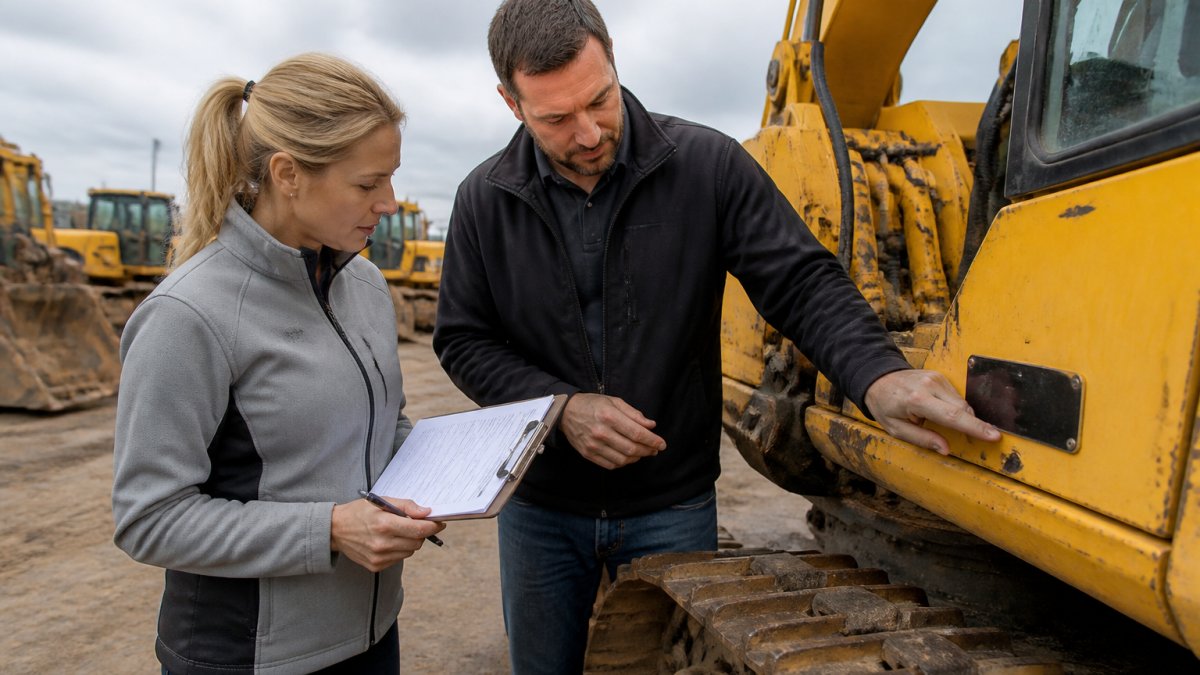
- Get the seller's exact legal name. Pull it from their business registration, not the listing.
- Collect the machine identifiers. Make, model, year, serial number, and VIN if it has one.
- Run a title search. Check the state titling agency for the ownership record.
- Run a UCC lien search. Search state and county records under the seller's legal name.
- Run a serial number check. Confirm the machine's identity and history.
- Review every result. Match names, dates, and descriptions against the deal.
- Request releases. Get a payoff letter or lien release for anything that comes back.
- Document it all. Keep copies of every search and every reply.
Most searches are cheap or free through state portals. Turnaround runs from same-day online results to a few days for county records. A professional search service costs more but handles the name variations and multi-state filings that trip up DIY buyers.
What to Do When a Lien or Ownership Gap Appears
A lien in the results is not automatically a dead deal. It is a problem with a process.
Your options:
- Seller clears it. The seller pays off the loan and provides a release before closing.
- You pay it off. The lien amount comes out of the purchase price, paid directly to the lender.
- Escrow holds funds. A neutral third party holds the money until the release arrives.
- You walk. If the seller will not resolve it, that tells you what you need to know.
For an ownership gap, like a missing title or a name that does not match, get a corrected document or a signed affidavit explaining the chain. Never accept a promise to "sort it out later."
This is where a broker earns their keep. At Ironmartonline, we connect buyers and sellers across nine web-based selling platforms with no contracts and no hidden fees. When a deal hits a paperwork snag, that reach and experience help both sides find a clean path to closing.
Frequently Asked Questions
How do I prove ownership of heavy equipment?
Proof of ownership typically comes from a certificate of title, a manufacturer's statement of origin, a bill of sale, or finance documentation showing the lien has been released. For equipment without a formal title, a notarized bill of sale combined with a UCC search and a serial number verification can establish ownership. Always match the seller's legal name to the name on the documents. If the seller is a business, check the entity's registration with the state to confirm it exists and is in good standing.
How do you run a lien search on heavy equipment?
Start with the state or county where the equipment is registered or the seller operates. Search under the seller's legal name and any business entity names. For UCC liens, search the state's UCC filing database, usually managed by the Secretary of State. Use the equipment's serial number and VIN when available. You can also request a lien search from a professional service that covers multiple jurisdictions. Review results for active filings, then ask the seller for a lien release or payoff letter before completing the purchase.
Can you perform a title search on heavy equipment yourself?
Yes, you can perform a heavy equipment title search yourself by contacting the state motor vehicle or equipment registration office, searching UCC records online, and checking county records for liens. However, equipment title rules vary by state, and some machines are not titled at all. A do-it-yourself search works for simple transactions, but for high-value or out-of-state purchases, hiring a professional search service reduces the risk of missing a filing in another jurisdiction.
What should you do if a lien appears in an equipment search?
Do not complete the purchase until the lien is resolved. Ask the seller to provide a lien release or a payoff letter from the secured creditor. If the seller cannot clear the lien, you can negotiate to pay the creditor directly as part of the transaction, but get the release in writing before funds change hands. If the lien is disputed or the seller is uncooperative, walk away. An unresolved lien can let the creditor repossess the equipment even after you have paid the seller.
A hidden lien or a broken ownership chain can turn a good machine into a legal headache. Ironmartonline connects buyers and sellers of used machinery through nine web-based selling platforms, with no contracts and no hidden fees, and we bring that deal experience to every transaction. Get started with Ironmartonline and move your equipment with confidence.