
Table of Contents
- What Mileage Really Tells You About a Used Heavy Truck
- Used Commercial Truck Engine Life Expectancy by Mileage Tier
- Duty Cycle and How It Reshapes Truck Longevity
- High Mileage Semi Truck Maintenance: Keeping 500,000+ Miles on the Road
- Heavy Duty Truck Inspection Checklist for Used Buyers
- Component-Specific Lifespans: What Wears Out First
- Total Cost of Ownership vs. Mileage for Used Heavy Trucks
- How Technology and Emissions Systems Affect Modern Truck Longevity
- When to Walk Away: Signs a Used Heavy Truck Is a Liability
- Frequently Asked Questions
Last Updated: September 11, 2026
What Mileage Really Tells You About a Used Heavy Truck
The average retail sale price for used Class 8 trucks hit $60,986 as of July 2026, a 4.0% dip from the prior month, according to ACT Research's Used Class 8 Retail Summary. That price softening makes one question sharper than ever for buyers sizing up used heavy trucks: how many good miles are actually left? This guide from Ironmartonline walks through what the odometer really tells you, what it hides, and how to price the remaining life of a commercial vehicle before you commit. If you're asking why use Ironmartonline as your heavy equipment broker, the short answer is reach: nine specialized selling platforms put your listing in front of millions of buyers, with no contracts and no hidden fees, so sellers and buyers meet in a marketplace that actually moves inventory.
Why Odometer Readings Fall Short
Mileage alone is a poor predictor of remaining life. A truck that logged 500,000 highway miles under a steady long-haul schedule often has more usable life left than one with 300,000 miles of stop-and-go vocational work.
Engine hours, idle time, and maintenance records matter more than the number on the dash. Industry analysts note that in 2026, how miles were accumulated and whether service records exist are the primary valuation factors, per Charter Trucks' breakdown for 2026 buyers.
Used Commercial Truck Engine Life Expectancy by Mileage Tier
A well-maintained Class 8 engine typically runs 750,000 to 1,000,000 miles before a major overhaul, according to Mehmi Group's used truck mileage guide. That range assumes disciplined preventative maintenance and honest service records.
| Mileage Tier | What It Means | Buying Signal |
|---|---|---|
| Under 300,000 | Early life | Strong value if records are clean |
| 300,000-600,000 | Moderate mileage | Excellent value with documented service |
| 600,000-800,000 | Mid-to-late life | Budget for upcoming component work |
| 800,000-1,000,000 | Late life | Overhaul likely; price accordingly |
| Over 1,000,000 | Rebuilt territory | Only with verifiable rebuild records |
The 300,000 to 600,000 band deserves special attention. Trucks in that range often deliver the best combination of remaining life and price, provided the paperwork backs up the story.
Duty Cycle and How It Reshapes Truck Longevity
Duty cycle is the mix of load, terrain, idle time, and route type a truck runs, and it drives wear far more than raw mileage. A long-haul tractor cruising interstate highways accumulates miles gently. A vocational dump truck grinding through construction sites does not.
Average annual usage for a semi-truck sits near 45,000 miles, per Rechtien International Trucks' life expectancy guide, but that average hides enormous variation. Short-haul and vocational trucks rack up engine hours and idle time that never show on the odometer. When you evaluate a used heavy truck, ask what it did, not just how far it went.
High Mileage Semi Truck Maintenance: Keeping 500,000+ Miles on the Road
High mileage semi truck maintenance is the discipline of extending service intervals intelligently rather than following a rigid schedule. Oil analysis becomes essential past 500,000 miles because it detects coolant contamination, fuel dilution, and bearing metal before they become failures.
Preventative maintenance at this stage means:
- Oil sampling every service interval, with trend tracking
- Cooling system and EGR cooler inspection
- Transmission and differential fluid changes on schedule
- Brake, suspension, and air system audits
- Emissions system diagnostics before they throw codes
Fleet managers who track these items extend engine life well past the million-mile mark. Those who skip them pay for it in major repairs.
Heavy Duty Truck Inspection Checklist for Used Buyers
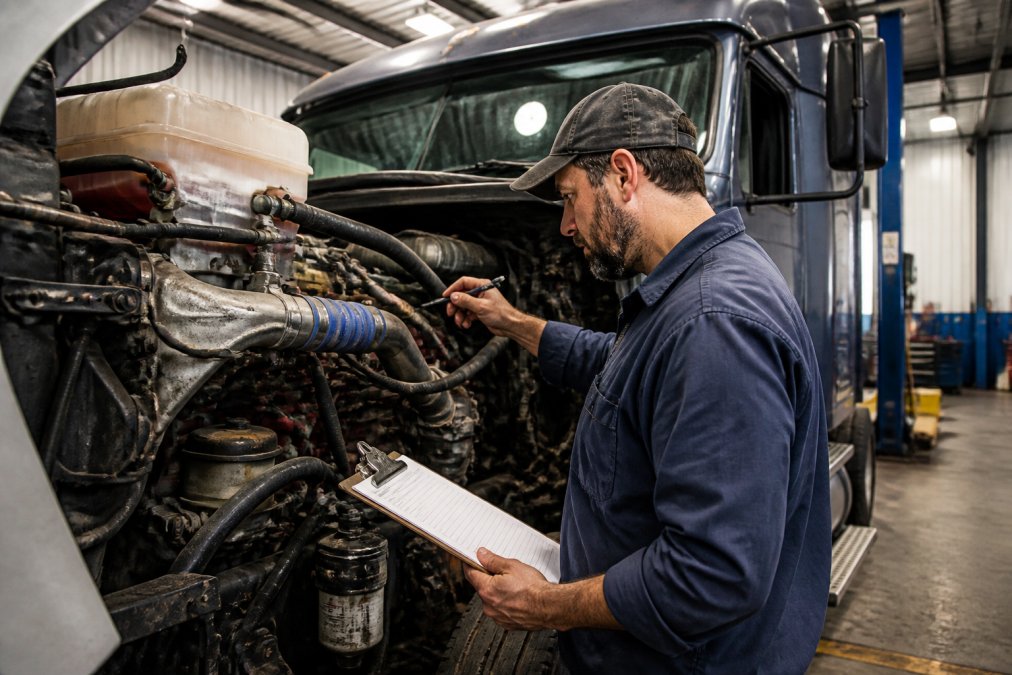
A heavy duty truck inspection checklist is the single most valuable tool a used buyer carries, and it should cover the drivetrain, chassis, and emissions systems in equal measure. Walk away from any truck whose seller cannot produce service records.
Drivetrain, Chassis, and Emissions Checks
Start with the engine block and look for oil seepage, coolant stains, and exhaust smoke color. Then move to the transmission, checking for shift quality and clutch wear on manual units.
On the chassis, inspect frame rails for cracks and rust, and check air bags, kingpins, and brake chambers. Emissions systems deserve special attention: DPFs, EGR coolers, and SCR components are expensive to replace and often the first casualty of deferred maintenance.
How to Read ECM Data Before You Buy
The engine control module stores more truth than any seller will volunteer. Ask for a download of the following parameters, and compare them against the odometer:
- Total engine hours vs. total miles, divide miles by hours. A result below 25 mph average indicates heavy idle or stop-and-go vocational use, which accelerates wear on internal components even when miles look low.
- Idle percentage, anything above 30% is a red flag for a long-haul tractor; above 50% suggests the truck spent more time parked with the engine running than actually working.
- Hard-brake events and overspeed history, these reveal driver behavior that no service record will show.
- Regeneration history on DPF-equipped trucks, frequent forced regens point to a clogging filter or a duty cycle that never gets hot enough to burn off soot passively.
A truck with 400,000 miles and 25,000 engine hours is a different animal than one with 400,000 miles and 12,000 hours. The first has been idling its life away; the second has been working efficiently.
Component-by-Component Walkaround
- Service records available and complete
- ECM data pulled and reviewed (hours, idle %, regen history)
- Oil analysis history present
- Frame rails free of cracks and heavy rust
- Emissions components recently serviced
- Turbocharger shaft play checked (remove intake boot, feel for in/out and side-to-side movement)
- Coolant tested for nitrite levels and pH
- Air system leak-down test performed (system should hold pressure for at least one minute after shutdown)
- Fifth wheel and kingpin wear inspected
- Tire dates checked (DOT code, anything over seven years old is suspect regardless of tread)
Component-Specific Lifespans: What Wears Out First
Component lifespans vary widely, and knowing which parts fail first helps you budget accurately. Most guides stop at the engine block. The reality is that the engine is often the last major component to need attention, the parts bolted to it and the driveline behind it usually go first.
Lifespan Ranges by Component and Duty Cycle
The table below reflects typical ranges reported by fleets and independent shops. Vocational (stop-and-go, heavy load, high idle) trucks should be expected at the lower end of each range; long-haul highway trucks at the upper end.
| Component | Long-Haul Range | Vocational Range | Primary Failure Mode |
|---|---|---|---|
| Turbocharger | 500,000-700,000 mi | 300,000-500,000 mi | Bearing wear from oil starvation or heat soak |
| EGR cooler | 400,000-600,000 mi | 250,000-400,000 mi | Coolant-side cracking from thermal cycling |
| DPF (filter substrate) | 400,000-600,000 mi | 200,000-400,000 mi | Ash loading from repeated forced regens |
| Water pump | 400,000-600,000 mi | 250,000-400,000 mi | Seal failure, bearing noise |
| Alternator / starter | 300,000-500,000 mi | 200,000-350,000 mi | Brush and bearing wear |
| Clutch (manual) | 400,000-600,000 mi | 200,000-350,000 mi | Friction disc wear from stop-and-go |
| Transmission (automatic) | 600,000-800,000 mi | 400,000-600,000 mi | Clutch pack wear, valve body solenoid failure |
| Differential | 700,000-1,000,000 mi | 500,000-700,000 mi | Pinion bearing and gear wear |
| Brakes (drums/shoes) | 200,000-300,000 mi | 80,000-150,000 mi | Friction material wear, drum cracking |
| Suspension (air bags, bushings) | 300,000-500,000 mi | 150,000-300,000 mi | Rubber degradation, bushing play |
Why the Engine Block Usually Outlasts Its Accessories
The long block, block, head, crankshaft, rods, pistons, is designed for the million-mile range when oil and coolant are maintained. The accessories that keep it running are not. A turbocharger spinning at over 100,000 rpm depends on a thin film of oil that degrades with heat and contamination. An EGR cooler sees exhaust gas on one side and coolant on the other, and the thermal cycling eventually cracks the core. A DPF accumulates ash that cannot be burned off, only removed or replaced.
This is why maintenance history matters more than the odometer: a truck with 700,000 documented miles and fresh components is a better bet than a 400,000-mile truck with no records. When you price a used truck, subtract the cost of the components likely to fail within your ownership window. A 600,000-mile vocational truck with original turbo, EGR cooler, and DPF is not a $60,000 truck, it is a $60,000 truck plus the $8,000 to $15,000 in emissions and forced-induction work that is almost certainly coming.
Total Cost of Ownership vs. Mileage for Used Heavy Trucks
Total cost of ownership is the better buying metric, and it's the angle most guides skip. Mileage tells you what a truck has done; TCO tells you what it will cost you to keep it running.
Operating costs include fuel, tires, brakes, preventative maintenance, insurance, and downtime. A higher-mileage truck with a documented maintenance schedule often costs less per mile than a low-mileage truck with unknown history. Depreciation also matters: the used Class 8 market saw prices slip 4.0% month-over-month in July 2026, so resale value depends heavily on condition and records at the point of sale.
How Technology and Emissions Systems Affect Modern Truck Longevity
Modern emissions technology has changed the longevity equation, and not always for the better. EGR coolers, DPFs, and SCR systems add components that can fail, and each one carries real repair cost.
The upside is that modern engines run cleaner and monitor themselves more closely. Onboard diagnostics catch problems early, and telematics data gives buyers a verifiable record of how a truck was actually operated. Academic research on heavy-duty vehicle transitions, including University of Southern California's zero-emission transition study, shows that duty cycle and operating profile remain the dominant variables in how long these systems last. Buyers who understand the emissions package on a specific truck make better decisions than those who only check the odometer.
When to Walk Away: Signs a Used Heavy Truck Is a Liability
Walk away when the records don't match the story. Missing service history, inconsistent ECM data, or a seller who won't allow an independent inspection are all red flags.
Other signals to take seriously:
- Blue or white exhaust smoke at operating temperature
- Coolant loss with no visible leak
- Transmission slipping under load
- Frame cracks or severe rust on structural members
- Emissions system codes that keep returning
Any one of these can turn a used heavy truck into a money pit. Two or more together mean you should keep looking.
Buying a used heavy truck is a calculation, not a guess, and the numbers only work when you can verify what you're buying. Ironmartonline connects buyers and sellers of used machinery through nine specialized web-based selling platforms, reaching millions of potential buyers with no contracts and no hidden fees. Whether you're acquiring a Class 8 tractor or moving surplus equipment, our heavy equipment broker service handles the marketplace so you can focus on the decision. Join our email list to see current listings and market updates.
Frequently Asked Questions
How many miles is too high for a used diesel truck?
There is no single cutoff, but 500,000 to 600,000 miles sits in the moderate range for a well-maintained Class 8 truck. Industry guidance categorizes 300,000 to 600,000 miles as moderate mileage that can still represent strong value when maintenance records back it up. Beyond 750,000 miles, buyers should expect more frequent major repairs and factor engine overhaul costs into the purchase price. The maintenance history and duty cycle matter more than the odometer alone.
How do engine hours compare to mileage when evaluating truck life?
Engine hours capture idle time that the odometer misses. A truck that logged 400,000 highway miles with low idle hours is generally in better shape than one with the same mileage spent idling in traffic or at job sites. Industry guidance for 2026 buyers emphasizes that how miles were accumulated, plus engine hours and maintenance logs, outweighs the raw odometer reading. Ask for both metrics before making an offer.
How does maintenance history impact the total lifespan of a commercial vehicle?
A well-maintained Class 8 engine can reach 750,000 to 1,000,000 miles, according to industry data. Trucks with documented preventative maintenance, oil analysis records, and on-time service intervals consistently outlast neglected units with identical mileage. Service records also protect resale value: buyers pay more for trucks with verifiable maintenance histories because they can estimate remaining component life with confidence instead of guessing.
At what point does a used heavy truck become a liability?
A truck turns into a liability when repair costs start outpacing its resale value and downtime threatens your operating schedule. Warning signs include repeated emissions system failures, transmission slipping, coolant loss, and oil analysis showing elevated metals. Once a truck needs an engine overhaul or major drivetrain work without supporting service records, the math often favors selling it through a brokerage rather than funding the repair yourself.