
Table of Contents
- Why Appraise a Used Mini Excavator Accurately
- Operating Hours and Machine Age in Mini Excavator Appraisal
- Hydraulic System and Pressure Testing
- Undercarriage Inspection: Tracks, Pins, and Bushings
- Engine Performance and Exhaust Analysis
- Structural Integrity and Weld Inspection
- Using a Mini Excavator Depreciation Calculator
- Impact of Attachments on Excavator Resale Value
- Building Your Used Heavy Equipment Inspection Checklist
- Frequently Asked Questions
Last Updated: September 26, 2026
Why Appraise a Used Mini Excavator Accurately
Learning how to appraise a used mini excavator correctly is critical, since getting the valuation wrong can cost tens of thousands of dollars. The difference between a rushed appraisal and a thorough one frequently amounts to 15-25% of the machine's fair market value.
How to appraise a used mini excavator requires a systematic approach that examines operating hours, hydraulic performance, undercarriage condition, engine health, and structural integrity. Each component tells a story about how the machine was maintained and how much useful life remains. According to Equipment World's 2026 market analysis, used mini excavators offer 30-50% cost savings compared to new machines while retaining 70-80% of their useful life. This makes accurate appraisal critical for both sides of the transaction.
Why use a Heavy Equipment Broker when selling or acquiring heavy equipment? The difference lies in expertise and reach. Mideast Equip's 2026 depreciation study confirms that residual value management directly impacts your total cost of ownership. A Heavy Equipment Broker connects you to millions of potential buyers across specialized selling platforms, ensuring your equipment reaches the right market without contracts or hidden fees. Whether you're a contractor liquidating surplus machines, a fleet manager acquiring equipment, or an owner-operator selling individual units, understanding how to properly value what you're buying or selling protects your bottom line.
Operating Hours and Machine Age in Mini Excavator Appraisal
Operating hours are the single most reliable indicator of remaining useful life. Most mini excavators are designed for 5,000-10,000 total operating hours before major component replacement becomes necessary.
Check the hour meter on the instrument panel and cross-reference against service records. Machines under 1,000 hours with complete service logs are premium assets. Machines exceeding 5,000 hours require careful inspection for wear on the final drive, swing bearing, and hydraulic cylinders.
Machine age matters, but operating hours matter more. A 10-year-old mini excavator with 800 hours is often worth more than a 5-year-old model with 4,000 hours. Seasonal equipment, used only during peak construction months, depreciates slower than year-round machines. According to Rubbl's 2026 brand analysis, Kubota, Caterpillar, and Takeuchi machines hold value better than lesser-known brands, particularly in the 3-7 year age range.
Verify the serial number matches the title and cross-reference with the manufacturer's database to confirm production year. A refurbished machine under 5 years old with fewer than 1,000 hours represents solid value if documentation is complete.
Hydraulic System and Pressure Testing
The hydraulic system is the heart of a mini excavator. Weak hydraulics mean slow cycle times, reduced digging force, and expensive repairs.
Visual Inspection and Baseline Checks
Look for leaks around cylinder rods, hose connections, and the main pump. Hydraulic fluid should be dark amber, not black. Black fluid indicates overheating or contamination. Check tank level with engine off and boom lowered. Inspect hose routing for abrasion points, a leading cause of premature failure.
Pressure Testing Under Load
Use a pressure gauge to test hydraulic pressure under load at the test port. Healthy systems typically produce 2,500-3,500 PSI. Pressure below 2,000 PSI indicates pump wear or internal leakage. Pressure above 4,000 PSI suggests relief valve malfunction.
Test cycle times by lowering the bucket from full height to ground. It should take 8-12 seconds depending on model size. Slower cycles indicate reduced pump output or internal leakage.
Advanced Diagnostic: Thermal Imaging and Fluid Analysis
Thermal imaging reveals heat signatures indicating hydraulic stress. Localized hot spots (more than 10-15 degrees above ambient) suggest internal friction, seal degradation, or impending component failure.
Oil analysis reveals wear metals, water content, and fluid degradation. Send a sample to a certified lab for particle count and contamination testing. Excessive wear metals indicate internal component damage. High water content suggests seal failure. This test can reveal problems invisible to visual inspection and justify downward valuation adjustment.
Interpreting Results for Appraisal Impact
Healthy pressure, normal cycle times, and clean fluid analysis command full market value. Pressure loss with no visible leaks suggests internal pump wear ($3,000-6,000 repair). High wear metals but normal pressure suggest early-stage degradation. Both pressure loss and contaminated fluid warrant 20-35% discount or rejection.
Undercarriage Inspection: Tracks, Pins, and Bushings
The undercarriage takes the most punishment on any mini excavator. Worn tracks, damaged pins, and loose bushings are expensive to repair and directly reduce machine value.
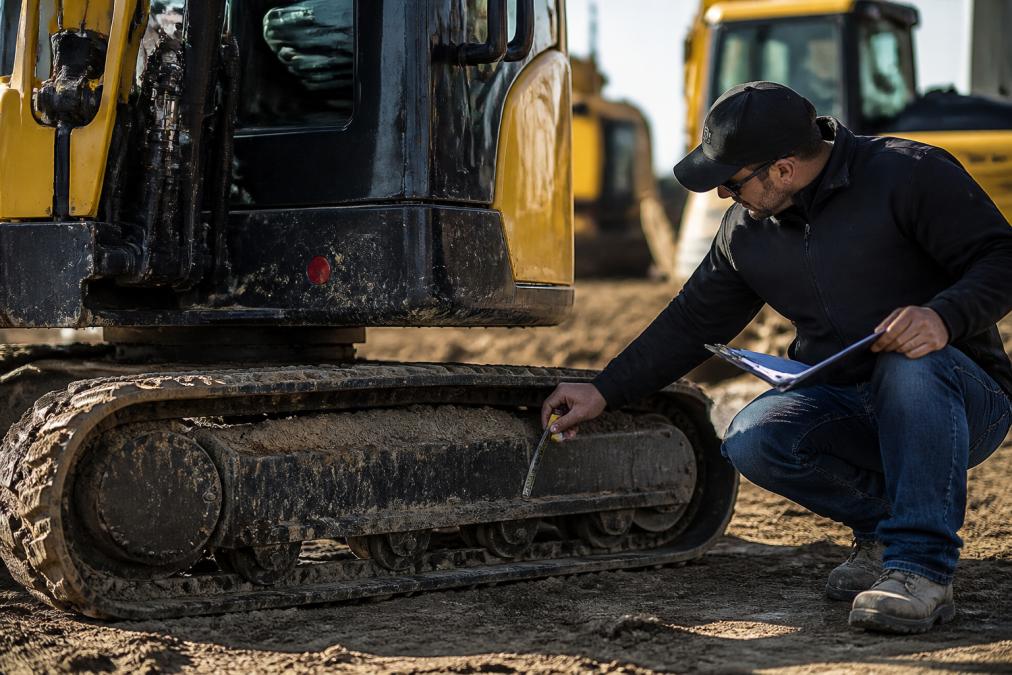
Rubber tracks should show even wear across their width. Uneven wear suggests misalignment. Look for cracks, chunks missing, or excessive thinning. Tracks with visible metal underneath are near end-of-life. Budget $2,000-4,000 for replacement.
Grab the track at the side and try to move it up and down. Excessive play (more than half an inch) indicates worn bushings. Inspect pins for cracks or bending. Severely worn pins and bushings require complete track replacement.
The idler wheel should spin freely with minimal resistance. Sprocket teeth should be sharp and symmetrical. Worn or broken teeth indicate hard use or poor maintenance. Replacement costs $1,500-3,000 per component.
The track should have slight give, about one inch of vertical movement at the midpoint. Proper tension extends track life and improves fuel efficiency.
Engine Performance and Exhaust Analysis
Start the engine from cold and listen for unusual sounds. Knocking, grinding, or grinding noises suggest internal damage. The engine should start within 10 seconds and idle smoothly. Rough idle or stalling indicates fuel system or ignition problems. Let it warm up for two minutes, then rev to full throttle. It should respond smoothly without hesitation or backfiring.
Check exhaust color. Blue smoke indicates oil burning, a sign of worn piston rings or valve seals. White smoke suggests coolant in the combustion chamber, indicating a head gasket leak. Black smoke means the engine is running too rich, often due to a clogged air filter or fuel system issues. Clear or nearly invisible exhaust is healthy.
Perform a blow-by test by removing the dipstick and placing your hand over the opening while the engine idles. Strong air pressure pushing your hand away indicates worn piston rings or cylinders. This is an expensive repair requiring engine rebuild or replacement.
Check coolant condition. It should be bright green or orange depending on type. Rusty or discolored coolant indicates corrosion inside the cooling system. Milky coolant suggests water contamination. Poor coolant condition can lead to overheating and head gasket failure.
Monitor engine temperature during operation. The gauge should stabilize in the normal range within five minutes. Overheating suggests a failing thermostat, clogged radiator, or water pump problem. Underheating (staying below normal) indicates a stuck-open thermostat, which reduces efficiency and engine life.
Structural Integrity and Weld Inspection
Cracks in the frame or boom are catastrophic failures that render a machine unsafe and uneconomical to repair. Structural damage typically means the machine should be scrapped or sold for parts only.
Inspect the main frame for visible cracks, especially around welded joints. Cracks propagate quickly under load and can cause sudden failure. Look at the boom, stick, and bucket attachment points. These areas experience the most stress and show damage first.
Use a magnet to inspect welds for repairs. A magnet will stick to bare steel but not to welding material. If you find multiple areas where the magnet doesn't stick, the frame has been repaired. Minor repairs are acceptable if properly done. Extensive repairs suggest the machine has been in an accident or suffered severe overload damage.
Check for bent or twisted components. The boom should be straight. The stick should align properly with the boom. Bent hydraulic cylinders reduce digging precision and indicate the machine has been abused. Straightening bent components is expensive and rarely restores full functionality.
Examine paint condition as an indicator of overall care. Faded or peeling paint suggests the machine has been exposed to weather without protection. Rust bubbles under the paint indicate corrosion that will spread if not addressed. Well-maintained machines typically show consistent paint condition across all surfaces.
Using a Mini Excavator Depreciation Calculator
A depreciation calculator removes guesswork from valuation and provides a defensible baseline for negotiations. The most reliable approach combines a formula with market data and real-world adjustments.
The Core Depreciation Formula
Start with the original purchase price. This information is usually available from the dealer or previous owner's invoice. If unavailable, use the NADA Guides or Black Book values for that model and year. These resources provide historical pricing data for most equipment.
Apply a depreciation rate based on age and hours using this formula:
Current Value = Original Price × (1 − Depreciation Rate)
For mini excavators, annual depreciation typically ranges from 8-12% for the first three years, then 5-8% annually after that. Machines with high hours depreciate faster. A machine with 5,000+ operating hours depreciates an additional 1-2% annually beyond the standard rate.
Worked Example: Valuing a Real Machine
Let's say you're appraising a Kubota U35 mini excavator:
- Original purchase price (from dealer invoice): $48,000
- Current age: 4 years old
- Operating hours: 1,800 hours
- Condition: Good (no major repairs needed, minor cosmetic wear)
- Attachments: Quick coupler and standard digging bucket, both in good condition
Step 1: Apply Age-Based Depreciation
- Years 1-3: 10% per year = 30% total
- Year 4: 7% = 7%
- Total depreciation: 37%
- Value after age adjustment: $48,000 × (1 − 0.37) = $30,240
Step 2: Adjust for Operating Hours
- 1,800 hours on a 4-year-old machine is below average (roughly 450 hours/year vs. typical 600-800 hours/year for active machines)
- Low-hour machines command a 5-10% premium
- Adjustment: +7% = $30,240 × 1.07 = $32,357
Step 3: Condition Adjustment
- Good condition (baseline, no adjustment needed): $32,357
Step 4: Attachment Value
- Quick coupler in good condition: +$2,500
- Standard bucket: included in baseline
- Total with attachments: $32,357 + $2,500 = $34,857
Step 5: Market Comparison Check
- Search recent sales of Kubota U35 models, 3-5 years old, 1,500-2,500 hours
- Comparable 1: $35,200 (sold 2 weeks ago, 1,650 hours)
- Comparable 2: $33,800 (sold 1 month ago, 2,100 hours)
- Comparable 3: $34,500 (listed now, 1,900 hours)
- Average: $34,500
- Your calculated value of $34,857 falls within the market range
Final Appraised Value: $34,500-$35,000
Adjusting for Condition Issues
If your inspection reveals defects, apply additional discounts:
| Issue | Discount | Reasoning |
|---|---|---|
| Hydraulic pressure 15% below spec | −8% to −12% | Pump wear; repair cost $3,000-5,000 |
| Track wear at 70% of useful life | −10% to −15% | Replacement cost $2,500-4,000 |
| Engine blow-by detected | −15% to −25% | Piston ring wear; rebuild cost $4,000-8,000 |
| Minor frame weld repair (documented) | −5% to −8% | Structural integrity concern |
| Excellent maintenance records | +5% to +10% | Confidence in remaining life |
| Accident history (repaired, documented) | −20% to −40% | Structural or hidden damage risk |
Regional and Market Timing Adjustments
Depreciation rates vary by region and market conditions. In strong construction markets with high equipment demand, machines hold value better, reduce depreciation by 2-3%. In slow markets, increase depreciation by 2-3%. Seasonal factors also apply: mini excavators sell faster in spring and summer, so machines listed in winter may require a 5-10% discount to move quickly.
Creating a Defensible Appraisal Range
Never settle on a single number. Instead, establish a range:
- Conservative estimate (buyer's perspective): Use higher depreciation rates and apply all condition discounts
- Fair market value (neutral baseline): Use standard rates and documented adjustments
- Optimistic estimate (seller's perspective): Use lower depreciation rates and highlight premium features
For the Kubota U35 example above:
- Conservative: $32,500 (assume future repairs)
- Fair market: $34,500 (baseline)
- Optimistic: $36,000 (excellent condition, low hours, strong market)
Use this range during negotiations. If a buyer offers $31,000, you have data showing fair market is $34,500. If a seller asks $37,500, you can justify a counteroffer of $35,500 based on comparable sales and condition adjustments.
Impact of Attachments on Excavator Resale Value
Attachments dramatically affect both the utility and resale value of a mini excavator. The right attachment can increase value by 5-15%. The wrong attachment or poor condition can decrease it significantly.
A quick coupler is nearly essential for modern mini excavators. It allows rapid attachment changes without tools. Machines without quick couplers are harder to sell and command lower prices. A quality quick coupler adds $2,000-4,000 to resale value. Damaged or worn couplers reduce value by $1,000-2,000.
Specialized buckets add value for specific applications. A digging bucket is standard. A grading bucket, trenching bucket, or cleanup bucket expands the machine's utility. Each additional bucket adds $500-1,500 to resale value if in good condition. Buckets with broken teeth or bent edges lose 30-50% of their value.
A thumb attachment (grapple) is highly desirable for demolition and material handling work. A quality thumb adds $3,000-6,000 to resale value. A damaged or worn thumb reduces value by $1,000-3,000.
Auxiliary hydraulics enable powered attachments like augers, breakers, or compactors. Machines with auxiliary hydraulics command 5-10% premiums because they can perform more work. Verify that auxiliary lines are properly connected and functioning. Leaking or damaged lines reduce value.
Evaluate attachment condition carefully. Bent or cracked attachment frames are expensive to repair. Missing pins or broken welds render attachments unsafe. Clean, well-maintained attachments in proper working order maximize resale value. Damaged or worn attachments should be removed before sale unless they're included at a significant discount.
Building Your Used Heavy Equipment Inspection Checklist
A systematic inspection checklist ensures you don't miss critical issues and provides documentation for your appraisal. Use this framework as your foundation.
Pre-Inspection Documentation:
- Verify serial number matches title
- Confirm operating hours on hour meter
- Review complete service history
- Check for accident or damage claims
- Obtain original purchase price and specifications
Engine and Fuel System:
- Listen for unusual sounds at startup
- Check exhaust color under load
- Verify coolant level and condition
- Test engine temperature stabilization
- Inspect fuel filter and fuel lines
Hydraulic System:
- Visual inspection for leaks
- Check hydraulic fluid level and color
- Measure pressure under full load
- Test cycle times for all functions
- Verify relief valve response
Undercarriage and Tracks:
- Inspect track condition and wear pattern
- Check pin and bushing play
- Examine idler wheel and sprocket
- Measure track tension
- Look for cracks in frame welds
Structural Components:
- Inspect boom for cracks or bending
- Check stick alignment
- Examine bucket attachment points
- Verify hydraulic cylinder condition
- Test all attachment mechanisms
Operator Controls and Cab:
- Verify all controls operate smoothly
- Test warning lights and gauges
- Inspect cab for damage or wear
- Check seat condition and adjustment
- Verify visibility from operator position
Post-Inspection Analysis:
- Calculate depreciation using formula
- Document all defects with photos
- Estimate repair costs for issues
- Compare against market comps
- Establish final valuation range
Accurate appraisal protects your investment whether you're buying or selling. The inspection process takes 45 minutes to two hours depending on machine complexity, but the time investment pays dividends through confident negotiations and fair pricing. When you're ready to list or acquire equipment, a Heavy Equipment Broker connects you to millions of qualified buyers and sellers across specialized platforms, ensuring your machines reach the right market without contracts or hidden fees. Our team helps contractors, fleet managers, and owner-operators maximize returns on heavy equipment transactions. Fact.MR's 2026 mini excavator rental market report confirms that equipment valuation directly impacts financing options and resale opportunities. Get started with a Heavy Equipment Broker and put your appraisal knowledge to work in a transparent marketplace.
Frequently Asked Questions
What is the fair market value of a used mini excavator?
Fair market value depends on operating hours, age, brand, and condition. Used mini excavators typically retain 70-80% of their total useful life and offer 30-50% cost savings compared to new machines. A proper physical inspection requires at least 45 minutes to accurately assess condition. Use a depreciation calculator based on purchase price, hours, and maintenance history to estimate current value.
How do operating hours and machine age affect a mini excavator appraisal?
Operating hours are one of the most critical factors in determining value. Machines under 1,000 hours with fewer than 5 years of age typically avoid excessive maintenance costs. Each additional 500 hours reduces value by roughly 3-5%, depending on maintenance records. Age compounds this impact: a 10-year-old machine with 2,000 hours may appraise lower than a 5-year-old machine with 1,500 hours due to component wear and technological obsolescence.
Why should I use Ironmartonline as my equipment broker?
Ironmartonline connects your used mini excavator to millions of potential buyers across nine specialized web-based selling platforms. Unlike traditional single-site listings, our global and local reach maximizes exposure and competitive bidding. We handle the marketing and logistics without contracts or hidden fees, so you receive fair market offers quickly. Our expertise in heavy equipment appraisal ensures accurate pricing and faster sales.
What maintenance records should I have ready for an appraisal?
Gather all service logs, repair receipts, hydraulic fluid analysis reports, and attachment maintenance records. Documentation of regular oil changes, filter replacements, and major repairs significantly increases appraised value. Machines with complete maintenance histories appraise 10-15% higher than those without records. Include dates, hours logged, and the name of the service provider to establish credibility and demonstrate responsible ownership.