

Table of Contents
- Why Use a Reputable Equipment Broker to Avoid Heavy Equipment Scams
- Identifying Fake Heavy Equipment Listings: Red Flags to Watch
- Heavy Equipment Dealer Verification: Confirming Seller Legitimacy
- Requesting and Verifying Serial Numbers and Machine IDs
- Heavy Equipment Inspection Services: The In-Person Verification Process
- Secure Heavy Equipment Payment Methods: Protecting Your Transaction
- Legal Recourse and Recovery: What to Do If You've Been Scammed
- Common Mistakes That Increase Your Scam Risk
- Your Complete Checklist for Avoiding Heavy Equipment Scams
- Conclusion
How to Avoid Heavy Equipment Scams: 9 Essential Steps
Last Updated: July 24, 2026
Learning how to avoid heavy equipment scams has become essential for anyone buying or selling construction machinery, heavy trucks, or industrial equipment online. The heavy equipment market attracts both legitimate dealers and fraudsters who exploit the complexity of remote transactions and the high dollar values involved. At Ironmartonline, we've tracked equipment fraud cases across our nine specialized selling platforms and identified the patterns that separate safe purchases from costly mistakes.
Why use an equipment broker like Ironmartonline instead of navigating marketplace listings alone? A reputable heavy equipment broker connects you with verified sellers, manages transaction security, and provides access to millions of potential buyers across multiple platforms, eliminating the risk exposure that comes with direct peer-to-peer sales. Rather than sorting through hundreds of suspicious listings, you work with a brokerage that has already vetted dealer legitimacy and enforced verification standards. This single decision, choosing a professional broker over an open marketplace, removes the majority of scam vectors that independent buyers face.
Below, we'll show you exactly how to identify fraudulent listings, verify seller credentials, request serial numbers, conduct inspections, and protect your payment. The nine strategies we cover have helped thousands of equipment buyers avoid losses that typically range from thousands to hundreds of thousands of dollars. But first, here's what most guides get wrong: they focus on red flags without explaining how to verify legitimacy proactively. Detection alone isn't enough. You need a verification system.
Why Use a Reputable Equipment Broker to Avoid Heavy Equipment Scams
Purchasing heavy equipment through a reputable broker fundamentally changes your risk profile. A broker like Ironmartonline operates across nine web-based selling platforms with built-in verification systems, meaning you're not starting from zero when assessing seller credibility. The broker has already established relationships with verified dealers, cross-referenced business registrations, and created accountability structures that individual sellers on open marketplaces lack entirely.
When you buy through an equipment broker, you gain access to transaction protections that independent purchases don't offer. Brokers facilitate escrow arrangements, verify machine IDs and serial numbers before listings go live, and maintain records that create legal recourse if something goes wrong. This infrastructure exists specifically to prevent the types of scams that plague unmoderated marketplaces.
Consider the alternative: purchasing directly from an online listing where you have no way to confirm the seller's identity, no third party to mediate disputes, and no record of the transaction beyond your own documentation. You're essentially trusting a stranger with tens of thousands of dollars based on photographs and a phone conversation. A broker eliminates this trust gap by inserting professional verification between you and the seller.
The hassle-free selling process that brokers provide also means fewer motivated sellers cutting corners on transparency. When a seller knows their listing will be reviewed by a professional brokerage, they're more likely to provide complete documentation, accurate machine conditions, and honest pricing. This self-selection effect, where legitimate sellers gravitate toward professional marketplaces, creates a higher baseline of trustworthiness than you'll find on unmoderated platforms.
Identifying Fake Heavy Equipment Listings: Red Flags to Watch
Fraudulent equipment listings follow predictable patterns once you know what to look for. The most obvious red flags appear in the presentation itself: professional photos mixed with blurry or stock images, vague equipment descriptions, and listings that appear across multiple platforms with different contact information. Scammers often copy photos from legitimate dealers' websites, rotate them across different listings, and use generic descriptions that could apply to any machine in that category.
Pricing That Seems Too Good to Be True
Significantly underpriced equipment is the most common lure in heavy equipment scams. A bulldozer listed at 40% below market value isn't a bargain, it's a warning. Scammers price aggressively to generate inquiry volume, knowing that even a small percentage of desperate buyers will commit before verifying legitimacy. The pricing gap creates urgency and clouds judgment.
Legitimate dealers price within 5-15% of market comparables. If you're seeing prices 30% or more below similar equipment from established dealers, the listing deserves immediate scrutiny. Cross-reference the asking price against recent sales data for identical or similar models. If the price discrepancy can't be explained by condition, mileage, or market timing, move on. The money you save on a too-good-to-true purchase rarely offsets the loss when the equipment doesn't exist or arrives damaged.
Suspicious Seller Behavior and Communication
How sellers respond to questions reveals more than their answers do. Legitimate dealers welcome detailed inquiries about machine condition, maintenance history, and operational specifications. They provide specific answers backed by documentation. Fraudulent sellers deflect technical questions, rush you toward payment decisions, and create artificial scarcity ("I have another buyer interested").
Watch for sellers who insist on wire transfers or cryptocurrency, refuse video calls, or claim they can't arrange in-person inspections because they're "traveling" or "managing multiple properties." These aren't inconveniences, they're deliberate barriers to verification. Legitimate dealers make themselves accessible because transparency builds buyer confidence.
Heavy Equipment Dealer Verification: Confirming Seller Legitimacy
Before committing to any purchase, verify that the seller is actually who they claim to be. This means confirming business registration, checking licensing status, and researching their transaction history across multiple platforms.
Researching Reputation and Customer Reviews
Start by searching the dealer's name, phone number, and business address across multiple review platforms, equipment trader forums, and the Better Business Bureau. Legitimate dealers accumulate verifiable customer reviews over time. A dealer with zero online presence or exclusively positive reviews that all appeared within the last month is suspicious, real businesses have mixed feedback and a history that extends back years.
Cross-reference reviews across platforms. Scammers sometimes create fake reviews on their own websites but struggle to maintain fake personas across independent review sites. If a dealer has positive reviews on their own site but no presence on third-party platforms like the BBB or equipment trading forums, that asymmetry is telling.
Verifying the Seller's Identity and Business Registration
Look up the seller's business registration with your state's Secretary of State office or equivalent agency. Confirm that the business name, address, and ownership match what the seller has provided. Many states offer free online lookup tools. If the business is registered under a different name than what appears on their website, or if the registration is recent (within the last few months), proceed with caution.
Verify the seller's physical address. Legitimate equipment dealers operate from established locations with verifiable phone numbers and business licenses. Use Google Maps to confirm the address exists and matches the business description. If the address is a residential home, a UPS store, or a mailbox service, that's a significant red flag for a heavy equipment dealer.
Requesting and Verifying Serial Numbers and Machine IDs
The serial number is your primary verification tool for confirming that equipment actually exists and belongs to the seller. Every piece of heavy equipment has a unique serial number (also called a machine ID or VIN for trucks). This number is permanent and traceable.
Request the serial number early in the inquiry process, before scheduling an inspection or committing any money. Legitimate sellers provide this immediately. Once you have the serial number, verify it directly with the manufacturer. Most heavy equipment manufacturers maintain databases where you can look up the machine's production date, original specifications, and service history. This verification step takes 15 minutes and can save you from purchasing stolen or misrepresented equipment.
Cross-reference the serial number against the equipment's documented history. If the machine shows multiple ownership transfers in a short timeframe, that pattern suggests either rapid flipping (potentially hiding mechanical problems) or title issues. Stolen equipment often cycles through multiple owners quickly as the thief attempts to move it before the original owner discovers the theft.
Heavy Equipment Inspection Services: The In-Person Verification Process
No amount of documentation substitutes for seeing the equipment in person. An in-person inspection is non-negotiable for purchases over a certain value. During inspection, you're verifying that the equipment exists, matches its description, and operates as claimed.
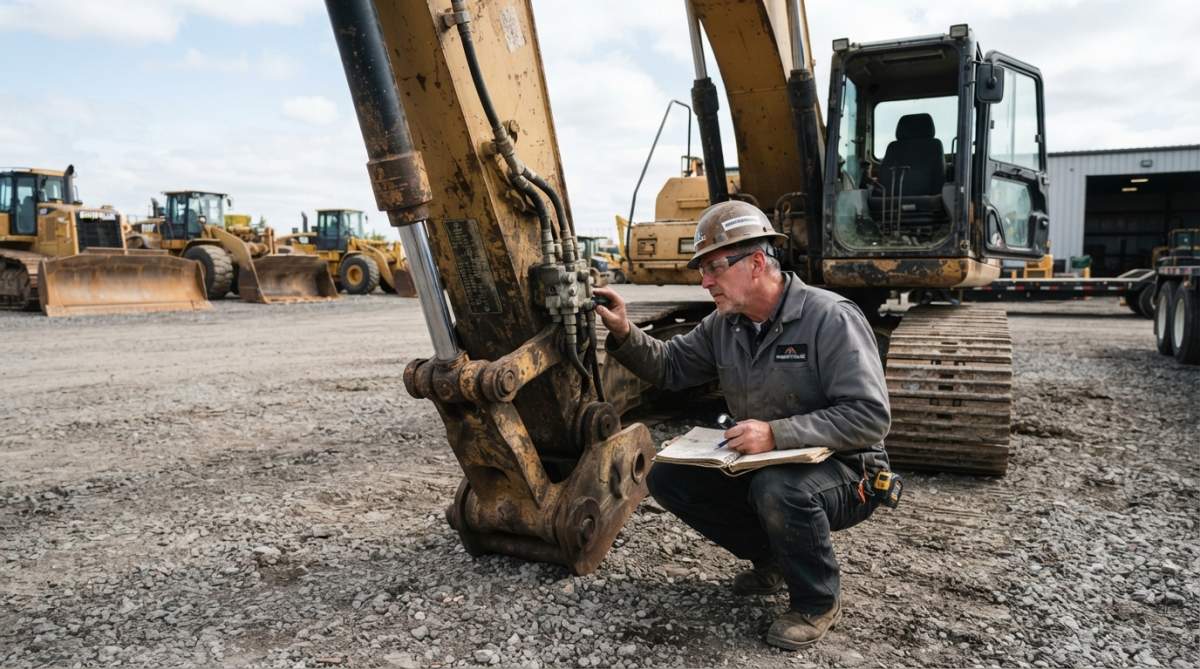
Conduct your inspection systematically. Start with the serial number verification, physically locate the stamped or engraved serial number on the machine and confirm it matches the documentation. Check the equipment's overall condition against photos provided in the listing. Look for signs of hidden damage: mismatched paint, welding repairs, fluid leaks, or worn components that don't match the stated hours of operation.
Operate the equipment if possible. Start the engine, test hydraulics, engage the transmission, and verify that all systems respond as expected. Bring a mechanic or equipment specialist if you lack technical expertise. Their assessment of mechanical condition is worth far more than your visual inspection alone. The cost of hiring an inspector ($200-500) is negligible compared to the risk of purchasing equipment with hidden mechanical problems.
Conducting Video Inspections for Remote Purchases
When in-person inspection isn't possible, a live video inspection with the seller is your next-best option. Schedule a call where the seller walks you through the equipment on camera, showing the serial number, operating all systems, and providing close-up views of any areas of concern. Video inspection isn't as reliable as in-person verification, but it's dramatically better than purchasing based on photos alone.
During the video call, ask the seller to show you the equipment's maintenance records, service history, and any documentation proving current registration or ownership. Legitimate sellers have these documents available. Request that they show you the serial number from multiple angles and read it aloud. This prevents the scam where photos are recycled from different equipment.
Record the video inspection (with the seller's permission) so you have documentation of the equipment's condition at the time of sale. This recording becomes critical if disputes arise later about the equipment's actual condition.
Secure Heavy Equipment Payment Methods: Protecting Your Transaction
How you pay determines whether you have recourse if something goes wrong. The payment method you choose is as important as all the verification steps combined.
Escrow Services and Third-Party Payment Protection
Escrow services hold your payment until you've verified equipment receipt and condition. The seller releases the equipment, you inspect it, and only then does the escrow service release payment to the seller. This structure protects both parties: you're not paying for equipment you haven't verified, and the seller isn't releasing equipment without payment assurance.
Reputable equipment brokers like Ironmartonline facilitate escrow arrangements as part of their transaction process. This removes the risk of direct payment to an unknown seller. The escrow service acts as a neutral third party, ensuring that the transaction completes only when both parties' conditions are met.
Wire transfers and bank transfers can be used safely within an escrow structure. The key is that you're not sending money directly to the seller, you're funding an escrow account that releases money only after conditions are satisfied.
Avoiding Unsecured Payment Methods
Never use payment methods that offer no recourse. Wire transfers sent directly to a seller's personal account cannot be reversed. Cryptocurrency payments are permanent and untraceable. Money orders and cashier's checks provide no buyer protection. Gift cards and prepaid cards are cash equivalents, once spent, the money is gone.
Credit cards offer fraud protection and chargeback rights, but many equipment dealers won't accept credit card payments for high-value purchases due to processing fees. If a dealer insists on wire transfer or cryptocurrency, that's a major warning sign. Legitimate dealers understand buyer concerns and work with secure payment methods that protect both parties.
Legal Recourse and Recovery: What to Do If You've Been Scammed
If you discover you've been defrauded, immediate action improves your chances of recovery. Document everything: screenshots of listings, email communications, payment confirmations, and any agreements with the seller. If you used a wire transfer, contact your bank immediately. While reversals are difficult, early notification sometimes allows banks to intercept the transfer before it clears.
File a complaint with the Federal Trade Commission through their online reporting system. The FTC aggregates fraud reports and uses them to identify patterns and pursue enforcement actions against serial scammers. Your report contributes to cases that may recover funds for multiple victims.
Report the fraud to local law enforcement and provide them with your documentation. If the seller is in another state or country, the FBI's Internet Crime Complaint Center (IC3) accepts reports of online fraud. These reports create an official record that may support civil recovery efforts.
Consult with an attorney about civil recovery options. Depending on the amount involved and the seller's location, filing a lawsuit in small claims court or pursuing arbitration may be viable. Some sellers operate scams that affect multiple buyers, creating class action opportunities.
Common Mistakes That Increase Your Scam Risk
The buyers who get scammed typically make one or more of these avoidable mistakes. Rushing the purchase process is the most common error. Equipment is a significant investment, taking time to verify legitimacy is never wasted. Legitimate sellers aren't offended by thorough due diligence. Scammers, by contrast, create artificial urgency to prevent verification.
Skipping the serial number verification is the second most common mistake. This single step takes 15 minutes and catches most scams. Stolen equipment, misrepresented machines, and equipment with hidden liens all reveal themselves through serial number verification.
Trusting seller testimonials without independent verification is another critical error. Scammers create fake reviews and testimonials on their own websites. Independent verification through third-party platforms, business registrations, and direct customer contact is far more reliable.
Assuming that professional-looking websites indicate legitimate business is a costly mistake. Modern website builders make it trivial for fraudsters to create convincing online presences. Legitimacy requires verification beyond appearance.
Your Complete Checklist for Avoiding Heavy Equipment Scams
Use this checklist before committing to any heavy equipment purchase:
| Step | Action | Timing |
|---|---|---|
| 1 | Research seller reputation across BBB, forums, review sites | Before inquiry |
| 2 | Verify seller's business registration with state agency | Before inquiry |
| 3 | Request serial number and verify with manufacturer | Initial contact |
| 4 | Search for seller's physical address and confirm legitimacy | Initial contact |
| 5 | Request equipment photos and compare to current listings | Initial contact |
| 6 | Schedule in-person or video inspection | Before commitment |
| 7 | Inspect serial number physically and verify documentation | During inspection |
| 8 | Test all equipment systems and document condition | During inspection |
| 9 | Hire third-party mechanic to assess condition | During inspection |
| 10 | Use escrow service for payment protection | Before payment |
| 11 | Document all communications and agreements in writing | Throughout process |
| 12 | Verify equipment receipt and condition before releasing payment | After delivery |
Following this checklist transforms equipment purchasing from a risky transaction into a structured, verifiable process.
Conclusion
Heavy equipment scams cause millions in losses annually because buyers often prioritize speed over verification. The fraudsters are sophisticated, they use professional presentations, stolen photos, and psychological pressure to rush decisions before verification occurs.
Ironmartonline eliminates these vulnerabilities by operating as a professional marketplace with built-in verification systems across nine specialized selling platforms. Sellers on the platform submit to identity verification, equipment documentation review, and transaction oversight that independent marketplace listings don't require. Buyers gain access to millions of potential sellers while benefiting from escrow protection, serial number verification, and dispute resolution processes that protect both parties.
Get started with Ironmartonline and move your heavy equipment purchase or sale to a verified, secure marketplace where both buyer and seller protections are built into every transaction. Join Our Email List to stay updated on equipment listings and industry insights.
Frequently Asked Questions
What are the most common red flags in heavy equipment scams?
Common red flags include prices significantly below market value, sellers who pressure you to wire funds immediately, refusal to allow in-person inspection or video verification, lack of verifiable business history, requests for payment via untraceable methods like wire transfer without escrow, missing or inconsistent serial numbers, and sellers unwilling to provide bill of sale documentation. Fraudulent listings often appear on lesser-known marketplaces and use stock photos rather than actual equipment images.
How can I verify a heavy equipment seller's legitimacy before purchase?
Research the dealer's reputation through customer reviews on established platforms, verify their business registration with your state, check for consistent contact information across multiple platforms, request references from previous buyers, and confirm their physical business address. Ask for detailed documentation including business license, tax ID, and proof of equipment ownership. Legitimate dealers welcome due diligence and provide transparent information about their transaction history and credentials.
What are the safest payment methods for buying heavy equipment online?
Escrow services and third-party payment platforms offer the strongest protection, holding funds until equipment verification is complete. Wire transfers through established banks provide some protection if documented properly. Avoid wire transfers without escrow, cryptocurrency, cash payments, and untraceable digital payment methods. Always use payment methods that provide transaction records and dispute resolution options. For significant purchases, consult with a legal representative about structuring the payment to protect your interests.
Should I always inspect heavy equipment in person before buying?
Yes, in-person inspection is the gold standard for avoiding scams. If distance makes this impossible, request detailed video inspections where the seller demonstrates the equipment's operation and shows serial numbers clearly. Professional inspection services can verify equipment condition and authenticity. Never purchase expensive machinery based solely on photos or descriptions. If a seller refuses in-person or video inspection, this is a major red flag indicating potential fraud or misrepresentation.
This article was written using GrandRanker