

Last Updated: November 2, 2026
Quick Summary
The step-by-step buying process for government surplus heavy equipment is: find listings, register to bid, review lot descriptions and fees, inspect the machine, set a maximum bid, plan total costs, and arrange pickup before the removal deadline. Government surplus is generally sold without a guarantee of condition, so buyers carry the inspection risk.
- Government surplus property is generally sold without a guarantee of condition, so buyers usually carry the inspection risk.
- Check the buyer's premium percentage and whether it changes with the sale price before you bid.
- Add the buyer's premium, transport, and expected repair costs to find your real maximum bid.
- Confirm the machine's serial number matches its listing, and request service records when available.
- Set up your buyer account and confirm the removal deadline as soon as you win the lot.
Table of Contents
- Where to Find Government Surplus Heavy Equipment Listings
- Registering to Bid and Understanding How Government Surplus Auctions Work
- Reviewing Lot Descriptions, Auction Terms and Buyer Fees
- Government Surplus Equipment Inspection Checklist
- Government Surplus Auction Bidding Process: Setting Your Maximum Bid
- Total Cost Planning: Fees, Transport and Repairs Before You Win
- Government Surplus Equipment Pickup and Transport After You Win
- Planning Your First Government Surplus Purchase Next Steps
- Frequently Asked Questions
Why use Ironmartonline as your equipment broker when buying government surplus heavy equipment? For many buyers, the real question is whether a broker's help is worth the extra step. Government surplus auctions can move quickly, lot descriptions can be thin, and the condition of a machine is often unclear until you see it in person. A broker who knows how these sales work can help you spot problems earlier and avoid costly mistakes. Ironmartonline is a heavy equipment brokerage that connects buyers and sellers of used machinery, and we built our service around making that process more straightforward. You can also see how a local Mississippi broker evaluates and negotiates deals before you buy. Below, we walk through the full buying process, from finding listings to getting the machine home, so you know what to expect at each stage.
Government surplus sales have their own rules. Government surplus property is generally sold without a guarantee of condition, which means the risk of inspection and assessment usually falls on the buyer. That is the main reason experienced buyers slow down before they bid. A broker can help you ask the right questions, review what the listing actually says, and decide whether a machine is worth your time.
Where to Find Government Surplus Heavy Equipment Listings
Government surplus heavy equipment is sold through several channels, and each one has its own listing style. Online auction platforms are the most common place to start. Many local and state agencies sell surplus through these sites, so buyers can search across many sellers in one place.
Ironmartonline lists used heavy equipment across many machine types. You can browse current used heavy equipment listings and compare excavators, dozers, and loaders side by side. If you need a specific machine type, our dump truck category page groups those listings together so you can review them quickly.
Searching by machine type works better than searching by generic terms. A search for "excavator" returns more useful results than "heavy machine," and it helps to save searches so new listings reach you as soon as they post.
Registering to Bid and Understanding How Government Surplus Auctions Work
Most government surplus platforms require you to create a buyer account before you can bid. Registration usually asks for basic contact details, and some sites require identity verification before you can place a bid. Set up your account before auction day so you are not rushing when a lot you want is closing.
Auctions run on set timelines. Each lot has an end time, and bidding usually climbs in increments until the timer ends. Read the auction format carefully, since some sales use open bidding and others use sealed or fixed-price formats. Know the payment deadline as well, because missing it can cost you the item.
Reviewing Lot Descriptions, Auction Terms and Buyer Fees
Lot descriptions are your first real look at a machine. Look for the make, model, year, serial number, and any mention of hours or condition. If a description is vague, treat that as a warning sign rather than a minor gap.
Auction terms cover how the sale works, who pays what, and what happens after you win. Pay close attention to buyer fees. Platforms commonly charge a buyer's premium, and that premium can be a meaningful share of the final price. Platforms commonly charge a buyer's premium, and some tier their fees, charging a higher percentage on smaller purchases and a lower percentage above a set amount. Add these fees to your maximum bid before you start bidding.
- Check the buyer's premium percentage
- Confirm whether the fee changes with the sale price
- Ask about any card processing fees
- Note the payment deadline and accepted payment methods
- Read any sales tax rules that apply to your purchase
Government Surplus Equipment Inspection Checklist
Inspection is where most surplus purchases succeed or fail. Because agencies do not guarantee condition, you need to verify it yourself. If you can see the machine in person, plan a visit before bidding. Bring a flashlight, check fluid levels and leaks, look at the tracks or tires, and start the engine if the seller allows it. Pay attention to warning lights, unusual noises, and signs of hard use.
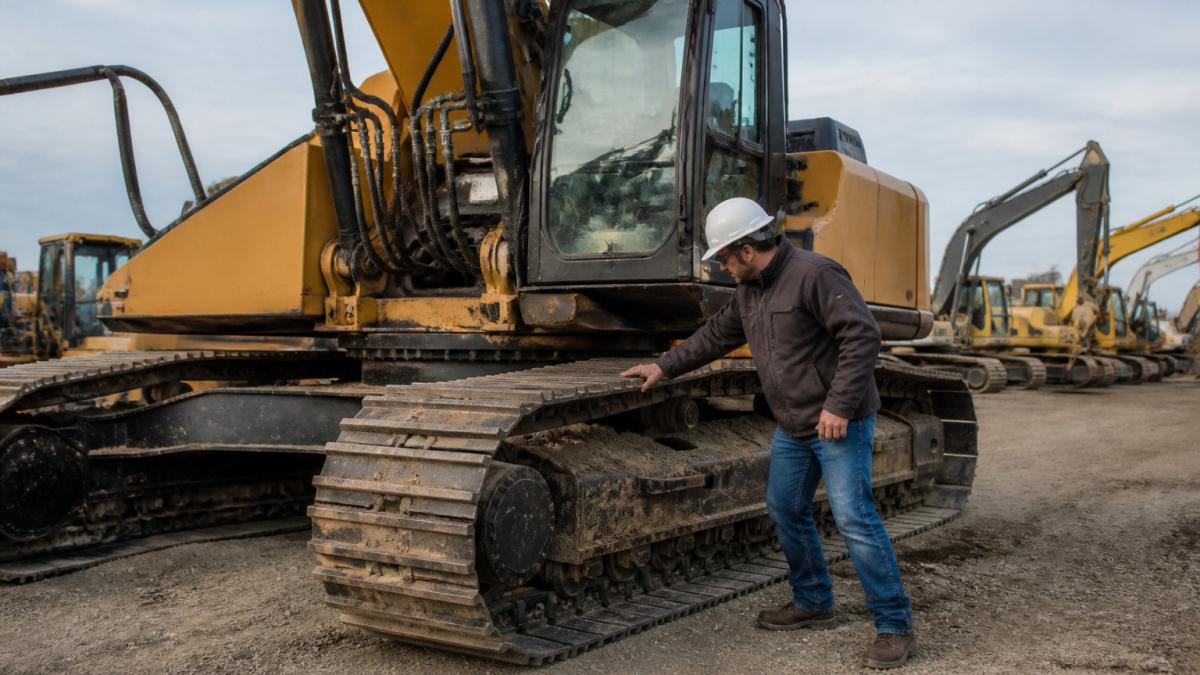
Photos and videos help, but they can hide problems. Ask for close-up shots of the undercarriage, hydraulic hoses, and the operator area. If the seller will not provide them, that tells you something too.
!Buyer in a work jacket and hard hat walking around a used excavator at an outdoor equipment yard, checking the tracks and hydraulic hoses
Checking Machine Identity, Hours and Service Records
Confirm that the machine matches its listing. Compare the serial number on the plate with the lot description, and check the model and year. A mismatch can point to a rebuilt unit or an error in the listing.
Hour meter readings show how much the machine has been used, but they are only useful if they are accurate. Ask for service records when they are available. Regular maintenance logs suggest a machine was cared for, while large gaps can mean deferred repairs.
Inspecting Equipment When In-Person Access Is Limited
Sometimes you cannot visit the yard before bidding. In that case, rely on high-quality photos, a detailed description, and direct questions to the seller. Ask about known problems, recent repairs, and whether the machine runs and moves under its own power.
Government Surplus Auction Bidding Process: Setting Your Maximum Bid
Set your maximum bid before the auction starts and stick to it. Start with the machine's likely value to you, then subtract the buyer's premium, transport, and expected repair costs. The number you have left is your real ceiling. That ceiling keeps a tempting lot from turning into an overpayment, and a disciplined way to calculate auction bids helps make the limit hold when bidding heats up.
Auction fever is real. Bidding against other buyers can push prices higher than a machine is worth to you. A firm limit protects you from overpaying.
Total Cost Planning: Fees, Transport and Repairs Before You Win
The winning bid is only the first line of your budget. A practical landed-cost estimate adds every cost you will pay before the machine is working on your site, and it is the single number you should use to decide whether to bid. Most experienced buyers build this estimate before the auction opens, not after they win.
Start with the hammer price. Then add the buyer's premium, which platforms commonly set as a percentage of the final bid. Platforms commonly set the buyer's premium as a percentage of the final bid. Some tier the fee, charging a higher percentage on smaller purchases and a lower percentage above a set amount, so confirm the tier that applies to your expected bid. Add any card or payment processing fee the platform charges, and add sales tax if your state taxes surplus equipment purchases.
Next, estimate transport and loading. Heavy equipment usually needs a licensed hauler with a trailer rated for the machine's weight, and many government yards require you to arrange loading equipment or hire a vendor who can lift or drive the machine onto the trailer. Route permits, escort vehicles, and insurance can add cost for oversize loads. Get a transport quote before you bid, because moving a machine across state lines can cost more than a minor repair.
Finally, budget for repairs and immediate maintenance. Even a machine that starts and moves may need filters, fluids, tires, undercarriage work, or hydraulic repairs soon after delivery. Set aside a repair reserve based on the inspection findings and the machine's hours. Estimate repairs based on the inspection findings and the machine's hours, then adjust up or down based on what you actually saw.
A simple landed-cost formula keeps the math honest:
- Winning bid
- Plus buyer's premium (confirm the percentage and any tier)
- Plus card or payment processing fees
- Plus sales tax, if applicable
- Plus loading and rigging at the yard
- Plus transport, permits, and insurance
- Plus immediate repairs and maintenance reserve
- Equals your landed cost
Compare that landed cost to the machine's value to you in working condition. If the landed cost leaves no margin for the risk you are taking, walk away. Watch out: buyers who budget only the bid price often discover after winning that the premium, transport, and repairs push the total well past what the machine is worth.
For current pricing or a quote, contact Ironmartonline directly before you commit.
Government Surplus Equipment Pickup and Transport After You Win
Winning the lot starts a clock. Most government sales require you to remove the equipment within a set window, and missing that window can mean forfeiting the machine or paying storage fees. Confirm the pickup location, gate hours, and removal deadline as soon as you win, and put the deadline on your calendar with a buffer.
Before pickup day, confirm site access. Some yards require appointments, limit the size of trucks that can enter, or restrict loading to certain hours. Ask whether the yard has a loading dock, ramp, or crane, and whether you must bring your own loading equipment. If the machine does not run, arrange a tow or a flatbed with a winch rather than assuming you can drive it onto a trailer.
Arrange transport with a hauler who handles your machine's size and weight. Confirm the trailer type, tie-down points, and whether the hauler carries cargo insurance that covers the load. For oversize loads, check route permits and escort requirements before the truck arrives, because a permit delay can blow through your removal deadline.
Bring the paperwork the yard requires. That usually includes your paid invoice, buyer identification, and any release or authorization form the agency issues. Some agencies require the buyer or an authorized agent to sign for release, so confirm who can pick up the machine if you cannot be there.
Use a removal checklist:
- Removal deadline and gate hours confirmed
- Appointment scheduled, if required
- Loading method and equipment confirmed
- Hauler booked with trailer rated for the machine
- Cargo insurance and permits in place
- Paid invoice and release paperwork in hand
- Authorized pickup person confirmed
- Machine inspected again during loading
Inspect the machine once more during loading. Note any damage that occurred after your inspection and photograph it before the machine leaves the yard. Watch out: removal deadlines are often enforced strictly, and a machine that is not out by the deadline can be resold or assessed storage charges at your expense.
Planning Your First Government Surplus Purchase Next Steps
Buying government surplus heavy equipment rewards careful preparation. Start by setting up your buyer account, reviewing fees, and building a total cost estimate for the machines you want. Inspect before you bid whenever you can, and treat missing information as a reason to ask questions rather than a reason to assume the best.
Frequently Asked Questions
How do you buy surplus directly from the government?
Most federal surplus property is sold through the General Services Administration and through agency sales, while state and local agencies usually sell through online auction platforms such as GovDeals or Public Surplus. Start by identifying which agency holds the equipment you want, then register for an account on the relevant platform. Buyers should expect that the government does not guarantee the condition of surplus items, so inspection before bidding matters. Read each lot description and the auction terms carefully before placing any bid.
Can anyone buy government surplus heavy equipment?
In most cases, yes. Public auctions for government surplus heavy equipment are generally open to the public, and individuals and businesses can register to bid. Some sales restrict eligibility, particularly for certain military equipment, which may be limited to qualified buyers or require specific documentation. Check the eligibility rules in each listing before you register, and confirm any restrictions that apply to the specific machine you want.
What should you check in a government surplus equipment listing?
Look for the machine's make, model, serial number, year, hour meter reading, and any stated operating condition. Check whether the lot is sold as-is and whether the seller has noted known damage or missing parts. Review the photos closely and note any details the listing leaves out. If the description is vague, ask the seller for clarification before the auction closes, because the listing description is often the only information you will have before you bid.
If you are ready to start, browse current listings and compare options at Ironmartonline. Our team can help you review lots, estimate total cost, and plan your pickup so your first government surplus purchase goes smoothly.
