
Table of Contents
- Why Used Excavator Value Is a Range, Not a Number
- Start With the Machine: Make, Model, Year, and Hours
- The Used Excavator Inspection Checklist That Moves the Number
- Excavator Resale Value by Hours and Remaining Service Life
- Pull Used Excavator Comparable Sales Instead of Guessing
- Adjusting Comps Into a Realistic Used Excavator Value Range
- When a Used Excavator Valuation Calculator Helps (and When It Misleads)
- Selling Channel Changes the Number: Private Sale, Trade-In, Auction, Retail
- Regional Demand, Seasonality, and Transport Costs
- Conclusion
- Frequently Asked Questions
Last Updated: October 21, 2026
Why Used Excavator Value Is a Range, Not a Number
Ask three people what a used excavator is worth and you'll get three answers. None of them are wrong. That's the first thing to understand about how to determine used excavator value: there is no single number sitting out there waiting to be discovered.
A valuation depends entirely on its purpose. As BDC's guidance on determining used equipment value puts it, equipment does not have one universal value independent of why you're asking. A lender wants a conservative number. A buyer wants the lowest defensible one. You want the highest one the market will actually pay.
So why use Ironmartonline as an equipment broker? Because a broker's job is to close the gap between what a machine is theoretically worth and what it actually sells for. We run nine web-based selling platforms, work without contracts or hidden fees, and put machines in front of millions of buyers. That reach is the difference between an estimate and a sale.
Below, we'll walk through the exact process: reading the machine, inspecting it, pulling comps, adjusting them, and settling on a defensible range.
Start With the Machine: Make, Model, Year, and Hours
Four data points drive most of the number: make, model, year, and operating hours. Get these wrong and every calculation downstream is wrong too.
Write them down before you do anything else:
- Make and model - the exact designation, including any suffix that signals a different configuration
- Year of manufacture - from the serial plate, not the paperwork
- Operating hours - from the hour meter, and note whether it's original or replaced
- Serial number - this is what a dealer or auction house will use to verify everything else
Brand reputation matters here. Machines from manufacturers with strong dealer networks and parts availability hold resale demand better than orphan brands. That's not sentiment, it's parts risk. A buyer who can't source a hydraulic pump cheaply will discount accordingly.
Attachments and specialized features also move the number. A standard digging bucket is expected. A hydraulic thumb, quick coupler, or grading blade adds value, but only to a buyer who needs it. Standard features keep the audience wide. Specialized features narrow it and raise the price for the right buyer.
The Used Excavator Inspection Checklist That Moves the Number
A used excavator inspection checklist is the single highest-use tool in this process. Condition is where estimates drift furthest from reality, because sellers describe machines from memory and buyers price them from evidence. Most guides list inspection items but stop short of telling you what a passing or failing result looks like, or how each finding changes the number. This checklist closes that gap with excavator-specific thresholds and adjustment guidance.
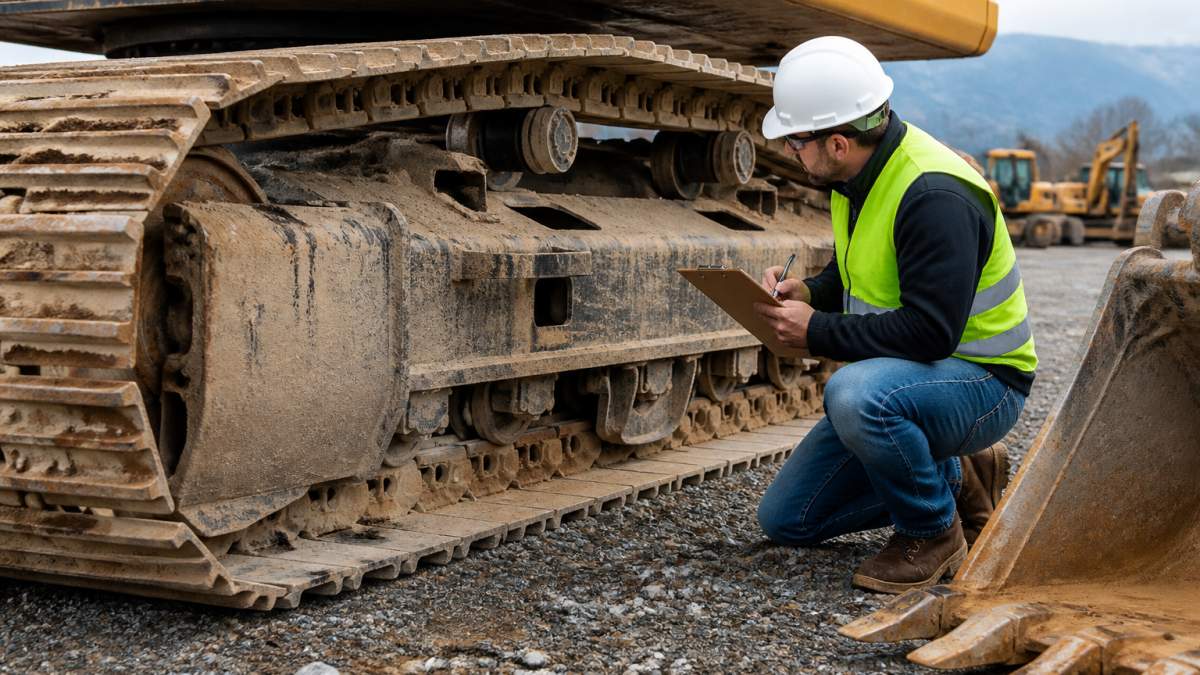
A thorough examination of the undercarriage and hydraulic components often reveals hidden wear, necessitating a precise approach to identifying equipment parts to ensure that every replacement maintains the machine's operational integrity.
Work through these in order and note the condition of each. For every item, record both the observation and a rough adjustment direction (add, subtract, or neutral) relative to your comp set.
- Undercarriage - Measure track shoe height and bushing diameter against new specs. Check sprocket teeth for sharpening or hooking, idler and roller condition for flat spots or leaks, and track tension. This is the most expensive wear item on the machine; a worn undercarriage can subtract a meaningful percentage from the base value, while a recently rebuilt one adds. Record remaining life as a percentage of new.
- Hydraulics - Inspect cylinder rods for scoring, pitting, or chrome flaking. Check hoses for cracking or weeping at fittings. Test for drift under load by holding a function against a load and watching for movement. Note any unusual noise from the pump. Hydraulic repairs are costly and unpredictable, so any weeping or drift is a subtract.
- Pins and bushings - Check for slop at the boom, stick, and bucket pivots by rocking the attachment. Excessive play indicates worn bushings and possible pin wear. Grease history shows here; a dry, squealing machine is a red flag. Replacing a full pin and bushing set is a known cost, so quantify the play and subtract accordingly.
- Engine and cooling - Look for blow-by at the breather, note smoke color at startup (blue for oil, white for coolant, black for over-fueling), check coolant condition and radiator fins for debris or corrosion. A cold-start video is useful evidence. Engine rebuild or replacement is a major subtract if symptoms are present.
- Structure - Inspect boom and stick pivot points for cracks, prior weld repairs, or deformation. Check the carbody and house for cracks or repairs. Prior attachment modifications (e.g., thumb or hammer plumbing) can be neutral or add if done well, but poor welds are a subtract. Structural cracks are a serious red flag and should be priced as a repair.
- Cab and controls - Check glass, seat condition, joystick play, monitor faults, and HVAC operation. These are smaller adjustments but affect operator comfort and resale appeal. A clean cab with working controls is a small add; a cracked windshield and faulty monitor are small subtracts.
- Fluid analysis - If the seller allows, pull engine oil and hydraulic oil samples for lab analysis. Results can reveal coolant contamination, metal wear particles, or fluid degradation that a visual inspection misses. This is a low-cost step that can justify a higher or lower adjustment with evidence.
- Maintenance history - Ask for service records, filter intervals, and major component repairs. Documented history is an add; gaps are a subtract. A machine with a complete file is easier to sell and supports a higher value.
After the inspection, translate each finding into an adjustment direction. You don't need precise dollar figures at this stage; you need a consistent set of plus, minus, and neutral marks that you will apply to your comps in the adjustment step. This checklist is also your defense when a buyer questions your number: you can point to specific measurements and observations rather than opinions.
Excavator Resale Value by Hours and Remaining Service Life
Excavator resale value by hours is a useful shorthand, but hours alone tell you very little. What matters is hours relative to the machine's expected service life and how those hours were spent.
A machine with high hours on a well-maintained undercarriage and documented service is worth more than a low-hour machine that sat idle and corroded. Hours are a proxy for wear, not a measurement of it.
Think in terms of remaining service life instead:
- Low hours, clean history - near the top of the range for its age
- Mid-life hours, documented maintenance - the broad middle, where most machines trade
- High hours, original major components - priced for the rebuild risk the buyer is taking on
- High hours, recently rebuilt engine or hydraulics - can beat a mid-life machine if the paperwork is solid
Ask directly: what major components have been replaced, and when? A rebuilt final drive or a resealed hydraulic pump changes the math. Undocumented claims don't.
Pull Used Excavator Comparable Sales Instead of Guessing
Used excavator comparable sales are the backbone of any defensible number. Comps are recent sales of machines that are genuinely similar to yours, and they beat asking prices every time.
Here's the distinction that trips people up. An asking price is a seller's hope. A sold price is a fact. Pull sold data wherever you can find it, and treat listed prices as the ceiling of the range, not the middle.
When you're selecting comps, match on:
- Same make and model family
- Similar year, within a couple of model years
- Comparable operating hours
- Similar configuration and attachments
- Same selling channel, since auction and retail prices diverge
A common mistake is pulling three listings from the other side of the country and calling it market data. Transport costs and regional demand make those numbers misleading. Keep your comps as local as the market allows.
Adjusting Comps Into a Realistic Used Excavator Value Range
Adjustment is where the actual skill lives. You don't average your comps, you adjust each one toward your machine and see where they cluster.
Run each comp through these adjustments and note whether it pushes the value up or down:
| Adjustment | If Your Machine Is Better | If Your Machine Is Worse |
|---|---|---|
| Operating hours | Add for lower hours | Subtract for higher hours |
| Undercarriage condition | Add for remaining life | Subtract for worn tracks |
| Maintenance records | Add for documented history | Subtract for gaps |
| Attachments | Add for included extras | Subtract if stripped |
| Selling channel | Compare like to like | Compare like to like |
| Location and transport | Add if demand is strong nearby | Subtract for haul distance |
Once adjusted, you'll usually see a cluster. That cluster is your range. If the comps scatter widely, you don't have enough of them or they aren't similar enough.
When a Used Excavator Valuation Calculator Helps (and When It Misleads)
A used excavator valuation calculator is a fast starting point and a poor finishing point. Use one to sanity-check your range, not to set it.
These tools work from broad inputs: make, model, year, hours, and sometimes condition ratings. That's enough to place a machine in a rough band. It is not enough to account for a rebuilt undercarriage, a documented service file, or a regional market that's hungry for that exact model.
Where calculators genuinely help:
- Giving you a quick cross-check against your comp-derived range
- Screening a machine before you invest time in a full inspection
- Starting a conversation with a lender or insurer who wants a baseline
Where they mislead:
- Treating a condition rating as a substitute for an inspection
- Ignoring selling channel entirely
- Producing a single number with false precision
Selling Channel Changes the Number: Private Sale, Trade-In, Auction, Retail
The same excavator is worth different amounts depending on how you sell it. This is the part most guides gloss over, and it's often the biggest single swing in the whole process. Competitors list channels but rarely explain the mechanics: who pays fees, who carries risk, and how long each route takes. Here is a side-by-side breakdown with concrete trade-offs and a worked example.
- Dealer trade-in - Fastest and lowest. You're paying for convenience and the dealer's resale margin. The dealer typically offers a wholesale value that leaves room for reconditioning and retail profit. No listing hassle, no payment risk, but you accept the bottom of the range.
- Auction - Variable and fast. The price depends on who shows up that day, and you carry the seller's fees (often a percentage of hammer price plus listing fees). Auctions are liquid but can produce surprises in either direction. You also bear transport to the auction site unless the auction is onsite.
- Private sale - Higher ceiling, slower. You handle tire-kickers, payment risk, and logistics yourself. You keep the full sale price but spend time and effort. Private sale works best when you have a clean, well-documented machine and patience.
- Retail through a broker - The widest audience and the strongest price, without you managing the process. A broker brings reach and handles buyer qualification. The net to you can exceed a private sale after accounting for your time and risk.
Here's the honest trade-off: the channel that pays the most usually takes the longest, unless you have reach working for you. That's the case for using a brokerage. We put machines in front of buyers across nine platforms, so a private-sale-level price doesn't have to mean a private-sale timeline.
What most sellers miss is that the channel decision should come before the valuation, not after. Pick your channel, then value the machine for that channel. A machine valued at private-sale retail is not worth that number in a trade-in scenario; the dealer's offer will reflect wholesale, not retail.
Worked example (hypothetical): Suppose your adjusted comp range for a mid-life excavator is $80,000 to $95,000 at private retail. A dealer trade-in might come in at $65,000 to $72,000 (wholesale). An auction might hammer at $70,000 to $85,000 before fees, netting you less after seller's fees. A broker-assisted retail sale might achieve a price close to the private-sale ceiling without the hassle. The numbers are illustrative, but the pattern is common: channel choice can move your net by a meaningful margin. Always compare net proceeds, not headline price.
Regional Demand, Seasonality, and Transport Costs
Geography and timing move excavator pricing as much as condition does. Two identical machines can sell weeks apart at noticeably different numbers because one sat in a strong regional market during a busy season.
Regional demand follows construction activity. Areas with heavy infrastructure and residential work absorb excavators faster than quiet markets. If your machine sits in a soft region, a buyer has to factor in hauling it out, and that discount comes out of your number.
Seasonality matters too. Demand tends to build heading into the working season and soften in the colder months in northern markets. Listing at the right time isn't a trick, it's just matching supply to demand.
Transport costs are the quiet killer. A machine that's cheap to move is worth more to a distant buyer than one that isn't. Factor haul distance into your range, and be upfront about it in your listing.
Conclusion
The hardest part of valuing a used excavator isn't the math. It's accepting that a range is the honest answer, and then choosing the channel that gets you to the top of it.
At Ironmartonline, we handle that part. Our heavy equipment brokerage puts your machine on nine web-based selling platforms, with no contracts and no hidden fees, reaching millions of buyers locally and globally. We've built our reputation on connecting sellers to the right buyers efficiently.
Join our email list to see how we market machines and what they're actually selling for.
Frequently Asked Questions
How much is my used excavator worth?
There is no single figure. Used excavator value depends on make, model, year, operating hours, condition, attachments, and the channel you sell through. Auction results and dealer retail prices for the same machine can sit far apart. Build a range instead: pull at least four to six used excavator comparable sales for machines within a few years and a few hundred hours of yours, then adjust for undercarriage wear, maintenance records, and attachments. The result is a defensible band, not one number, and that band is what you present to buyers.
How do operating hours affect excavator resale value by hours?
Hours are a proxy for wear and remaining service life, not a scoreboard. A 4,000-hour machine with documented maintenance and a fresh undercarriage often beats a 2,500-hour machine with no records and worn tracks. What matters is hours relative to the class and use: a high-hour machine that ran light duty in a yard is different from one that ran a breaker in rock. Compare your hours against comps in the same size class and duty cycle, then adjust for undercarriage condition, hydraulic health, and whether major components have been rebuilt.
Is there a blue book for used excavators?
Not in the way there is for cars. Equipment valuation guides and used excavator valuation calculator tools exist, but they produce estimates from limited data and cannot see your machine's actual condition. The valuation method also depends on purpose: a lender, an insurer, and a buyer at auction are each solving a different problem. Treat any guide value as one input. Pair it with used excavator comparable sales, an inspection, and a channel adjustment before you commit to an asking price.
What should I inspect before valuing a used excavator?
Work through a used excavator inspection checklist covering undercarriage (track shoes, rollers, idlers, sprockets, chain stretch), hydraulic cylinders and hoses for leaks or weeping, pins and bushings for play, bucket and cutting edge wear, engine and cooling system condition, and the cab interior and electronics. Pull fluid samples where you can and request maintenance history. Photograph every wear point. Documented flaws let you price honestly and defend the number, while undocumented ones surface during the buyer's inspection and cost you leverage.