
Table of Contents
- Why Use an Equipment Broker When Selling Your Excavator?
- How to Sell Used Excavators Safely: Preparation Steps
- Excavator Inspection Checklist for Sellers
- Setting Competitive Pricing and Market Value
- Secure Payment Methods for Heavy Equipment
- Avoiding Heavy Equipment Scams and Fraud
- Legal Aspects of Selling Used Machinery
- Where to List Used Excavators: Private Sale vs. Auction
- Common Mistakes to Avoid When Selling Excavators
- Conclusion: Selling Your Excavator Safely and Efficiently
How to Sell Used Excavators Safely: A 2026 Guide
Last Updated: July 21, 2026
Why Use an Equipment Broker When Selling Your Excavator?
Learning how to sell used excavators safely requires more than just posting an ad online. The equipment market is complex, and private sales carry real risks, from fraud and payment issues to legal complications and logistics headaches. At Ironmartonline, we've seen countless sellers navigate these challenges, and the ones who succeed share one thing in common: they take a methodical, safety-first approach.
But here's the question most sellers ask before diving in: why use an equipment broker when selling your excavator? The answer lies in what private sales demand of you. When you sell directly, you become responsible for vetting buyers, managing inspections, handling secure payments, and navigating the paperwork. You're exposed to scammers, delayed payments, and disputes over equipment condition. An equipment broker like Ironmartonline eliminates most of this friction by using nine specialized web-based selling platforms that reach millions of potential buyers globally. Instead of managing the sale yourself, you get professional representation, verified buyer networks, and simplified transactions, all without contracts or hidden fees.
The real value isn't just reach. It's protection. Brokers maintain buyer verification systems, handle payment security through escrow services, and manage the logistics that private sellers often bungle. According to industry practitioners, the difference between a successful equipment sale and a problematic one often comes down to process rigor. Below, we'll show you exactly how to sell used excavators safely, whether you choose to work with a broker or handle the sale independently. The frameworks and safeguards we cover have helped hundreds of equipment owners avoid costly mistakes and close deals faster.
How to Sell Used Excavators Safely: Preparation Steps
The foundation of any safe equipment sale is preparation. Most sellers jump straight to listing without documenting their machinery's history, and this single mistake costs them thousands in negotiating power and buyer confidence. Before you contact a single buyer, your excavator needs a complete paper trail.
Proper preparation accomplishes three things: it proves your equipment's condition and maintenance history, it protects you legally by documenting what you're selling, and it dramatically increases buyer confidence, which translates directly into faster sales and better prices. Think of preparation as building a case for why your excavator is worth the asking price.
Document Service Records and Maintenance Logs
Every service record you have is evidence of responsible ownership. Buyers of used excavators understand that maintenance history directly correlates with remaining equipment life. A machine with documented regular service is worth 15-20% more than an identical unit with no records.
Gather these documents:
- Oil change receipts and service logs (every interval)
- Hydraulic system maintenance records
- Filter replacements and fluid top-ups
- Major repair invoices (engine work, transmission, undercarriage)
- Warranty documentation if still valid
- Operator manuals and parts lists
Organize these chronologically and create a summary document that lists every service date and type of work performed. If some records are missing, note that honestly in your listing. Buyers respect transparency far more than gaps they discover later. Digital scans of all documents should be prepared for sharing with serious buyers, this is non-negotiable for high-value equipment sales.
Gather Equipment Specifications and Serial Numbers
Your excavator's specifications are the baseline for pricing and verification. Buyers need to confirm they're purchasing exactly what the listing describes, and you need documentation to prove ownership and condition.
Collect:
- Serial number (VIN equivalent for heavy equipment)
- Make, model, and year of manufacture
- Engine type and horsepower rating
- Operating weight and bucket capacity
- Hydraulic system pressure and flow specifications
- Maximum digging depth and reach
- Current operating hours (from the hour meter)
- Fuel capacity and type
- Transmission type (manual, automatic, CVT)
Cross-reference these specs against the manufacturer's documentation. Mismatches between what you think your excavator is and what it actually is can derail sales and create legal disputes. If you're unsure about any specification, contact the manufacturer's support line or consult the equipment manual.
Excavator Inspection Checklist for Sellers
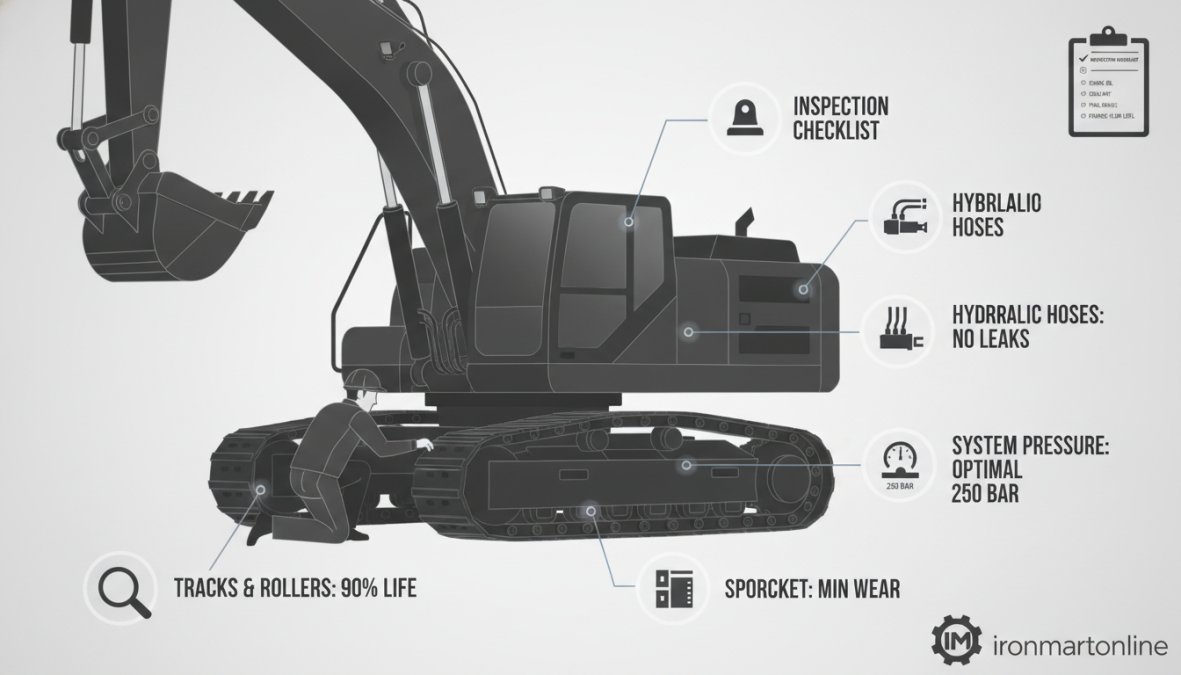
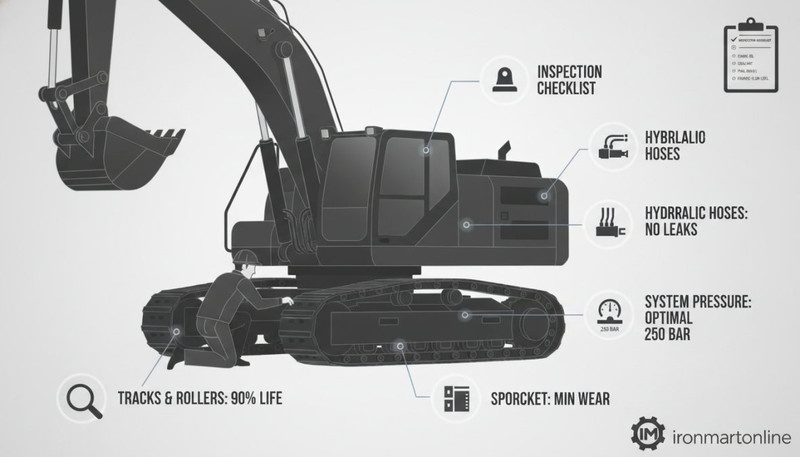
Before listing, you need to know your equipment's actual condition. This isn't about hiding problems, it's about understanding what you're selling so you can price accurately and answer buyer questions confidently. A pre-sale inspection also gives you the chance to address minor issues that could tank a deal.
Conduct a thorough inspection yourself, then consider having a third-party mechanic review the equipment if you're uncertain about any findings. This costs $200-400 but can save you thousands in negotiation disputes.
Undercarriage and Hydraulic System Assessment
The undercarriage is where most wear accumulates on an excavator. Cracked or severely worn undercarriage components signal expensive repairs ahead, and buyers know this. Hydraulic leaks, meanwhile, are immediate red flags, they indicate seal failure and potential system collapse.
Inspect these undercarriage elements:
- Track condition (tread depth, cracks, missing links)
- Idler wheels and sprockets (wear patterns, damage)
- Frame and boom welds (cracks, separation)
- Bucket teeth and edges (wear, missing teeth)
- Pin connections (rust, corrosion, play in joints)
For the hydraulic system:
- Check all visible hoses for leaks, cracks, or bulging
- Inspect cylinders for rod damage or scoring
- Look for fluid pooling under the machine
- Test bucket and boom movement for sluggishness or jerking
- Listen for unusual noises during operation (grinding, squealing)
Document any issues with photos and notes. Minor wear is normal and expected; major issues need disclosure and pricing adjustment.
Operating Hours and Engine Condition
Operating hours are the excavator equivalent of mileage on a car. An excavator with 5,000 hours is significantly more valuable than one with 12,000 hours, all else equal. Engine condition directly impacts those hours, a well-maintained engine at 10,000 hours can be more reliable than a neglected one at 6,000.
Check:
- Hour meter reading (photograph it for proof)
- Engine oil color and level (dark oil suggests long intervals between changes)
- Coolant level and condition (rust-colored fluid indicates corrosion)
- Air filter condition (clogged filters indicate poor maintenance)
- Battery terminals (corrosion suggests electrical issues)
- Fuel tank interior (look for rust or sediment through the filler)
- Exhaust for excessive smoke or leaks
Start the engine and listen for rough idling, knocking, or excessive vibration. These are signs of internal engine problems that will be expensive for the buyer to address.
Setting Competitive Pricing and Market Value
Pricing is where most sellers either leave money on the table or price themselves out of the market entirely. The right price reflects your excavator's condition, market demand, and comparable sales, not what you hope to get or what you paid for it years ago.
Research comparable excavators currently listed and recently sold. Check Equipment Trader, Iron Planet, and other major marketplaces for similar models with comparable hours and condition. Note the asking prices and, if available, actual sale prices. Asking price and sale price often differ significantly, aim for the realistic sale price range, not the asking price.
Many sellers make the mistake of pricing based on emotion or original cost. An excavator that cost $150,000 new might realistically sell for $35,000-45,000 used, depending on age, hours, and condition. Accept market reality early and you'll avoid months of failed listings.
Secure Payment Methods for Heavy Equipment
The moment money changes hands is when most equipment sales go wrong. Scammers exploit this vulnerability by offering wire transfers that bounce, cashier's checks that are counterfeit, or payment plans that evaporate. Protecting yourself requires using payment methods designed for high-value transactions.
Wire Transfers and Escrow Services
Wire transfers are the standard for equipment sales above $10,000, but they carry risk if the buyer's bank account is compromised or fraudulent. Escrow services add a critical layer of protection: a neutral third party holds the funds until both buyer and seller confirm the transaction is legitimate.
How escrow works:
- Buyer deposits funds into escrow account (held by escrow company, not you)
- You release the equipment for inspection and transport
- Buyer confirms receipt and condition
- Escrow releases funds to you
This protects both parties. You're guaranteed payment before releasing the equipment, and the buyer can verify condition before funds are released. Escrow typically costs 1-2% of the sale price, split between buyer and seller.
For wire transfers without escrow, require these safeguards:
- Payment from a verified business bank account (not personal)
- Call the buyer's bank directly to confirm the wire details
- Never release equipment until funds clear completely (allow 2-3 business days)
- Require a bill of sale signed by the buyer before equipment leaves your property
Vetting Buyers and Fraud Prevention
Not every inquiry is a legitimate buyer. Scammers use several tactics: they ask for equipment shipment before payment, they offer prices significantly above market (then request a refund for "overpayment"), or they claim to be international buyers with logistics companies that handle payment later.
Red flags that signal a scam:
- Buyer wants to pay via wire transfer to a third-party logistics company
- Buyer offers to pay more than asking price
- Buyer refuses inspection or wants equipment shipped immediately
- Buyer cannot provide business references or verifiable contact information
- Buyer pressures you for quick decision or threatens to buy elsewhere
- Communication is vague or contains grammatical errors suggesting non-native English speaker in a suspicious context
Legitimate buyers:
- Want to inspect equipment in person or hire a professional inspector
- Ask detailed questions about maintenance history and current condition
- Provide business information and can be contacted at multiple numbers
- Offer payment through established channels (wire, escrow, bank check)
- Are willing to wait for proper documentation and title transfer
Avoiding Heavy Equipment Scams and Fraud
The heavy equipment market attracts sophisticated fraud operations. Understanding common scams helps you avoid becoming a victim.
The most common scam involves counterfeit cashier's checks. A buyer sends a check for the full amount, you deposit it, release the equipment, and 2-3 weeks later the bank notifies you the check was fraudulent. By then, the equipment is gone and you've lost the entire sale price. Never release equipment based on a check deposit, wait for the check to fully clear at your bank, which takes 10-14 business days.
Wire transfer reversals are another common attack. A buyer initiates a wire transfer, you release equipment, then the buyer claims fraud with their bank and reverses the transaction. You lose the equipment and the payment. Protect yourself by:
- Confirming the buyer's identity independently
- Waiting 3-5 business days after wire transfer before releasing equipment
- Using escrow services for transactions over $25,000
- Keeping detailed records of all communications and agreements
FBI guidance on equipment sale fraud
International buyers present additional risk. While legitimate international purchases happen, the distance and complexity create opportunities for fraud. Require:
- Verified business registration in their country
- References from previous equipment purchases
- Escrow payment through an international service
- Clear customs and import documentation responsibility assignment
Legal Aspects of Selling Used Machinery
The legal side of equipment sales protects both you and the buyer. Missing or incorrect documentation creates liability that can haunt you months after the sale.
Title Transfer and Bill of Sale Documentation
Most states require a bill of sale for equipment transactions above a certain value (typically $500-$1,000). This document proves ownership transfer and protects you from liability if the buyer uses the equipment illegally or causes damage after purchase.
Your bill of sale should include:
- Date of sale
- Full legal names and addresses of buyer and seller
- Equipment description (make, model, year, serial number)
- Purchase price
- Equipment condition statement ("sold as-is" or specific repairs included)
- Signature and date from both parties
- Statement that seller has the right to sell the equipment
Keep a signed copy for your records. For equipment with titles (some states require this), transfer the title through your state's department of motor vehicles or equivalent agency. Contact your state's DMV before the sale to understand title transfer requirements.
Tax Implications and Reporting Requirements
Equipment sales may have tax consequences. If you sell an excavator for more than your adjusted basis (original cost minus depreciation claimed), you'll owe capital gains tax on the profit. If you sell for less, you may be able to claim a loss.
Consult a tax professional before the sale to understand:
- Your adjusted basis in the equipment
- Whether the sale qualifies for Section 1231 treatment (generally favorable for equipment)
- Estimated tax liability
- Whether you need to make quarterly estimated tax payments
- State-specific equipment sales tax requirements
For business equipment, you may be required to file Form 4797 (Sales of Business Property) with your tax return. The IRS tracks equipment sales, especially high-value ones, so proper reporting is essential.
Where to List Used Excavators: Private Sale vs. Auction
Two primary channels exist for selling equipment: private sale and auction. Each has advantages and drawbacks.
Private Sale Advantages:
- Higher final price (no auction fees or commission)
- Control over buyer vetting
- Time to negotiate terms
- Can highlight equipment's unique features
Private Sale Disadvantages:
- Takes longer to find qualified buyers
- More work managing inquiries and inspections
- Higher personal liability during sales process
- Requires secure payment handling
Auction Advantages:
- Faster sale (auctions close on a set date)
- Built-in buyer verification
- Professional handling of payment and logistics
- No negotiation required
Auction Disadvantages:
- Auction house takes 10-15% commission
- Potentially lower final price due to competition
- Less control over who buys the equipment
- Equipment must meet auction house standards
For private sales, list on Equipment Trader, Machinery Trader, and industry-specific platforms. Professional heavy equipment brokers like Ironmartonline maintain networks across multiple platforms, giving your equipment exposure to millions of qualified buyers without the overhead of managing the sale yourself. Brokers handle buyer verification, payment security, and logistics, critical functions that protect you throughout the transaction.
| Sales Channel | Time to Sale | Final Price | Effort Required | Risk Level |
|---|---|---|---|---|
| Private sale (direct) | 4-12 weeks | Highest | Very high | High |
| Private sale (broker) | 2-6 weeks | High | Low | Low |
| Unreserved auction | 2-4 weeks | Moderate | Low | Low |
| Reserved auction | 4-8 weeks | Moderate-high | Low | Low |
Common Mistakes to Avoid When Selling Excavators
Sellers repeat the same errors repeatedly. Learning from others' mistakes accelerates your path to a successful sale.
Mistake 1: Overpricing and refusing to adjust. A machine listed at $50,000 that receives no inquiries in four weeks should be repriced. The market has spoken. Dropping the price by 5-10% often generates immediate interest and multiple offers. Stubbornness costs you months and eventually results in a lower sale price than you would have received earlier.
Mistake 2: Poor photography and vague descriptions. Buyers make decisions based on photos. Blurry images, poor lighting, and missing angles signal that you don't care about the sale. Invest in clear, well-lit photos showing the equipment from multiple angles, close-ups of the undercarriage and hydraulic system, and the hour meter reading. Include detailed specifications and maintenance history in the listing.
Mistake 3: Accepting payment before verifying funds. This is the #1 cause of equipment seller fraud. A buyer sends a check or wire transfer notification, you release the equipment, and the payment bounces or reverses. Wait for funds to fully clear before releasing anything.
Mistake 4: Failing to document equipment condition. If a buyer claims the equipment arrived damaged or non-functional, you need proof of its condition at the time of sale. Photograph and video record the equipment's operation before it leaves your property. Have the buyer sign a condition statement acknowledging the equipment's state.
Mistake 5: Skipping the bill of sale. This document is your legal proof that you're no longer responsible for the equipment. Without it, you could face liability if the buyer uses the equipment illegally or it causes damage. Never skip this step.
Conclusion: Selling Your Excavator Safely and Efficiently
Selling heavy equipment safely requires process discipline, documentation, verification, secure payments, and legal protection. Most sellers who encounter problems did so because they skipped steps or trusted the wrong buyers.
Ironmartonline specializes in connecting equipment sellers with verified buyers across nine global platforms, handling payment security through escrow services, managing title transfers and documentation, and coordinating logistics, all without contracts or hidden fees. Rather than managing these complexities yourself, working with a professional broker eliminates the friction and risk that plague private sales.
Whether you sell independently or through a broker, apply the safeguards in this guide: document maintenance history, inspect thoroughly, price competitively, vet buyers carefully, and use secure payment methods. These practices protect your interests and result in faster sales at better prices.
Equipment Trader marketplace safety guidelines
National Association of Equipment Dealers resources on sales documentation
Frequently Asked Questions
What are the biggest risks when selling a used excavator privately?
Private sales expose you to payment fraud, buyer disputes over equipment condition, title transfer complications, and liability issues if the equipment is damaged during inspection or transport. Unvetted buyers may misrepresent their ability to pay or attempt to negotiate after inspecting the machine. Secure payment methods and thorough documentation significantly reduce these risks. Working with a reputable equipment broker can mitigate many of these concerns by handling buyer verification and payment processing.
What documentation do I need to sell a used excavator safely?
Essential documents include the original title or bill of sale, complete maintenance and service records, operator manuals, warranty information if still valid, and a detailed equipment specification sheet with serial number and operating hours. For tax purposes, maintain records of the sale price and transaction date. A professional excavator inspection report adds credibility and protects both parties. These documents establish the machine's legitimacy, condition history, and legal ownership, critical for buyer confidence and legal compliance.
How can I protect myself from scams when selling heavy equipment online?
Verify buyer credentials before allowing inspections, require deposits through secure escrow services rather than direct bank transfers, and never release title or equipment until payment fully clears. Request references from previous equipment purchases and check their business registration. Use only established listing platforms with fraud protection policies. Avoid buyers who pressure you to skip documentation steps or offer unusually high prices. Meet for inspections in safe, public locations and bring a colleague. Document all communications in writing.
Should I use an escrow service when selling a used excavator?
Yes, escrow services are highly recommended for high-value equipment sales. An escrow service holds buyer funds until both parties confirm the equipment's condition and all documentation is complete, protecting you from payment disputes and fraud. The buyer gains assurance that the equipment matches the listing description before releasing payment. While escrow involves a small fee, the security and legal protection it provides justifies the cost for excavators and other heavy machinery. This approach is standard practice among professional equipment brokers and dealers.
This article was written using GrandRanker