
Table of Contents
- Why Use an Equipment Broker for International Machinery Shipping
- Understanding How to Ship Heavy Machinery Internationally
- Pre-Shipment Equipment Assessment and Preparation
- Heavy Equipment Shipping Documentation Requirements
- RORO vs Container Shipping for Machinery: Choosing Your Method
- Preparing Heavy Equipment for Overseas Transport
- Customs Clearance and International Compliance
- Calculating Costs, Insurance, and Transit Timelines
- Frequently Asked Questions
Last Updated: September 1, 2026
Why Use an Equipment Broker for International Machinery Shipping
When shipping heavy machinery internationally, complexity multiplies fast. Documentation requirements vary by country. Shipping methods depend on equipment type and destination. Customs clearance timelines stretch unpredictably. Most sellers and fleet managers handle this alone and lose weeks to coordination problems, incomplete paperwork, or wrong shipping choices.
This is why understanding how to ship heavy machinery internationally matters. The global heavy equipment transport services market is valued at $10 billion in 2024, projected to reach $15 billion by 2033. The global heavy construction equipment market size was valued at USD 204.4 billion in 2023 and is projected to grow from USD 233.4 billion in 2026 to USD 289.3 billion by 2030, at a CAGR of 5.2% from 2024 to 2030.
But here's the critical question: why use a Heavy Equipment Broker for international machinery shipping? The answer lies in three concrete realities. First, brokers maintain direct relationships with freight forwarders, customs agents, and shipping lines. They know which carriers handle your specific equipment type and which ports offer the fastest clearance. Second, brokers consolidate shipments and negotiate rates, something individual sellers cannot do. Third, they absorb the coordination burden. Documentation gets verified before submission. Export compliance gets checked against destination rules. Transit timelines get managed end-to-end.
Without this expertise, a single mistake, misfiled commercial invoice, wrong Incoterms declaration, incomplete pre-shipment inspection, can delay your shipment by two weeks or trigger unexpected import duties. A broker prevents that. At Ironmartonline, we've helped construction contractors, fleet managers, and owner-operators move surplus equipment to buyers worldwide using our nine specialized web-based platforms. Our team handles the logistics complexity so you don't have to.
The rest of this guide walks you through exactly how to ship heavy machinery internationally, whether you work with a broker or manage the process yourself.
Understanding How to Ship Heavy Machinery Internationally
Shipping heavy machinery internationally differs fundamentally from standard freight. Your equipment likely weighs 10 to 500+ tons, requires specialized handling, and must survive weeks in saltwater environments. The method you choose, roll-on roll-off (RoRo), container, flat-rack, or breakbulk, determines cost, timeline, and whether your machinery arrives operational.
Construction machinery makes up approximately 40% of heavy equipment shipments. This includes excavators, dozers, wheel loaders, and graders. Each type ships differently. An operable excavator with tracks intact might go RoRo. A disassembled dozer may fit in a container. An oversized dragline requires flat-rack or breakbulk.
International ocean transit for heavy machinery typically takes 15-45 days port-to-port. Add inland transport, customs clearance, and final delivery, and total time ranges from 4-8 weeks. Nearly 40% of international heavy equipment shipments are ocean-based. The remaining 60% use road, rail, or intermodal combinations. Your choice depends on origin, destination, equipment size, and budget.
Pre-Shipment Equipment Assessment and Preparation
Before any shipment leaves your yard, you need a complete equipment assessment. This step determines shipping method, cost accuracy, and whether your machinery will arrive in sellable condition.
Start with physical measurements and weight documentation. Measure length, width, height, and diagonal. Weigh the equipment on a certified scale. Actual dimensions often differ from specifications due to attachments or modifications. A bucket on an excavator adds 18 inches to overall length. These details matter because they determine whether your equipment fits in a 40-foot container (40'L × 8'W × 8'6"H) or requires flat-rack or breakbulk.
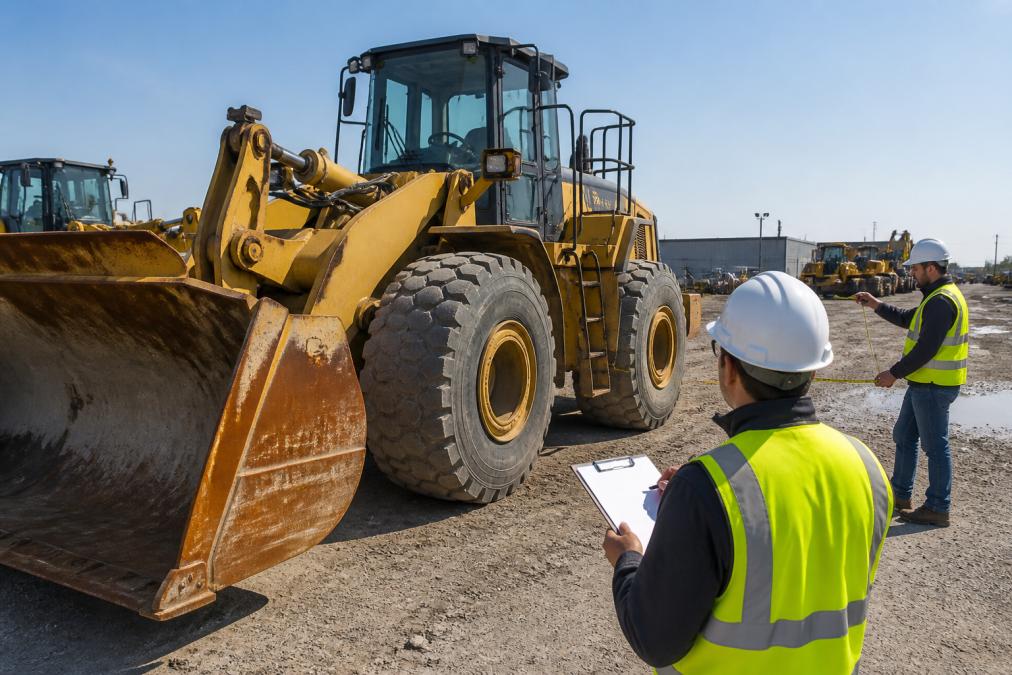
Document the equipment's operating condition. Can the engine start? Do hydraulics work? Are there fluid leaks? Take photographs of the entire unit from all angles and close-ups of any damage. This protects you by establishing pre-shipment condition and providing buyers with proof of working condition.
Check for hazardous materials compliance. Fuel tanks, hydraulic fluid, and coolant must be drained or certified safe for transport. If your equipment contains fluid residue exceeding regulatory thresholds, you'll need hazmat certification or face customs holds and fines.
Verify the equipment's title and ownership documentation. International buyers want clear proof of ownership. If the equipment was financed, ensure the lien is released. Obtain a pre-shipment inspection certificate if shipping internationally. This third-party verification confirms the equipment's condition, dimensions, and weight. Many destination countries require ISPM-15 standards certification for wooden crating materials.
Heavy Equipment Shipping Documentation Requirements
Documentation is where most international shipments get delayed. Missing or incorrect paperwork can hold equipment at the port for weeks, triggering storage fees and demurrage charges. You must also establish who bears the cost and risk at each stage. This is where Incoterms 2020 becomes critical.
Understanding Incoterms 2020 for Heavy Machinery
Incoterms are standardized international commercial terms that define the buyer's and seller's obligations, costs, and risk transfer. For heavy machinery, the Incoterm you choose determines who pays for freight, insurance, customs clearance, and who is liable if the equipment is damaged or lost in transit.
The most common Incoterms for heavy equipment are:
Ex Works (EXW): The buyer assumes all costs and risk once the equipment leaves your facility. You are responsible only for making the equipment available at your location. This minimizes your liability but may deter international buyers lacking logistics expertise.
Free on Board (FOB): You pay for transport to the origin port and assume risk until the equipment is loaded onto the vessel. Once loaded, the buyer assumes all risk and cost. FOB is common for RoRo shipments. You remain liable for loading damage, so proper securing and documentation are essential.
Cost, Insurance, and Freight (CIF): You pay for freight, insurance, and all costs to the destination port. Risk transfers to the buyer once the equipment is loaded at the origin port. CIF gives you control over the shipping method and carrier selection.
Delivered Duty Paid (DDP): You pay for everything, including destination customs clearance and import duties. The buyer receives the equipment ready to use. DDP exposes you to unexpected import duty costs and destination-country compliance risks.
For international heavy machinery sales, FOB and CIF are most common. Always specify your chosen Incoterm in the commercial invoice and bill of lading.
Core Shipping Documents
The bill of lading is your core shipping document. This contract confirms what cargo is being shipped, from where, to where, and on what terms. It serves as proof of ownership and is required for customs clearance. Always request a clean bill of lading (no notations of damage or discrepancies).
The commercial invoice is the financial document stating the equipment's sale price, payment terms, buyer/seller details, and the agreed Incoterm. Destination customs authorities use this to calculate import duties. Include the equipment's serial number, condition (used or new), and any relevant certifications.
The packing list details what's inside each container or flat-rack. If shipping multiple pieces or one large machine disassembled, the packing list maps each component to its location. For containerized shipments, include the container seal number and weight of each crate.
The certificate of origin declares where the equipment was manufactured. Many countries apply preferential tariffs based on origin. U.S.-manufactured equipment may qualify for lower duties under trade agreements like USMCA.
Export documentation depends on the equipment type and destination. Most heavy construction equipment falls under General License GTDA (no export license required). However, verify your specific equipment type on the BIS website at BIS Export Administration Regulations. Some specialized machinery, equipment with advanced controls, or dual-use technology may require an export license.
The shipper's letter of instruction (SLI) tells the freight forwarder exactly what you want done: which port to use, which shipping line to book, whether to insure the cargo, and where to deliver it. Include your chosen Incoterm so the forwarder knows who pays for what.
For used equipment, obtain a pre-shipment inspection certificate from a third-party inspector. This certifies the equipment's condition, dimensions, weight, and operational status. The inspection also verifies that wooden crating materials meet ISPM-15 phytosanitary standards.
RORO vs Container Shipping for Machinery: Choosing Your Method
Your choice between roll-on roll-off (RoRo) and container shipping determines cost, timeline, and equipment condition at arrival.
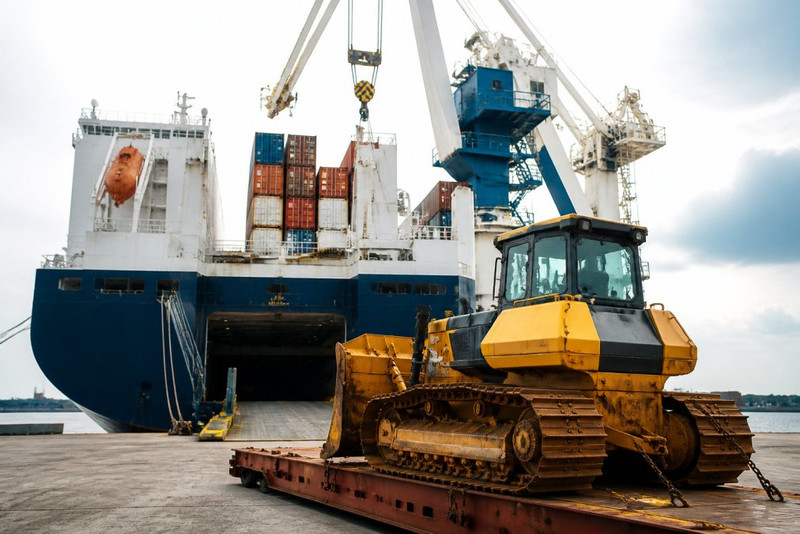
Roll-on roll-off (RoRo) is the most common method for operable heavy equipment. The machinery drives or is towed onto a specialized vessel designed to carry wheeled and tracked vehicles. Excavators, wheel loaders, dozers, and graders are ideal RoRo candidates. RoRo is faster and cheaper than container shipping for operable equipment.
RoRo's main limitation is exposure. Your equipment sits on an open deck, exposed to salt spray, wind, and weather. Rust forms on exposed metal. Paint fades. This is acceptable for used equipment sold as-is, but if you're selling premium machinery that must arrive in showroom condition, RoRo is risky.
Container shipping offers protection. Your equipment is disassembled, crated, and loaded into a 40-foot or high-cube container. The container is sealed, protecting contents from weather, salt spray, and theft. This method costs more but your equipment arrives in better condition.
Container shipping requires disassembly skill. Removing a bucket from an excavator, disconnecting hydraulic lines, and crating components takes time and labor. This adds 3-7 days to your timeline and increases costs, but the protection often justifies the expense.
Flat-rack shipping is the middle ground. Your equipment sits on an open flat-rack container with steel supports and tie-down points. It's not fully enclosed, but the frame provides structure and securement. Flat-racks work well for oversized equipment that doesn't fit in standard containers.
Breakbulk shipping is the last resort for extremely large or oddly shaped machinery. Your equipment is loaded directly onto the vessel without a container or flat-rack. Breakbulk is expensive and slow, but it's the only option for equipment exceeding 500 tons or with dimensions that don't fit standard shipping infrastructure.
Preparing Heavy Equipment for Overseas Transport
Once you've chosen your shipping method, preparation begins. This phase determines whether your equipment survives the journey intact.
For RoRo shipments, preparation is minimal. Drain fuel and hydraulic fluid to safe levels. Remove or secure any loose attachments, buckets, blades, or hydraulic arms. Secure the cab doors and windows. Ensure the equipment can be driven or towed onto the vessel.
For container shipments, disassembly is critical. Remove the bucket and hydraulic arms. Disconnect hydraulic lines and cap them to prevent fluid leakage. Drain all fluid reservoirs completely. Each component gets wrapped in heavy plastic, then packed in wooden crates with foam padding.
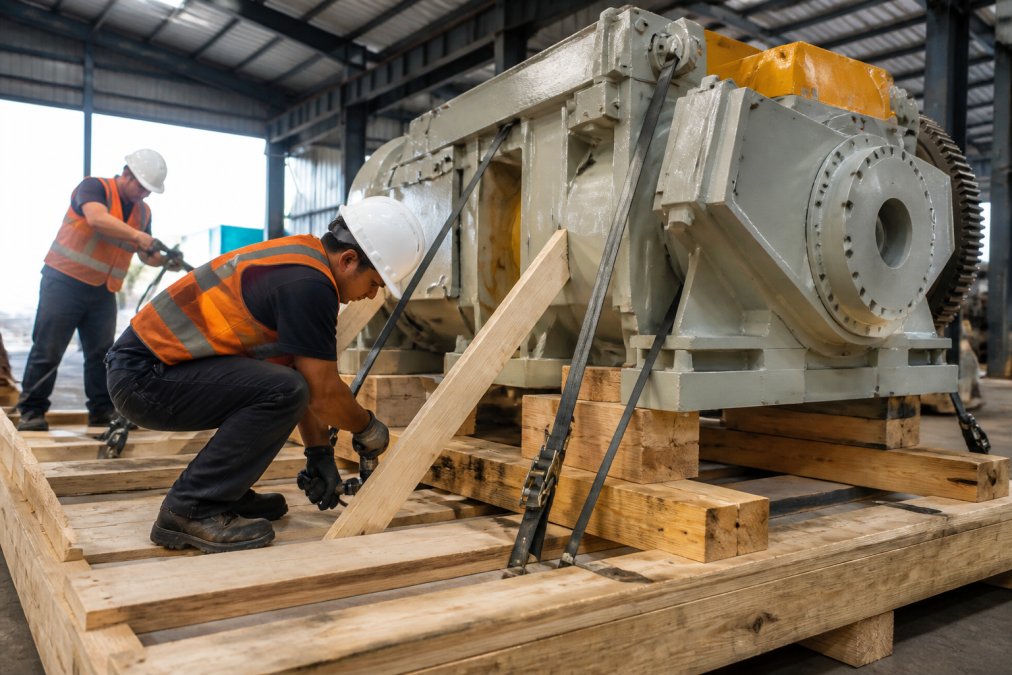
Crating materials must meet ISPM-15 standards if shipping internationally. Wood must be kiln-dried and heat-treated, or fumigated with methyl bromide. Your crating vendor should provide ISPM-15 certification. Without it, destination customs will reject your shipment.
Label every crate clearly with your equipment's serial number, destination address, and handling instructions. Include your contact information and the freight forwarder's details. Clear labeling prevents mix-ups at the port and speeds unloading.
For flat-rack shipments, secure your equipment with steel straps and turnbuckles. The equipment must not shift during the 15-45 day ocean transit. Use at least four tie-down points, and use straps rated for at least 5 tons of tension each.
Document everything with photographs. Take images before disassembly, during crating, and after loading. These images prove the condition at shipment and protect you against damage claims.
Customs Clearance and International Compliance
Customs clearance is where many shipments stall. Your equipment must satisfy the importing country's regulations, and the process can take 1-5 workdays with correct documentation or two weeks with errors. Compliance requirements vary dramatically by destination region.
How Customs Clearance Works
The destination country's customs authority will inspect your shipment, verify the bill of lading matches the cargo, check that the commercial invoice is accurate, and assess import duties. Your freight forwarder or customs broker at the destination handles most of this process. They prepare the import documentation, file necessary forms with customs, arrange cargo inspection if required, and coordinate equipment release.
Country-Specific Import Restrictions and Compliance Checklist
Before shipment, research the destination country's specific import rules.
Shipments to European Union Countries:
- Verify equipment meets EU emissions standards (Stage V for non-road mobile machinery).
- Confirm the equipment has a CE mark or can obtain one at the destination.
- Obtain a pre-shipment inspection certificate. Most EU countries require this for used machinery imports.
- Check if the equipment requires a Type Approval Certificate (TAC). This can take 4-8 weeks to obtain.
- Verify tariff classification under the EU's Combined Nomenclature (CN).
- Confirm that wooden crating materials meet ISPM-15 standards.
- Research anti-dumping duties. Some EU countries apply additional tariffs on used machinery from specific origins.
Shipments to Asian Markets (China, India, Japan, South Korea):
- Verify equipment meets local emissions and safety standards.
- Obtain a Certificate of Conformity (CoC) or equivalent.
- Check import restrictions on used machinery. Some Asian countries restrict used equipment imports to protect domestic manufacturers.
- Confirm tariff rates.
- Verify that the equipment's serial number and identification are clearly documented.
- Research local registration requirements.
Shipments to Latin American Markets (Mexico, Brazil, Colombia):
- Verify compliance with local emissions standards.
- Confirm tariff classification under the Harmonized System (HS) code.
- Check for trade agreement benefits. Equipment shipped from the U.S. to Mexico may qualify for reduced tariffs under USMCA if it meets rules-of-origin requirements.
- Obtain a pre-shipment inspection certificate.
- Verify that the bill of lading and commercial invoice are in Spanish or Portuguese or include certified translations.
- Research local financing restrictions.
Export Compliance from the United States
Export compliance from the U.S. requires attention to the Bureau of Industry and Security (BIS) classification. Most heavy equipment falls under General License GTDA (no export license required). However, verify your specific equipment type on the BIS website at BIS Export Administration Regulations. Some specialized machinery may require an export license: equipment with advanced controls or sensors, certain hydraulic systems, dual-use technology, or equipment destined for countries under U.S. trade sanctions. If your equipment requires an export license, apply via the SNAP-R system at SNAP-R Application Portal. Processing typically takes 10-30 days.
Documentation Red Flags That Trigger Customs Holds
Customs authorities hold shipments when they identify discrepancies. Common red flags include: bill of lading weight differs from commercial invoice weight by more than 5%, equipment description is vague, commercial invoice price is significantly lower than market value, missing or incomplete pre-shipment inspection certificate, wooden crating materials lack ISPM-15 certification, equipment contains undeclared hazardous materials, or seller and buyer addresses don't match invoice and bill of lading.
Timeline Expectations
With correct documentation and no inspection triggers, customs clearance typically takes 1-5 workdays. If customs inspects your shipment, add 3-7 days. If documentation errors are found, add 2-3 weeks for correction and resubmission. Budget for this variability when quoting delivery timelines to buyers.
Calculating Costs, Insurance, and Transit Timelines
Understanding the full cost of international machinery shipping prevents surprises and helps you price your equipment competitively.
Freight cost is the largest expense. Ocean freight for heavy equipment varies depending on equipment size, origin port, destination port, and shipping method. Inland transport adds to the total. Getting your equipment from your location to the origin port costs $2-$8 per mile for heavy haul trucking. Port handling fees (loading your equipment onto the vessel) vary depending on equipment weight and port rates.
Cargo insurance protects against loss or damage during transit. Insurance typically costs 1-3% of the equipment's declared value. This is optional but strongly recommended for valuable equipment. Ocean transit carries risk; vessels encounter storms, equipment can shift during loading, and theft at ports occurs.
Destination port charges include unloading, customs inspection, and storage. These vary by port and country. Customs broker fees (paying a local agent to handle clearance paperwork) vary by complexity.
Final delivery from the destination port to the buyer's location is often the buyer's responsibility, but if you're arranging door-to-door service, add inland transport costs at the destination.
Total timeline from pickup to delivery typically ranges 4-8 weeks. Domestic U.S. transport to the origin port takes 1-7 days. Ocean transit takes 15-45 days depending on route. Customs clearance takes 1-5 workdays (or 2+ weeks if documentation is incomplete). Destination inland transport takes 1-7 days. Add buffer time for port congestion, vessel delays, or unexpected customs issues.
| Cost Component | Typical Range | Notes |
|---|---|---|
| Ocean freight | Varies | Depends on size, route, method |
| Inland transport (origin) | Varies | Heavy haul trucking to port |
| Port handling | Varies | Loading onto vessel |
| Cargo insurance | 1-3% of equipment value | Optional but recommended |
| Customs broker (destination) | Varies | Clearance paperwork |
| Port charges (destination) | Varies | Unloading and storage |
=== FAQ ANSWERS (audit these too, same rules) ===
[1] Q: What documentation is required for international heavy machinery shipping? A: International machinery shipments require a commercial invoice, bill of lading, packing list, equipment specifications (weight and dimensions), proof of ownership, export compliance documentation, and country-specific import permits. Customs clearance for well-planned shipments typically takes 1-5 workdays, but incomplete documentation can extend this to two weeks or longer. The exporting country may require Bureau of Industry and Security classification codes and EPA emissions compliance before customs clearance. Verify importing country requirements separately, as they vary by destination.
[2] Q: What is the difference between RORO and container shipping for machinery? A: Roll-on/Roll-off (RORO) is ideal for operable wheeled or tracked equipment that can drive on and off vessels, offering lower costs and faster loading. Container shipping protects dismantled or compact equipment from corrosive salt air and weather damage, though it requires disassembly and reassembly. Flat-rack shipping handles oversized units that exceed container dimensions. Breakbulk accommodates cargo too large for standard containers. Choose RORO for operational machines, containers for protection of sensitive equipment, and flat-rack or breakbulk for oversized units.
[3] Q: How long does international heavy machinery shipping typically take? A: International ocean transit for heavy machinery averages 15-45 days port-to-port, depending on destination and route. Total time from pickup to destination release typically ranges 4-8 weeks when accounting for inland haulage, vessel booking, and customs clearance. Direct sailings are faster than transshipped routes. Factors like port congestion, missed vessel cutoffs, and customs inspections can extend timelines. Domestic U.S. heavy equipment shipments average 3-7 days by contrast.
[4] Q: How are international shipping costs calculated for heavy equipment? A: Costs depend on equipment dimensions, weight, operating condition, origin and destination ports, shipping method chosen, and whether inland haulage is included. Port handling, cargo insurance, customs charges, and destination delivery are typically additional. Domestic U.S. heavy equipment hauling averages $3-$8 per mile, with long-haul shipments (over 2,500 miles) potentially dropping to around $1 per mile. International ocean shipments for compact to mid-size equipment commonly range $3,500-$10,000 port-to-port, while oversized flat-rack or breakbulk shipments often exceed $10,000.
Frequently Asked Questions
What documentation is required for international heavy machinery shipping?
International machinery shipments require a commercial invoice, bill of lading, packing list, equipment specifications (weight and dimensions), proof of ownership, export compliance documentation, and country-specific import permits. Customs clearance for well-planned shipments typically takes 1-5 workdays, but incomplete documentation can extend this to two weeks or longer. The exporting country may require Bureau of Industry and Security classification codes and EPA emissions compliance before customs clearance. Verify importing country requirements separately, as they vary by destination.
What is the difference between RORO and container shipping for machinery?
Roll-on/Roll-off (RORO) is ideal for operable wheeled or tracked equipment that can drive on and off vessels, offering lower costs and faster loading. Container shipping protects dismantled or compact equipment from corrosive salt air and weather damage, though it requires disassembly and reassembly. Flat-rack shipping handles oversized units that exceed container dimensions. Breakbulk accommodates cargo too large for standard containers. Choose RORO for operational machines, containers for protection of sensitive equipment, and flat-rack or breakbulk for oversized units.
How long does international heavy machinery shipping typically take?
International ocean transit for heavy machinery averages 15-45 days port-to-port, depending on destination and route. Total time from pickup to destination release typically ranges 4-8 weeks when accounting for inland haulage, vessel booking, and customs clearance. Direct sailings are faster than transshipped routes. Factors like port congestion, missed vessel cutoffs, and customs inspections can extend timelines. Domestic U.S. heavy equipment shipments average 3-7 days by contrast.
How are international shipping costs calculated for heavy equipment?
Costs depend on equipment dimensions, weight, operating condition, origin and destination ports, shipping method chosen, and whether inland haulage is included. Port handling, cargo insurance, customs charges, and destination delivery are typically additional. Domestic U.S. heavy equipment hauling averages $3-$8 per mile, with long-haul shipments (over 2,500 miles) potentially dropping to around $1 per mile. International ocean shipments for compact to mid-size equipment commonly range $3,500-$10,000 port-to-port, while oversized flat-rack or breakbulk shipments often exceed $10,000.
When you work with an equipment broker like Ironmartonline, these costs are negotiated on your behalf. Brokers consolidate shipments, maintain carrier relationships, and leverage volume to secure lower rates. They also prevent costly mistakes, incomplete documentation, wrong shipping method, or missed export compliance deadlines, that can add thousands to your final cost. Our team helps you navigate this complexity, connect with qualified buyers, and move your equipment efficiently.
This article was written using GrandRanker