
Table of Contents
- What Is a Bill of Sale for Heavy Equipment
- Why Use an Equipment Broker for Your Bill of Sale
- Legal Components of a Machinery Bill of Sale
- Essential Information to Include
- How to Transfer Heavy Equipment Ownership
- Using a Heavy Equipment Bill of Sale Template
- Signatures, Notarization, and Execution
- Common Mistakes to Avoid When Writing Your Bill of Sale
- Tax and Registration Considerations
- Frequently Asked Questions
Last Updated: September 21, 2026
Why should you use an equipment broker when writing a bill of sale for heavy equipment? This question matters more than most sellers realize. A bill of sale is a legal document that proves ownership transfer, but the process of creating one, and ensuring it protects both buyer and seller, requires careful attention to detail. The process of creating a bill of sale, and ensuring it protects both buyer and seller, requires careful attention to detail.
When you're selling heavy machinery, the bill of sale becomes your primary proof of ownership transfer. It documents the transaction details, equipment specifications, and payment terms in a way that protects everyone involved. But here's what most guides miss: a poorly written bill of sale can create legal complications, tax issues, and disputes over equipment condition or payment. Clear documentation prevents future liability, much like establishing rigorous protocols to lift heavy machinery safely ensures the physical integrity of the assets remains intact throughout the transition.
At Ironmartonline, we connect buyers and sellers across nine specialized web-based selling platforms, reaching millions of potential buyers globally. That reach means nothing if the paperwork isn't right. A strong bill of sale accelerates the sale process and builds buyer confidence. It shows you're a serious seller who understands the business. Working with a Heavy Equipment Broker like Ironmartonline means you're not navigating this process alone, you have experienced professionals guiding you through documentation, buyer expectations, and the details that close deals faster.
Below, we'll walk you through exactly how to write a bill of sale for heavy equipment that protects your interests and closes the deal faster. We'll cover the legal components you need, the information that must be included, and the common mistakes that cost sellers time and money. Whether you're moving a single excavator or managing a fleet disposal, this guide gives you the framework to get it done correctly.
What Is a Bill of Sale for Heavy Equipment
A bill of sale is a legal document that records the transfer of equipment ownership from seller to buyer. It serves as proof that the transaction occurred, documenting what was sold, for how much, and under what conditions.
For heavy equipment, a bill of sale replaces a formal vehicle title in many cases. According to the United States Census Bureau documentation, when heavy machinery lacks a formal vehicle title, a bill of sale becomes the primary legal documentation to prove ownership transfer.
Think of it as your receipt and your protection combined. It protects the seller by proving you received payment. It protects the buyer by documenting the equipment's condition and any warranties included in the sale.
The document needs to be specific enough that anyone reading it understands exactly what equipment changed hands, when, and for what price. Vague descriptions create disputes later.
Why Use an Equipment Broker for Your Bill of Sale
An equipment broker brings expertise to the entire transaction process, including the bill of sale itself. An equipment broker brings expertise to the entire transaction process, including the bill of sale itself. This experience means understanding what buyers expect to see in the documentation.
When you list equipment through our nine web-based selling platforms, you're not just reaching more buyers, you're accessing a marketplace where transactions are structured correctly from the start. Buyers on these platforms expect professional documentation. They want to see a properly prepared bill of sale that includes all required information.
The real value of working with a Heavy Equipment Broker is that we guide you through the paperwork while you focus on preparing the equipment. Many sellers waste weeks handling documentation details that could be simplified. Our approach is straightforward: no hidden fees, no contracts, just access to millions of potential buyers and the support to close deals efficiently.
A broker also protects you from common mistakes. We've seen sellers lose deals because their bill of sale was incomplete or because they didn't understand local registration requirements. That's where experience matters.
Legal Components of a Machinery Bill of Sale
Your bill of sale must include specific legal elements to be enforceable and recognized by buyers and regulatory agencies. Missing any of these creates gaps that can derail a sale or create future disputes.
According to industry documentation standards from EquipBrokerAZ, a valid bill of sale requires the full legal names and addresses of both buyer and seller. This isn't optional. Regulatory agencies and title transfer offices need this information to process ownership changes.
The document must also clearly state the sale price and the date of the transaction. These details establish when ownership transferred and what consideration was exchanged. Payment method should be documented as well, whether it's cash, check, wire transfer, or financing.
The bill of sale should explicitly state whether the equipment is being sold "as-is" or with specific warranties. This is critical. An "as-is" clause protects you from liability claims after the sale. If you're including any warranty, spell out exactly what's covered and for how long.
Finally, signatures from both parties make the document binding. Some states or specific situations may require notarization, though this varies by location and the nature of the transaction.
Essential Information to Include
Getting the details right is what separates a professional bill of sale from an amateur one. Every piece of information serves a purpose, either protecting you legally or helping the buyer understand exactly what they're purchasing.
Equipment identification must be specific and complete. Include:
- Make and model of the equipment
- Year manufactured
- Serial number (this is non-negotiable)
- Current meter reading (hours or mileage)
- Any identifying marks or modifications
According to current template standards from TemplateArchive, these identifiers are essential for equipment registration and ownership verification. A serial number alone can prevent disputes, it's the equipment's fingerprint.
Buyer and seller information must include full legal names, addresses, and contact information. Use legal names as they appear on identification documents, not nicknames or shortened versions.
Purchase price and payment terms should be crystal clear. State the exact amount, the currency, and how payment will be made. If the equipment is being financed, document the terms. If there's a deposit, note that separately from the final payment.
Equipment condition deserves its own section. Describe the current state honestly. Note any damage, wear, or known mechanical issues. This protects you from later claims that you misrepresented the equipment.
How to Transfer Heavy Equipment Ownership
The bill of sale is the foundation of ownership transfer, but the process extends beyond signatures. Understanding the full transfer workflow, and the risk-mitigation steps most guides skip, ensures the transaction is legally sound and protects both parties from costly disputes.
Step 1: Verify No Liens Exist Against the Equipment
Before any sale proceeds, the buyer must verify that no liens or outstanding claims exist on the equipment. A lien is a legal claim against the equipment by a creditor, bank, or lessor. If a lien exists and the seller hasn't disclosed it, the buyer could inherit that debt obligation.
To check for liens:
- Contact your state's Secretary of State office or UCC (Uniform Commercial Code) filing database. Most states maintain searchable UCC records online.
- Request a UCC search using the equipment's serial number and the seller's name.
- Ask the seller directly for proof that any financing or leasing agreements have been paid off. Request a lien release letter from the lender if one exists.
- For equipment purchased through equipment finance companies, verify the loan is satisfied before closing.
If a lien exists, the seller must arrange for lien release before the bill of sale is signed. The lender will provide a release document once the debt is paid. Without this release, the buyer cannot legally take ownership.
Step 2: Conduct a Pre-Sale Inspection
A pre-sale inspection protects the buyer and creates a documented record of the equipment's condition at time of sale. This step prevents post-sale disputes over what was and wasn't working.
Key inspection points for heavy equipment:
- Mechanical operation: Start the engine, test hydraulics, check brakes, steering, and transmission function.
- Structural integrity: Look for cracks, rust, bent frames, or signs of major repair.
- Fluid levels and leaks: Check oil, coolant, hydraulic fluid, and fuel. Document any active leaks.
- Tire or track condition: Note wear, damage, or replacement needs.
- Meter reading: Record hours (for engines) or mileage. This becomes part of the bill of sale.
- Attachments and accessories: Verify all promised attachments are present and functional.
- Documentation: Confirm maintenance records, warranty documents, and operator manuals are available.
Document the inspection in writing. Take photos or video. Have both buyer and seller sign off on the inspection report. This becomes supporting documentation to the bill of sale and prevents claims like "the hydraulics didn't work when I got it."
Step 3: Complete the Bill of Sale with Accurate Equipment Details
Once inspection is complete and liens are cleared, fill out the bill of sale with precise information:
- Serial number (verified against the physical equipment)
- Current meter reading (hours or mileage, recorded during inspection)
- Equipment condition (reference the inspection report)
- Any known issues or repairs needed
- Warranty status ("as-is" or specific warranty terms)
- Sale price and payment method
- Date of transfer
Both parties sign and date the document. If notarization is required in your state or requested by the buyer, have it notarized at this stage.
Step 4: Handle Payment and Provide Documentation
Payment method should match what's stated in the bill of sale. Common methods for heavy equipment include:
- Wire transfer (fastest, most secure)
- Cashier's check (verified funds)
- ACH transfer (if both parties have banking relationships)
- Cash (for smaller transactions, though less common for high-value equipment)
Once payment clears, provide the buyer with:
- Original signed bill of sale (or certified copy)
- Lien release documents (if applicable)
- Inspection report
- Maintenance records
- Warranty documents or "as-is" statement
- Any operator manuals or technical documentation
Step 5: Register the Equipment with State Authorities
The buyer's responsibility is to register the equipment with the appropriate state agency. For vehicles and some machinery, this means contacting the Department of Motor Vehicles or equivalent. For specialized equipment, registration requirements vary by type and jurisdiction.
The buyer will need the bill of sale to complete registration. Some states require the seller to file a notice of sale or transfer form. Check your state's requirements, some states impose penalties on sellers who don't file properly.
For equipment that requires inspection or certification before operation (such as cranes, lifts, or pressure vessels), the buyer must arrange for that certification. The bill of sale doesn't replace these regulatory requirements.
Step 6: Keep Records for Tax and Legal Purposes
Both buyer and seller should retain copies of the bill of sale, inspection report, lien release, and payment documentation for at least three to seven years. These records protect both parties if disputes arise later and are necessary for tax reporting.
Using a Heavy Equipment Bill of Sale Template
A template saves time and ensures you don't miss critical information. Rather than starting from scratch, a well-designed template gives you a structure that covers all necessary elements.
A good template includes:
- Header identifying the document as a bill of sale
- Buyer and seller identification section
- Equipment description with space for make, model, year, and serial number
- Purchase price and payment terms
- Condition statement and warranty disclaimer
- Signature lines for both parties
- Date of execution
- Optional notarization section
When choosing a template, make sure it's specific to heavy equipment, not generic. Equipment-specific templates address industry standards and common requirements that general templates miss.
Fill in the template completely and accurately. Don't leave blanks or use placeholder text. Every field should contain real information relevant to your specific transaction. Print it clearly so there's no question about what was written.
Signatures, Notarization, and Execution
The signatures are what make the bill of sale legally binding. This step is where the transaction becomes official and enforceable.
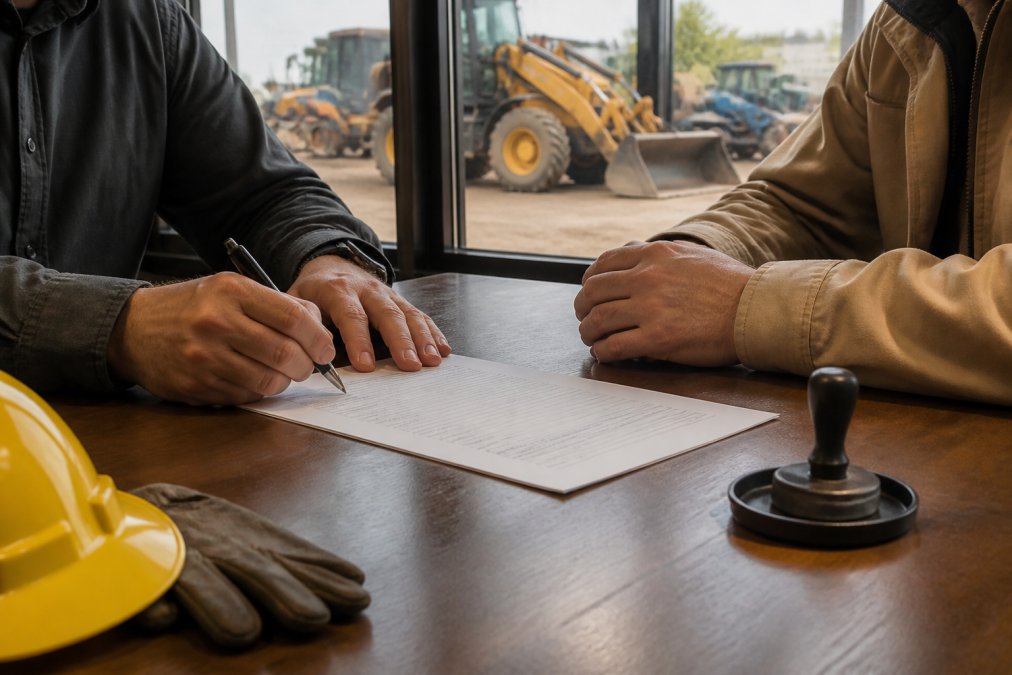
Both buyer and seller must sign the document in front of a witness or notary. Some states don't require notarization for equipment bills of sale, but having a notary sign off adds a layer of legal protection. It proves the signatures are genuine and that both parties understood what they were signing.
When signing, use your full legal name as it appears on your identification. Print clearly. Both parties should sign and date the document. If there's a witness, they should also sign and print their name.
Keep a copy for your records. Give the buyer the original or a certified copy. Some buyers request additional copies for their own records and for registration purposes.
The date of execution, when the document is signed, matters legally. It establishes when ownership transferred. Make sure the date is clear and matches when the transaction actually occurred.
Common Mistakes to Avoid When Writing Your Bill of Sale
Most mistakes happen because sellers rush the process or don't understand what information matters. Learning what to avoid prevents costly problems later.
Incomplete equipment descriptions are the biggest problem we see. Sellers write "excavator" when they should write "2019 Caterpillar 320 excavator, serial number ABC123, 4,200 hours." The generic version creates confusion and disputes.
Missing or incorrect serial numbers cause registration delays and can prevent the buyer from legally operating the equipment. Always verify the serial number matches the actual equipment before writing it down.
Vague condition statements leave room for argument. Don't write "equipment in good condition." Instead, write "equipment operates but has worn tracks, minor hydraulic leak, repaired transmission." Specific language protects you.
Forgetting the "as-is" clause exposes you to liability after the sale. If you're not providing warranties, state that clearly: "Equipment sold as-is, where-is, with no warranties expressed or implied."
Leaving blank spaces creates opportunities for fraud or disputes. Fill in every field completely. If something doesn't apply, write "N/A" rather than leaving it blank.
Not keeping copies means you have no proof of the transaction if questions arise later. Make copies before the buyer takes the original.
Mismatched signatures where one party signs differently than their legal name can create registration problems. Consistency matters.
Tax and Registration Considerations
The bill of sale has financial and legal implications beyond the transaction itself. Understanding tax obligations and registration requirements prevents costly mistakes and ensures compliance with state law.
Sales Tax Obligations
Sales tax on heavy equipment varies significantly by state and by equipment classification. As the seller, you may have a reporting obligation; as the buyer, you may owe tax on the purchase.
Sales tax rules depend on:
- State law: Some states tax all equipment sales; others exempt certain machinery used in agriculture, manufacturing, or construction.
- Equipment classification: A piece of equipment might be taxed as personal property in one state and exempt in another. For example, a tractor used for farming may be exempt in some states but taxable in others.
- Buyer's use: If the buyer is a business using the equipment for resale or production, they may qualify for a sales tax exemption and provide a resale certificate.
- Seller's location: If you're selling across state lines, the buyer's state of residence typically determines tax liability.
The bill of sale documents the sale price, which is the basis for calculating any tax owed. Keep the bill of sale and payment records for tax reporting purposes.
Reporting Requirements for Sellers
In most states, if you're selling equipment as a business (not a one-time personal sale), you may need to:
- Report the sale to your state's Department of Revenue or equivalent tax authority.
- Collect sales tax from the buyer (if applicable in your state) and remit it to the state.
- File a Form 8949 (Sales of Business Property) or equivalent state form if the equipment is a business asset.
- Report the sale on your business tax return.
Registration and Title Transfer
Heavy equipment registration varies by type and state:
Vehicles and titled equipment (excavators, bulldozers, loaders with VINs):
- The buyer must register the equipment with the state Department of Motor Vehicles or equivalent agency.
- The bill of sale is typically required to complete registration.
- Some states issue a certificate of title; others rely on the bill of sale as proof of ownership.
- The buyer must complete registration within a specified timeframe (often 10-30 days) to avoid penalties.
Non-titled equipment (attachments, specialized machinery without VINs):
- Registration may not be required, but the bill of sale still serves as proof of ownership.
- Some states require equipment to be registered with the county assessor for property tax purposes.
- Check your county assessor's office for local requirements.
Specialized equipment (cranes, lifts, pressure vessels):
- Registration may be required with OSHA or an equivalent regulatory body.
- Inspection and certification may be mandatory before the buyer can legally operate the equipment.
- The bill of sale doesn't replace these regulatory requirements, the buyer must handle them separately.
Documentation to Retain
Keep records of the sale for at least three to seven years:
- Original or certified copy of the bill of sale
- Payment records (bank statements, wire confirmations, canceled checks)
- Inspection reports or condition documentation
- Lien release documents (if applicable)
- Any correspondence with the buyer
- Tax documentation (if you reported the sale to your state)
State-Specific Variations
Frequently Asked Questions
What specific details must be included in a heavy equipment bill of sale?
A complete bill of sale for heavy equipment must include the full legal names and addresses of both buyer and seller, the make, model, year, and serial number of the equipment, current meter readings (hours or mileage), the sale price, date and time of purchase, payment method, and a statement of the equipment's condition (whether sold 'as-is' or with warranties). These details ensure the transfer of ownership is legally documented and protects both parties.
Is a handwritten bill of sale legally binding for heavy machinery?
Yes, a handwritten bill of sale can be legally binding for heavy equipment if it contains all required information and is signed by both parties. However, using a standardized template ensures all necessary legal fields, such as serial numbers, hours, and 'as-is' disclaimers, are captured during the transfer of ownership. Handwritten documents may lack clarity or miss critical details, making a typed or printed template the safer choice for protecting both buyer and seller.
Do I need to notarize a bill of sale for construction equipment?
Notarization is not always legally required for a bill of sale, but it is strongly recommended for heavy equipment transactions. Notarization adds an extra layer of legal protection and verification, making the document more difficult to dispute later. Since heavy machinery represents significant financial value, having the document notarized by a public notary adds credibility and can be crucial if ownership disputes arise.
How does a bill of sale protect both the buyer and the seller?
A bill of sale serves as formal proof of the transaction and transfer of ownership. For the seller, it documents that the equipment was sold and removes future liability once the buyer takes possession. For the buyer, it proves ownership and provides evidence of the purchase price, condition, and any warranties or disclaimers. This mutual protection is why a bill of sale is essential for any heavy equipment transaction, especially when a formal vehicle title is missing.