

Table of Contents
- Why Use an Equipment Broker for International Heavy Equipment Shipping
- Understanding International Heavy Equipment Shipping Methods
- Equipment Dimensions, Weight, and Oversize Load Permits
- Customs Clearance and Heavy Equipment Import Documentation
- Heavy Equipment Shipping Companies and Freight Forwarders
- Heavy Machinery Transport Cost Factors and Pricing
- Marine Insurance and Heavy Equipment Protection
- Crating, Packing, and Equipment Preparation for Transit
- Load Securement, Safety Compliance, and Hazmat Regulations
- Incoterms 2020 for Heavy Machinery International Shipping
- Post-Delivery Assembly, Commissioning, and Supply Chain Management
- Geopolitical Risk and Transit Time Considerations
- Sustainability and Carbon Footprint in Equipment Logistics
- Common Mistakes in International Heavy Equipment Shipping
- Conclusion
International Heavy Equipment Shipping Logistics: Complete 2026 Guide
Last Updated: July 27, 2026
Why Use an Equipment Broker for International Heavy Equipment Shipping
When moving heavy machinery across borders, complexity multiplies fast. International heavy equipment shipping logistics involves coordinating customs, permits, specialized transport, insurance, and compliance across multiple jurisdictions. Most companies handling this alone waste weeks on paperwork, overpay for freight, and face delays at ports.
Why use a Heavy Equipment Broker for international heavy equipment shipping? The answer lies in specialized knowledge and established networks. An experienced broker like Ironmartonline understands equipment movement nuances, calculating dimensional weight, securing oversize permits, navigating tariff codes, and meeting Incoterms 2020 requirements. They've already solved the problems you're about to face.
Consider the alternative: contacting three vendors for quotes, researching customs documentation for days, discovering halfway through that your equipment exceeds port crane capacity, and scrambling for alternative routing. A Heavy Equipment Broker eliminates these bottlenecks. They know which ports handle your equipment type, which freight forwarders offer best rates for your route, and which insurance policies cover heavy machinery in transit. Their relationships with customs brokers, inland haulage providers, and vessel operators save thousands in negotiation time alone.
The real value is risk mitigation. A broker reviews equipment specifications, identifies compliance issues before they become costly delays, and ensures proper load securement and documentation. For companies moving equipment internationally, this expertise translates to faster delivery, lower costs, and reduced liability exposure.
Below, we'll walk through the complete international heavy equipment shipping logistics process, covering shipping methods, customs clearance, insurance, and post-delivery assembly. Whether shipping excavators, bulldozers, drilling rigs, or industrial machinery, understanding these fundamentals helps you make informed decisions and avoid expensive mistakes.
Understanding International Heavy Equipment Shipping Methods
Selecting the right shipping method is foundational to successful international heavy equipment shipping logistics. Your choice depends on equipment dimensions, weight, destination port infrastructure, budget, and timeline. The three primary methods, Roll-On/Roll-Off, flat rack containers, and breakbulk shipping, each serve different equipment profiles and cost structures.
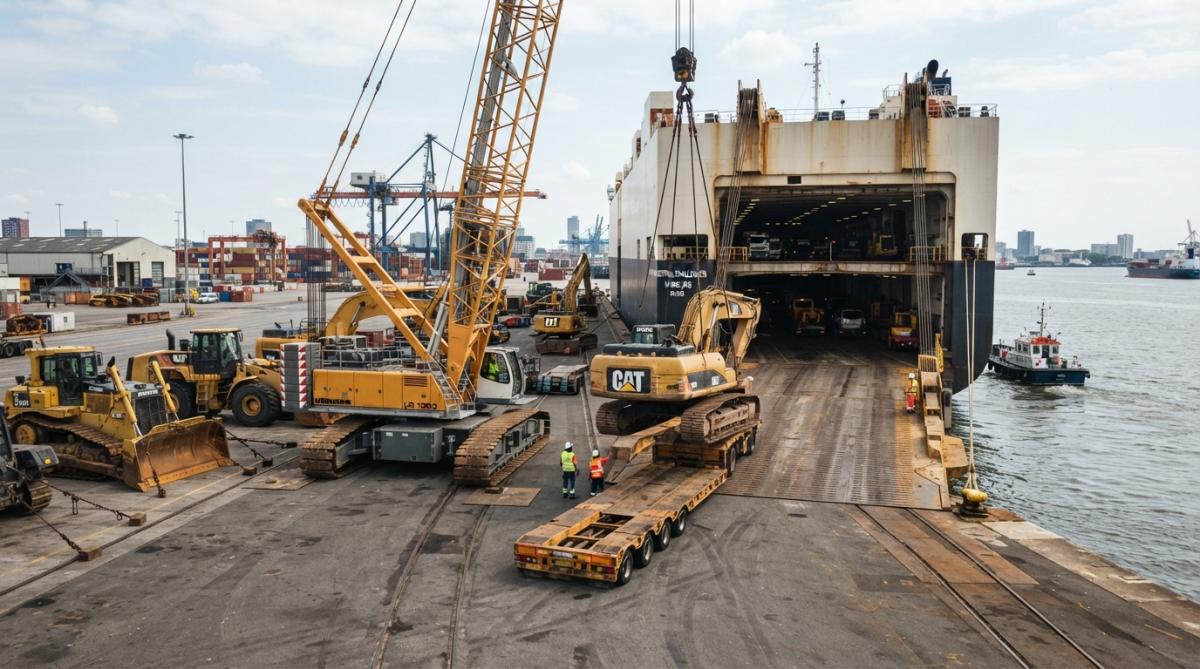
Roll-On/Roll-Off (RoRo) Shipping
Roll-On/Roll-Off shipping is the most cost-effective method for self-propelled or wheeled heavy equipment. Vehicles drive onto specialized vessel decks and are secured for transit. This method works well for excavators, wheel loaders, articulated dump trucks, and other mobile machinery that can operate under their own power or be towed.
RoRo vessels accommodate equipment up to 200 tons and 15 meters in length on standard decks, with specialized heavy-lift decks supporting larger loads. The process is straightforward: equipment is inspected at the origin port, driven aboard, and driven off at destination. No crating required. No complex rigging needed. This simplicity translates to lower handling costs and faster turnaround compared to other methods.
However, RoRo shipping has limitations. Equipment must be in operating condition or towable. Extremely oversized loads, anything wider than 3.5 meters or taller than 4 meters, won't fit standard deck configurations. Fragile components or equipment with protruding appendages require additional protective measures. RoRo vessels follow fixed schedules to specific ports, limiting destination flexibility.
Flat Rack and Breakbulk Shipping
Flat rack containers and breakbulk shipping handle equipment exceeding RoRo parameters. Flat racks are open-sided containers designed for oversized cargo. Equipment is loaded onto the flat rack using cranes, then stacked aboard the vessel. This method accommodates equipment up to 45 tons per unit.
Breakbulk shipping is more flexible. Individual machinery pieces are loaded directly into the vessel's hold using ship's cranes or portable dock cranes. This method accommodates truly massive equipment, mining excavators, tunnel boring machines, industrial presses, exceeding flat rack dimensions or weight limits.
The trade-off is cost and complexity. Flat rack rates typically run 20-40% higher than RoRo. Breakbulk is even more expensive because each piece requires custom rigging and securing. Equipment must be carefully documented with precise dimensions and weight distribution. Loading and unloading take longer. Port handling fees increase. But if your equipment is oversized, fragile, or immobile, these methods are necessary.
Container Shipping for Heavy Machinery
High-cube containers (40-foot units with 9.5-foot height) can accommodate some heavy machinery, particularly if equipment can be disassembled or if you're shipping multiple smaller items together. Container shipping offers predictable pricing and frequent sailings. Your equipment is sealed and protected from weather and theft throughout transit.
However, container weight limits (typically 28 tons payload) and dimensional constraints make this option unsuitable for most heavy machinery. This method works best when consolidating multiple smaller items or combining equipment with other cargo to optimize container use.
Equipment Dimensions, Weight, and Oversize Load Permits
Accurate equipment specifications are non-negotiable in international heavy equipment shipping logistics. Underestimating dimensions or weight creates cascading problems: port equipment can't handle the load, permits become invalid, and you face costly delays or rerouting.
Begin with precise measurements of equipment in its shipping configuration. Measure length, width, and height including attachments, booms, counterweights, or stabilizers in their extended positions. Many companies measure equipment in working position rather than transport configuration. A crane with boom retracted measures 8 meters; with boom extended, it's 22 meters. Your shipping method must accommodate the extended measurement.
Weight documentation requires equal precision. Obtain certified weight documentation from the equipment manufacturer or have machinery professionally weighed. Port operators, freight forwarders, and vessel operators make routing and pricing decisions based on weight data. Underreporting weight creates liability issues; overreporting inflates costs unnecessarily.
Oversize load permits are required when equipment exceeds standard dimensions. In the United States, oversized loads typically exceed 8.5 feet in width, 13.5 feet in height, or 53.5 feet in length. International shipping adds complexity because each country has different dimensional standards and permit requirements.
Your freight forwarder handles most permit coordination. Permits typically require 2-4 weeks for processing; expedited permits can reduce this to 5-7 business days. Heavy haul routing specialists determine the specific route accommodating your equipment's dimensions while avoiding infrastructure that can't support the load.
| Dimension Category | Standard Limit | Oversize Threshold | Permit Required |
|---|---|---|---|
| Width | 8.5 feet | Over 8.5 feet | Yes |
| Height | 13.5 feet | Over 13.5 feet | Yes |
| Length | 53.5 feet | Over 53.5 feet | Yes |
| Weight | 80,000 lbs | Over 80,000 lbs | Possible |
Customs Clearance and Heavy Equipment Import Documentation
Customs clearance represents one of the most complex elements of international heavy equipment shipping logistics. Each country maintains different import regulations, tariff classifications, and documentation requirements. Missing or incorrect paperwork delays shipments, triggers inspections, penalties, or equipment seizure.
The process begins before equipment leaves the origin country. Export compliance documentation must be prepared and submitted to your country's export authority. In the United States, this involves the Commerce Department's Bureau of Industry and Security (BIS), particularly if your equipment contains controlled technologies or is destined for countries with trade restrictions.
Required Export Compliance Documents
Your export documentation package includes several critical components. The Commercial Invoice details the sale transaction, including equipment description, value, buyer information, and payment terms. This document establishes the commercial nature of the shipment and provides the basis for tariff assessment.
The Packing List itemizes every piece of equipment and component being shipped, including dimensions, weight, and packaging details. Customs inspectors use this to verify shipment contents match documentation. Discrepancies trigger inspections and delays.
The Bill of Lading (B/L) serves as the shipping contract and proof of ownership transfer. Ocean freight B/Ls are negotiable documents representing ownership of cargo. Whoever holds the B/L can claim equipment at the destination port. This document includes vessel information, routing, equipment description, and freight charges. For international heavy equipment shipping logistics, the B/L is your most critical legal document.
Export licenses may be required depending on equipment type and destination. Heavy machinery with potential dual-use applications may require export licenses from the Commerce Department. Processing these licenses adds 4-8 weeks to your timeline, so early identification is essential.
Bill of Lading and Tariff Codes
The Bill of Lading is your equipment's passport through international waters. It includes shipper, consignee, notify party, equipment description, and routing. The B/L must accurately describe equipment; vague descriptions like "machinery" create customs delays. Specific descriptions like "Caterpillar 320 Excavator, Serial #ABC123, Weight 45 tons" are necessary.
Tariff codes determine import duties at destination. These codes are standardized internationally but assessed differently by each country. A Caterpillar excavator might be classified as HS Code 8429.51.00 (self-propelled excavators with bucket capacity exceeding 0.5 cubic meters). Import duty rates vary by country, typically ranging from 0% to 15% depending on trade agreements and destination nation.
Your freight forwarder or customs broker calculates estimated duties based on equipment value and tariff codes. Accurate valuation documentation, manufacturer invoices, sales contracts, condition assessments, helps ensure proper tariff assessment and prevents disputes with customs authorities.
Heavy Equipment Shipping Companies and Freight Forwarders
Selecting the right logistics partner fundamentally shapes your international heavy equipment shipping logistics experience. Freight forwarders serve as intermediaries between you and ocean carriers, handling documentation, booking, insurance coordination, and customs clearance. A Heavy Equipment Broker connects you with vetted shipping partners while managing the entire process.
Freight forwarders range from small regional operators to massive multinational firms. Larger forwarders offer extensive port networks and carrier relationships. Smaller, specialized forwarders often provide more personalized service and deeper expertise in specific equipment types or trade lanes.
When evaluating freight forwarders, verify their specific experience with heavy equipment. Ask for references from companies that shipped similar machinery. Confirm they maintain relationships with RoRo operators, breakbulk carriers, and specialized heavy-lift vessels. Request their contingency plans for common delays, port congestion, and vessel schedule changes.
Ironmartonline's role as a Heavy Equipment Broker adds significant value. Beyond connecting buyers and sellers of used machinery, Ironmartonline coordinates the logistics ecosystem. Their nine web-based selling platforms connect equipment to millions of potential buyers globally. When you sell through Ironmartonline, their team manages supply chain complexity, connecting you with appropriate freight forwarders, coordinating inspections, and ensuring smooth international delivery.
Heavy Machinery Transport Cost Factors and Pricing
Understanding what drives international heavy equipment shipping logistics costs helps you negotiate effectively and budget accurately. Costs break into several categories: ocean freight, port handling, inland transport, documentation and brokerage, insurance, and contingency fees.
Ocean Freight and Port-to-Port Pricing
Ocean freight represents the largest cost component for most shipments. Pricing depends on equipment dimensions and weight, shipping method, vessel availability, seasonal demand, and fuel surcharges.
RoRo rates typically range from $500-$2,000 per unit depending on route. A standard excavator shipped from Shanghai to Rotterdam might cost $1,200-$1,500. That same excavator shipped to a secondary port could cost 30-50% more because the vessel requires additional time and repositioning.
Flat rack shipping costs significantly more due to specialized equipment and handling. Expect $3,000-$8,000 per flat rack depending on equipment weight and destination. Breakbulk shipping for truly massive equipment is priced case-by-case, often quoted per ton or as a percentage of equipment value.
Fuel surcharges fluctuate with crude oil prices. A 2-3% fuel surcharge is standard; during high oil price periods, surcharges can reach 5-8%. These charges are added to base freight rates and adjusted monthly based on published indices.
Port handling fees include cargo handling, documentation processing, and port authority charges. These vary dramatically by port. Major hubs have competitive rates. Secondary ports charge 50-100% premiums. Port congestion adds demurrage charges, daily fees for equipment remaining at the port beyond free time (typically 5-7 days).
Inland Haulage and Door-to-Door Logistics
Inland haulage, transport from the origin facility to the port and from the destination port to final location, adds substantial cost. Heavy haul trucking companies charge based on distance, equipment weight, and route complexity. A 200-kilometer haul for a 45-ton excavator might cost $3,000-$5,000. Routes requiring special permitting, pilot cars, or nighttime-only travel increase costs 25-50%.
Door-to-door logistics means your equipment moves from your facility to the buyer's location without coordinating multiple handoffs. This integrated approach simplifies logistics but typically costs 15-25% more than port-to-port shipping. The convenience and reduced coordination burden justify the premium for most shippers.
Multi-modal transport, combining ocean freight with rail or barge inland transport, sometimes offers cost savings for equipment destined to inland locations. Equipment shipped to inland European destinations might move via ocean freight to Rotterdam, then rail to final destination. This approach costs less than trucking the entire distance but requires careful coordination.
Marine Insurance and Heavy Equipment Protection
Marine insurance protects your equipment during international transit. Coverage typically includes "all-risk" policies covering loss or damage from most causes except specifically excluded perils. For heavy equipment, marine insurance is non-negotiable; equipment damage in transit can total tens of thousands of dollars.
Standard marine insurance covers the equipment's insurable value (typically the equipment's market value or replacement cost, whichever is lower). Deductibles typically range from $500-$2,500 per claim. Premium rates vary based on equipment type, route, and declared value, typically running 1-3% of the insured value.
However, standard marine policies contain exclusions worth understanding. Wear and tear, mechanical breakdown, and damage from improper operation are typically excluded. Damage from inadequate packaging or securing is often excluded, which is why proper load securement and crating are critical. Some policies exclude damage from strikes, riots, or civil unrest in specific regions.
Additional coverage options include "warehouse to warehouse" policies covering equipment from your facility through final delivery, not just ocean transit. This extended coverage costs more but provides comprehensive protection. Inland transport insurance is often separate from marine insurance, requiring coordination between multiple policies.
Crating, Packing, and Equipment Preparation for Transit
Proper equipment preparation is fundamental to successful international heavy equipment shipping logistics. Inadequate preparation causes damage in transit, triggers insurance claim denials, and delays delivery.
Heavy machinery typically doesn't require full crating for RoRo shipping. Vehicles are driven aboard the vessel and secured with lashing equipment (steel cables and chains). However, delicate components, hydraulic hoses, glass windows, mirrors, electronic controls, require protective wrapping. Foam padding, plastic sheeting, and corrugated cardboard protect these items from salt spray, vibration, and impact.
For flat rack and breakbulk shipping, crating is often necessary. Wooden crates protect equipment from moisture, impact, and contamination. Crate design depends on equipment size and fragility. A 45-ton excavator might require a crate costing $2,000-$4,000. Specialized equipment like drilling rigs or precision machinery might require custom-engineered crates costing $8,000-$15,000.
Preparation also includes draining fluids (fuel, hydraulic oil, coolant) to reduce fire risk and environmental contamination. Most vessels prohibit equipment with full fuel tanks aboard. Batteries must be disconnected. Loose parts must be secured or removed. Documentation of this preparation, photos, checklists, condition reports, protects you if damage claims arise.
| Preparation Task | RoRo Shipping | Flat Rack Shipping | Breakbulk Shipping |
|---|---|---|---|
| Crating Required | No | Possibly | Usually |
| Fluid Draining | Required | Required | Required |
| Component Protection | Moderate | Extensive | Extensive |
| Estimated Cost | $500-$1,500 | $2,000-$5,000 | $5,000-$15,000 |
Load Securement, Safety Compliance, and Hazmat Regulations
Proper load securement prevents equipment shifting during transit, which can damage cargo and endanger vessel stability. International Maritime Organization (IMO) standards govern load securement on vessels. Equipment must be secured with sufficient lashing equipment (steel cables, chains, turnbuckles) to prevent movement even in heavy seas.
For RoRo shipments, vessel operators typically handle lashing using standardized procedures. However, verify the lashing plan before departure. Inadequate lashing creates liability if equipment shifts and damages other cargo or the vessel.
For flat rack and breakbulk shipments, specialized lashing engineers design custom securing systems. Equipment is secured to the flat rack or vessel structure using multiple securing points. Load calculations ensure the securing equipment can withstand forces generated by vessel motion in worst-case sea states.
Hazmat (hazardous materials) regulations apply if your equipment contains hazardous substances. Hydraulic fluid, diesel fuel, batteries, and compressed gas cylinders are classified as hazardous materials. Equipment must be declared as hazardous if it contains these substances. Hazmat declarations require additional documentation and may restrict which vessels can carry your equipment. Hazmat shipping costs 20-40% more than standard shipping.
The International Maritime Dangerous Goods (IMDG) Code governs hazmat shipment procedures. Your freight forwarder ensures compliance, but understanding the basics helps you anticipate requirements. Most heavy equipment contains hydraulic fluid, so hazmat compliance is standard practice.
Incoterms 2020 for Heavy Machinery International Shipping
Incoterms define responsibility for costs, insurance, and risk transfer during international shipment. These standardized terms prevent disputes and clarify who pays for what. Understanding Incoterms is essential when negotiating equipment sales and purchases, particularly because heavy equipment transactions involve high dollar values where liability shifts create significant financial exposure.
The critical distinction in Incoterms is the moment when risk of loss transfers from seller to buyer. This is not the same as when payment occurs or when equipment physically moves. Risk transfer determines who bears the financial loss if equipment is damaged, lost, or destroyed during transit.
FOB (Free on Board): Seller delivers equipment to the vessel and arranges loading. Risk transfers to the buyer once equipment is aboard the vessel. The buyer assumes all costs and risk from that point forward, ocean freight, insurance, port handling, inland transport, customs duties, and any damage occurring during transit. FOB is common for equipment sales but places maximum burden on the buyer to arrange freight and insurance. The buyer must secure marine insurance before equipment leaves the origin port, otherwise they're uninsured during ocean transit. FOB pricing typically reflects only equipment cost plus loading to the vessel; all other costs are the buyer's responsibility.
CIF (Cost, Insurance, and Freight): Seller pays for ocean freight and insurance, but buyer assumes risk once equipment is aboard the vessel. This creates a critical timing mismatch: the buyer owns the risk during ocean transit, but the seller paid for the insurance. If equipment is damaged in transit, the buyer files the insurance claim, but the seller's insurance company investigates. Disputes arise when the insurance company denies the claim due to improper securing or inadequate crating, the buyer loses the equipment value, but the seller already received payment. CIF is less common for heavy equipment because of this misalignment.
DAP (Delivered at Place): Seller pays all costs and assumes all risk until equipment reaches the agreed destination (typically the buyer's facility or a specified port). Risk transfers to the buyer only when equipment is unloaded at the destination. This means the seller bears the risk of damage during ocean transit, port handling, inland haulage, and customs delays. DAP is increasingly common for international equipment sales because it simplifies the buyer's logistics burden and creates clear accountability. However, sellers must carefully calculate total landed costs to ensure profitability.
DDP (Delivered, Duty Paid): Seller assumes all costs and risk, including import duties and final delivery to the buyer's specified location. DDP is the most buyer-friendly term but places maximum burden on the seller. The seller must calculate import duties based on the destination country's tariff codes and trade agreements, which can be complex and uncertain. Sellers typically add 15-25% to equipment pricing to cover DDP obligations, plus a contingency for duty rate uncertainty. DDP also requires the seller to clear customs at the destination, which involves hiring a customs broker and potentially addressing import compliance issues.
Risk Transfer Timing and Insurance Implications: The moment risk transfers is critical for insurance purposes. Under FOB or CIF terms, the buyer must secure marine insurance before equipment leaves the origin port. Under DAP or DDP, the seller maintains insurance throughout transit. If equipment is damaged and the insured party is not the one who paid for insurance, claim disputes arise. This is why many sellers insist on FOB terms, they avoid the complexity of maintaining insurance for equipment they no longer own. Buyers, conversely, prefer DAP or DDP because they avoid logistics coordination and insurance complexity.
Practical Application for Heavy Equipment: For most international equipment sales, DAP (Delivered at Place) represents a reasonable middle ground. Sellers cover most logistics costs and maintain insurance, but avoid the complexity of import duty calculations and final delivery coordination. Buyers receive equipment at their facility without managing freight forwarders or customs brokers. Ironmartonline's brokerage services often facilitate DAP negotiations, helping both parties understand the cost implications and risk allocation. When selling equipment internationally through their platforms, their team helps negotiate terms that work for both parties and ensures clear documentation of risk transfer points. Understanding these terms helps you negotiate effectively whether buying or selling, and prevents disputes that arise from ambiguous risk allocation.
Post-Delivery Assembly, Commissioning, and Supply Chain Management
Equipment arrival at the destination is not the end of international heavy equipment shipping logistics; it's the beginning of the final and often most critical phase. Post-delivery assembly, testing, commissioning, and operational verification determine whether equipment functions as expected and whether warranty disputes arise.
Assembly and Setup Requirements: Many pieces of heavy machinery require assembly or preparation before operation. Excavators might need boom installation, hydraulic system testing, and operational verification. Drilling rigs require assembly of multiple components, hydraulic system pressurization, and extensive system testing. Wheel loaders need tire mounting, fluid filling, and engine startup procedures. This assembly work typically takes 3-7 days for standard equipment, but complex machinery can require 2-4 weeks of assembly and testing.
Assembly complexity directly impacts total project cost and timeline. A buyer who underestimates assembly time faces project delays and cost overruns. A seller who underestimates assembly support creates warranty disputes and customer dissatisfaction. Clear documentation of assembly requirements, timelines, and responsibility allocation prevents these conflicts.
Who performs assembly, buyer or seller, significantly impacts logistics and liability. In some transactions, the seller arranges assembly and commissioning as part of the sale, particularly for complex equipment. This approach adds cost but ensures proper setup and reduces buyer risk. In other transactions, the buyer assumes assembly responsibility, reducing equipment cost but requiring technical expertise. Many buyers hire the equipment manufacturer's authorized service centers to perform assembly, ensuring warranty compliance and proper setup.
Commissioning and Operational Testing: Commissioning involves testing all equipment systems under load to verify proper operation. This process includes hydraulic system testing (pressurizing systems to rated pressure, checking for leaks, verifying flow rates), electrical system verification (testing circuits, battery charging systems, control systems, safety interlocks), engine and drivetrain testing (running engines through operating cycles, verifying fuel consumption, checking transmission operation, confirming brake functionality), load testing (operating equipment under actual working conditions), and safety system verification (confirming emergency stops, warning systems, and safety interlocks function properly).
Commissioning typically takes 3-5 days for standard equipment but can extend to 2-3 weeks for complex machinery. During this period, equipment is operated by trained technicians who document performance against manufacturer specifications. Any deviations are identified and addressed before equipment is released to the buyer.
Post-Delivery Inspection Documentation: Documentation of post-delivery inspection protects both buyer and seller. Detailed condition reports, photos, and test results create a record of equipment condition upon arrival. This documentation should include visual inspection photos (high-resolution images taken immediately upon arrival before any operation or cleaning), condition assessment (detailed written description of equipment condition, including any visible damage, wear, or defects), test results (documented results of all commissioning tests compared against manufacturer specifications), defect log (any defects or performance issues identified during commissioning, with notes on warranty coverage), and sign-off documentation (written confirmation that equipment has been received in acceptable condition and is operational, or documentation of specific defects and warranty claims).
If damage is discovered later, this documentation supports insurance claims or warranty disputes. Without contemporaneous documentation, disputes become unresolvable situations where neither party can prove equipment condition at delivery. This documentation is particularly critical when equipment is shipped under DAP or DDP terms, where the seller bears responsibility for condition until delivery.
Warranty and Defect Responsibility: International equipment sales typically include warranties covering defects in materials and workmanship for 30-90 days after delivery. However, warranty disputes frequently arise because of ambiguous definitions of "defect" versus "damage from improper operation" or "wear from use."
A hydraulic leak discovered 2 weeks after delivery might be a manufacturing defect (covered by warranty) or damage from improper securing during transit (not covered by warranty). Without clear documentation of equipment condition at delivery, determining responsibility becomes contentious. Clear commissioning documentation prevents these disputes. If the initial commissioning test showed no leaks and the equipment was operated properly afterward, the leak is likely a manufacturing defect covered by warranty. If the initial test showed a leak, it's a pre-existing condition not covered by warranty. Documentation creates objective evidence.
Supply Chain Management and Repeat Transactions: For companies regularly shipping equipment internationally, establishing relationships with consistent partners creates efficiency. These partnerships include freight forwarders (consistent partners reduce negotiation time, improve service consistency, and often generate volume discounts), customs brokers (established relationships streamline import clearance and reduce delays), inland haulage providers (consistent partnerships ensure equipment availability and priority scheduling), assembly and commissioning partners (relationships with authorized service centers ensure quality assembly and proper commissioning), and insurance providers (marine insurance providers familiar with your equipment types can provide faster quotes and better coverage terms).
These partnerships reduce transaction costs and improve service quality. A company managing 50+ international equipment shipments annually can reduce logistics costs through optimized partnerships and volume discounts.
Operational Readiness and Project Success: The final measure of successful international heavy equipment shipping is not equipment arrival, it's equipment operational readiness. Equipment that arrives damaged, incomplete, or improperly assembled creates project delays and cost overruns. Equipment that arrives in perfect condition but requires 3 weeks of assembly and commissioning still delays project start.
Successful transactions account for the entire timeline: equipment preparation (1-2 weeks), ocean transit (2-4 weeks), port handling and customs clearance (1-2 weeks), inland haulage (1-2 weeks), assembly and commissioning (1-4 weeks). Total timeline from decision to operational equipment is typically 8-16 weeks. Projects that underestimate this timeline face delays and cost overruns.
Ironmartonline's equipment brokerage services extend beyond logistics coordination to include post-delivery support. When selling equipment internationally through their platforms, their team helps coordinate assembly and commissioning, ensuring equipment arrives operational and ready for use. This comprehensive approach, from equipment sourcing through operational readiness, transforms international equipment transactions from logistics challenges into successful project outcomes.
Geopolitical Risk and Transit Time Considerations
International geopolitical conditions significantly impact international heavy equipment shipping logistics. Trade restrictions, sanctions, port disruptions, and political instability can delay shipments or make certain routes unavailable.
Trade tensions between major economies create tariff uncertainty. Equipment destined for certain countries may face suddenly increased duties. Advance knowledge of these risks allows you to adjust pricing or routing before problems arise. Freight forwarders monitor geopolitical developments and alert clients to emerging risks.
Port disruptions from labor actions, natural disasters, or political events create bottlenecks. Equipment scheduled for a port affected by labor strikes gets rerouted to alternative ports, adding days or weeks to transit time. Diversifying your port options reduces this risk.
Transit time varies dramatically based on route and equipment type. RoRo shipments from Asia to North America typically take 15-25 days ocean transit, plus 5-10 days for port handling and inland transport. Breakbulk shipments might take 30-45 days because of specialized handling requirements. Planning for these timelines prevents surprises and allows you to communicate realistic delivery dates to customers.
Sustainability and Carbon Footprint in Equipment Logistics
Environmental considerations increasingly influence international heavy equipment shipping logistics decisions. Ocean freight generates significant carbon emissions, though per-ton-per-mile, it's more efficient than air or truck transport.
Calculating equipment shipping carbon footprint requires understanding fuel consumption rates. A typical RoRo vessel consumes 50-100 tons of fuel per day depending on size and speed. Distributing this fuel consumption across hundreds of pieces of equipment results in relatively modest per-unit emissions.
However, companies increasingly track and report Scope 3 emissions (supply chain emissions). Equipment manufacturers and sellers are expected to quantify shipping emissions and identify lower-carbon alternatives. Slower vessel speeds reduce fuel consumption but increase transit time. Consolidating shipments to reduce empty vessel capacity improves efficiency.
Some companies offset shipping emissions through carbon credit purchases. Others prioritize suppliers and logistics partners with lower-carbon operations. These sustainability considerations are becoming standard practice in enterprise procurement, particularly for companies with environmental commitments or ESG reporting requirements.
Common Mistakes in International Heavy Equipment Shipping
Understanding frequent errors helps you avoid costly delays and complications. The most common mistake is underestimating equipment dimensions. Companies measure equipment in its operating configuration rather than its transport configuration, then discover mid-shipment that the equipment exceeds vessel deck space. This triggers expensive rerouting or equipment repositioning.
Inadequate documentation is the second most common error. Missing export licenses, incomplete customs forms, or inaccurate equipment descriptions create holds at departure ports or destination ports. These delays cost thousands in demurrage fees and lost revenue.
Poor communication between buyer and seller causes the third category of mistakes. Unclear delivery terms, ambiguous equipment condition descriptions, or misaligned expectations about delivery dates create disputes. Many of these disputes could be prevented through detailed written agreements and clear communication from the start.
Inadequate insurance coverage represents another frequent mistake. Companies skimp on marine insurance to reduce costs, then face massive expenses when equipment is damaged in transit. The insurance premium savings pale compared to potential damage claims.
Finally, many companies fail to account for total landed costs. They focus on ocean freight pricing without including port fees, inland haulage, customs duties, insurance, and documentation fees. This incomplete cost accounting leads to unprofitable deals or budget overruns.
Conclusion
International heavy equipment shipping logistics demands expertise across multiple disciplines: maritime regulations, customs law, heavy haul transport, insurance, and supply chain management. The complexity creates significant opportunity for error, but also significant value for partners who navigate it skillfully.
When you work with Ironmartonline as your Heavy Equipment Broker, you gain access to partners who've solved these problems repeatedly. Ironmartonline connects equipment buyers and sellers globally through nine specialized web-based platforms, reaching millions of potential buyers. More importantly, they manage the supply chain complexity, coordinating freight forwarders, customs brokers, and inland haulage providers to ensure smooth international delivery. Their expertise in export compliance, documentation, and logistics coordination transforms what could be a months-long headache into a simplified process. Get started with Ironmartonline and access the global equipment market without the logistics burden.
Frequently Asked Questions
What documents are required for international heavy equipment shipping?
Essential documents include a Bill of Lading, commercial invoice, packing list, equipment specification sheets, export licenses (if applicable), and customs declaration forms. For import into the United States, you'll need the HS tariff code for your equipment, proof of origin, and any relevant compliance certifications. A freight forwarder or customs broker can guide you through export compliance requirements specific to your equipment type and destination.
What are the main methods for international heavy equipment shipping?
The three primary methods are Roll-On/Roll-Off (RoRo) shipping, which drives equipment directly onto specialized vessels; breakbulk and flat rack container shipping, which uses heavy-duty containers and frames; and ocean freight combined with inland haulage for door-to-door delivery. RoRo works best for self-propelled equipment like dozers and excavators, while breakbulk suits stationary machinery that requires crating and crane services.
How does customs clearance work for heavy equipment imports into the United States?
Customs clearance for heavy equipment involves submitting proper documentation, including tariff codes and equipment specifications, to U.S. Customs and Border Protection. A customs brokerage firm can manage this process, ensuring all export compliance requirements are met and import duties are calculated correctly. Processing typically takes 2-5 business days once all documentation is complete and the shipment arrives at the port of entry.
What insurance coverage is needed for international heavy equipment shipping?
Marine insurance is essential for protecting your equipment during ocean freight and multi-modal transport. Coverage typically includes all-risk protection from warehouse to final destination, covering loss, damage, and liability. Your freight forwarder or logistics provider can arrange marine insurance, which usually costs a percentage of the equipment's declared value. Confirm coverage limits match your equipment's replacement value.
What factors affect heavy machinery transport cost?
Transport costs depend on equipment dimensions and weight, shipping method (RoRo vs. container), port-to-port distance, inland haulage distance, seasonal demand, and current fuel surcharges. Additional costs include permit requirements for oversize loads, crating and packing services, crane services, marine insurance, and customs brokerage fees. For accurate pricing, provide your equipment specifications and desired origin/destination to a freight forwarder for a detailed quote.
How long does international heavy equipment shipping typically take?
Transit time varies by route and method. Ocean freight typically takes 2-6 weeks depending on origin and destination ports. Add 1-2 weeks for pre-shipment preparation, customs clearance, and inland haulage. Total door-to-door delivery often ranges from 4-10 weeks. Geopolitical factors, vessel scheduling, and port congestion can extend timelines, so building buffer time into your supply chain management is prudent.
Can used heavy equipment be imported into the United States?
Yes, used heavy equipment can be imported into the United States, but it must meet EPA and DOT standards depending on the equipment type. Older equipment may require emissions compliance modifications. Import duties apply based on HS tariff codes, typically ranging from 0-5% for industrial machinery. A customs brokerage firm can confirm regulatory requirements for your specific equipment and calculate import duties before shipment.
This article was written using GrandRanker