

Table of Contents
- Why Use an Equipment Broker When Selling Heavy Machinery
- Understanding Heavy Equipment Title and Ownership Requirements
- Conducting UCC Searches and Clearing Liens
- Step 1: Run the UCC Search
- Step 2: Interpret Search Results and Identify Active Liens
- Step 3: Obtain Lien Release Documentation
- Step 4: Handle Liens at Closing
- Step 5: Document Lien Clearance in the Bill of Sale
- Step 6: File the UCC-3 Termination and Provide Proof to the Buyer
- What If You Can't Find or Reach the Lien Holder?
- Creating a Compliant Heavy Equipment Bill of Sale
- Managing As-Is Equipment Sale Liability
- Condition Disclosures and Due Diligence
- Tax Implications and Sales Tax Obligations
- Payment Security and Fraud Prevention
- Preparing Equipment for Sale and Inspection
- Regulatory Compliance and Environmental Requirements
- International Export and Customs Compliance
- Frequently Asked Questions
Last Updated: October 10, 2026
Why Use an Equipment Broker When Selling Heavy Machinery
Selling heavy machinery involves far more than posting a listing and waiting for offers. Why use a Heavy Equipment Broker when navigating these requirements alone?
A broker handles the complexity. When you sell directly, you manage title research, UCC filings, contract drafting, and buyer vetting yourself.
Ironmartonline connects you to millions of qualified buyers across nine specialized web-based selling platforms, but the real value extends beyond reach. For construction contractors moving surplus excavators, fleet managers acquiring heavy-duty trucks, agricultural business owners seeking cost-effective used tractors, rental house managers disposing of end-of-lease machinery, and owner-operators needing expert support, this removes the friction that makes independent sales risky.
The question isn't whether you can sell heavy machinery on your own. You can.
Below, we'll walk you through every legal consideration selling heavy machinery requires, from ownership documentation to international compliance.
Understanding Heavy Equipment Title and Ownership Requirements
Proof of ownership is your foundation. Without clear title, you cannot legally transfer equipment to a buyer, regardless of how much they're willing to pay. Heavy machinery title works differently than vehicle titles.
The legal considerations selling heavy machinery start here: you must prove you own what you're selling. A buyer's lender will require this. A title company, if one is involved, will demand it.
Proof of Ownership Documentation
Gather your original bill of sale from when you purchased the equipment. This is your primary ownership document.
Include any registration documents from your state or local jurisdiction. Some states require equipment registration; others don't.
For equipment purchased from dealers or auctions, keep all documentation from that transaction. Auction house records, dealer invoices, and transfer paperwork all strengthen your ownership position.
Serial Numbers and Equipment Identification
Every piece of heavy machinery has a unique serial number. Locate it on the equipment itself, usually stamped on the frame, engine block, or chassis.
Cross-reference the serial number against manufacturer records. Contact the equipment manufacturer with your serial number and ask them to confirm the original owner and production date.
When you sell internationally or across state lines, the serial number becomes even more critical.
Conducting UCC Searches and Clearing Liens
A UCC (Uniform Commercial Code) search reveals whether anyone holds a secured interest in your equipment. If a lender financed your purchase, they likely filed a UCC-1 financing statement against the equipment. Until that lien is released, you cannot transfer clean title. This is one of the most common sources of post-sale disputes, a buyer discovers a lien after taking possession and files a claim against you personally, even though the sale is complete.
Step 1: Run the UCC Search
Before you list your equipment, search your state's Secretary of State office UCC database. Most states offer online searches through their Secretary of State website. Search by:
- The equipment's serial number (primary identifier)
- Your name as the owner (last name, first name)
- Your business name, if you own the equipment in a business entity
The search results will display any filed UCC-1 financing statements. Each result shows the secured party (usually a lender or finance company), the filing date, and the filing number. Print or download these results, you'll need them for the next steps.
Step 2: Interpret Search Results and Identify Active Liens
Not every UCC filing on record is an active lien. Some may have been terminated or satisfied. Look for:
- Filing date: When was the lien filed?
- Secured party name and address: Who holds the lien?
- Collateral description: Does it match your equipment?
If you see multiple filings, contact each secured party to confirm whether the lien is still active. A lender may have released the lien but not yet filed a UCC-3 termination, this happens frequently when loans are paid off. Ask the lender directly: "Is there an active lien against [equipment serial number]? If not, will you file a UCC-3 termination statement?"
Step 3: Obtain Lien Release Documentation
If you still owe money on the equipment, contact the lender and request a payoff quote. This quote specifies the exact amount needed to satisfy the loan, including accrued interest and any prepayment penalties.
If the equipment is paid off but the lien hasn't been formally terminated, request the lender issue a UCC-3 termination statement immediately. Provide them with the UCC filing number from your search results.
Step 4: Handle Liens at Closing
You have two options for clearing liens before the buyer takes possession:
Option A: Pay off the lien before closing. If you have the funds, pay the lender in full, obtain the UCC-3 termination statement, and file it with your state's Secretary of State. Once filed, the lien is officially released. You can then transfer clean title to the buyer.
Option B: Use escrow to pay off the lien at closing. For high-value equipment or when you don't have funds available, arrange an escrow account. The buyer deposits their payment into escrow. You provide the lender's payoff quote to the escrow agent. At closing, the escrow agent pays the lender directly, receives the UCC-3 termination statement, and releases the remaining funds to you.
Step 5: Document Lien Clearance in the Bill of Sale
Your bill of sale must state that the equipment is being transferred free and clear of all liens and encumbrances. Include language such as:
"Seller warrants that the equipment is free and clear of all liens, security interests, and encumbrances, except as follows: [list any liens that will be paid at closing via escrow]. Seller shall provide buyer with a copy of the UCC-3 termination statement or lien release letter prior to delivery of the equipment."
If a lien will be paid at closing through escrow, specify the lender's name, the payoff amount, and that the escrow agent will handle the payoff. Attach the lender's payoff quote to the bill of sale as an exhibit.
Step 6: File the UCC-3 Termination and Provide Proof to the Buyer
Once the lien is paid and the lender issues the UCC-3 termination statement, file it with your state's Secretary of State. Keep a copy for your records. Provide the buyer with a certified copy of the filed UCC-3 termination statement before or at the time of delivery. This proves to the buyer (and to their lender, if they're financing) that the equipment transfers with clear title.
What If You Can't Find or Reach the Lien Holder?
If your search reveals a lien but the lender is out of business, has changed names, or is unresponsive, you have options:
- File a UCC-3 termination yourself (as the debtor) if your state allows it. Contact your Secretary of State for the form and instructions.
- Work with a title company that specializes in equipment liens. They can research the lien holder, attempt contact, and file terminations on your behalf.
- Obtain a lien-release insurance policy from a title company. This protects the buyer against claims from an old, unlocated lien holder. The buyer may accept this in lieu of a formal termination, though most prefer a cleared title.
For interstate or international sales, lien clearance becomes more critical. A buyer in another state cannot easily challenge a lien holder in your state, but they can sue you for breach of warranty if they discover a lien after taking possession. Always clear liens before closing.
Creating a Compliant Heavy Equipment Bill of Sale
Your bill of sale is the legal document that transfers ownership. It must include specific information to be enforceable and to protect you from liability after the sale.
Start with the basics: your name and address as the seller, the buyer's name and address, the date of sale, and the sale price.
State the condition of the equipment clearly. Write "sold as-is" if that's the case. Describe any known defects or repairs needed.
Essential Contract Terms and Conditions
Include a statement that the buyer is responsible for all transportation and delivery costs. Specify who arranges shipping and who pays for it.
Address post-sale support. Will you provide any warranty period, even a limited one? Or are you selling as-is with no warranty? State this clearly.
Include a clause requiring the buyer to obtain all necessary permits and licenses for operation.
Warranty Disclaimers and As-Is Language
An as-is sale means the buyer accepts the equipment in its current condition, with all faults.
Write: "Seller makes no warranties, express or implied, regarding the condition, merchantability, or fitness for a particular purpose of the equipment.
Then add specifics about what you know: "Seller discloses the following known conditions: [list any known issues].
This two-part approach protects you. The disclaimer limits liability for unknown issues.
Managing As-Is Equipment Sale Liability
When you sell equipment as-is, you're not guaranteeing it will work or perform as expected.
The legal considerations selling heavy machinery include understanding the difference between cosmetic wear and safety hazards.
If you're aware the equipment has a known mechanical problem, the hydraulic system leaks, the transmission slips, the engine misfires, disclose it.
For equipment you're unsure about, get a pre-sale inspection. A certified mechanic or equipment specialist can identify hidden problems.
Condition Disclosures and Due Diligence
Buyers expect to inspect equipment before purchase. Facilitate this. Allow inspections, answer questions honestly, and document what the buyer observed.
Provide maintenance records if you have them. Service history demonstrates you maintained the equipment properly. Missing records suggest potential neglect.
Disclose the equipment's operating hours if applicable. For engines, transmissions, and hydraulic systems, hours of operation matter.
State whether the equipment has been in accidents or required major repairs.
Tax Implications and Sales Tax Obligations
Sales tax on heavy equipment varies by state and by how the equipment is used.
Research your state's sales tax rules for heavy equipment. Contact your state's Department of Revenue or a tax professional.
For interstate sales, the rules are more complex.
Document the sale price clearly. Sales tax is calculated on the actual sale price, not on list price or appraised value.
Payment Security and Fraud Prevention
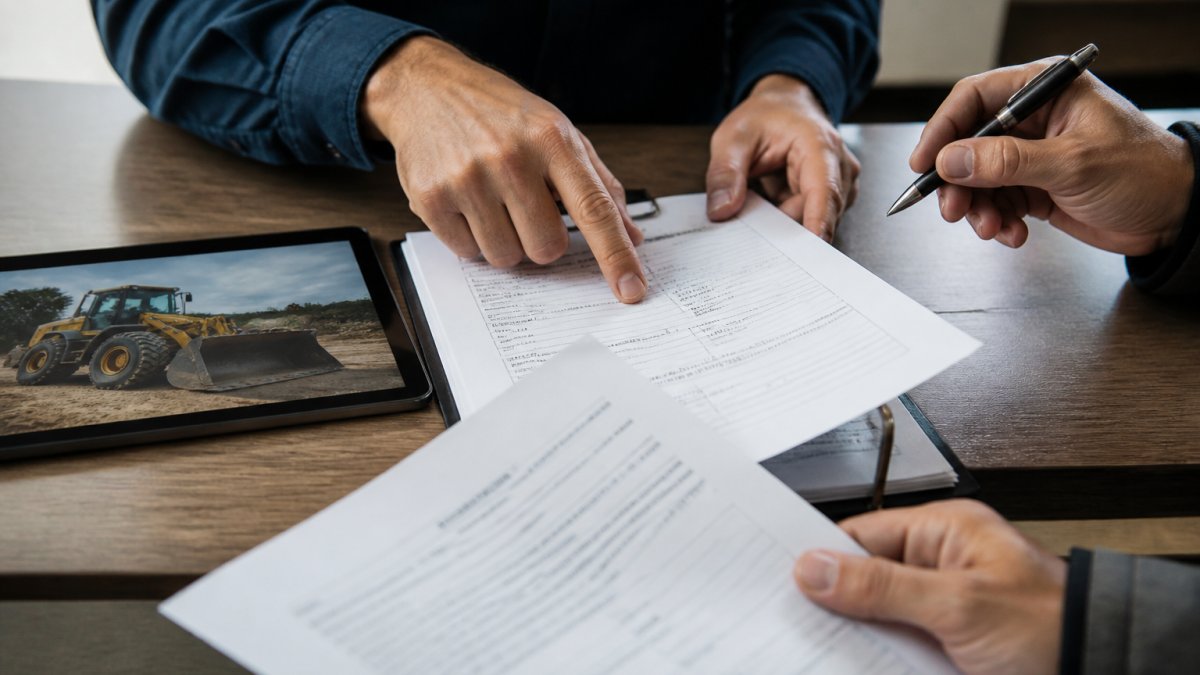
Equipment fraud is common. Scammers pose as legitimate buyers, arrange financing that falls through, or use stolen funds. By the time you discover the fraud, the equipment is gone and your bank account is liable for the reversed payment.
Verify Buyer Identity and Financial Credentials
Before accepting an offer, verify the buyer's legitimacy:
For individual buyers:
- Request a government-issued photo ID (driver's license or passport). Verify the name matches the purchase agreement.
- Ask for a phone number and call to confirm the buyer is reachable.
- Search the buyer's name online. Scammers often use variations of real names or stolen identities.
For business buyers:
- Request a copy of their business license and verify it with your state's Secretary of State or business registration database.
- Ask for a Dun & Bradstreet number (DUNS) and verify their business credit profile.
- Request bank references: the name and contact information of their business bank. Call the bank directly (use the number on their official website, not a number the buyer provides) to confirm the account is in good standing.
Identify Red Flags and Scam Patterns
Common equipment fraud schemes include:
Wire-fraud scams:
- Buyer pressures you to accept a wire transfer and release equipment immediately.
- Buyer sends a wire from an unfamiliar bank or country.
- Buyer asks you to wire funds back (for shipping, taxes, or "processing fees") before the sale is complete.
Financing fraud:
- Buyer claims to have financing but the lender's approval letter is forged or outdated.
- Buyer arranges a loan that falls through after you've released the equipment.
- Buyer's check bounces or their credit card payment is disputed weeks later.
Identity theft:
- Buyer uses a stolen identity or forged documents.
- Buyer claims to represent a legitimate company but is actually a third party.
- Buyer's contact information changes multiple times during the transaction.
Pressure tactics:
- Buyer demands you lower the price or offer financing.
- Buyer creates artificial urgency: "I need this equipment by Friday or the deal is off."
- Buyer asks you to skip standard verification steps to "speed up the process."
Payment Methods: What to Accept and What to Avoid
Safe payment methods:
- Wire transfer from a verified bank account: The buyer wires funds from their bank to yours. Once the wire settles (typically 1-3 business days), the funds are yours and cannot be reversed. Confirm the wire has settled in your account before releasing equipment. Call your bank to verify if you're unsure.
- Certified check or cashier's check: The buyer's bank guarantees the funds. Verify the check is legitimate by calling the issuing bank directly (use the number on the back of the check or the bank's official website). Wait for the check to clear (5-7 business days) before releasing equipment.
- Escrow service: A neutral third party holds the buyer's funds until you deliver the equipment and all documentation. Once the buyer confirms receipt, escrow releases payment to you. This is the safest method for high-value equipment.
Unsafe payment methods:
- Personal checks: Can bounce or be disputed weeks later.
- Credit card payments: Can be charged back by the buyer's bank.
- ACH transfers: Can be reversed if the buyer disputes the transaction.
Use Escrow for High-Value Equipment
For equipment valued above $10,000, escrow is standard practice and strongly recommended. Here's how it works:
-
Buyer and seller agree on an escrow service. Common escrow providers for equipment include specialized escrow companies, title companies, and some banks. The buyer and seller split the escrow fee or the buyer pays the full fee.
-
Buyer deposits funds into escrow. The escrow agent holds the funds in a segregated account and does not release them until conditions are met.
-
You deliver the equipment and documentation. Once the buyer takes possession and inspects the equipment, they notify the escrow agent.
-
Escrow releases payment to you. The escrow agent transfers the funds to your account. At this point, payment is final and cannot be reversed.
-
If a lien must be paid at closing, the escrow agent pays the lien holder directly from the buyer's funds, receives the UCC-3 termination statement, and releases the remaining funds to you.
Escrow protects both parties: the buyer knows the equipment will be delivered and liens will be cleared, and you know payment is guaranteed once the buyer confirms receipt.
Document Payment Terms in Your Bill of Sale
Your bill of sale must specify:
- Payment method: Wire transfer, certified check, escrow, etc.
- Payment timing: When is payment due? (e.g., "Payment due upon delivery" or "Payment due within 3 business days of delivery")
- Condition of payment: Is payment contingent on the buyer's inspection? (e.g., "Buyer has 48 hours to inspect equipment; if buyer rejects equipment, payment is refunded in full.")
Example language:
"Payment shall be made via wire transfer to Seller's account [account details]. Payment must clear Seller's bank account before equipment is released to Buyer. If payment is made via check or ACH transfer, Seller retains possession of equipment until payment has cleared (5-7 business days). Buyer shall not take possession of equipment until all payment obligations are satisfied and all liens have been released."
Never Release Equipment Until Payment Clears
This is the golden rule. Wire transfers, checks, and ACH transfers can be reversed days or weeks after the transaction. Wait for:
- Wire transfers: Confirmation from your bank that the wire has settled (typically 1-3 business days). Call your bank to verify if you're unsure.
- Checks: Full clearance (5-7 business days). Do not release equipment based on a deposited check; wait until it has cleared.
- ACH transfers: Full settlement (1-2 business days) plus an additional 3-5 days to ensure the transfer cannot be reversed.
If you release equipment before payment clears and the payment is reversed, you've lost both the equipment and the money. The buyer's bank will not recover the equipment for you.
What to Do If Payment Fails or Is Disputed
If a buyer's payment bounces, is reversed, or is disputed:
- Stop the transaction immediately. Do not release any equipment or documentation.
- Contact the buyer. Ask for an explanation and request immediate payment via a secure method (wire transfer or certified check).
- If the buyer cannot pay, you have the right to cancel the sale and keep the equipment. Notify the buyer in writing that the sale is void due to failed payment.
- If the buyer disputes the charge (claims they didn't authorize it or the equipment didn't match the description), you have a right to respond. Provide your bill of sale, photos of the equipment, and documentation of the buyer's inspection. Most payment processors and banks side with the seller if you have clear documentation.
- For high-value disputes, consult an attorney. You may need to file a claim in small claims court or pursue collection through a debt collector.
Preparing Equipment for Sale and Inspection
Clean and inspect your equipment before listing. A well-maintained appearance increases buyer confidence and justifies higher prices.
Test all major systems if safe to do so. Start the engine. Check hydraulic functions.
Prepare the equipment for transport. Drain fluids if required by law or safety standards. Secure loose parts.
Gather all documentation: original purchase receipts, service records, parts lists, operator manuals, and any warranty information.
Regulatory Compliance and Environmental Requirements
Heavy equipment is subject to environmental regulations. Some states require emissions testing before sale.
Research your state's environmental rules for the equipment type you're selling.
If the equipment contains fluids, oil, coolant, hydraulic fluid, disclose their condition. If they're contaminated or contain hazardous substances, that's a buyer concern.
For equipment that operates in specific environments, construction sites, agricultural land, factories, research any industry-specific regulations. OSHA standards may apply.
International Export and Customs Compliance
Selling equipment internationally adds complexity. Export controls, tariffs, and customs regulations apply.
For most heavy equipment, you'll need an export license. Contact the U.S.
Provide the buyer with accurate specifications and documentation.
Include a bill of lading and commercial invoice with the shipment.
Clarify who pays for export documentation, customs duties, and import taxes.
A Heavy Equipment Broker specializes in managing this complexity.
Frequently Asked Questions
What documents do I need to sell heavy machinery?
You need proof of ownership (title or registration), the bill of sale, maintenance and service records, inspection reports, and any warranty documentation. A UCC search result showing no liens is critical. Include equipment serial numbers, current condition disclosures, and tax clearance certificates if applicable. If the equipment was financed, obtain a lien release from the secured party before closing. These documents protect both you and the buyer and ensure a legal transfer of ownership.
How do I verify ownership before selling used heavy equipment?
Check your original purchase documents and title or registration paperwork. Conduct a UCC (Uniform Commercial Code) search through your state's Secretary of State office to confirm no liens or secured interests are recorded against the equipment. Contact the manufacturer with the serial number to verify ownership history. If you financed the equipment, review your loan documents to confirm you hold clear title. These steps prevent legal disputes and ensure you can transfer full ownership to the buyer.
Should a heavy equipment bill of sale include an as-is clause?
Yes, including an as-is clause protects you from future liability claims. The clause should explicitly state that the buyer accepts the equipment in its current condition without warranties or guarantees. However, you must still disclose known defects and major issues. The as-is language should specify that the buyer waives claims for mechanical failure, wear, or condition after purchase. Have an attorney review your bill of sale to ensure it complies with your state's laws and provides adequate protection.
What are my tax obligations when selling heavy machinery?
Sales tax requirements vary by state and depend on whether the buyer is in-state or out-of-state. Some states exempt used equipment sales; others apply sales tax based on the sale price. You may owe income tax on the sale proceeds. If the equipment was depreciated for business purposes, you may face depreciation recapture taxes. Consult a tax professional or accountant to understand your specific obligations, especially for large sales or international transactions. Proper tax reporting protects you from audits and penalties.
Can a seller be held liable for defects after an as-is equipment sale?
Liability after an as-is sale is limited but not eliminated. If you knowingly conceal a defect or make false statements about the equipment's condition, you can still face fraud claims regardless of as-is language. You remain liable for any defects you knew about but failed to disclose. As-is clauses protect you from claims about unknown conditions and normal wear. Always disclose known issues in writing, obtain signed acknowledgment from the buyer, and include comprehensive as-is language in your bill of sale to minimize post-sale liability.
How do I protect myself when selling heavy machinery privately?
Use a written bill of sale with clear as-is language, warranty disclaimers, and liability waivers. Conduct a UCC search and obtain a lien release if needed. Require secure payment methods and verify funds before releasing equipment. Document the equipment's condition with photos and written inspection reports. Disclose all known issues in writing. Have the buyer sign acknowledgment of condition and as-is terms. Consider requiring the buyer to carry insurance during transport. If possible, use a professional broker or escrow service to handle payment and reduce fraud risk.
Why use an equipment broker like Ironmartonline when selling heavy machinery?
A professional equipment broker handles the legal complexity for you, manages listings across multiple platforms to reach millions of buyers, and handles payment security and fraud prevention. Brokers know state-specific regulations, lien requirements, and tax implications, reducing your legal exposure. They prepare compliant contracts and bill of sale documents, conduct due diligence on buyers, and manage the closing process. This saves time, minimizes disputes, and often results in faster sales and better prices than private sales. Brokers provide the expertise and reach needed to maximize your return while staying compliant.