
Table of Contents
- Why Use an Equipment Broker for Heavy Equipment Sales
- What Is a Private Party Heavy Equipment Sale Contract
- Key Parties Involved in Equipment Transactions
- Essential Elements of a Heavy Equipment Sale Contract
- Heavy Equipment Bill of Sale Template and Requirements
- As-Is Heavy Equipment Sale Clause: What Buyers and Sellers Need to Know
- Heavy Equipment Inspection Checklist Before Purchase
- Lien and Encumbrance Verification
- Representations, Warranties, and Risk of Loss
- Tax Implications for Private Equipment Sales
- Frequently Asked Questions
Last Updated: September 28, 2026
Why Use an Equipment Broker for Heavy Equipment Sales
Why should you use Ironmartonline as your equipment broker instead of handling a private party heavy equipment sale contract on your own? The answer lies in complexity, risk, and reach. When contractors, fleet managers, and equipment owners attempt to navigate private sales without professional guidance, they face a maze of legal requirements, financing obstacles, and market limitations that can cost thousands in lost value or legal exposure.
According to Equipment World's 2026 contractor survey, 83% of contractors plan to purchase construction equipment this year, creating unprecedented demand. Yet most private party transactions stumble on the same preventable issues: poorly drafted agreements, lien verification failures, and payment security problems that lenders reject outright. The 2026 Dealer Insights Report from Fusable Data found that private party equipment sales are often cheaper but present significantly higher risks for buyers, specifically noting that lenders are far more cautious about approving private party deals compared to dealer-facilitated transactions.
This is where a Heavy Equipment Broker like Ironmartonline changes the equation. Rather than wrestling with contract language, title transfers, and buyer sourcing alone, you gain access to nine specialized web-based selling platforms that connect your equipment to millions of potential buyers globally and locally. A heavy equipment broker handles the legal, financial, and operational burden that private sellers typically absorb, eliminating contract complexity while protecting your interests. No hidden fees. No contracts that lock you in. Just a simplified marketplace designed to move machinery efficiently while you focus on your business.
The real question isn't whether you can sell equipment privately, you can. The question is whether you should absorb the legal, financial, and operational burden when a professional broker can eliminate it. Below, we'll walk you through what a private party heavy equipment sale contract actually requires, what risks most sellers overlook, and why working with an experienced broker like Ironmartonline protects your interests while maximizing your return.
What Is a Private Party Heavy Equipment Sale Contract
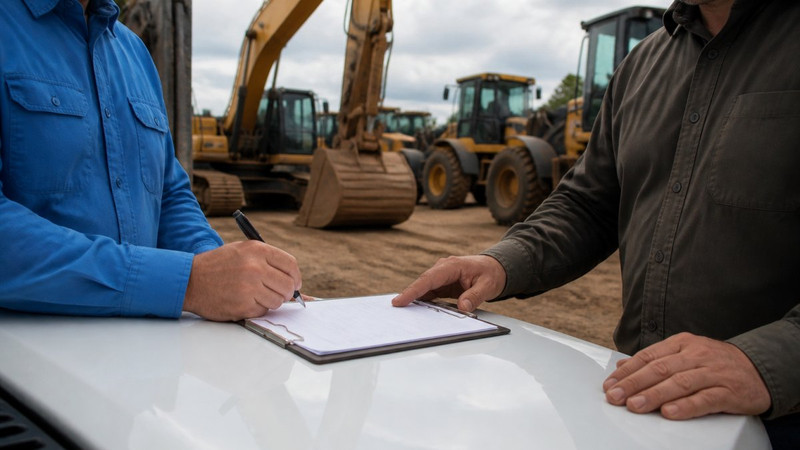
A private party heavy equipment sale contract is a binding legal agreement between an individual buyer and seller that documents the transfer of ownership, payment terms, equipment condition, and risk allocation for machinery like excavators, dozers, trucks, and tractors. Unlike dealer transactions, which operate under established legal frameworks and financing protocols, private sales depend entirely on the quality of your contract to prevent disputes, secure payment, and protect both parties from liability.
The contract creates a clear record of what's being sold (make, model, serial number, condition), establishes payment terms and delivery logistics, allocates risk (who handles transportation, insurance, post-sale repairs), and includes representations and warranties about the equipment's history and functionality.
Most private sellers underestimate how much protection a well-drafted contract provides. WFJ Law Firm's 2026 guidance on equipment sales agreements emphasizes that poorly drafted contracts, common in private transactions, frequently lead to costly disputes, lost revenue, and exposure to liabilities that could have been prevented with proper language. Without clear terms on condition ("as-is" vs. warranted), payment security, and dispute resolution, you're exposed to buyer claims months after the sale closes.
This is precisely why Ironmartonline's brokerage model works. By handling the transaction through our platforms, you benefit from standardized, legally sound processes that protect your interests without requiring you to become a contract expert.
Key Parties Involved in Equipment Transactions
Every equipment transaction involves distinct roles, and understanding them clarifies who bears which responsibilities. The seller is the equipment owner transferring title and possession. The buyer is the party acquiring ownership and taking on operational responsibility. In private sales, these two parties negotiate directly, no middleman to mediate disputes or verify claims.
Lenders, insurance companies, transporters, inspection services, and title agencies often enter the transaction, each requiring specific documentation and coordination.
Essential Elements of a Heavy Equipment Sale Contract
A comprehensive private party heavy equipment sale contract must include specific elements to be enforceable and protective. Missing even one can create expensive gaps.
Equipment Specifications and Serial Numbers
Include the manufacturer name, model number, year of manufacture, and serial number, the unique identifier that proves ownership and prevents confusion.
Document visible wear, known mechanical issues, and recent repairs to protect both parties and limit post-sale liability claims.
Purchase Price and Payment Terms
State the total purchase price and payment method: lump sum, down payment with balance due on delivery, or installments. If installments apply, define the schedule, interest rate, and late-payment consequences.
Specify payment method (cashier's check, wire transfer, escrow). Avoid cash payments; they create no paper trail. If the buyer is financing, note that the sale is contingent on lender approval.
Delivery and Transportation Responsibilities
Assign responsibility for transportation and define who bears risk of loss during transport. Typically, the party arranging transportation assumes that risk unless otherwise stated.
Specify delivery timeline and any conditions that might delay delivery.
Heavy Equipment Bill of Sale Template and Requirements
A bill of sale is a simplified document proving transfer of personal property ownership. While less comprehensive than a full equipment sale contract, it's often used alongside a detailed agreement or as a standalone document for smaller transactions.
A proper bill of sale includes the date, seller and buyer names and addresses, equipment description (make, model, year, serial number), purchase price, payment method, and signatures. Verify whether your state requires notarization.
| Element | Purpose | Example |
|---|---|---|
| Equipment description | Identifies the specific asset | 2019 Caterpillar 320 Excavator, Serial #CAT123456 |
| Purchase price | Documents consideration | $85,000 |
| Payment terms | Clarifies payment method and timing | Full payment via wire transfer upon delivery |
| Seller representations | Confirms seller's authority and claims | Seller warrants ownership and authority to sell |
| Buyer acknowledgment | Confirms buyer acceptance of condition | Buyer accepts equipment in as-is condition |
| Signatures and date | Makes document legally binding | Both parties sign and date |
As-Is Heavy Equipment Sale Clause: What Buyers and Sellers Need to Know
The as-is condition clause is perhaps the most misunderstood element of equipment contracts. An "as-is" sale means the buyer accepts the equipment in its current condition, with all faults, and waives the right to claim the seller misrepresented its condition or functionality after the sale closes.
An as-is clause prevents buyers from claiming hidden damage after closing, but doesn't eliminate liability for actively concealed defects or false statements.
Buyers accepting as-is equipment are responsible for thorough pre-purchase inspection and accept post-closing risk.
State any seller warranties explicitly. Vague warranties create disputes; specific ones protect both parties.
Heavy Equipment Inspection Checklist Before Purchase
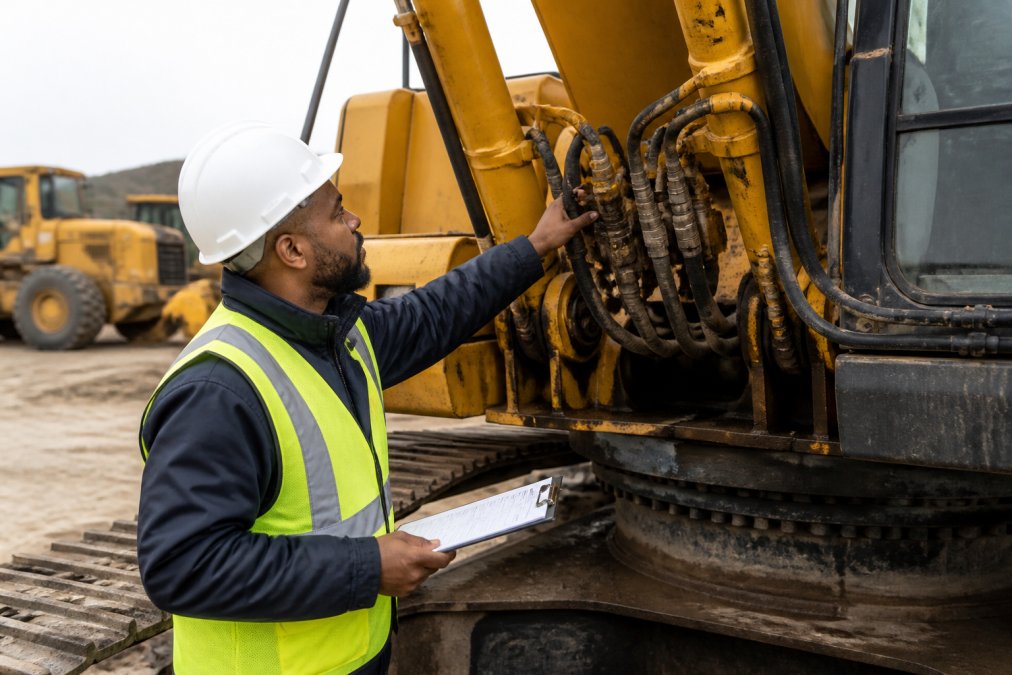
Before signing, conduct a thorough physical inspection. A rushed inspection is one of the most expensive mistakes private buyers make, problems discovered after closing become your financial burden.
Pre-Inspection Planning
Gather maintenance records, service history, and hour-meter documentation before visiting. Request the original purchase invoice to verify age and ownership. Ask the seller to have equipment fueled, warmed up, and ready to operate. Establishing this clear paper trail early minimizes potential disputes and ensures that the final purchase closing process remains as straightforward for heavy machinery as it does for high-value maritime assets.
Bring a mechanic if you're not confident evaluating machinery. Document everything with photographs and written notes for evidence if disputes arise.
Critical Inspection Areas (Prioritized)
Engine and Power Systems (Highest Priority)
Listen for unusual knocking, grinding, or rattling at idle and under load. Check for oil leaks and examine oil color (dark, gritty oil suggests poor maintenance). Check coolant level and condition. Verify hour-meter reading is reasonable for the equipment's age.
Hydraulic Systems (High Priority)
Inspect hoses for leaks, cracks, or bulges. Check fluid level and color. Operate all hydraulic functions and listen for hesitation or jerking. Look under the equipment for fluid pooling or staining.
Undercarriage and Structural Integrity (High Priority)
Count broken track links; more than 5-10 suggests heavy use. Check for excessive play in the track. Examine the frame and boom for cracks, bends, or welding repairs. Cracks are structural failures that are expensive to repair.
Inspect tires for tread depth, cuts, bulges, or uneven wear. Uneven wear suggests alignment or suspension damage.
Cab, Controls, and Safety Systems (Medium Priority)
Test all controls, gauges, and switches. Verify hour meter, fuel gauge, temperature gauge, and warning lights function. Test backup alarm and safety systems.
Maintenance Records and Service History (Medium Priority)
Request complete maintenance records. Regular service indicates proper care; sporadic records suggest neglect. Verify major repairs were done by qualified technicians.
Red Flags That Should Stop the Deal
- Engine won't start or runs rough: Indicates ignition, fuel, or compression problems; diagnosis is expensive and uncertain.
- Active hydraulic leaks: Hydraulic system repairs are costly and often require complete component replacement.
- Cracked or bent frame: Structural failure; repair is dangerous and may be impossible.
- Hour meter inconsistency: If the seller can't explain why a 2010 machine has only 3,000 hours, the meter may have been rolled back.
- Missing or illegible serial number: Prevents title transfer and raises theft concerns.
- Seller refuses inspection or limits access: A legitimate seller welcomes inspection; refusal is a major warning sign.
Documentation and Decision-Making
Take 24-48 hours to review your notes. Use minor issues as negotiation points. If you discovered major problems, walk away.
Request a written statement from the seller confirming equipment condition as of the inspection date.
Lien and Encumbrance Verification
A lien is a legal claim against equipment, typically held by a lender. If you purchase equipment with an active lien, the lender can repossess it from you, even though you paid the seller.
Why This Matters: Real-World Risk
If you purchase equipment with an active lien, the lender can repossess it from you even though you paid the seller. You lose both the equipment and your money, with no legal recourse if the seller has disappeared.
How to Conduct a UCC Search
A UCC (Uniform Commercial Code) search reveals whether any liens have been filed against the equipment.
Step 1: Identify the Correct Jurisdiction
UCC filings are recorded at the state level through the Secretary of State's office. If the equipment is registered in one state but the seller is in another, search both states.
Step 2: Access the Secretary of State's UCC Database
Most states offer online UCC search portals through their Secretary of State website. You'll need the equipment's serial number.
Step 3: Interpret the Results
If the search returns no results, the equipment is clear of liens. If it returns UCC-1 filings, note the secured party (lender), debtor, collateral description, and filing/expiration dates (filings expire after five years unless renewed).
If the debtor name matches the seller and the filing is active, the lender has a claim. Do not proceed unless the seller agrees to pay off the lien from sale proceeds.
Step 4: Request a UCC Search from the Seller
Ask the seller to provide a UCC search showing no liens. If the seller refuses, that's a red flag.
Payoff and Lien Release
If a lien exists, the seller must pay it off from the sale proceeds. Here's how to structure this safely:
- Obtain a payoff statement from the lender. This shows the exact amount owed and the deadline for payment.
- Use escrow or a third-party payment service. Don't hand money directly to the seller. Instead, deposit funds with an escrow agent or use a service like a title company. The escrow agent pays the lender directly from the sale proceeds, then releases remaining funds to the seller and the equipment title to you. This protects everyone: the lender gets paid, the seller gets their net proceeds, and you get clear title.
- Obtain a lien release letter from the lender confirming that the lien has been satisfied and released. This letter should be provided before or at closing.
- Verify the lien release by conducting a follow-up UCC search 5-10 days after closing to confirm the lien no longer appears.
Title Verification and Bill of Sale Requirements
Beyond UCC liens, verify that the seller actually owns the equipment. Request:
- Original purchase documentation or bill of sale from when the seller acquired the equipment. The seller's name should match the ownership record.
- Title certificate (if the state issues one for the equipment type). Some states title heavy equipment like other vehicles; others don't. Confirm your state's requirements.
- Registration documentation showing current registration in the seller's name.
If the seller cannot produce these documents, that's a warning sign. Legitimate owners have records of their purchases.
The Bill of Sale Lien Warranty
Your bill of sale should include explicit language warranting that the equipment is free of liens:
"Seller warrants that the equipment is owned free and clear of all liens, encumbrances, and security interests, except as disclosed herein. Seller further warrants that Seller has full authority to transfer title and that no third party has any claim on the equipment. Seller agrees to execute any documents necessary to release any liens and transfer clear title to Buyer."
This language creates a contractual obligation that the seller can be held liable for if a lien appears after closing.
Additional Protections
- Conduct the UCC search yourself rather than relying solely on the seller's representation. You're the one at risk.
- Search multiple times if there's a delay between offer and closing. New liens can be filed; a search that was clear two weeks ago might show a lien today.
- Use a title company or attorney for larger transactions ($50,000+). The cost ($300-$500) is insurance against a six-figure loss.
- Never take possession of equipment until you have proof of clear title and a signed bill of sale. Possession without title is a recipe for disputes.
Representations, Warranties, and Risk of Loss
Representations are statements of fact about the equipment's history and condition. Warranties are promises about the equipment's future performance or condition. Risk of loss defines who bears the financial burden if the equipment is damaged or destroyed.
A seller representation might state: "Seller represents that the equipment has not been in any accidents, has no hidden damage, and all mechanical systems are in working order as of the date of this agreement."
A warranty might state: "Seller warrants that the engine will operate without significant mechanical failure for 30 days following delivery, and that any defects discovered within this period will be repaired or replaced at Seller's expense."
Risk of loss typically transfers to the buyer upon delivery. This means once you take possession, you're responsible for insuring the equipment and bearing the cost of any damage that occurs. The contract should state: "Risk of loss transfers to Buyer upon delivery and acceptance of the equipment. Buyer assumes all responsibility for insurance and maintenance from that point forward."
These clauses protect both parties by setting clear expectations and limiting disputes over who's responsible for problems discovered after the sale.
Tax Implications for Private Equipment Sales
Private equipment sales have tax consequences that many sellers overlook. When you sell equipment for a gain (sale price exceeds your tax basis), you may owe capital gains tax. The amount depends on how long you've owned the equipment and your tax bracket.
If the equipment is used in your business, the sale may trigger depreciation recapture, which is taxed at ordinary income rates (higher than capital gains rates). Consult a tax professional before closing to understand your liability.
For buyers, the purchase may qualify for business deductions or depreciation if the equipment is used in a trade or business. Buyers should also understand that sales tax may apply, depending on your state's rules and whether the seller is a dealer or private party.
Document the transaction carefully with the bill of sale and contract. Keep records of the purchase price, date of sale, and equipment description. These records support your tax reporting and protect you if the IRS questions the transaction.
Navigating a private party heavy equipment sale contract involves legal, financial, and operational complexity that most individual sellers and buyers aren't equipped to handle alone. Ironmartonline simplifies this process by connecting you with qualified buyers and guiding transactions through our established platforms, eliminating the contract burden and reducing your exposure to the disputes and financing obstacles that plague private sales. Get started with Ironmartonline and access millions of potential buyers without the legal headaches.
Frequently Asked Questions
What should be included in a heavy equipment bill of sale?
A heavy equipment bill of sale must include the seller and buyer names, equipment make, model, and serial number, purchase price, payment terms, condition statement (as-is or warranted), delivery details, and date of execution. Both parties should sign and date the document. Include a statement transferring title and any warranties or disclaimers. The bill of sale serves as proof of ownership transfer and is essential for registration and financing purposes.
How do I verify liens and encumbrances before buying heavy equipment?
Request the seller provide proof that all liens have been satisfied or will be paid at closing. Check the equipment's title history through the state's DMV or relevant agency. Conduct a UCC search through the Secretary of State's office to identify any outstanding claims. Ask the seller for documentation of any outstanding loans or mortgages against the equipment. Have your lender run their own lien search before financing approval. Never complete a private party heavy equipment sale contract without clearing all encumbrances.
Is an as-is heavy equipment sale clause legally binding?
Yes, an as-is heavy equipment sale clause is legally binding when both parties agree to it and the contract is properly executed. The clause means the buyer accepts the equipment in its current condition without warranties from the seller. However, the as-is clause does not protect sellers from fraud or misrepresentation about the equipment's condition. Some states limit the enforceability of as-is clauses in certain contexts. Always have an attorney review your heavy equipment sale contract to ensure the as-is language complies with state law.
What is the difference between a bill of sale and a purchase agreement for heavy equipment?
A bill of sale is a simpler document that confirms the transfer of ownership and basic transaction details like price and equipment description. A purchase agreement is more comprehensive, covering payment terms, delivery responsibilities, warranties, representations, dispute resolution, and governing law. For significant equipment purchases, a full purchase agreement provides stronger legal protection for both parties. A heavy equipment sale contract typically combines elements of both, ensuring clear title transfer while addressing buyer and seller obligations.