
Table of Contents
- Why Use Ironmartonline as Your Equipment Broker
- What Is an Escrow Service for Heavy Equipment
- How the Escrow Process Works for Used Machinery
- Top Escrow Services for Heavy Equipment Compared
- How to Avoid Heavy Equipment Scams
- Milestone-Based Payment Releases and Inspection Contingencies
- Fee Structure Transparency and Cost Comparison
- Dispute Resolution Protocols and Buyer Protection
- Frequently Asked Questions
Last Updated: September 30, 2026
Why Use Ironmartonline as Your Equipment Broker
When you're selling heavy equipment, a single excavator or fleet of dozers represents significant capital. Getting maximum value requires reaching the right buyers fast. But here's the question that matters most: why use a Heavy Equipment Broker like Ironmartonline instead of listing on generic marketplaces or handling sales alone?
The answer comes down to reach and efficiency. Ironmartonline connects sellers to millions of potential buyers across nine specialized web-based selling platforms. That's nine different channels working simultaneously to showcase your equipment to contractors, fleet managers, rental companies, and international buyers actively searching for exactly what you're selling.
According to Mordor Intelligence's 2026 market analysis, the used construction equipment market is valued at USD 132.67 billion, with projected growth of 5.63% annually through 2031. Most sellers miss this opportunity because they lack access to multiple distribution channels or the expertise to navigate them.
Ironmartonline eliminates that friction. No contracts. No hidden fees. Just a straightforward approach to connecting your machinery with qualified buyers globally and locally. For construction contractors offloading surplus excavators, fleet managers acquiring heavy-duty trucks, agricultural business owners seeking cost-effective used tractors, equipment rental companies disposing of end-of-lease machinery, and owner-operators needing brokerage support, Ironmartonline provides the professional marketplace infrastructure that independent sellers can't replicate alone.
But selling equipment safely requires more than just reach. It requires protection, especially when high-value transactions are involved. That's where escrow services become critical.
What Is an Escrow Service for Heavy Equipment
An escrow service is a neutral third-party arrangement where funds are held securely until both buyer and seller fulfill their contractual obligations. Rather than the buyer sending payment directly to the seller, the escrow agent holds the money in a segregated account. Payment is only released once agreed-upon conditions are met: inspection is complete, title transfers are verified, and delivery is confirmed. Establishing these rigorous protocols ensures that the transaction remains protected throughout the entire process, reinforcing the necessity of utilizing secure payment methods when navigating private sales.
For heavy equipment transactions, escrow services function as a critical fraud-mitigation layer. ProcurementIQ's 2026 sourcing guide documents that escrow and title services provide essential benchmarks, risk analysis, and supplier identification for high-value asset transactions. Without this protection, both buyers and sellers face significant exposure.
A buyer wires funds for a used bulldozer. The seller receives payment. Then the buyer discovers undisclosed damage, a clouded title, or the unit never arrives. With escrow, the seller doesn't get paid until the buyer confirms the equipment is as described and in their possession. Escrow services are faster and more cost-effective than traditional bank guarantees or insurance. Lexology's 2026 analysis reports that escrow agents typically release funds within two business days of verification, making the transaction cycle predictable for both parties.
How the Escrow Process Works for Used Machinery
The escrow process for heavy equipment follows a structured sequence designed to protect both parties while keeping transactions moving.
Step 1: Agreement and Deposit. The buyer and seller agree on price, equipment specifications, delivery terms, and inspection contingencies. The buyer deposits funds into the escrow account, typically held in FDIC-insured accounts for security.
Step 2: Inspection and Verification. The buyer arranges inspection of the equipment, verifying that the machinery matches the agreed-upon description, operates as represented, and has no hidden damage or title issues.
Step 3: Conditional Release Approval. Once inspection is complete and satisfactory, the buyer approves the release of funds. If issues are discovered, the buyer can request repair, a price adjustment, or cancellation. The escrow agent does not release funds until both parties agree on resolution.
Step 4: Title and Delivery Verification. The seller arranges delivery and title transfer. The escrow agent verifies that the bill of lading matches the equipment being delivered and that title documents are in order.
Step 5: Fund Release. Once all conditions are met, inspection approved, title verified, delivery confirmed, the escrow agent releases the funds to the seller. The transaction is complete.
Top Escrow Services for Heavy Equipment Compared

The safest escrow services for heavy equipment each bring different strengths. The right provider depends on your transaction profile: equipment category, value, buyer/seller geography, and whether logistics coordination is critical.
Escrow.com: Established Platform for Equipment Transactions
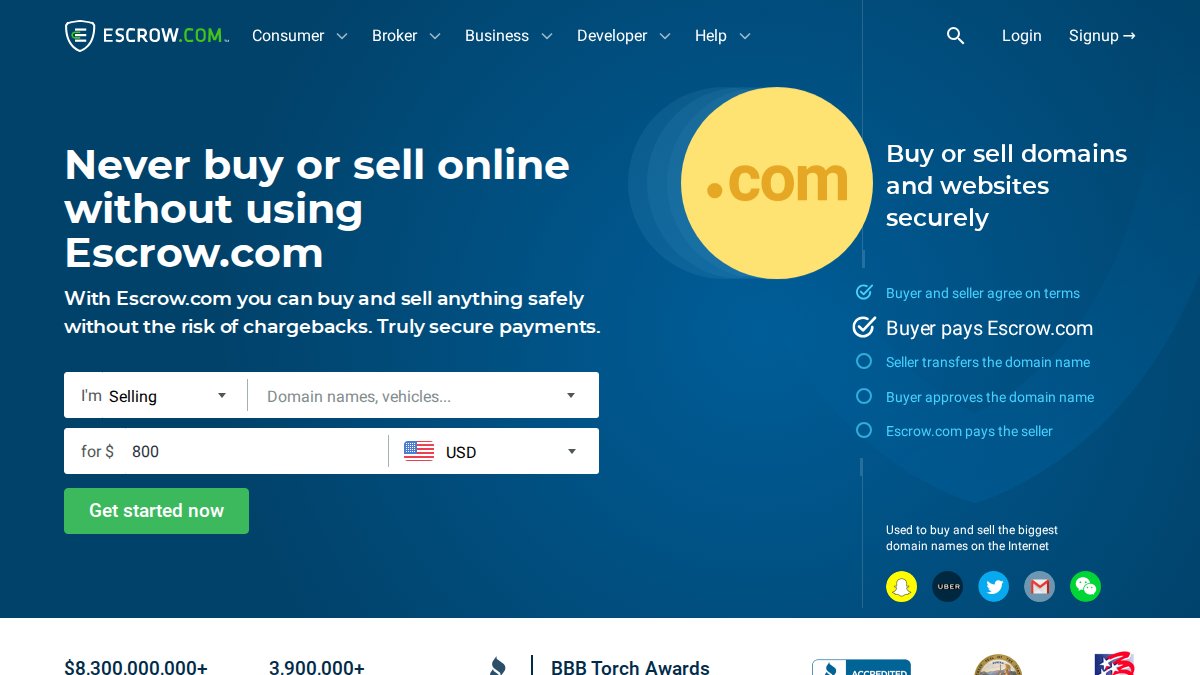
Escrow.com is an established independent escrow service. For equipment buyers and sellers, it offers a standardized, reputation-backed platform.
The service holds buyer funds in segregated, FDIC-insured accounts using milestone-based fund release. Payment is only disbursed once the buyer confirms delivery and equipment condition. For equipment transactions, Escrow.com provides neutral third-party mediation if disputes arise.
Pros:
- Highly established with strong industry reputation
- Handles complex equipment transactions with title verification
- Global transaction support for international equipment sales
- Neutral mediation available if buyer-seller disputes occur
- Automated milestone tracking reduces manual coordination
Cons:
- Percentage-based fees become expensive on high-value machinery
- Process is standardized, not customized for equipment-specific logistics
- Less specialized knowledge of heavy machinery trade requirements
Best For: Individual buyers and sellers, small fleet transactions, and domestic sales where standardized processes and brand recognition matter more than industry specialization.
Freightplus Escrow Services: Industry-Specific Expertise
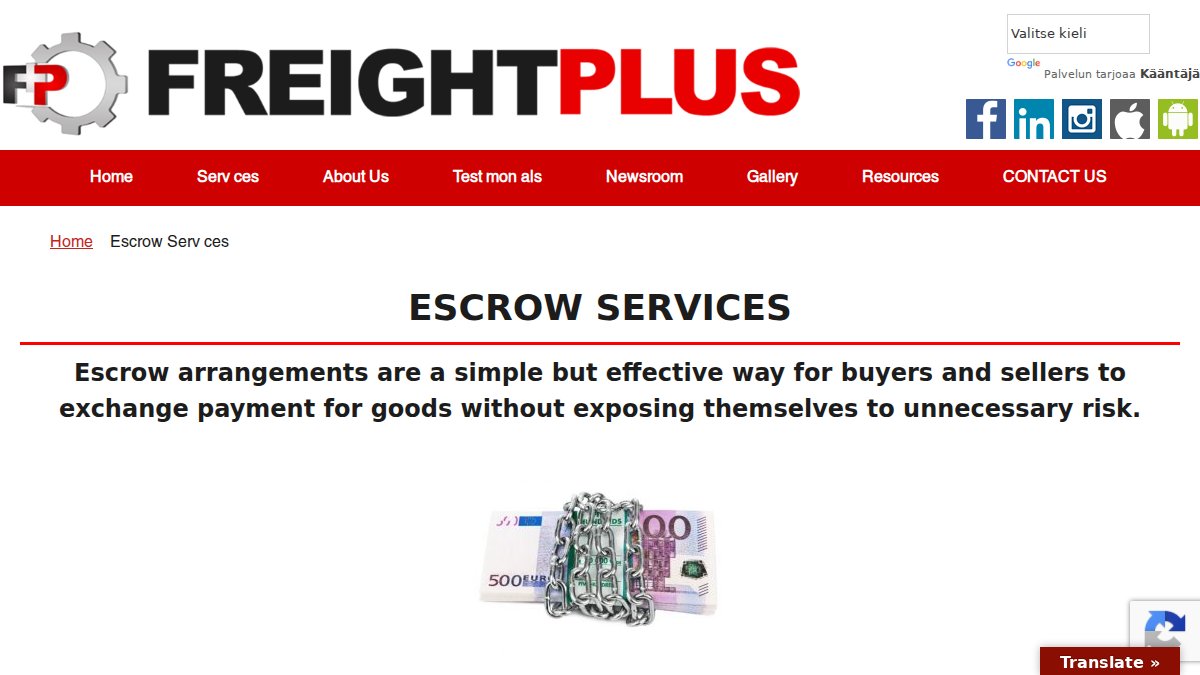
Freightplus specializes in escrow for heavy machinery and international equipment trade. Unlike general-purpose platforms, Freightplus understands the logistics, documentation, and regulatory requirements specific to equipment sales.
The service includes custom escrow agreements tailored to equipment transactions, handling of associated bank charges within the service fee, and direct coordination with freight and logistics providers. Freightplus integrates third-party inspection reports and bill-of-lading verification into the escrow release trigger, tying fund release to verified inspection reports plus shipping confirmation.
Pros:
- Fixed pricing provides budget certainty
- Customized agreements designed for equipment-specific requirements
- Logistics coordination reduces friction in delivery verification
- Bank charges covered within the service fee
- Inspection report integration ties payment release to third-party verification
- International transaction expertise
Cons:
- Less automated than general-purpose platforms; more manual coordination required
- Smaller company means less brand recognition than Escrow.com
- Requires direct communication; no self-service portal
Best For: Professional equipment buyers and sellers, particularly those handling international transactions, multi-unit sales, or equipment requiring third-party inspection.
Build Safe Escrow: FDIC-Insured Security for Large Deals
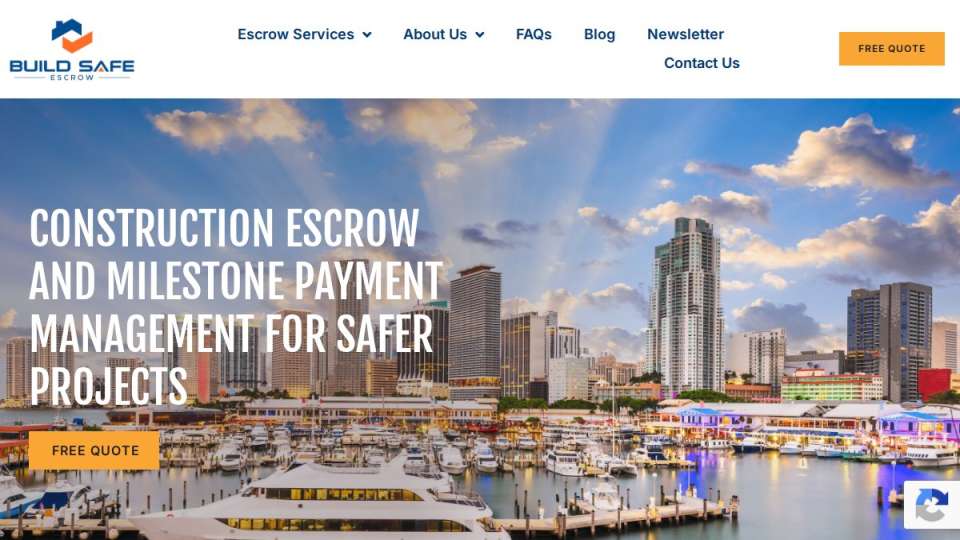
Build Safe Escrow is designed for large-scale construction projects and equipment procurement. The service emphasizes maximum financial security by holding all funds in FDIC-insured accounts and using milestone-based payment release schedules.
For construction equipment purchases, funds are held until specific project milestones are completed: equipment delivery, inspection approval, title verification, and integration into the buyer's fleet or project.
Pros:
- FDIC-insured accounts provide maximum financial security
- Milestone-based releases align payment with equipment delivery and performance
- Designed specifically for large-scale construction and procurement
- Transparent fee structure that doesn't scale with transaction value
Cons:
- Primarily focused on construction projects rather than individual equipment sales
- Requires direct contact for pricing
- Slower process due to custom agreement negotiation
Best For: Large-scale construction firms, equipment rental companies, and fleet managers managing complex procurement with multiple milestones or high-value machinery purchases.
Guaranty Escrow: B2B Fraud Prevention Focus
Guaranty Escrow specializes in business-to-business equipment transactions with strong emphasis on fraud prevention and contract enforcement. Professional agents review transaction documentation, verify buyer and seller credentials, and ensure all contractual obligations are clearly defined before escrow is established.
Pros:
- Strong focus on B2B security and fraud mitigation
- Professional mediation enforces contract terms
- Comprehensive guidance on secure transaction processes
- Pre-escrow credential verification reduces fraud risk
Cons:
- Requires direct contact for pricing and service initiation
- Less transparent fee structure than competitors
- Slower process due to manual review and mediation
Best For: Businesses engaged in high-value or complex equipment transactions requiring professional legal and financial oversight, particularly those with international buyers or sellers.
Quick Selection Guide
| Your Situation | Recommended Service | Why |
|---|---|---|
| Single equipment sale, domestic, under $100,000 | Escrow.com | Brand trust, automated process, reasonable percentage fee |
| Multi-unit or international sale, inspection-critical | Freightplus | Flat fee, logistics integration, inspection report automation |
| Large construction project, $150,000+, multiple milestones | Build Safe Escrow | Custom milestones, FDIC security, professional oversight |
| High-value deal with unverified buyer, fraud risk | Guaranty Escrow | Credential verification, professional mediation, B2B expertise |
How to Avoid Heavy Equipment Scams
Heavy equipment fraud is widespread. Scammers pose as legitimate sellers, request wire transfers to fake escrow services, or disappear after payment is received. The safest escrow services for heavy equipment protect against these scenarios, but buyers must also take active steps.
Verify the escrow service independently. Don't use an escrow service the seller recommends without verification. Look up the service's website directly, call their phone number, and confirm the transaction. Scammers frequently create fake escrow websites that look identical to legitimate ones.
Require in-person or video inspection. Never buy equipment sight-unseen. Arrange a video call where the seller demonstrates the machinery operating, shows the title documents, and provides multiple angles of the equipment.
Verify title and lien status. Before releasing escrow funds, confirm that the seller actually owns the equipment and that no liens are attached. Check the equipment's VIN or serial number against state lien registries and the National Equipment Register.
Use only FDIC-insured escrow accounts. Verify that the escrow service holds funds in FDIC-insured accounts. The standard FDIC limit is $250,000 per account.
Avoid wire transfers outside escrow. Never wire funds directly to a seller. Wire fraud is nearly impossible to reverse. Escrow exists specifically to prevent this scenario.
Check the seller's history. For equipment marketplaces, review the seller's feedback and transaction history. Scammers typically have no history or recent negative reviews.
Milestone-Based Payment Releases and Inspection Contingencies
Milestone-based payment release is the backbone of secure equipment escrow. Rather than releasing all funds at once, the escrow agent releases payment in stages tied to specific, verifiable events.
Typical milestone structure:
- Milestone 1 (10% of funds): Released upon escrow account funding and transaction agreement confirmation
- Milestone 2 (40% of funds): Released upon equipment inspection approval and buyer sign-off
- Milestone 3 (40% of funds): Released upon delivery verification and title transfer confirmation
- Milestone 4 (10% of funds): Released upon final buyer acceptance and no disputes within 30 days
This structure protects both parties. The seller knows payment is coming in stages tied to verifiable events. The buyer knows equipment won't be delivered until they've had a chance to inspect it.
Inspection contingencies are the conditions that must be met before payment is released:
- Equipment operates as represented
- No hidden damage or mechanical defects
- Title is clear and in seller's name
- Equipment matches the agreed-upon specifications
- Delivery occurs within the specified timeframe
- All documentation is provided
If inspection reveals issues, the buyer can request repair, a price reduction, or cancellation. According to Build Safe Escrow's 2026 guidance, funds held in FDIC-insured accounts and released only upon completion of agreed-upon milestones provide the highest level of transaction security for equipment purchases exceeding $50,000.
Fee Structure Transparency and Cost Comparison
Understanding escrow fees is critical because they directly impact your net proceeds or total equipment cost.
Percentage-based fees scale with transaction value. Flat-fee models are predictable regardless of transaction size. For high-value equipment, flat fees are significantly cheaper. Custom-quote models vary based on transaction complexity.
Here's a cost comparison across transaction sizes:
| Transaction Value | Escrow.com (1%) | Freightplus (Flat) | Build Safe (typical) |
|---|---|---|---|
| $25,000 | $250 | $250 | $300-400 |
| $50,000 | $500 | $250 | $400-600 |
| $100,000 | $1,000 | $250 | $600-900 |
| $250,000 | $2,500 | $250 | $1,200-1,800 |
| $500,000 | $5,000 | $250 | $2,000-3,000 |
Additional costs to budget:
- Wire transfer fees
- Title search and verification
- International transactions
- Dispute resolution mediation
Always ask escrow services about their complete fee structure upfront. The safest escrow services for heavy equipment provide transparent, itemized pricing with no hidden charges.
Dispute Resolution Protocols and Buyer Protection
Even with careful inspection and verification, disputes sometimes arise. A buyer claims the equipment doesn't match the description. A seller claims the buyer damaged the machinery after delivery. The escrow agent's role is to mediate these conflicts and determine whether funds should be released, refunded, or held pending resolution.
The Dispute Resolution Workflow
Step 1: Notification and Documentation. The party with the complaint notifies the escrow agent in writing within the dispute window. The complaint must include a detailed description of the issue, photographic or video evidence, reference to the original equipment description, and requested resolution.
Step 2: Evidence Submission from Both Parties. The seller has a defined response window to submit their own evidence: proof that the equipment was in the described condition at time of shipment, shipping documentation, communications with the buyer, and denial or explanation of the claimed defect.
Step 3: Investigation and Third-Party Verification. For significant disputes, the escrow agent may require independent verification through mechanical inspection, title verification, or shipping investigation. The cost is typically split between the parties or deducted from escrow funds.
Step 4: Escrow Agent Determination. The escrow agent reviews all evidence and makes a decision: full release to seller, partial release, refund to buyer, or holdback pending repair.
Step 5: Fund Release or Refund.
Real-World Dispute Scenarios and Resolutions
Scenario 1: Hidden Engine Damage
Buyer purchases a used excavator. Three days after delivery, the buyer discovers the engine knocks under load, a sign of internal damage. An independent mechanic inspects the engine and determines the knock is consistent with pre-existing internal wear, not shipping damage. The escrow agent releases a portion of funds to the seller and holds the remainder as a credit toward the buyer's repair costs.
Scenario 2: Title Lien Discovery
Buyer purchases a fleet of used dump trucks. The title search reveals a lien that the seller did not disclose. The escrow agent contacts the lien holder and confirms the lien is still active. The seller provides a payoff letter. The escrow agent releases funds to the seller and holds the lien amount to pay off the lien. Once the lien is satisfied and the title is clear, the remaining funds are released to the seller.
Scenario 3: Non-Delivery
Buyer wires funds to escrow for high-value equipment. The seller arranges shipping but the equipment never arrives. The escrow agent requests shipping documentation from both the seller and freight company. If no bill of lading exists, the equipment was never shipped and the escrow agent refunds the buyer in full. If a bill of lading exists, the escrow agent releases funds to the seller and the buyer pursues a claim against the freight company's cargo insurance.
Buyer Protection Mechanisms Built Into Escrow
Inspection Contingency and the Verification Workflow
Most escrow agreements include an inspection period. Equipment is delivered to the buyer's location or a neutral inspection facility. The buyer inspects the equipment and documents its condition with photos, video, and a written report. The buyer submits the inspection report to the escrow agent along with either approval or a list of issues. If approved, the buyer signs off and the escrow agent releases funds. If issues are found, the buyer requests repair, price reduction, or cancellation. The escrow agent holds funds pending resolution.
The key protection: Funds are not released until the buyer has physically inspected the equipment.
Title Guarantee and Lien Verification
Before releasing funds, the escrow agent verifies the seller is the registered owner, no liens or encumbrances are attached, and the title is transferable. If a lien is discovered, funds are held until the lien is satisfied.
Delivery Verification and Bill of Lading Matching
Payment is not released until the bill of lading matches the equipment being delivered and the buyer confirms receipt in the described condition.
Holdback Agreements for Latent Defects
For high-value equipment, some escrow services hold back a portion of funds for a period after delivery. If no issues arise, the remaining funds are released. If a defect appears, the holdback covers repair costs.
Dispute Prevention: What Buyers Should Do
1. Define inspection contingencies in writing before escrow is established.
The escrow agreement should specify what "as represented" means, what inspection methods will be used, the inspection timeline, and what happens if issues are found.
2. Hire an independent mechanic for high-value equipment.
A professional mechanic's report carries weight in dispute resolution and provides objective evidence of the equipment's condition.
3. Document everything in writing.
If the seller makes any representations about the equipment, get it in writing in the escrow agreement. Verbal promises are unenforceable in disputes.
4. Verify title before releasing escrow funds.
Request a title search or lien check as part of the escrow process. This is especially critical for equipment with financing history.
5. Require bill-of-lading matching.
Before approving payment release, confirm that the serial numbers on the bill of lading match the equipment you received.
Seller Protection: Chargeback Fraud Prevention
Escrow prevents chargeback fraud by requiring the buyer to physically inspect and approve the equipment before funds are released. Once the buyer signs off on the inspection, they cannot later claim non-delivery or misrepresentation.
Sellers should require the buyer to sign an inspection approval form before requesting fund release, document the equipment's condition with photos and video before shipment, use a reputable freight company with cargo insurance and tracking, and retain all communications with the buyer confirming the equipment specifications and condition.
Frequently Asked Questions
How do I know if an escrow company is legitimate for safest escrow services?
Verify that the escrow service holds funds in FDIC-insured accounts, maintains transparent fee structures, and has documented experience with heavy equipment transactions. Check for third-party certifications, client testimonials, and whether they provide detailed written agreements before funds are transferred. Legitimate providers publish their processes openly and respond to verification requests.
What are the common red flags when using escrow for heavy equipment sales?
Avoid services that pressure you to wire funds directly without holding them in escrow, offer unusually low fees, lack clear milestone definitions, or cannot provide proof of FDIC insurance. Be wary of providers unwilling to document inspection contingencies or those requesting payment before establishing a formal agreement. Scammers often pose as legitimate escrow agents but bypass security protocols entirely.
How does the escrow process for used machinery protect both buyer and seller?
The escrow process for used machinery works by having a neutral third-party agent hold buyer funds until agreed-upon milestones are verified. The seller only receives payment after the buyer confirms equipment delivery and condition. This structure protects sellers from non-payment fraud and buyers from receiving damaged or misrepresented machinery, with funds held in secure, FDIC-insured accounts throughout the transaction.
What should I look for in a seller's checklist before using escrow services?
Verify the buyer's financial capacity and legitimacy before initiating escrow. Require detailed equipment specifications, photographs, and maintenance records. Establish clear inspection timelines and acceptance criteria within the escrow agreement. Ensure the escrow service specifies who covers shipping, insurance, and logistics costs. Document all equipment defects upfront to prevent disputes during the inspection phase.