

Table of Contents
- Why Use an Equipment Broker to Sell Used Trucks for Maximum Profit
- Determining Fair Market Value for Your Used Truck
- Essential Truck Selling Tips for Private Party Sales
- Private Party Truck Sale vs. Dealership Trade-In
- Understanding Used Truck Market Trends in 2025
- Marketing Your Truck Across Multiple Platforms
- Screening Buyers and Managing the Sale Transaction
- Legal Requirements: Title Transfer, Bill of Sale, and Odometer Disclosure
- Tax Implications and Post-Sale Liability Protection
- Common Mistakes to Avoid When Selling Used Trucks
Sell Used Trucks for Maximum Profit: A 2026 Guide
Last Updated: July 23, 2026
When you're ready to sell used trucks for maximum profit, every decision, pricing, marketing, buyer screening, directly impacts your bottom line. According to Kelley Blue Book's 2026 market analysis, used truck values remain stable, with private party sales consistently outpacing dealership trade-ins by 15-25% when properly positioned.
Not all truck sales follow the same path. A commercial fleet liquidation requires different tactics than selling a personal pickup. A heavy-duty work truck demands different marketing channels than a commuter vehicle.
Why use a Heavy Equipment Broker for your truck sale? Because selling through traditional channels, local classifieds, dealership trade-ins, or generic online marketplaces, leaves money on the table. A professional Heavy Equipment Broker connects your truck to millions of potential buyers across nine specialized web-based selling platforms, eliminating the friction of private sales while avoiding the steep discounts dealerships offer. You get professional exposure without managing inquiries, test drives, or paperwork. More importantly, you avoid the common mistakes that cost sellers 10-20% of potential value.
Below, we'll show you exactly how to sell used trucks for maximum profit, whether you're working with a broker, handling a private sale, or exploring trade-in options. We cover valuation strategies, reconditioning tactics, legal requirements, and the specific mistakes that cost sellers the most money.
Why Use a Heavy Equipment Broker to Sell Used Trucks for Maximum Profit
A broker like Ironmartonline operates differently than a dealership or classified platform. Rather than buying your truck at wholesale discount, a broker markets your equipment to a global audience across multiple channels simultaneously. Your truck reaches serious buyers actively searching for exactly what you're selling.
The broker advantage centers on three mechanics: reach, credibility, and transaction safety. A single listing on Ironmartonline's network reaches millions of potential buyers across nine specialized platforms. That exposure drives competitive bidding, naturally pushing your final sale price higher. Buyers trust broker-listed equipment more than private-party sales, reducing negotiation friction. A broker handles transaction structure, escrow coordination, payment verification, and liability documentation, protecting you from post-sale disputes.
A private party sale requires you to vet buyers, manage test drives, hold the title until payment clears, and remain liable for undisclosed mechanical issues even after closing. A dealership trade-in offers simplicity but cuts 15-25% off market value. A broker splits the difference: professional handling with market-rate pricing.
Determining Fair Market Value for Your Used Truck
Setting the right price is the single biggest lever for maximum profit. Too high and your truck sits unsold. Too low and you leave tens of thousands on the table. The goal is finding the precise intersection of market demand, truck condition, and current trends.
Fair market value depends on four inputs: baseline valuation from recognized guides, adjustment for mileage and condition, market demand signals in your region, and the specific truck category (light-duty, heavy-duty, commercial, personal).
Using Kelley Blue Book and NADA Guides
Kelley Blue Book and NADA Guides are the two authoritative sources for used truck valuation. Both aggregate transaction data from thousands of sales and adjust for regional variation, mileage, condition, and options.
Start with Kelley Blue Book's valuation tool. Enter your truck's year, make, model, mileage, and condition rating. The system returns a range: typical listing price, trade-in value, and private party value. The private party value is your floor if selling independently. Using a broker, expect to land within 5-10% of this figure depending on market conditions.
NADA Guides operates similarly but skews slightly more conservative and is preferred by lenders and dealerships. Cross-reference both tools. If they diverge significantly, investigate why: one may be adjusting for regional demand you haven't accounted for.
Accounting for Mileage, Condition, and Market Demand
Baseline valuation assumes "average" condition and regional demand. Your truck almost certainly deviates, so adjustments are mandatory.
Mileage adjustments are straightforward. Most guides use 12,000 miles per year as baseline. Every 1,000 miles above that typically reduces value by 0.5-1% depending on truck class. A heavy-duty commercial truck with 200,000 miles loses less per mile than a light-duty pickup because commercial trucks are expected to rack up high mileage.
Condition rating drives larger adjustments. Moving from "good" to "very good" typically increases value 8-15%. The difference between "very good" and "excellent" is another 5-10%. These adjustments reward reconditioning investments heavily.
Market demand varies seasonally and regionally. Pickup trucks sell faster and command premiums in rural areas and harsh-winter regions. Heavy-duty trucks command premiums in agricultural and construction-heavy regions. Check local listings for identical trucks to gauge regional demand. If comparable trucks sit 60+ days, your market is soft; price accordingly. If they sell within 7-14 days, demand is strong.
Research from NADA Guides 2026 market report shows commercial trucks in high-demand regions sell 40% faster than national average, often commanding 8-12% premiums.
| Condition Rating | Typical Price Adjustment | Reconditioning ROI |
|---|---|---|
| Excellent | +10-15% | High (newer parts/service) |
| Very Good | +5-10% | High (visible maintenance) |
| Good | Baseline | Moderate (standard prep) |
| Fair | -10-15% | Low (major issues needed) |
| Poor | -20-30% | Negative (not worth fixing) |
Essential Truck Selling Tips for Private Party Sales
If handling the sale yourself rather than using a broker, these fundamentals separate maximum-profit sellers from those who leave money on the table.
Private party sales eliminate broker commission but require managing the entire process: marketing, buyer screening, test drive coordination, payment handling, and legal documentation. The profit upside is real; you capture full market price without commission drag. The operational burden is equally real.
Preparation and Reconditioning
A truck's condition at sale directly determines its price. Reconditioning isn't optional if you want maximum profit; it's the highest-ROI investment you can make before listing.
Have a trusted independent mechanic inspect the truck thoroughly. Repair anything affecting drivability: brakes, suspension, steering, transmission, engine. Mechanical repairs typically return 80-120% of their cost in resale value. A $500 brake service returns $400-600 in higher sale price.
Change the oil and filter. Top off all fluids. Replace air filters. A truck that looks neglected sells for less, even if mechanically sound. Clean fluids signal maintenance and care.
Address rust and corrosion before listing. Wire-brush surface rust and apply rust converter. If you see through-holes or structural rust, disclose it clearly and price accordingly.
Detailing and Documentation
Detailing is the second-highest-ROI investment. A professionally detailed truck commands 5-8% price premiums and sells 30-40% faster than an undetailed truck.
Exterior detailing: Wash thoroughly. Clay bar the paint. Polish and wax. Clean wheel wells and undercarriage. Dress tires. Detail windows inside and out.
Interior detailing: Vacuum every surface. Clean the dashboard and steering wheel. Condition leather if present. Clean windows and mirrors. Remove odors professionally.
Engine bay detailing: Degrease and detail the engine bay. Replace any visibly damaged hoses or belts. Clean battery terminals.
Gather every service record, maintenance receipt, and warranty document. Create a clean folder with complete service history, maintenance records, warranty documents, clean title, and vehicle history report. Service records are worth 3-5% price premium because they reduce perceived risk.
Private Party Truck Sale vs. Dealership Trade-In
The decision between selling privately and trading in at a dealership shapes your profit outcome more than any other choice.
A private party sale captures the highest price. You receive full market value without commission or dealer markup. If your truck is in good condition and you have time to market it properly, private sales typically yield 15-25% more than dealership trade-in values.
A dealership trade-in prioritizes convenience. You drive in, negotiate once, and drive out in a new truck the same day. No buyer screening, no test drives to coordinate, no liability concerns post-sale. But dealerships buy at wholesale prices, not retail. The trade-in offer is typically 15-25% below market value.
A Heavy Equipment Broker sits between these extremes. You get professional marketing and buyer reach with transaction handling and liability protection. Brokers typically capture 90-95% of market value because they handle volume and reduce per-transaction friction.
Advantages and Disadvantages of Each Method
| Method | Price Capture | Time Investment | Liability | Best For |
|---|---|---|---|---|
| Private Party | 100% (baseline) | High (30-60 hours) | High (post-sale) | Experienced sellers, flexible timeline |
| Dealership Trade-In | 75-85% | Low (2-4 hours) | None (dealer assumes) | Quick sales, new truck purchase |
| Heavy Equipment Broker | 90-95% | Low (5-10 hours) | Low (broker manages) | Fleet liquidation, maximum value |
Private party sales demand time you may not have. You'll spend 30-60 hours marketing, fielding inquiries, scheduling test drives, negotiating, and handling paperwork. If your hourly value exceeds $50-75, that time investment erodes your profit advantage.
Dealership trade-ins are fastest but cheapest. Useful only if you're buying another vehicle from the same dealer and can negotiate the new purchase aggressively to offset the trade-in discount.
Heavy Equipment Brokers offer the practical middle ground: professional reach and credibility without the time burden of private sales. Ironmartonline's network ensures your truck reaches millions of qualified buyers without you managing individual inquiries.
Understanding Used Truck Market Trends in 2025
Market conditions in 2026 differ significantly from prior years. Understanding current trends helps you price strategically and time your sale for maximum advantage.
Used truck demand remains strong but has shifted. Light-duty pickup trucks see steady demand but face increasing competition from new inventory. Heavy-duty commercial trucks command premiums in construction and agricultural regions. Supply constraints that elevated prices in 2023-2024 have eased, meaning values have stabilized but stopped climbing. This isn't bad; it means values are predictable and fair.
Regional variation matters more than national trends. Rural and agricultural regions see sustained demand for heavy-duty trucks. Urban regions see stronger demand for smaller, fuel-efficient trucks. Seasonal demand peaks in spring (March-May) and fall (September-October) for recreational trucks.
According to Cox Automotive 2026 used vehicle report, used truck values have stabilized within 5-8% of 2025 levels, with commercial trucks outperforming light-duty segments.
Marketing Your Truck Across Multiple Platforms
Where you list your truck determines who sees it. A truck listed only on Craigslist reaches a fraction of potential buyers. A truck listed across multiple platforms reaches millions.
Effective marketing means simultaneous presence on 4-6 channels: a dedicated broker platform (like Ironmartonline), national marketplaces (Facebook Marketplace, Craigslist), specialized truck sites (TruckPaper, Machinio), and local classified sites. Each channel reaches different buyer segments.
Listing Platforms: Facebook Marketplace, Craigslist, and Specialized Sites
Facebook Marketplace reaches local buyers actively searching for used trucks. Listings appear in buyers' feeds, generating visibility without active searching. Facebook's algorithm prioritizes listings with photos and detailed descriptions.
Craigslist remains the largest classifieds platform for used vehicles. Listings are free, reach a broad audience, and allow direct buyer contact. Repost weekly to stay visible.
TruckPaper and similar specialized platforms reach serious truck buyers actively shopping. If your truck targets commercial buyers, TruckPaper is essential.
Ironmartonline's network distributes your listing across nine platforms simultaneously, eliminating the need to manage separate postings. This centralized approach saves time and ensures consistent information across channels.
High-quality photos drive response rates more than any other factor. Include 12-15 photos covering exterior condition, interior, engine bay, undercarriage, and close-ups of any damage or wear. Write detailed descriptions covering year, make, model, mileage, condition, service history, recent repairs, and any issues. Transparency builds trust. Price your listing slightly above your minimum acceptable price. Expect negotiation; most buyers will offer 5-10% below asking.
Screening Buyers and Managing the Sale Transaction
Not every inquiry is a serious buyer. Screening buyers protects you from time-wasters, scammers, and post-sale disputes.
Ask qualifying questions early: Are you paying cash or financing? Do you need a test drive? What's your timeline? Serious buyers answer directly. Request pre-qualification for financed purchases to filter out unqualified buyers.
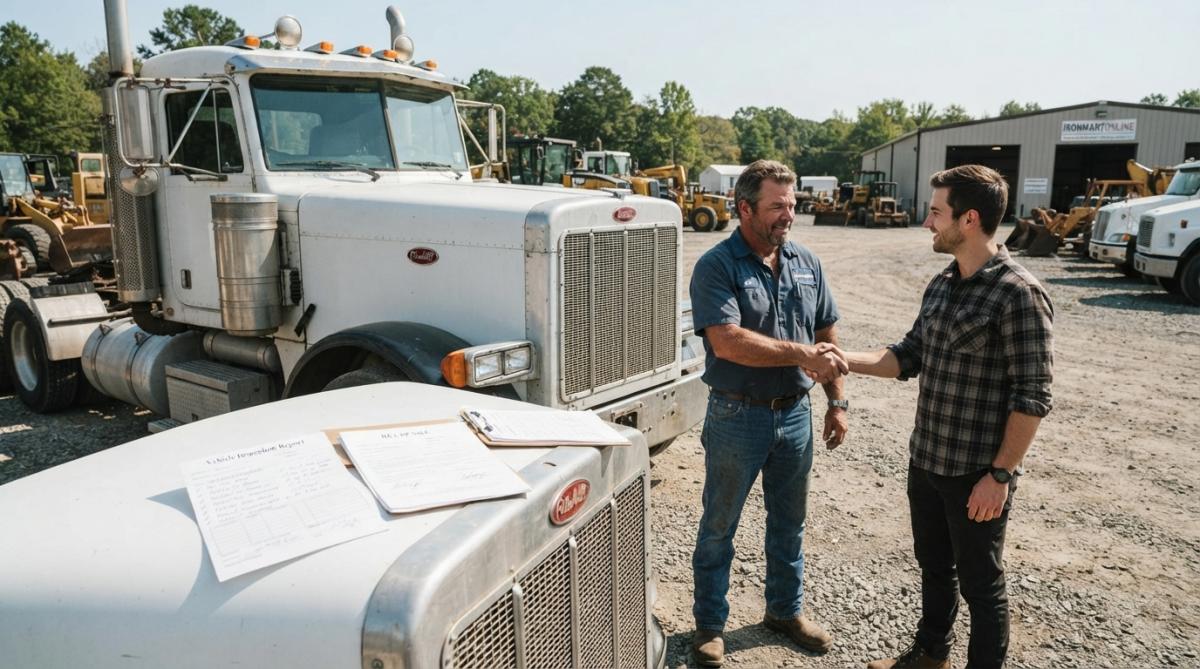
Conducting a Safe Test Drive
Meet in a public location during daylight. Never invite test-drive candidates to your home or remote location. Require a valid driver's license before handing over keys. Take a photo of their ID.
Accompany the buyer on the test drive. Don't let them take the truck alone. Sit in the passenger seat and let them drive for 20-30 minutes covering highway and city driving. Point out known issues proactively. Transparency prevents post-sale disputes.
Handling Payment and Escrow
Payment is the moment of truth. Never hand over keys or title until payment clears completely.
For cash sales, insist on a cashier's check or bank transfer, not cash. Verify the funds cleared with your bank before releasing the truck.
For financed sales, the buyer's lender will coordinate the title transfer and payment directly to you. This is the safest method because the lender verifies the title and funds simultaneously.
Use a bill of sale document that clearly states the truck's condition, price, date of sale, and buyer acknowledgment of condition. Both parties sign and keep copies.
Legal Requirements: Title Transfer, Bill of Sale, and Odometer Disclosure
Selling a truck involves specific legal requirements that vary by state but follow consistent patterns.
Title transfer is mandatory. You must transfer the title to the buyer's name with your signature releasing ownership. Contact your state's Department of Motor Vehicles for the specific form and process.
A bill of sale documents the transaction. This is a simple form stating the truck's year, make, model, VIN, mileage, sale price, date, and both parties' signatures. It's not legally required in all states, but it's invaluable protection for both parties.
Odometer disclosure is federally required. The buyer must acknowledge the truck's mileage at sale. This prevents odometer fraud and protects both parties.
As-is condition statements are important. Most private sales are "as-is," meaning the buyer accepts the truck in its current condition. However, as-is doesn't eliminate liability for material defects you knew about and didn't disclose. Document every known issue in writing.
Research from FTC guidance on used vehicle sales emphasizes that sellers must disclose known material defects. As-is sales don't override this requirement.
Tax Implications and Post-Sale Liability Protection
High-value truck sales have tax implications you should understand before closing the deal.
Sales tax is the buyer's responsibility in most states, not the seller's. However, verify your state's specific rules.
Capital gains on personal trucks are typically not taxable if the truck is for personal use. However, if you're selling commercial trucks or fleet vehicles, the sale may trigger capital gains tax or depreciation recapture. Consult a tax professional if you're selling multiple trucks or commercial equipment.
Understanding As-Is Sales and Lemon Law Nuances
As-is sales protect sellers from warranty liability. When you sell a truck as-is, the buyer accepts it in its current condition and waives warranty rights.
However, as-is doesn't eliminate liability for fraud or material misrepresentation. If you knowingly sell a truck with a failing transmission and claim it's in good condition, that's fraud. The buyer can pursue legal action regardless of the as-is language.
Lemon Law protections vary by state but generally apply to new vehicles, not used. Most used trucks sold as-is fall outside lemon law protection. Private party sales are typically exempt.
Document your truck's condition thoroughly. Take photos before the sale showing any damage, wear, or known issues. Get the buyer's signed acknowledgment of the truck's condition.
Common Mistakes to Avoid When Selling Used Trucks
Most sellers leave money on the table by making predictable mistakes. Avoid these and you'll capture maximum profit.
Pricing too high or too low. Research fair market value using Kelley Blue Book and NADA Guides. Price within 5% of market. Too high and the truck sits unsold. Too low and you leave money on the table.
Skipping reconditioning. A $1,000 detailing investment returns $5,000-8,000 in higher sale price. Reconditioning is the highest-ROI investment you can make.
Poor photos and descriptions. Buyers make snap judgments based on photos. Invest in quality images and detailed descriptions. List on multiple platforms to maximize reach.
Handling payment unsafely. Never release the truck before payment clears. Insist on cashier's checks or bank transfers. Verify funds with your bank.
Skipping documentation. A bill of sale and odometer disclosure protect both parties. Document the truck's condition and get the buyer's signed acknowledgment.
Selling to unqualified buyers. Screen buyers early. Ask qualifying questions. Require pre-qualification for financed purchases. This saves time and prevents post-sale disputes.
Ignoring liability protection. Disclose all known issues in writing. Get the buyer's signed acknowledgment of the truck's condition. This documentation shields you from post-sale lawsuits.
The difference between a mediocre sale and a maximum-profit sale is attention to these details. Most sellers rush the process. The sellers who capture maximum value slow down, prepare thoroughly, and document everything.
Selling used trucks for maximum profit doesn't require luck, it requires strategy. Whether you're liquidating a fleet, upgrading equipment, or selling a personal truck, the fundamentals remain constant: accurate pricing, professional presentation, qualified buyers, and legal protection. Ironmartonline specializes in connecting truck sellers with millions of qualified buyers across nine dedicated platforms, eliminating the friction of private sales while maintaining market-rate pricing. No contracts, no hidden fees, just professional reach and transparent transaction handling. Get started with Ironmartonline and capture the full market value your truck deserves.
Frequently Asked Questions
What is the best way to determine fair market value when selling a used truck?
Use Kelley Blue Book and NADA Guides as your primary valuation tools. Input your truck's VIN, mileage, condition, and options to get an accurate estimate. Compare recent private party sales in your region, as local market trends significantly affect value. Factor in depreciation, maintenance history, and any mechanical issues. Adjust your asking price based on demand for your truck type, commercial trucks and heavy-duty models may command different premiums than standard pickups.
Should I sell my used truck privately or trade it to a dealership?
Private party sales typically yield higher proceeds but require more effort in marketing, screening buyers, and handling paperwork. Dealership trade-ins are faster and hassle-free but offer lower payouts due to dealer margins. Private sales work best when you have time and want maximum profit; trade-ins suit those prioritizing convenience. Consider your truck's condition, well-maintained vehicles sell better privately, while those needing repairs may benefit from dealership options.
What essential truck selling tips should I follow to maximize my profit?
Invest in thorough reconditioning: address mechanical issues, perform a professional detailing, and ensure all service records are documented. Provide a Carfax report and VIN check to build buyer confidence. Take high-quality photos and write detailed listings highlighting maintenance history and upgrades. Price competitively based on market research. Screen buyers carefully, conduct safe test drives, and use a bill of sale. For commercial truck sales, disclose any commercial use history and ensure proper as-is condition documentation.
What paperwork and legal requirements are needed to sell a used truck?
You'll need a completed bill of sale, odometer disclosure statement, and lien release (if applicable). Transfer the title to the buyer according to your state's requirements, most states require the seller's signature and mileage certification. Provide maintenance records and service history. For as-is sales, document the truck's condition in writing to protect yourself from post-sale liability claims. Understand your state's Lemon Law provisions, which may affect your liability even after sale. Keep copies of all documents for your records.
This article was written using GrandRanker