
Table of Contents
- Why Sell Used Dozer Parts Online in 2026?
- The Shift from Salvage Yards to Digital Marketplaces
- Step 1: Identify Your Used Dozer Parts Accurately
- Step 2: How to Price Used Heavy Equipment Parts
- Step 3: Preparing and Photographing Used Bulldozer Parts for Sale
- Step 4: Choosing a Used Dozer Parts Marketplace
- Step 5: Managing Heavy Equipment Parts Shipping
- Step 6: Handling Payments, Returns, and Disputes
- Legal and Environmental Considerations for Salvage Equipment
- Conclusion: Turning Surplus Inventory into Revenue
- Frequently Asked Questions
Last Updated: October 6, 2026
Why Sell Used Dozer Parts Online in 2026?
Selling used dozer parts online means listing individual components from a crawler dozer, bulldozer, or other heavy equipment machine on a digital marketplace so buyers can find and purchase them directly. It replaces the old salvage yard model, where parts sat in a physical lot waiting for someone to walk in.
Why use Ironmartonline as your equipment broker? Because we run nine specialized web-based selling platforms that put your parts and machines in front of millions of potential buyers, with no contracts and no hidden fees. That reach matters more than ever as buyers move online first.
The shift away from salvage yards happened for a simple reason: buyers stopped driving to lots. Contractors, fleet managers, and repair shops now search inventory online, compare part numbers, and check availability before they ever make a call. A U.S. used construction equipment market analysis tracking dealer inventories shows how much pricing pressure and buyer hesitation now shape this market, which means sellers who list clearly and price realistically move parts faster than those who wait for foot traffic.
Below, we'll walk through the full process, from identifying a part correctly to getting paid without a dispute.
The Shift from Salvage Yards to Digital Marketplaces
Physical salvage yards still exist, but they no longer set the pace. A used dozer parts marketplace reaches buyers across regions, not just the contractors within driving distance of your lot.
That changes what "selling" actually means. You are no longer negotiating with whoever shows up. You are writing a listing that has to answer questions before they're asked: What machine does this fit? What condition is it in? What's the part number?
Sellers who treat a listing like a classified ad lose. Sellers who treat it like a specification sheet win.
Step 1: Identify Your Used Dozer Parts Accurately
Accurate identification is the foundation of every sale. If you misidentify a part, you get returns, disputes, and a damaged reputation.
Start with the machine itself. Note the make, model, and serial number of the dozer the part came off. Then find the part number stamped or cast into the component. On undercarriage parts, that stamp is often the only thing separating a part that fits one machine from one that fits another.
Locating Part Numbers and Serial Numbers
Part numbers appear in a few predictable places. Check the component itself first, then cross-reference against a parts manual for that machine.
- Casting numbers: raised digits cast into the metal, common on housings and brackets
- Stamped numbers: punched into flat surfaces, often on wear parts
- Tag or plate numbers: riveted tags that may be worn or missing
- Serial number: identifies the machine, which narrows the correct part range
A common mistake is listing a part by the machine model alone. Compatibility depends on the serial number break, not just the model name.
Step 2: How to Price Used Heavy Equipment Parts
Pricing used heavy equipment parts comes down to three inputs: condition, demand, and what comparable parts actually sold for. Not what someone listed them for.
Most sellers anchor to asking prices and then wonder why nothing moves. Asking prices are wishes. Sold prices are facts. Look for completed sales on the channels where you plan to list, and price against those.
Condition drives the biggest swing. A rebuilt part with documentation supports a higher number than a salvaged part pulled from a retired machine. Availability matters too: if a part is hard to source and a buyer needs it this week, your use is higher.
Don't guess. If you can't find a comparable, price conservatively and let interest tell you whether you set it too low.
Step 3: Preparing and Photographing Used Bulldozer Parts for Sale
Preparation and photography decide whether a buyer trusts your listing. Clean the part, photograph it from every meaningful angle, and describe flaws before a buyer finds them.
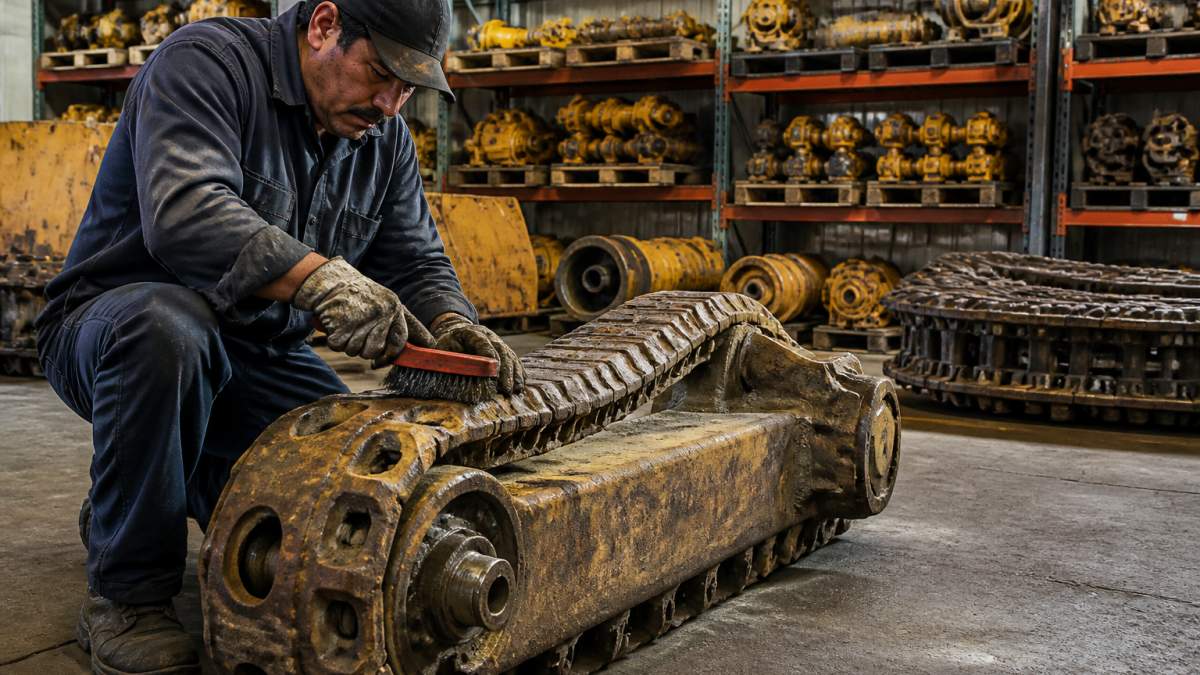
Cleaning away years of grease and debris reveals the critical casting numbers and serial plates necessary for identifying original OEM parts before you finalize your listing.
Clean parts photograph better and signal that you take the sale seriously. Grease and dirt hide cracks, wear, and damage, and buyers know it.
Your photo set should cover:
- Overall shot of the complete part
- Close-up of the part number or casting stamp
- Any wear surfaces, cracks, or repairs
- The mounting points where it connects to the machine
Describing Condition: New, Rebuilt, and Salvaged Parts
Condition language has real meaning in this market. Use it precisely.
| Condition | What It Means | Buyer Expectation |
|---|---|---|
| New | Never installed, still in original packaging | Full OEM spec, no wear |
| Rebuilt | Disassembled, worn components replaced, reassembled | Functions like new, documented work |
| Remanufactured | Rebuilt to original specification with warranty | Close to new, backed by warranty |
| Salvaged | Pulled from a retired machine, inspected but not rebuilt | Usable as-is, sold as inspected |
Never describe a salvaged part as rebuilt. That single word choice is the most common source of disputes.
Step 4: Choosing a Used Dozer Parts Marketplace
The right marketplace depends on whether you want reach, control, or speed. Most sellers do better spreading listings across more than one channel than betting everything on a single site. But not all channels are equal, and the differences show up in fees, buyer traffic, and how much work you handle yourself.
Here is how the main channel types compare for used dozer parts:
| Channel Type | Typical Fee Structure | Reach | Seller Workload | Best For |
|---|---|---|---|---|
| General marketplaces | Listing fee + final value fee (often 10-15%) | Very high, broad buyer base | High: you photograph, list, answer questions, ship | Sellers with time and a steady parts flow |
| Equipment-specific marketplaces | Subscription or listing fee, sometimes no final value fee | Targeted to construction buyers | Medium: you manage listings but reach serious buyers | Sellers who want qualified leads without broad noise |
| Auction platforms | Buyer's premium + seller commission (varies) | High for rare or desirable parts | Medium: you set starting bid and let market decide | Sellers unsure of value or wanting quick liquidation |
| Brokerage services | Commission on sale (often 10-20%) | High through multiple channels | Low: broker handles photos, listings, inquiries, freight | Owners with surplus inventory and limited time |
| Direct sale (your own site or social) | No platform fee, but you drive all traffic | Low unless you have an audience | Very high: you build the listing, market it, and close | Sellers with an existing customer base |
Fees matter, but so does net proceeds. A 15% fee on a part that sells in two weeks often beats a 5% fee on a part that sits for six months. Factor in your time, storage, and the risk of the part degrading or becoming obsolete.
Auction platforms work when you want the market to set the price and you're not in a hurry. Fixed-price listings work when you know your number and want to hold it. Brokerage works when you'd rather not manage the process at all.
This is where a broker changes the math. Ironmartonline runs nine web-based selling platforms, so a single listing reaches buyers across multiple channels instead of one. For an owner-operator with two machines to move, that reach is the difference between a part sitting for months and a part moving in weeks. We work with individual sellers, not just large fleets.
Before you commit to a channel, read its fee schedule and seller protection policy. Some platforms offer dispute resolution and buyer verification; others leave you to handle problems alone. The cheapest listing fee is not always the cheapest sale.
Step 5: Managing Heavy Equipment Parts Shipping
Heavy equipment parts shipping is where deals quietly fall apart. A part that costs more to ship than it's worth won't sell, no matter how well you priced it.
Weigh and measure before you list. Undercarriage components, final drives, and hydraulic cylinders are heavy and awkward, and freight quotes depend on dimensions, weight, and whether it ships on a pallet.
- Small parts: standard parcel carriers, easy to quote
- Medium components: palletized freight, quote by weight and class
- Large assemblies: flatbed or dedicated freight, often needs a dock or forklift
Decide upfront who pays freight and state it in the listing. "Buyer arranges freight" is a clean, defensible term. Ambiguity is not.
Step 6: Handling Payments, Returns, and Disputes
Payment terms set before the sale prevent most disputes. State your terms in the listing, not after a buyer commits. For used dozer parts, where individual components can run into thousands of dollars, the payment method you accept is a risk decision as much as a convenience one.
Here is how common payment methods compare for high-value parts:
| Payment Method | Speed | Seller Protection | Buyer Protection | Best For |
|---|---|---|---|---|
| Wire transfer | 1-2 business days | High: funds are irreversible once received | Low: buyer bears risk | High-value parts, established buyers |
| Escrow service | 3-5 business days | High: funds released after buyer inspection | High: buyer inspects before release | First-time transactions, large assemblies |
| Credit card | Instant | Medium: chargebacks possible | High: buyer can dispute | Smaller parts, buyers who need card convenience |
| Instant payment apps | Instant | Low: limited recourse | Low: limited recourse | Local pickup, low-value parts |
| Cashier's check | 1-3 business days to clear | Medium: can be forged | Medium | Local sales, buyers without wire capability |
For high-value parts, verified payment methods beat convenience every time. Wire transfer and escrow protect both sides. Instant payment apps offer little recourse if something goes wrong. If you accept credit cards, understand that a buyer can initiate a chargeback months later, and you may lose the funds even if the part was as described.
Returns are the harder question. Used parts are sold as inspected, and most sellers state that clearly. If you offer a return window, define it in days and require the part come back in the same condition. A common pattern is a 14-day return window for parts that are not as described, with the buyer paying return freight. For parts sold as-is, state that clearly and include photos of any flaws.
Disputes often arise from mismatched expectations, not bad faith. A buyer who receives a part that does not fit may claim it was misdescribed. To prevent this, include the machine make, model, and serial number range in the listing, and encourage buyers to verify compatibility before purchase. If a dispute does arise, respond promptly and professionally. Most platforms have a resolution process, and a clear paper trail of your listing, photos, and communication is your best defense.
Finally, consider whether you need a written sales agreement for large transactions. A simple document that states the part number, condition, price, payment method, and return policy can prevent misunderstandings and provide a reference if a dispute escalates. For sales that cross state lines, the agreement can also specify which state's law governs the transaction.
Legal and Environmental Considerations for Salvage Equipment
Salvage equipment carries obligations that whole machines don't. Fluids, refrigerants, and certain components are regulated, and how you handle them matters.
Dismantling a machine means managing the fluids inside it. Hydraulic oil, coolant, diesel, and refrigerant all have disposal rules that vary by state. Check with your state environmental agency before you drain anything, and keep records of proper disposal.
If you're dismantling machines at any volume, confirm whether your operation needs a permit. The rules differ by state and by volume, so verify locally rather than assuming.
Conclusion: Turning Surplus Inventory into Revenue
Surplus dozer parts sitting in a yard earn nothing. Every month they sit, they lose value and take up space you could use for something that sells.
If you'd rather not manage listings, photos, freight quotes, and payment disputes yourself, that's exactly the work we do. Ironmartonline connects buyers and sellers of used machinery through nine web-based selling platforms, with no contracts and no hidden fees, and we handle the process from listing to close. Join our email list to see how we turn surplus inventory into revenue.
Frequently Asked Questions
Where can I sell used dozer parts online?
You can sell used dozer parts through specialized heavy equipment marketplaces, online auctions, and brokerage services. Each channel reaches different buyer groups, so the right choice depends on how quickly you need to sell and how much you want to earn. Brokerage services can list your parts across multiple platforms at once, which broadens your reach. Before listing, confirm the marketplace supports crawler dozer and bulldozer parts specifically, since general classified sites attract fewer qualified heavy equipment buyers.
How do I determine the value of used bulldozer parts?
Start by checking recent sale prices for the same part number or machine compatibility on active marketplaces. Condition matters most: rebuilt and remanufactured parts typically command higher prices than as-is salvaged parts. Factor in the part's remaining service life, current demand for that machine make and model, and whether new aftermarket equivalents are readily available. Documenting the part's history and testing results helps justify your asking price and reduces back-and-forth with buyers.
What information should I include in a used dozer parts listing?
A strong listing includes the exact part number, the machine make and model it fits, the year range, and the part's condition category (new, rebuilt, remanufactured, or salvaged). Add clear photos from multiple angles, note any wear or damage, and state whether the part was tested. Including serial number details and machine compatibility reduces returns and builds buyer confidence. Listings with complete fitment data sell faster because buyers can verify the part works for their equipment without contacting you first.
Is it better to sell used dozer parts individually or as a lot?
It depends on the parts and your timeline. High-demand components like final drives, undercarriage assemblies, and hydraulic pumps usually earn more sold individually to buyers seeking specific replacement parts. Low-value or slow-moving items may sell faster bundled as a lot, especially to rebuilders or salvage yards. If you need cash quickly, lots reduce your listing and shipping workload. If maximizing total return matters more, individual listings with detailed fitment data typically outperform bulk sales.