
Table of Contents
- Why Use an Equipment Broker for Shipping Heavy Machinery
- Understanding Shipping Heavy Equipment Across State Lines
- Heavy Equipment Shipping Costs and Rate Structures
- Heavy Equipment Transport Permits and DOT Compliance
- How to Prepare Machinery for Transport
- Heavy Equipment Shipping Insurance Requirements
- Selecting the Right Transport Trailer Type
- Route Planning and Logistics for Interstate Hauling
- Conclusion
- Frequently Asked Questions
Last Updated: September 25, 2026
Why Use an Equipment Broker for Shipping Heavy Machinery
When you're moving heavy equipment across state lines, the logistics alone can overwhelm even experienced operators. Permits, routing, insurance, specialized trailers, each element demands expertise. This is precisely why using a Heavy Equipment Broker like Ironmartonline makes the difference between a smooth transaction and a costly nightmare.
A Heavy Equipment Broker specializes in connecting buyers and sellers while handling the operational complexity that comes with shipping heavy equipment across state lines. Rather than navigating regulations, securing permits, and coordinating transport yourself, a broker manages these layers. They know which routes require pilot cars, which states demand specific overweight permits, and how to calculate load securement requirements that keep your machinery safe and compliant.
The real question isn't whether you can ship heavy equipment yourself, you can. The question is whether the time, risk, and hidden costs are worth avoiding a professional. Most owner-operators and fleet managers discover too late that DIY shipping means absorbing unexpected permit fees, route delays, and potential liability exposure. Why use Ironmartonline equipment broker? A broker absorbs that friction.
Ironmartonline operates nine specialized web-based selling platforms that reach millions of potential buyers globally and locally. But beyond listing your equipment, a broker like Ironmartonline can coordinate the entire shipping logistics if you're selling to a distant buyer. They understand the regulatory landscape, the cost structures, and the timeline realities. No contracts, no hidden fees, just transparent guidance on what it takes to execute shipping heavy equipment across state lines properly.
Understanding Shipping Heavy Equipment Across State Lines
Shipping heavy equipment across state lines isn't a standard freight operation. It's a regulated, specialized process that requires understanding interstate commerce rules, DOT compliance, and state-specific permitting. The moment your load exceeds certain weight or dimension thresholds, you enter a different regulatory universe.
Heavy equipment transport involves machinery that typically weighs thousands of pounds and occupies significant space. Once equipment exceeds 80,000 pounds gross vehicle weight rating (GVWR) or specific dimensional limits, you're dealing with oversized load regulations. Each state has its own thresholds, and crossing state lines means complying with the strictest rules along your entire route. Navigating these complex interstate requirements often highlights the necessity of professional oversight, a principle that remains equally critical when securing reliable vehicle transport for high-value assets.
According to Bureau of Transportation Statistics, North American transborder freight moved by truck saw a 19.9% increase in June 2026 compared to the previous year. This volume reflects the scale of equipment movement happening constantly across state lines, but it also underscores how critical proper logistics coordination has become.
The core challenge is that shipping heavy equipment across state lines requires coordination across multiple jurisdictions. A flatbed trailer loaded with a 45-ton excavator isn't just a transportation problem, it's a regulatory puzzle. Different states enforce different rules on load weight distribution, axle limits, lane restrictions, and required permits. Missing a single requirement can result in fines, confiscated equipment, or worse.
Heavy Equipment Shipping Costs and Rate Structures
Understanding the cost structure for shipping heavy equipment across state lines helps you budget accurately and avoid sticker shock. The pricing model combines several factors: distance, equipment weight, trailer type, and route complexity.
According to BAH Logistics, heavy equipment shipping costs typically range from $2.50 to $7.50 per mile for standard heavy haul transport. For specialized heavy-haul requirements, think 150-ton loads or routes requiring pilot cars, costs can escalate to $5.00 to $15.00 or more per mile. The total cost to ship heavy equipment across state lines typically falls between $1,000 and $50,000, depending on equipment type, distance, and specific transport requirements.
Why Loyalty's budgeting guide recommends adding a 10-15% cost buffer to your estimate. This accounts for permit fees, potential route adjustments, and unexpected requirements discovered during planning. If your initial quote is $3,000, budget $3,300-$3,450 to avoid surprises.
| Cost Component | Typical Range | Notes |
|---|---|---|
| Mileage Rate | $2.50-$7.50/mile | Varies by equipment weight and trailer type |
| Permit Fees | $200-$1,500 | State-specific; oversized loads cost more |
| Pilot Car Service | $500-$2,000 | Required for loads exceeding certain dimensions |
| Insurance Premium | $300-$1,200 | Depends on cargo value and route risk |
| Loading/Unloading | $500-$2,000 | Crane service or specialized equipment |
The mileage rate is just the foundation. Permits, escort vehicles, and specialized equipment add up quickly. This is where working with an experienced broker or logistics provider pays dividends, they negotiate rates, identify cost-saving routes, and help you avoid unnecessary expenses.
Heavy Equipment Transport Permits and DOT Compliance
Moving heavy equipment across state lines without proper permits is illegal and expensive. The Department of Transportation (DOT) and individual state agencies enforce strict rules on oversized and overweight loads. Understanding these requirements prevents fines and keeps your shipment moving.
Most states require permits for loads exceeding 80,000 pounds GVWR or specific dimensional thresholds (typically 8.5 feet wide, 13.5 feet tall, or 75 feet long for a single unit). Once your equipment crosses these limits, you need an oversize/overweight permit from each state your route passes through.
Each state maintains its own permit portal and fee structure. Some states charge flat fees; others charge per-mile rates. A cross-country haul might require 10+ individual state permits, each with its own processing time and cost. This is why permit coordination is critical, delays in one state cascade through your entire schedule.
DOT compliance extends beyond permits. Your carrier must maintain proper licensing, insurance, and safety certifications. The equipment itself must meet load securement standards. Improper chaining and binding can result in roadside inspections, citations, and equipment seizure.
How to Prepare Machinery for Transport
Preparing equipment for transport is more than just cleaning it and calling a truck. Proper preparation prevents damage, ensures compliance, and speeds up the loading process.
Start by documenting the equipment's condition. Take photographs from multiple angles, note any existing damage, and record the serial number and specifications. This documentation protects you if damage occurs during transit and helps the carrier understand the load they're handling.
Next, perform basic maintenance checks. Ensure fluid levels are appropriate for transport (some equipment requires drained hydraulic systems). Secure or remove any loose components that could shift during transit. Fold mirrors, lower booms, and retract any extendable parts. Equipment that arrives in transport-ready condition loads faster and safer.
Clear the transport route to your loading dock. Heavy equipment needs a straight, stable approach. Remove obstacles, mark low-hanging wires or structures, and ensure the ground can support the trailer weight. A 45-ton load on a lowboy trailer exerts significant pressure; soft ground or pavement can fail under that weight.
Coordinate site access with the carrier. Confirm gate hours, parking locations, and any height or width restrictions at your facility. Provide the carrier with contact information for someone who can be present during loading. Miscommunication about site access is a leading cause of shipping delays.
Finally, arrange for loading equipment if your facility lacks a dock or crane. Many carriers bring their own equipment, but confirming this in advance prevents surprises. If your equipment requires specialized loading techniques, brief the carrier crew before they arrive.
Heavy Equipment Shipping Insurance Requirements
Insurance for shipping heavy equipment across state lines is non-negotiable. Standard auto insurance doesn't cover heavy machinery transport. You need cargo insurance that specifically covers the equipment type and value you're shipping.
Cargo insurance typically covers loss or damage during transit, loading, and unloading. The premium depends on the cargo value, the route, and the equipment type. High-risk cargo (hazardous materials, extremely heavy loads) costs more to insure.
Understanding Cargo Insurance vs. Carrier Liability
Carriers are required to maintain liability insurance, but that protects them from third-party claims, not your equipment. Carrier liability typically caps at a certain amount per pound of cargo. This gap is why you need your own cargo insurance. Cargo insurance covers your financial loss if damage occurs during transit, loading, or unloading, regardless of carrier negligence.
When purchasing cargo insurance, verify the coverage limits match your equipment's actual replacement value, not its sale price. Underinsuring creates a gap in protection. For example, if you're shipping a piece of equipment but only insure it for a lower amount, a claim pays out only that lower amount maximum. Also clarify what's covered, some policies exclude certain damage types (rust, wear, mechanical failure) or require specific loading procedures. Ask your insurer whether the policy covers damage from improper securement, weather exposure, or accidents caused by the carrier.
The Pre-Shipment Documentation Process
Documentation is your strongest defense in a claim. Before the carrier arrives, photograph the equipment from multiple angles, front, rear, sides, top, and close-ups of any existing damage, rust, or mechanical issues. Record the serial number, model, year, and current condition in writing. Video walkthrough is even better; narrate what you're showing so there's no ambiguity about pre-existing damage.
Provide this documentation to both the insurance carrier and the shipping company. The shipping company should sign off on the condition report before loading begins. This creates a baseline. If the equipment arrives damaged, you can prove what damage occurred during transit versus what existed beforehand. Without this documentation, insurers may deny claims or reduce payouts, arguing the damage was pre-existing.
Claim Process and Timeline
If damage occurs, notify the carrier and your insurance company immediately, most policies require notice within 24-48 hours. Do not accept delivery if the equipment is visibly damaged; document the damage with photos and video before signing the bill of lading. Request a damage inspection report from the carrier.
File your insurance claim within the timeframe specified in your policy (typically 30-90 days). Provide the pre-shipment documentation, post-delivery photos, the carrier's damage report, and repair estimates. The insurer will investigate and either approve the claim or request additional information. This process typically takes 2-4 weeks. If the claim is approved, you receive payment based on the repair cost or the difference between the equipment's pre-damage and post-damage value.
Selecting the Right Transport Trailer Type
The trailer type you select directly impacts cost, safety, and compliance. Different equipment demands different trailers. Choosing wrong means inefficiency, regulatory violations, or damaged machinery. The decision hinges on three factors: equipment dimensions (height, width, length), ground clearance, and loading method.
Flatbed Trailers: The Standard Choice
Flatbed trailers are the most common choice for heavy equipment because they're open on all sides, making loading and unloading straightforward with standard cranes or ramps. Flatbeds work well for compact equipment like smaller excavators, dozers, or wheel loaders that can be driven or lifted onto the deck. A standard flatbed is 8.5 feet wide and typically 53 feet long, accommodating most equipment under 80,000 pounds GVWR.
However, flatbeds offer no weather protection and require proper load securement with chains and binding. They also create height challenges: if your equipment stands 12 feet tall and the flatbed deck is 3.5 feet high, your total load height is 15.5 feet, exceeding the 13.5-foot legal limit in most states. This triggers oversized load permits and potential route restrictions. Flatbeds are the cheapest option but often the most expensive in terms of permit costs when equipment is tall.
Lowboy Trailers: The Height Solution
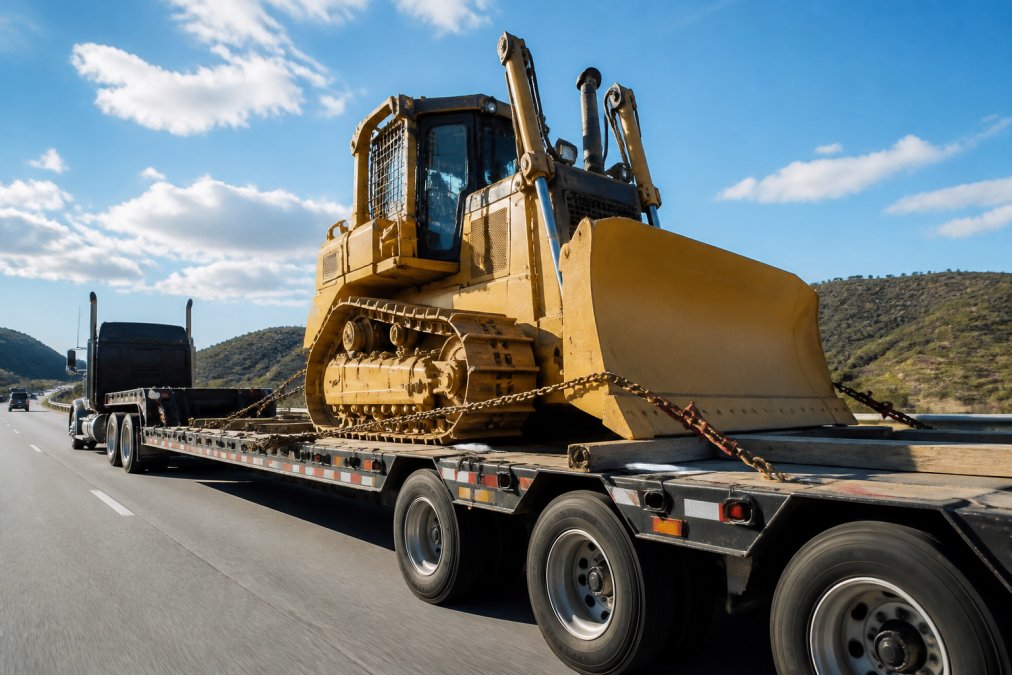
Lowboy trailers (also called low-deck trailers) have a lower deck height, typically 2.5 to 3 feet above ground, which reduces the overall height of the load. This is critical for equipment with height restrictions. A lowboy can accommodate a 12-foot-tall piece of equipment while keeping the total height within the 13.5-foot legal limit, eliminating the need for oversized height permits in many states.
Lowboys are more expensive to operate but can save money overall by reducing permit requirements. If your equipment is tall, a lowboy often pays for itself through permit savings. Lowboys also provide better stability for top-heavy equipment because the lower center of gravity reduces tipping risk.
The trade-off: lowboys have weight limits. Heavier equipment requires a specialized heavy-haul lowboy, which costs significantly more.
Step Deck Trailers: The Compromise
Step deck trailers (also called step-decks or drop-decks) have a two-level deck. The front section is higher (around 4 feet), the rear section is lower (around 2.5 feet). This design accommodates a wider range of equipment sizes and can sometimes reduce permit requirements by lowering the overall load height compared to a flatbed.
Step decks are useful for equipment that's long but not extremely tall, or for loads that combine multiple pieces of machinery. They're a middle-ground option when your equipment doesn't quite fit a flatbed's height envelope but doesn't justify the cost of a dedicated lowboy.
RGN Trailers: For Ground-Level Loading
RGN trailers (Removable Gooseneck) feature a detachable front section that allows the rear deck to lower to ground level. This is essential for tracked equipment (excavators, dozers, track loaders) or machinery with very low ground clearance that can't be driven up a ramp.
RGNs are specialized and expensive but are the only practical option for certain equipment. If your machinery has tracks or sits only inches off the ground, an RGN is not optional, it's required.
Making the Decision: A Practical Framework
Start by measuring your equipment: height (from ground to highest point), width, length, and weight. Then apply this logic:
- If height + deck height exceeds 13.5 feet: Use a lowboy or RGN. Calculate permit costs for flatbed vs. lowboy. If flatbed permits exceed $800-$1,000, the lowboy's higher rate is cheaper overall.
- If equipment has tracks or sits on the ground: Use an RGN. No alternative.
- If equipment is wide (over 8 feet): Confirm the trailer can accommodate it. Some lowboys are narrower than flatbeds; verify dimensions with the carrier.
- If equipment weighs over 50 tons: Specify a heavy-haul lowboy or multi-axle flatbed. Standard trailers won't work.
- If equipment is compact and under 80,000 GVWR with normal height: Flatbed is usually the most cost-effective.
Consult with your carrier or broker about the optimal trailer type for your specific machinery. They can model permit costs, route restrictions, and total landed cost for each trailer option. The cheapest mileage rate often isn't the cheapest total cost.
Route Planning and Logistics for Interstate Hauling
Route planning for shipping heavy equipment across state lines requires more than GPS. You're coordinating around permit restrictions, weight limits, and infrastructure constraints.
Start by identifying all possible routes between origin and destination. Then filter based on permit requirements. Some routes might avoid certain states entirely, reducing the number of permits needed. A route variation might save on permit costs and processing time.
Check for infrastructure constraints along each route. Low bridges, narrow roads, or weight-restricted routes eliminate otherwise viable paths. Many states provide route maps for oversized loads. Use these to identify corridors where oversize equipment is permitted.
Consider timing. Oversized loads often have movement restrictions; some states prohibit night movement, others require daylight-only transport. Weekend restrictions are common. A route that takes 2 days during permitted hours might take 4 days if movement windows are limited.
Pilot cars are required on many routes. These are escort vehicles that travel ahead of or alongside the oversized load to alert other drivers and ensure safe passage. Pilot car requirements vary by state and load dimensions. They add to your shipping cost but are legally required when applicable.
Conclusion
Shipping heavy equipment across state lines demands expertise in permits, regulations, insurance, and logistics coordination. The costs are significant, but so are the risks of getting it wrong. Working with a professional Heavy Equipment Broker eliminates the guesswork and protects your investment.
Ironmartonline connects buyers and sellers of heavy equipment while providing the logistics expertise to make complex transactions seamless. Whether you're selling equipment to a distant buyer or acquiring machinery that requires interstate transport, our nine specialized web-based platforms reach millions of potential buyers with zero contracts and no hidden fees. Get started with Ironmartonline and simplify your next equipment transaction.
Frequently Asked Questions
What permits are required for shipping heavy equipment across state lines?
Equipment exceeding 80,000 lbs requires state-specific oversize/overweight permits from the Department of Transportation. Each state has different dimension and weight thresholds. You must obtain permits before transport begins, failure to do so results in fines and equipment seizure. Most logistics providers handle permit acquisition, but it's your responsibility to verify compliance. Plan 7-10 days lead time for permit processing to avoid expedited fees.
How much does it cost to ship heavy equipment per mile?
Heavy equipment shipping rates vary depending on equipment type, distance, and transport requirements. A cost buffer is recommended for permit fees and unexpected logistics adjustments.
Do I need specialized insurance for interstate heavy equipment shipping?
Yes. Standard auto insurance does not cover heavy equipment transport. You need cargo insurance and liability coverage specific to oversized loads. Insurance requirements vary by equipment value, weight, and destination state. Licensed and bonded logistics providers carry their own coverage, but verify that it meets required liability standards. Damaged machinery claims require documented proof of condition before transport and photographic evidence of damage.
What's the difference between an RGN and a flatbed trailer?
A flatbed trailer is an open platform best for equipment with standard dimensions and weight distribution. An RGN (Removable Gooseneck) trailer has a hydraulic neck that lowers to ground level, making it ideal for low-clearance equipment like dozers and excavators that cannot be driven onto a standard flatbed. Step decks and lowboy trailers offer intermediate options for specific equipment profiles. Choose based on your machinery's height, weight, and loading capability.