
Table of Contents
- Why Upgrade Your Excavator for Resale?
- Step 1: Diagnose Your Excavator's Current Market Value
- Step 2: Create an Excavator Maintenance Checklist for Resale
- Step 3: Evaluate and Add the Best Excavator Attachments for Resale Value
- Step 4: Address Repair Costs vs. Market Value Analysis
- Step 5: Restore Cosmetic Condition and Paint
- Step 6: How to Prepare Heavy Machinery for Sale
- Step 7: Understand Tax Implications of Equipment Upgrades
- Maximizing Your Excavator's Resale Potential
- Frequently Asked Questions
Last Updated: October 1, 2026
Why Upgrade Your Excavator for Resale?
The equipment market moves fast. According to Equipment World's 2026 market analysis, new financed mini excavator sales fell 7.7% year-over-year to just 32,500 units. That decline shifts the entire resale landscape. When fewer new machines hit the market, demand for quality used equipment increases. This is where upgrading old excavator resale becomes a real opportunity.
But here's the question that matters: why use a Heavy Equipment Broker when you're ready to sell? When you're ready to sell, you need a partner with genuine reach. A Heavy Equipment Broker connects buyers and sellers through specialized platforms, ensuring your equipment reaches millions of potential buyers globally and locally. No contracts. No hidden fees. Just a straightforward marketplace built for efficiency.
Most contractors selling used excavators face the same problem: they're not sure which upgrades actually move the needle on resale price. Some improvements cost money but add minimal value. Others transform a machine from "maybe" to "sold." The difference between a machine that sits on the market and one that sells fast often comes down to smart, targeted upgrades.
This guide walks you through exactly which upgrades matter for upgrading old excavator resale value. You'll learn how to diagnose your excavator's market position, create a maintenance checklist that buyers trust, evaluate which attachments add real value, and prepare your heavy machinery for sale. By the time you're ready to list, you'll know exactly what your machine is worth and how to position it for maximum returns.
The five diagnostic areas that drive resale decisions are financial, mechanical, operational, safety, and technology. We'll cover each one.
Step 1: Diagnose Your Excavator's Current Market Value
Start by understanding where your excavator sits in the current market. This isn't guesswork, it's the foundation for every decision that follows.
Top brands like Caterpillar, Komatsu, Volvo, and Hitachi typically retain 55-70% of their resale value over five years, according to MidEast Equip's used excavator brand analysis. That's your baseline. A machine with strong brand heritage and solid maintenance records will command premium pricing.
If your machine is mechanically sound but cosmetically worn, you can invest in targeted improvements that cost far less than the resale value gain.
Check these specifics:
- Operating hours on the meter
- Brand and model year
- Condition of the undercarriage and tracks
- Service history documentation
- Current engine diagnostics
Pull recent comparable sales for your exact model and year. Look at what similar machines sold for in the last 60 days. That's your market reality. From there, you can calculate which upgrades justify the investment.
Step 2: Create an Excavator Maintenance Checklist for Resale
Buyers trust machines with documented maintenance. A comprehensive excavator maintenance checklist for resale separates serious sellers from casual ones.
Your checklist should cover:
- Oil and filter changes with dates
- Hydraulic system inspections and fluid top-ups
- Track tension adjustments and wear measurements
- Bucket tooth replacement history
- Coolant and fuel system maintenance
- Electrical system checks and battery condition
Documentation matters more than perfection. A machine with minor wear but complete service records outsells a pristine-looking machine with no history. Buyers know that documented maintenance means fewer surprises.
Take photos of each maintenance task as you complete it. Include the date, work performed, and parts replaced. This visual proof of care adds credibility that a service log alone cannot match.
Regular maintenance and maintaining a "shiny and new" paint job are identified as primary drivers for increasing resale value, according to TigerTough's equipment refurbishment guide. That combination, solid mechanics plus visual appeal, is what moves machines fast.
Step 3: Evaluate and Add the Best Excavator Attachments for Resale Value
Not all attachments add value. Some are niche. Others are universally wanted. The critical difference is quantifiable ROI: knowing the upgrade cost versus the realistic resale value increase.
Most sellers guess at attachment value. Smart sellers calculate it. Here's how to evaluate each upgrade:
ROI Analysis: Attachment Upgrades vs. Resale Increase
| Attachment Type | Typical Installation Cost | Expected Resale Value Increase | Net ROI | Buyer Demand |
|---|---|---|---|---|
| Hydraulic quick coupler | $2,000-$4,000 | $3,500-$6,000 | 75-200% | Very high |
| GPS and slope control retrofit | $8,000-$15,000 | $10,000-$18,000 | 25-125% | High (precision contractors) |
| Fresh bucket with new teeth | $1,500-$3,000 | $5,000-$8,000 | 167-433% | Very high |
| Thumb attachment (hydraulic) | $3,000-$5,000 | $2,000-$4,000 | -33-33% | Medium (niche) |
| Grapple bucket | $4,000-$7,000 | $2,500-$4,500 | -36-13% | Low-medium (specialized) |
| Breaker/hammer attachment | $5,000-$9,000 | $3,000-$6,000 | -40-20% | Low-medium (niche) |
| Cab upgrade (air, heat, radio) | $2,000-$4,000 | $1,500-$3,000 | -25-50% | Medium |
The data is clear: quick couplers and fresh buckets deliver the highest ROI. GPS systems appeal to a premium buyer segment but carry higher upfront cost. Specialized attachments like grapples and breakers often reduce resale value because they narrow the buyer pool to contractors who need that specific function.
Quick Coupler Systems
A hydraulic quick coupler system is the single best attachment upgrade for resale value. It signals versatility. Buyers see a machine that can accept multiple attachments without manual hydraulic reconnection, which means more job flexibility and faster changeovers on job sites.
A machine without one is at a disadvantage in negotiation.
When to skip it: If your excavator is over 15 years old and already priced as a budget machine, the coupler may not move the needle enough to justify cost. If it's under 10 years old or mid-range in price, install it.
GPS and Slope Control Technology
GPS and slope control systems represent the premium upgrade path. These systems reduce operator fatigue, improve grade accuracy to within inches, and appeal to contractors doing precision excavation, site prep, or grading work where accuracy directly impacts profitability.
The resale value increase can be significant because you're positioning a used machine as competitive with new models at a fraction of new-machine price.
The catch: GPS systems only add value if your buyer segment values precision. A contractor buying a machine for demolition or general site work may not care. A contractor doing fine grading or utility work will pay a premium for it.
Research your local market. If most excavators in your region are sold to demolition or earthmoving contractors, GPS may not justify the cost. If your region has active utility, drainage, or precision grading work, it's a strong upgrade.
Bucket and Tooth Condition
Bucket condition is the first thing serious buyers inspect. Worn teeth, bent edges, cracked welds, and corrosion signal neglect and heavy use. A fresh bucket with new teeth can significantly increase resale value.
Why the outsized ROI? Because buyers assume a worn bucket means the rest of the machine has been run hard. A fresh bucket removes that red flag and signals that you've invested in the machine's presentation.
When to replace: If your bucket shows more than 30% tooth wear, visible cracks, or significant corrosion, replacement is almost always worth it. Buyers will negotiate down aggressively for worn buckets. A fresh one removes that negotiation point entirely.
Avoid Low-ROI Attachments
Thumb attachments, grapples, and breaker hammers are specialized tools. They appeal to contractors who need them but reduce appeal to the broader market. A machine marketed with a grapple bucket is seen as a grapple machine, not a general-purpose excavator. That narrows your buyer pool and can lower overall resale value.
Exception: If you're selling to a contractor who specifically wants that attachment, price it as an included bonus. Otherwise, remove niche attachments before listing and sell them separately if possible.
The Attachment Decision Framework
Before upgrading:
- Calculate the attachment cost
- Research comparable machines with and without that attachment
- Estimate the resale value increase (use the table above as a baseline)
- Calculate net ROI: (Expected increase − Cost) ÷ Cost × 100
- If ROI is below 50%, skip it unless it's critical for operation
- If ROI is 50% or higher, prioritize it
Quick couplers and fresh buckets almost always clear this threshold. GPS systems do if your market supports them. Specialized attachments rarely do.
Step 4: Address Repair Costs vs. Market Value Analysis
This is where many sellers make mistakes. They fix things that don't matter while ignoring critical issues.
A key threshold: repair costs trending toward 50% or more of a machine's current market value indicate it is time to upgrade, according to ML Heavy Construction Equipment's replacement diagnostic guide. In other words, if your excavator's market value is $40,000 and repairs exceed $20,000 annually, you're at the replacement threshold.
Use this framework:
- Calculate your machine's current market value
- Estimate annual repair costs
- If repairs exceed 50% of market value, sell as-is or sell for parts
- If repairs are below 30%, invest in upgrades
- If repairs fall between 30-50%, evaluate each repair individually
Some repairs protect resale value. Others just keep the machine running. Hydraulic system work, engine overhauls, and track replacement are worth doing. Cosmetic fixes and minor electrical repairs often aren't.
| Repair Type | Market Value Impact | Worth Doing? |
|---|---|---|
| Hydraulic system rebuild | High | Yes, if under 30% of market value |
| Engine overhaul | High | Yes, if under 30% of market value |
| Track replacement | High | Yes, if under 25% of market value |
| Paint and cosmetics | Medium | Yes, always worth it |
| Electrical repairs | Low | Only if critical for operation |
| Bucket replacement | High | Yes, almost always |
Step 5: Restore Cosmetic Condition and Paint
Appearance drives first impressions. A machine that looks well-maintained sells faster and commands higher prices than one that looks neglected, even if the mechanical condition is identical.
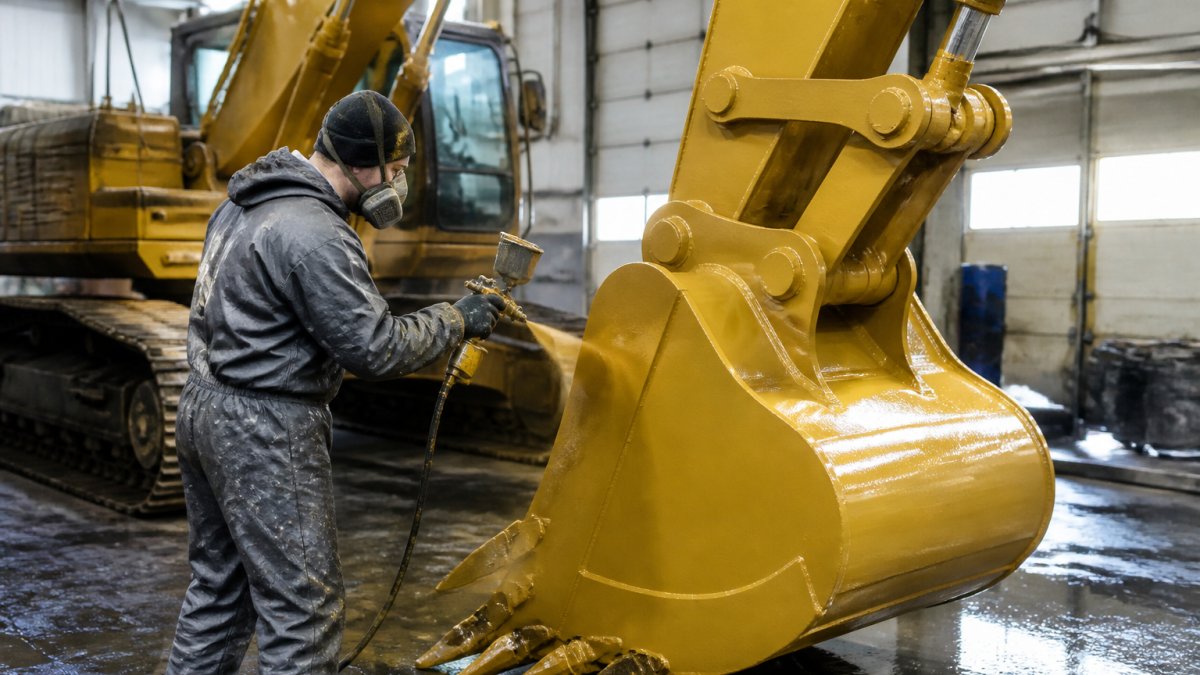
A polished exterior signals that the machine has been maintained with care, a standard of upkeep that remains equally vital when transitioning toward the selection of machines detailed in our heavy equipment guide.
A fresh paint job transforms perception. Buyers see investment and care. They're willing to pay more for a machine that looks like it's been maintained.
Focus on these visible areas:
- Bucket and teeth
- Boom and arm
- Cabin and operator controls
- Undercarriage (where visible)
- Hydraulic lines and connections
Professional detailing matters. Pressure wash the entire machine to remove dirt and grime. Replace worn decals. Touch up any rust spots. These small investments compound into significant resale value gains.
Step 6: How to Prepare Heavy Machinery for Sale
Preparation is the bridge between upgrades and actual sale. How you present the machine determines whether buyers take you seriously and how aggressively they negotiate.
Most sellers rush this step. They list a machine with incomplete documentation, vague photos, and no proof of condition. Serious buyers walk away. The ones who stay negotiate hard because uncertainty always favors the buyer.
Instead, follow a structured pre-sale preparation workflow that removes buyer doubt at every stage.
Pre-Sale Inspection Checklist
Before listing, conduct a formal inspection. This isn't a casual walk-around, it's a documented assessment that you'll share with buyers.
Mechanical Systems:
- Engine compression test (all cylinders recorded)
- Hydraulic pressure test on all circuits (boom, bucket, swing, travel)
- Fuel system inspection (filter condition, tank cleanliness, fuel quality)
- Coolant condition and level
- Oil analysis (if available from recent service)
- Battery voltage and condition
- All fluid levels documented with photos
Undercarriage and Tracks:
- Track tension measurement (both sides)
- Track pad wear percentage (visual and measurement)
- Roller and idler condition (spin test, visual inspection)
- Sprocket tooth wear assessment
- Frame and structural integrity check for cracks or bends
Operator Controls and Cab:
- All joystick and pedal functionality test
- Seat condition and adjustment mechanism
- Cabin glass and wipers
- Lights and warning indicators
- Radio and communication equipment (if equipped)
- Operator manual and documentation present
Exterior and Cosmetics:
- Paint condition and rust spots
- Decal condition and legibility
- Hydraulic line routing and condition
- Bucket tooth wear and edge condition
- Boom and arm for cracks or bends
- All fasteners tight and accounted for
Documentation Gathering:
- Complete service history with dates and parts replaced
- Operating hour meter reading (photographed)
- Original purchase documentation if available
- Warranty records or service contracts
- Any recalls or service bulletins issued for this model
- Inspection reports from this assessment
Hire a certified heavy equipment technician to conduct this inspection. The written report is worth significant value in buyer confidence.
Create a Detailed Listing Package
Once inspection is complete, build a comprehensive listing that answers every question a buyer might ask before they ask it.
Written Documentation:
- Machine specification sheet (model, year, operating hours, attachments)
- Complete service history with dates, work performed, and technician name
- Inspection report from your pre-sale assessment
- Photos of all service records and maintenance logs
- Any warranty or service contract documentation
- Recall history and how each was addressed
Visual Content:
- 15-20 high-resolution photos from multiple angles (front, rear, sides, undercarriage, bucket detail, cab interior, controls)
- Close-up photos of any wear areas with context (show the wear, then show the surrounding condition)
- Photos of the hour meter, service records, and inspection report
- Video walkthrough (2-3 minutes) showing the machine from all angles, then starting and operating it through basic movements
- Video of the inspection report being reviewed by the technician (builds credibility)
Presentation Strategy:
- Lead with the inspection report. Buyers see proof of condition immediately.
- Include photos of service records. Documentation is proof of care.
- Show wear honestly. A machine with visible wear but complete service history outsells a pristine-looking machine with no documentation.
- Highlight upgrades. If you've added a quick coupler, GPS system, or fresh bucket, show before-and-after photos.
- List all attachments included in the sale.
The Pre-Sale Preparation Timeline
Don't rush. Plan 4-6 weeks before you want to list:
Week 1: Schedule inspection with certified technician. Complete any critical repairs identified in your initial walk-around (hydraulic leaks, non-functional controls, engine warning lights).
Week 2: Receive inspection report. Address any findings that affect safety or operation. Document all work with photos and receipts.
Week 3: Cosmetic preparation. Pressure wash the entire machine. Replace worn decals. Touch up rust spots. Polish visible metal. Replace any cracked or missing cabin glass.
Week 4: Gather all documentation. Organize service records chronologically. Photograph hour meter, service logs, and inspection report. Collect any warranty or recall documentation.
Week 5: Create listing package. Shoot photos and video. Write detailed description. Compile all documentation into a single PDF or digital folder.
Week 6: List the machine. Monitor inquiries and schedule inspections with qualified buyers.
Handling Buyer Inspections
When a serious buyer wants to inspect the machine in person, prepare for it:
- Have the machine clean and ready to operate
- Provide a copy of your inspection report and service history
- Be present during the inspection (don't hand off to someone else)
- Have the technician who performed your pre-sale inspection available by phone if questions arise
- Demonstrate all functions: hydraulic movements, engine start, controls, attachments
- Answer questions directly. If you don't know something, say so and offer to research it
- Don't oversell. Let the machine and documentation speak for itself
Red Flags That Kill Sales
Avoid these mistakes:
- Incomplete documentation. "I don't have service records" is a deal-killer. Buyers assume the worst.
- Vague or low-quality photos. Blurry photos or photos taken in poor light suggest you're hiding something.
- Refusing a pre-purchase inspection. Serious buyers always want one. Refusing signals a problem.
- Inconsistent operating hours. If the meter shows 8,000 hours but you claim 6,000, credibility is gone.
- Mechanical issues you haven't disclosed. A hydraulic leak, engine knock, or track slip that you know about but don't mention will be discovered during inspection. Disclose it upfront and offer a price adjustment. Hiding it kills the deal.
- Overstating condition. "Runs like new" on a 12-year-old machine with 10,000 hours sets false expectations. Be honest.
The Documentation Advantage
Machines with complete documentation sell faster and command higher prices than machines with incomplete history. The reason is simple: documentation removes uncertainty. Buyers can make confident offers instead of building in a discount for unknown risk.
Your pre-sale inspection and detailed listing package are your competitive advantage. They signal that you've invested in presenting the machine professionally. Serious buyers recognize that and reward it with faster sales and higher offers.
Step 7: Understand Tax Implications of Equipment Upgrades
Equipment upgrades have tax consequences. Understanding them helps you calculate true ROI.
Upgrades to business equipment may be deductible as business expenses in the year they're performed, depending on cost and type. Some improvements might qualify for Section 179 deductions, allowing you to deduct the full cost in a single year rather than depreciating over time.
Consult with a tax professional before making major upgrades.
Maximizing Your Excavator's Resale Potential
The path to maximum resale value isn't complicated. It's systematic.
Frequently Asked Questions
When is it time to upgrade an old excavator instead of selling it as-is?
Financial benchmarks suggest upgrading when annual repair costs trend toward 50% or more of the machine's current market value. Evaluate your excavator across five diagnostic areas: Financial (repair costs vs. resale value), Mechanical (engine diagnostics and hydraulic systems), Operational (performance decline), Safety (track tension and structural integrity), and Technology (GPS and slope control capabilities). If repair costs exceed this threshold, strategic upgrades typically yield better net returns than selling a deteriorating machine.
What excavator attachments increase resale value the most?
Quick coupler systems, GPS and slope control technology, and well-maintained buckets with sharp teeth deliver the highest resale premiums. Quick couplers appeal to contractors seeking operational flexibility. GPS slope control attracts buyers in grading and precision work. A bucket in excellent condition with minimal tooth wear signals proper maintenance history to buyers. These attachments demonstrate that the machine was actively maintained and equipped for modern job demands, directly influencing market demand and final sale price.
How much can I expect to save by buying a used excavator instead of new?
A well-maintained used excavator can deliver substantial cost savings upfront while maintaining strong residual value when you're ready to sell or upgrade again.
Why should I use an equipment broker like Ironmartonline to sell my upgraded excavator?
An equipment broker connects your machine to millions of potential buyers across nine specialized web-based selling platforms, maximizing exposure and competitive bidding. Brokers handle the complexities of marketing, buyer qualification, and logistics coordination, saving you time and effort. With no contracts or hidden fees, you retain control while gaining professional marketplace reach. For owner-operators and fleet managers alike, a broker accelerates the sales process and typically results in better final prices than private sales or single-platform listings.
Ready to sell your excavator for maximum value? Join our email list to stay updated on market trends, upgrade strategies, and buyer demand patterns. Ironmartonline connects sellers like you with millions of qualified buyers across nine specialized platforms, no contracts, no hidden fees, just straightforward selling that gets results.