
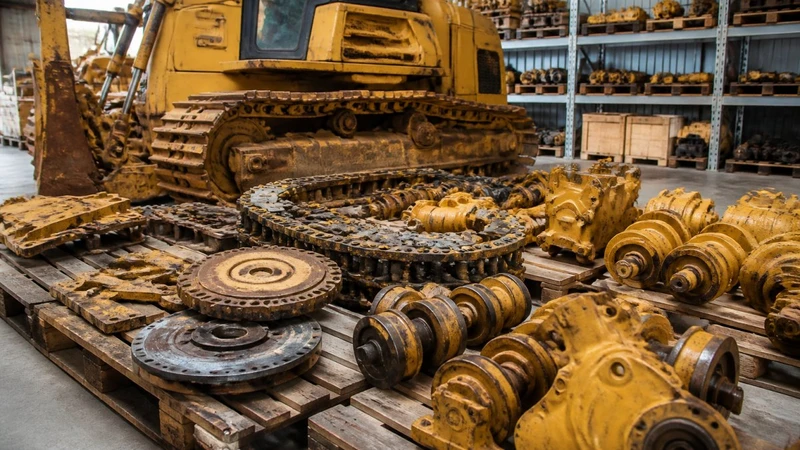
Last Updated: October 22, 2026
Quick Summary
Used bulldozer parts compatibility is decided by model, serial-number range, and machine configuration, not by the model badge alone. Always match the OEM part number and serial break before buying bulldozer parts, because a part that fits one serial range may not fit another. Same-family and different-make parts are rarely or never interchangeable.
- New OEM parts carry the lowest fitment risk; used, aftermarket, and remanufactured parts follow the same fitment rules.
- Track chains must match pitch and link count, and sprockets must match chain pitch and tooth count.
- A D5 and D6 share a family name but differ in track gauge, sprocket pitch, and blade mounting.
- Check for casting numbers, measure pitch and bushing diameter, and count links before buying a part with no number.
- Confirm the return window, shipping responsibility, and restocking fee in writing before the part ships.
Table of Contents
- Why Used Bulldozer Parts Compatibility by Model Decides Whether a Part Fits
- New, Used, Aftermarket, and Remanufactured Parts: What Compatibility Really Means
- Bulldozer Parts Lookup by Serial Number: A Step-by-Step Check
- Bulldozer OEM Part Numbers and How Interchange Works
- Dozer Undercarriage Parts Compatibility: Track Chains, Links, and Sprockets
- Used Bulldozer Parts Compatibility by Model: Fitment Examples Across Makes
- Identifying a Part When the Number Is Missing
- Compatibility Risks Across Model Years and Machine Configurations
- Used-Part Inspection and Return Safeguards Before You Buy
- Conclusion
- Frequently Asked Questions
Why Used Bulldozer Parts Compatibility by Model Decides Whether a Part Fits
A track chain that fits a Cat D6T will not fit a D6N. That single fact explains why used bulldozer parts compatibility by model matters more than the part number on the box. At Ironmartonline, we've watched buyers lose time and money on dozers that seemed like a match on paper but failed at the undercarriage.
So why use Ironmartonline as an equipment broker? Because when you sell a machine, the right buyer needs to know exactly what fits it. Model and serial details drive that sale.
The core problem is simple. A dozer is not a single model. It is a model, a serial-number range, a configuration, and a production year. Change any one of those and the part changes with it. Buyers who skip that check end up with a sprocket that won't seat or a track link that wears wrong from day one.
Below, we'll show you exactly how to verify fitment before you buy, using the same checks we recommend to sellers listing machines through Ironmartonline.
New, Used, Aftermarket, and Remanufactured Parts: What Compatibility Really Means
Compatibility means a part matches your machine's model, serial range, and configuration, not just its general category. That definition holds whether the part is new, used, aftermarket, or remanufactured.
Here's how the four part types differ on fitment risk:
- New OEM parts match the factory part number for your serial range. Lowest risk, highest cost.
- Used parts come off a donor machine. Fitment depends on the donor's model and serial range matching yours.
- Aftermarket parts are made by third parties. Quality and fit vary by supplier, so verify the cross-reference.
- Remanufactured parts are rebuilt to OEM specs. Fitment should match OEM if the core was correct.
The part type changes the price and the warranty. It does not change the fitment rules. A used sprocket from the wrong serial range is still the wrong sprocket.
Bulldozer Parts Lookup by Serial Number: A Step-by-Step Check
A bulldozer parts lookup by serial number starts with the plate on the machine, not the parts catalog. Get the serial first, then match it to a range, then confirm the part.
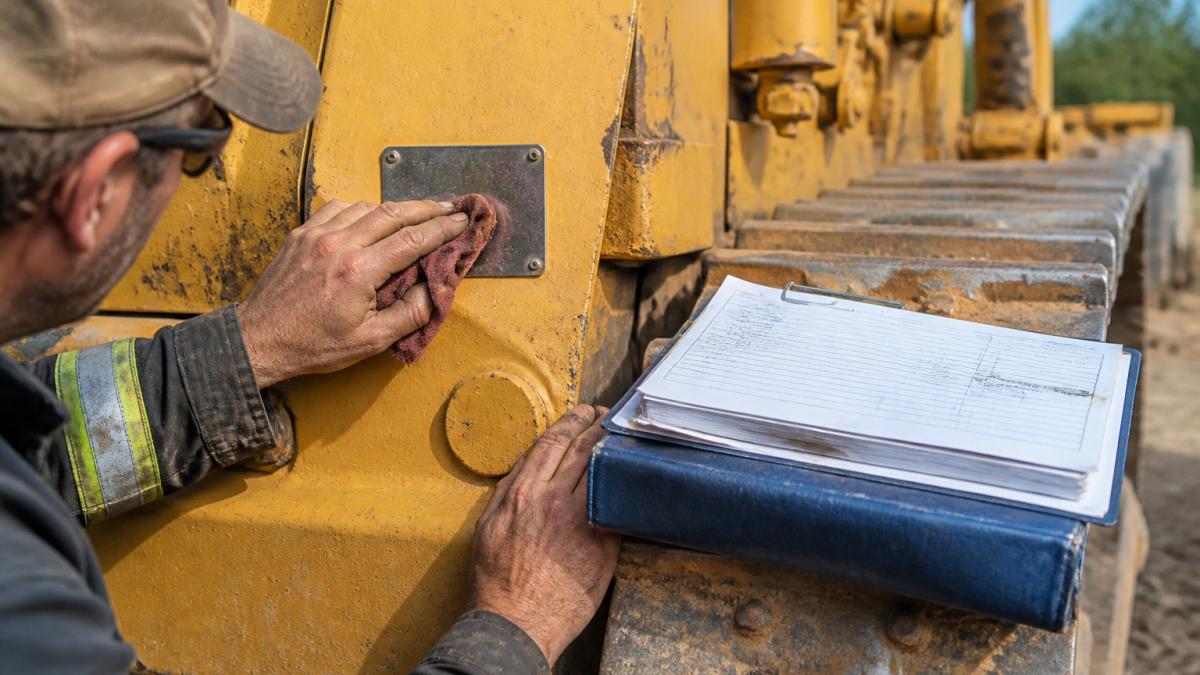
Finding the Model and Serial Plate on the Machine
The plate is usually on the frame near the operator station or on the engine block. Wipe it clean and photograph it. Stamped numbers fade, and a photo protects you if a seller's listing is unclear.
Write down three things: the model, the serial number, and the prefix letter. The prefix often signals the production run.
Reading the Serial-Number Range Before You Order
Manufacturers publish serial-number breaks for parts changes. A part that fits serial numbers below a break may not fit those above it. Match your serial to the range, not to the model name alone.
If a listing shows only the model, ask the seller for the serial. No serial, no certainty.
Bulldozer OEM Part Numbers and How Interchange Works
An OEM part number is the manufacturer's unique code for a specific part on a specific machine build. Interchange is the process of matching that code to an equivalent part from another source.
Interchange works through cross-reference tables. A used part carries its own OEM number. You compare that number to your machine's required number. If they match, fitment is likely. If they cross-reference, verify the source.
Keep a simple rule: part number first, cross-reference second, model name last.
Dozer Undercarriage Parts Compatibility: Track Chains, Links, and Sprockets
Dozer undercarriage parts compatibility comes down to wear patterns and matched sets, not just bolt patterns. Track chains, track links, and sprockets wear together, so mixing worn and new components accelerates failure.
Undercarriage is where most fitment mistakes happen. The parts look similar across models but differ in pitch, width, and mounting.
- Track chains must match the machine's pitch and link count.
- Track links must match the chain series and bushing size.
- Sprockets must match the chain pitch and tooth count.
- Drive components like final drives must match the model and serial range.
A used undercarriage part from a similar model can fit physically and still wear fast. Match the full set, not one piece.
Used Bulldozer Parts Compatibility by Model: Fitment Examples Across Makes
Fitment examples across makes show the same pattern: model families share parts within a serial range, then break at a redesign. A D6 and a D6T are not interchangeable across the board, and the same holds for Komatsu and John Deere families. But the real value is in the specific serial breaks and configuration codes that separate a direct fit from a near miss.
Here is how to read a model family like a parts specialist:
- Same model, same serial range: Most major components interchange directly. A sprocket from a D6T with serial prefix KMT and a serial number below the mid-year break will fit another D6T in that same range. Confirm the part number stamped on the donor component matches the number in your machine's parts catalog for that serial range.
- Same model, different serial range: Wear parts like track links and bushings often carry over, but redesigned major components, final drives, steering clutches, and hydraulic pumps, may not. For example, a Caterpillar D6N built before a certain serial break may use a different final drive ratio than a later unit with the same model badge. Always check the serial number against the manufacturer's parts break.
- Same family, different model: Rarely interchangeable. A D5 and a D6 share a family name but differ in track gauge, sprocket pitch, and blade mounting. Undercarriage parts from a D5 will not fit a D6 even if they look similar. The same applies to Komatsu's D61 and D65 families, close in size, different in pitch and link count.
- Different make: Almost never interchangeable. A track chain from a John Deere 700K will not fit a Caterpillar D6K, even if both are classified as similar-sized dozers. Bolt patterns, pitch, and bushing sizes differ by manufacturer.
Use this as a starting filter, then confirm with the part number and serial range. The table below shows how model families typically break, but always verify against the specific serial number.
| Machine Family | What Usually Interchanges | What Usually Does Not |
|---|---|---|
| Same model, same serial range | Most major components | Nothing, if numbers match |
| Same model, different serial range | Some wear parts | Redesigned major components |
| Same family, different model | Rarely | Undercarriage and drive parts |
| Different make | Almost never | Everything structural |
For a deeper check, request the donor machine's serial plate photo and compare it to your machine's plate. If the prefix letters differ, treat the part as incompatible until proven otherwise with a cross-reference.
Identifying a Part When the Number Is Missing
When the number is gone, identify the part by measuring it and matching it to the machine's build. Casting marks, bolt patterns, and dimensions usually narrow it down. This is the step most buyers skip, and it is where wrong parts get ordered.
Start with these steps:
- Check for a casting number or stamp on the part body. Casting numbers are often on the underside or inside face of the component, not the exterior. Wire-brush the area and look for raised or stamped digits.
- Measure key dimensions and compare to the service manual. For undercarriage parts, measure pitch (the distance between pin centers), link height, and bushing diameter. For a sprocket, count teeth and measure the outside diameter. Write these down and compare to the manual's specifications for your serial range.
- Count bolt holes, teeth, or links. A track chain with 42 links is not the same as one with 44, even if the pitch matches. Count twice.
- Match the part to the donor machine's model and serial. If you are buying from a salvage yard, ask for the donor's serial plate photo. Compare the prefix and serial range to your machine.
- Confirm with a cross-reference table before buying. Use the OEM part number from the donor component and cross-reference it to your machine's required number. If the numbers do not match or cross-reference, do not buy.
A service manual is your best tool here. It lists dimensions and part numbers by serial range. Without it, you are matching by eye, which is how wrong parts get ordered. For older machines where manuals are scarce, take clear photos of the part from multiple angles, top, bottom, side, and any casting marks, and compare them to online parts diagrams for your model. Many dealership parts counters will help identify a part from a photo and a serial number, even if you are not buying from them.
If the part is a structural component like a blade or ripper, look for weld patterns and mounting bracket shapes. These often differ between model years even when the part name is the same. A blade from a D6T with a SU (semi-universal) configuration will not mount to a D6T with an A (angle) blade without different brackets. Check the configuration code on your machine's serial plate and match it to the donor part.
Compatibility Risks Across Model Years and Machine Configurations
Model years and configurations create the hidden fitment risks that model names hide. A mid-year redesign can change a part while the badge stays the same.
Watch for these risks:
- Mid-year changes: A part can change within one model year. Always check the serial break.
- Configuration options: Long track, wide track, and specialty setups use different undercarriage parts.
- Attachment differences: Ripper and winch setups can change rear components.
- Rebuilt machines: A rebuilt dozer may carry mixed parts from different ranges.
Used-Part Inspection and Return Safeguards Before You Buy
Inspection and return terms protect you when a used part arrives wrong. Check the part before you pay, and confirm the return policy in writing.
Inspect for these before buying:
- Cracks, welds, and repaired damage on structural parts
- Wear depth on undercarriage components
- Correct part number stamped or cast on the body
- Photos of the donor machine's serial plate
Then confirm the return terms. Ask about the return window, who pays shipping, and whether a restocking fee applies. Get it in writing before the part ships.
Conclusion
The hardest part of buying used dozer parts is not finding them. It is proving they fit your exact machine. Model, serial range, and configuration decide that, and no listing photo replaces the check.
When you're ready to move a machine instead of chasing parts for it, Ironmartonline connects your dozer to millions of buyers across nine selling platforms, with no contracts and no hidden fees. List your equipment and let the right buyer find it.
Frequently Asked Questions
How do I find the correct part number for my bulldozer?
Start with the machine's model and serial number from the plate on the frame or engine, then use the manufacturer's parts catalog or service manual for that serial range. Cross-reference the number against the seller's listing and ask for a photo of the stamped number on the part itself. Used bulldozer parts compatibility by model depends on matching both the part number and the serial range, because builders revised components mid-production. If the number is worn off, measure the part and compare castings and mounting points against a known-good unit.
Are bulldozer parts interchangeable between models?
Sometimes, but rarely across the board. Undercarriage components and some engine or hydraulic parts are shared between machines built on the same platform or within the same serial range, while final drives, blades, and rollers usually differ. A bulldozer parts lookup by serial number is the only reliable way to confirm interchange, since the same model name can cover several configurations. Treat any claim of universal fit as a starting point for verification, not proof.
What should I check before buying used bulldozer undercarriage parts?
Ask for bushing and pin wear readings, sprocket tooth profile photos, and the machine hours the part came off. Check that the track chain pitch and link count match your dozer's spec, and confirm the sprocket tooth count and hub bolt pattern. Dozer undercarriage parts compatibility depends on these details, not just the model name. Also confirm the seller's return window and whether shipping damage or fitment failure is covered before you pay.
Can aftermarket parts fit the same bulldozer models as OEM parts?
Many aftermarket suppliers build to OEM specifications, and their catalogs list the bulldozer OEM part numbers they replace, so fitment can match when the cross-reference is correct. The risk is a catalog that lists a broad model range without serial limits. Ask the seller to confirm the exact OEM number their part replaces and the serial range it covers. If they cannot, verify against your service manual before ordering, and keep the return terms in writing.
Selling a dozer means answering fitment questions before buyers ask them. Ironmartonline gives your machine global and local reach through nine web-based selling platforms, with a hassle-free process and no hidden fees. Join our email list to see how the right listing turns a model and serial number into a sale.