
Table of Contents
- Why Ironmartonline Is the Smarter Way to Buy and Sell Used Heavy Equipment
- Used vs New Heavy Equipment: Quick Comparison Table
- Upfront Cost: The 30-70% Gap That Decides Most Purchases
- The Heavy Equipment Depreciation Schedule: Who Absorbs the Loss
- Maintenance, Downtime, and Machine Hours: The Real Operating Risk
- How to Inspect Used Construction Equipment Before You Commit
- Section 179 Tax Deduction for Heavy Equipment: What Changes the Math
- Telematics, Tier 4 Engines, and Technology Gaps Between New and Used
- Warranty Coverage, Financing Options, and Insurance Premiums
- Building a TCO Model: Resale Value, ROI, and Asset use
- Frequently Asked Questions
Last Updated: September 13, 2026
Why Ironmartonline Is the Smarter Way to Buy and Sell Used Heavy Equipment
Used heavy equipment typically costs 30% to 70% less than comparable new machinery, according to Machinery Planet's 2026 used vs. new analysis. That single gap explains why the used heavy equipment market keeps pulling buyers away from dealer lots. But here's the question worth asking early: why use Ironmartonline as your equipment broker instead of listing privately or trading through a dealer?
The answer comes down to reach and terms. Ironmartonline runs nine specialized web-based selling platforms, works without contracts, and charges no hidden fees, which means your excavator or dozer gets in front of millions of potential buyers while you keep control of the deal. This guide from Ironmartonline breaks down the used heavy equipment vs new equipment pros and cons so you can decide with numbers, not gut feel.
The stakes are higher in 2026. Rising capital costs and unpredictable project pipelines have pushed contractors to rethink both buy-versus-rent and new-versus-used models, according to Custom Truck's 2026 contractor guide. Meanwhile, market analysis from My Equipment's February 2026 report shows demand for used construction equipment climbing through the year.
Below, we'll show you exactly where new equipment wins, where used wins, and how to build a total cost of ownership model that settles the argument for your fleet.
Used vs New Heavy Equipment: Quick Comparison Table
The table below summarizes how new and used machinery compare across the factors that drive most purchase decisions. Treat it as a starting map; each row gets a full breakdown in the sections that follow.
| Factor | New Equipment | Used Equipment |
|---|---|---|
| Upfront cost | Highest capital expenditure | 30-70% lower purchase price |
| Depreciation | Steepest loss in first years | Previous owner absorbed the drop |
| Maintenance risk | Low, covered by warranty | Rises with machine hours |
| Availability | Long factory lead times | Immediate availability |
| Technology | Latest telematics, Tier 4 engines | May lag on features |
| Financing | Full financing plus tax deductions | Lower financing burden |
| Resale value | Depends on brand and hours | Already past the sharp decline |
The pattern is consistent: new equipment buys certainty and technology, used equipment buys cash flow and speed. Neither column wins outright.
Upfront Cost: The 30-70% Gap That Decides Most Purchases
Upfront cost is the single biggest lever in the new-versus-used decision, and the gap is wider than most buyers expect. A used machine at 30% to 70% below new pricing frees capital for labor, fuel, and the next project.
That matters because used equipment reduces financing burdens and shortens the timeline to positive ROI, according to ML Heavy Construction Equipment's acquisition analysis. A smaller loan means smaller monthly payments and faster payback.
The counterargument deserves a fair hearing. New equipment can deliver double tax deductions through both depreciation and interest expenses, a point contractors raise frequently in civil engineering community discussions. If your business can absorb the higher capital expenditure, the tax treatment narrows the real-world gap.
The Heavy Equipment Depreciation Schedule: Who Absorbs the Loss
Depreciation is where the new-versus-used math quietly flips. New equipment loses its steepest value in the first years of ownership, according to Eagle Power and Equipment's cost analysis. The first owner eats that drop.
Buy a two- or three-year-old machine and the previous owner has already absorbed the sharpest decline. Your heavy equipment depreciation schedule starts from a lower basis, so annual value loss is gentler and resale value holds steadier.
This is the contrarian point most buyers miss: depreciation isn't a reason to avoid used equipment, it's the core argument for it. The exception is equipment you plan to keep for a decade or more. Over a long lifecycle, the depreciation curves converge and the technology gap starts to matter more.
Maintenance, Downtime, and Machine Hours: The Real Operating Risk
Maintenance risk rises with machine hours, and that's the honest downside of buying used. As machines accumulate operating hours, the likelihood and cost of future maintenance increases compared to new, warrantied machines, according to Boss JCB's equipment guidance.
The practical response is a maintenance schedule built on service history, not optimism. Ask for records, check hour meters against documented service, and budget for wear items like undercarriage, hydraulics, and injectors. Downtime is the real cost; a machine that fails mid-project burns labor and penalties.
New equipment shifts that risk to the dealer through warranty coverage. You pay for that certainty in the purchase price. For a fleet running tight schedules, the trade can be worth it. For a fleet with backup capacity, used machinery plus a reserve fund is usually cheaper.
How to Inspect Used Construction Equipment Before You Commit
Knowing how to inspect used construction equipment is the skill that separates a good deal from an expensive lesson. A structured inspection catches most costly problems before money changes hands.
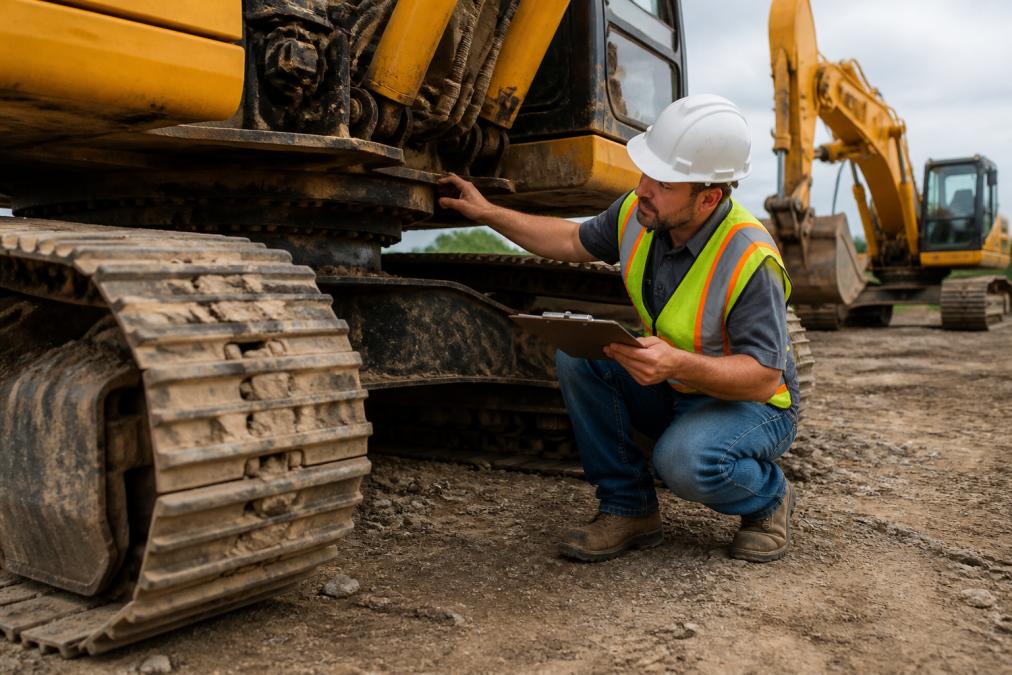
Run this checklist on every machine:
- Verify serial number and hour meter against service records
- Inspect undercarriage: tracks, rollers, idlers, and sprocket wear
- Check hydraulic cylinders, hoses, and pumps for leaks or weeping
- Test engine cold-start behavior and watch for excessive smoke
- Scan for frame cracks, weld repairs, and prior structural damage
- Pull telematics or fault-code history where available
- Confirm parts availability for the specific model and year
Section 179 Tax Deduction for Heavy Equipment: What Changes the Math
The Section 179 tax deduction for heavy equipment lets businesses deduct the full purchase price of qualifying equipment in the year it's placed in service, rather than spreading deductions across years. Both new and used equipment can qualify, which surprises buyers who assume the deduction is new-only.
That's why the "buy new for taxes" argument is weaker than it sounds. Used machinery that meets the requirements can still deliver a substantial first-year deduction. Confirm eligibility and current limits with your tax professional and check IRS guidance directly, since thresholds change.
The real differentiator is financing. New equipment often comes with manufacturer financing that adds interest deductions on top of depreciation. Used equipment usually carries a lower principal, so the deduction base is smaller but the cash outlay is far lighter. Run both scenarios against your actual tax position before deciding.
Telematics, Tier 4 Engines, and Technology Gaps Between New and Used
Technology is the clearest advantage new equipment holds. Late-model machines ship with advanced telematics, real-time fault reporting, and Tier 4 engines that meet current emission standards. Older used units may lack that data layer entirely.
Telematics changes fleet management in practical ways: use tracking, preventive maintenance alerts, and fuel monitoring all feed better asset use decisions. If your operation runs on data, a machine without telematics is a blind spot.
Used equipment isn't locked out of this. Aftermarket telematics kits can retrofit many models, and late-model used units increasingly include factory systems. The gap is narrowing each year as more Tier 4 machines enter the secondary market. For most contractors, the question is whether the data is worth the premium, not whether it exists.
Warranty Coverage, Financing Options, and Insurance Premiums
Warranty coverage and financing terms often decide the deal more than purchase price does, and the mechanics behind each differ sharply between new and used machinery.
Warranty coverage. New equipment arrives with a full manufacturer warranty that typically covers major components, engine, hydraulics, powertrain, for a set period measured in months or engine hours, whichever comes first. Used equipment usually carries a limited or expired warranty unless it is dealer-certified, in which case the dealer may offer a short-term powertrain or aftertreatment warranty. The practical difference is who pays for a major failure in year one. On a new machine, the manufacturer does. On a used machine, you do, unless you buy an extended service contract, which is essentially pre-paying for that risk.
Financing options. New machinery qualifies for manufacturer-backed programs with longer terms, promotional rates, and sometimes deferred first payments. Used equipment financing depends on age, hours, and condition, and lenders often cap terms on older machines, a common pattern is shorter amortization and higher rates as machine age increases. Some lenders also require a larger down payment on used units because the collateral depreciates faster. The trade-off is straightforward: new equipment financing is cheaper per dollar borrowed, but you are borrowing a larger amount.
Insurance premiums. Insurance premiums follow replacement value. Newer, higher-value equipment costs more to insure because a total loss payout is larger. Used units carry lower replacement values and therefore lower premiums, but some carriers require an inspection or impose actual cash value rather than replacement cost coverage on older machines. That distinction matters after a loss: actual cash value pays what the machine was worth, not what it costs to replace.
| Consideration | New Equipment | Used Equipment |
|---|---|---|
| Warranty | Full manufacturer coverage, months or hours | Limited, expired, or dealer-certified short-term |
| Financing terms | Longer, promotional rates, deferred payments | Shorter, condition-based, higher down payment |
| Insurance premiums | Higher replacement value | Lower replacement value, possible ACV coverage |
| Best for | Risk-averse, long-hold fleets | Cash-flow-focused operators |
Building a TCO Model: Resale Value, ROI, and Asset use
A total cost of ownership model settles the new-versus-used debate with your own numbers. Most articles stop at the formula. This section gives you the inputs, a worked example, and a calculator framework you can run before you bid on the next project.
The formula:
TCO = Purchase Price + Financing + Maintenance + Insurance + Downtime - Resale Value
Run it for a new machine and a comparable used unit over the same holding period. Used equipment usually wins on the first three inputs and loses on downtime risk. New equipment wins on warranty and technology but carries the steepest depreciation.
Worked example. Suppose you are comparing a new excavator against a three-year-old unit with 3,000 hours. The used machine costs roughly half the new price. Over a five-year hold at 1,200 hours per year:
- Purchase price: used is lower by a wide margin.
- Financing: used carries a shorter term and higher rate, but a smaller principal, so total interest may still be lower.
- Maintenance: used starts higher and climbs; new starts near zero under warranty and climbs later.
- Insurance: used premiums are lower because replacement value is lower.
- Downtime: used carries more risk; assign a dollar value per day of lost production and multiply by expected downtime days.
- Resale value: used has already absorbed the steepest depreciation, so it retains a higher percentage of its purchase price at exit.
The result is rarely a landslide. The used machine often wins on cash flow and resale retention; the new machine often wins on downtime certainty and technology. The variable that tips it most is annual hours.
Asset use. A machine running 1,500 hours a year justifies new pricing because the fixed cost is spread over more production. One running 400 hours rarely does, the depreciation and financing costs per hour become too high to recover. Match the machine to the utilization rate, not the other way around.
Trade-in value. Operators can trade in used models after project completion to recoup capital, according to Reco Equip's fleet guidance. That flexibility is why short-term project work often favors used equipment.
Calculator framework. Build a simple spreadsheet with these columns: Year, Hours Run, Maintenance Cost, Downtime Days, Downtime Cost, Insurance, Financing Payment, Resale Value. Sum the costs, subtract resale value at exit, and divide by total hours to get cost per hour. Compare cost per hour between the new and used scenarios. The lower cost per hour wins for that utilization profile.
When you're ready to sell, a broker that reaches millions of buyers through nine selling platforms, with no contracts and no hidden fees, turns resale value from a guess into a number you can plan around. That's the Ironmartonline advantage on both sides of the transaction.
Frequently Asked Questions
Should I buy new or used heavy equipment?
It depends on your project pipeline and cash position. Used heavy equipment typically costs 30-70% less than new, according to Machinery Planet's 2026 market analysis, and it avoids the steepest depreciation years. New equipment makes more sense when you need the latest Tier 4 engines, full warranty coverage, and can use Section 179 deductions to offset a higher purchase price. Contractors with unpredictable pipelines often favor used because it shortens the timeline to positive ROI.
How many years do you depreciate heavy equipment?
Under standard IRS rules, most heavy construction equipment falls into a 5-year or 7-year Modified Accelerated Cost Recovery System (MACRS) class, meaning it is depreciated over five to seven years. However, Section 179 and bonus depreciation rules can let you write off a much larger share in the first year. Check with your tax advisor, because the right schedule depends on how the machine is used and your business structure.
How does depreciation impact the long-term value of heavy machinery?
New equipment loses the largest share of its value in the first few years of ownership. When you buy used, the previous owner has already absorbed that drop, so your resale value holds steadier. That is why a used machine's trade-in value after a short project can often be close to what you paid. New buyers gain tax depreciation benefits but carry the sharper value loss.
What should I check when inspecting used construction equipment?
Start with the service history and machine hours, then inspect the undercarriage, hydraulic hoses, engine compartment, and cooling system for leaks or wear. Check for rust, weld repairs, and cracked welds on the frame. Run the machine through a full operating cycle, watch for excessive smoke or hydraulic lag, and verify that parts availability for that model is still strong. A third-party inspection is worth the cost on any high-value unit.
How do Section 179 and other tax incentives apply to equipment purchases?
Section 179 lets businesses deduct the full purchase price of qualifying heavy equipment in the year it is placed in service, up to annual IRS limits. Bonus depreciation can be stacked on top for additional first-year write-offs. Some buyers also deduct interest expenses on financed equipment, which is why new purchases sometimes offer a double tax advantage. Confirm eligibility and limits with a tax professional before you buy.