

Last Updated: November 4, 2026
Quick Summary
Successful used truck negotiation means valuing the rig at wholesale, inspecting it hard, and negotiating the out-the-door price instead of the monthly payment. Document every defect, price the repairs, and challenge any fee that isn't required by law. Get pre-approved financing and stay ready to walk away.
- Pull wholesale value, retail price, and regional fair market price before you make an offer.
- Bring a mechanic who knows Class 7 and Class 8 trucks to the pre-purchase inspection.
- Agree on the out-the-door price in writing before discussing trade-in or financing.
- Ask the finance manager to cite the statute requiring each fee on the contract.
- Get loan approval from a lender before you shop so you have more leverage.
Table of Contents
- Why Use Ironmartonline as Your Equipment Broker?
- How to Value a Used Commercial Truck Before You Negotiate
- The Used Truck Inspection Checklist That Creates Use
- Negotiating on Out-the-Door Price, Not Monthly Payment
- Negotiation Scripts for Heavy Equipment Buyers
- Dealer Fees to Avoid When Buying a Truck
- Negotiating Commercial Financing Terms vs. Retail Loans
- Digital Negotiation Strategies for Used Truck Sales
- Handling Trade-Ins and Post-Purchase Maintenance Separately
- Ready to Buy or Sell? Start With Ironmartonline
- Frequently Asked Questions
Why Use Ironmartonline as Your Equipment Broker?
Most buyers walk into used truck negotiation outnumbered. The seller has a salesperson, a finance manager, and a closer. You have a checkbook and a handshake.
That gap is where money disappears. According to LSA Global's analysis of sales negotiation challenges, 97% of the time buyers face specific, research-backed sales negotiation tactics. Sellers rehearse. Buyers improvise.
So why use Ironmartonline as your equipment broker? Ironmartonline runs nine web-based selling platforms with no contracts and no hidden fees, connecting buyers and sellers of used machinery. You can also browse heavy equipment listings to see what's available. Our service is built to be straightforward, so you can focus on the deal.
Below, we'll show you exactly how to negotiate a used truck, from valuing the rig to signing the purchase agreement. The tactics here apply whether you buy from a dealer lot or a private fleet.
Here's what most guides get wrong: they treat a truck like a sedan. It isn't. The inspection, the financing, and the maintenance tail all work differently.
How to Value a Used Commercial Truck Before You Negotiate
Value a used commercial truck by pulling three numbers before you talk: wholesale value, retail price, and the fair market price for your region. Then anchor your offer near wholesale, not retail.
Most vehicle models can be negotiated to 5-10% below MSRP when new, per CarEdge's negotiation guidance. Used trucks follow the same logic, just with wider spreads. A dealer buys at wholesale and sells at retail. Your job is to shrink that gap.
Use these sources to build your number:
- Auction results for the same make, model, and mileage band
- VIN check and vehicle history report for accident and title flags
- Odometer reading verified against service records
- Depreciation curve for that engine and transmission combo
Reading the Market: Wholesale Value vs. Retail Price
Wholesale value is what a dealer pays at auction. Retail price is what the lot asks. The spread between them is the dealer's room to move.
Watch days on market. Trucks sitting for extended periods give you more room to negotiate, according to CarEdge's market analysis. A unit that's been listed for months costs the seller money every day.
For a deeper read on current conditions, see our breakdown of why construction equipment sales dropped and what it means for buyers in this market.
The Used Truck Inspection Checklist That Creates Use
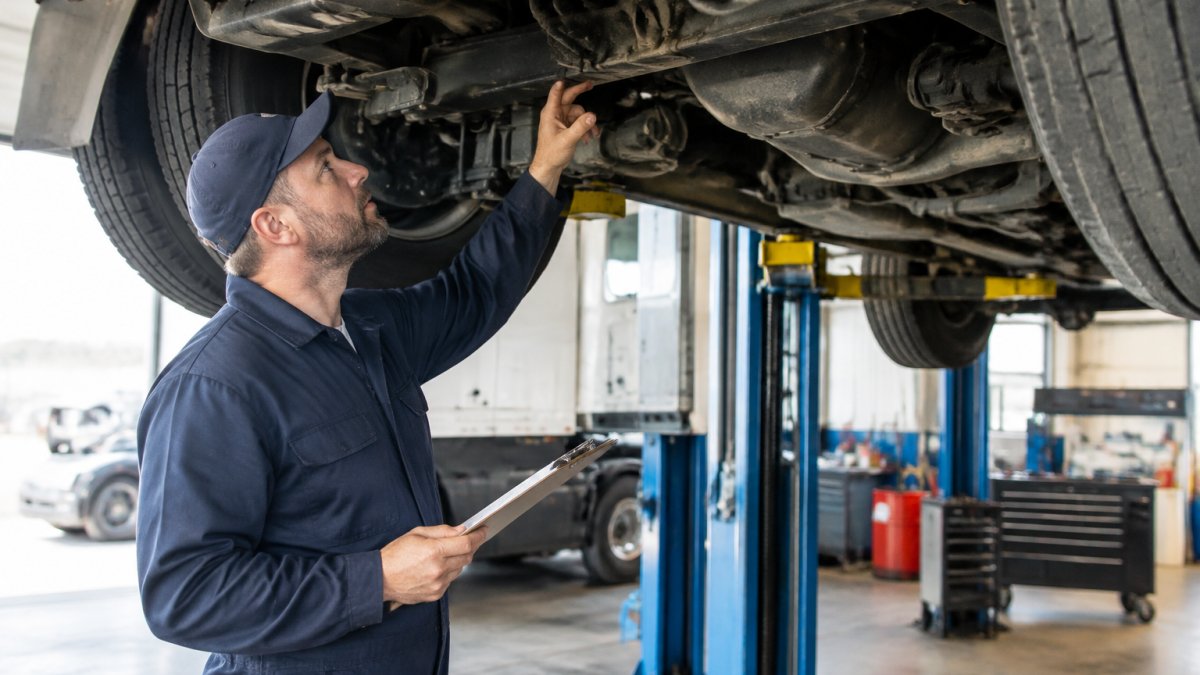
A pre-purchase inspection turns opinion into evidence. Every defect you document becomes a line item you can price, and every line item is negotiating use. The difference between a truck buyer who saves money and one who doesn't is usually the quality of the inspection report they carry into used truck negotiation.
Bring a mechanic who knows commercial trucks, not a general auto shop. A technician who works on Class 7 and Class 8 units will know where these vehicles fail and what a repair actually costs. Then work through this used truck inspection checklist:
- Frame rails: cracks, rust, prior welds, and stretched bolt holes
- Fifth wheel and kingpin wear, including jaw slack and mounting bolts
- Air brake system: slack adjusters, chambers, lines, and compressor build-up time
- Tire dates and tread depth across all axles, plus sidewall cracking
- Engine blow-by and oil analysis results
- Transmission shift quality under load, not just in the yard
- Rear end and driveline play, including u-joints and carrier bearings
- Cab mounts, suspension bushings, and airbag condition
- Coolant and oil sample reports if the seller has them
Commercial-Specific Systems to Inspect
Passenger-car checklists miss the systems that cost the most on a working truck. Focus here:
- DOT inspection status and any out-of-service history. Ask for the last annual inspection report and check the date. An expired sticker is a negotiating point, not a dealbreaker.
- Hours meter versus odometer. Idle time wears an engine without adding miles. A truck with low miles and high hours has more wear than the odometer suggests. Compare the ratio against similar units in the same vocation.
- APU and reefer units if the truck runs temperature-controlled freight. Ask for service records and confirm the unit holds temperature under load.
- Wet kit and PTO condition on vocational units. Check for leaks, unusual noise under load, and whether the PTO engages smoothly.
- Aftertreatment system health on newer units. A failed DPF or DEF system can cost thousands to repair, so ask for fault codes and regeneration history.
Turning Inspection Findings into Negotiating Use
An inspection report is only as good as the number you attach to it. Before you negotiate, price the repairs. Get quotes from an independent shop for every defect you find. Then present the list as a package.
A common pattern is to group findings into three buckets: safety items that must be fixed before the truck goes into service, wear items that will need attention within a year, and cosmetic issues that don't affect operation. Use the first two buckets to justify your offer. The third bucket is usually noise.
Watch out: Sellers will sometimes agree to fix defects themselves before delivery. Get the repair scope in writing and confirm the work was done by a shop you trust, or the fix may not hold.
Once you know what to check, browse heavy trucks to compare real listings against your checklist.
Negotiating on Out-the-Door Price, Not Monthly Payment
Negotiate the out-the-door price, never the monthly payment. The out-the-door figure includes the purchase price, dealer fees, taxes, and title costs. The monthly payment hides all of it.
"Focus negotiations on the total 'out-the-door' price of the vehicle, not the monthly payment," advises an automotive contributor at U.S. News & World Report. Salespeople can stretch a loan term to shrink a payment while the total cost climbs.
Try this sequence:
- Agree on the out-the-door price in writing
- Confirm the trade-in value separately
- Then discuss financing terms
- Review the purchase agreement line by line before signing
Negotiation Scripts for Heavy Equipment Buyers
Good negotiation scripts for heavy equipment keep you calm and specific. You state the number, cite the evidence, and stay quiet.
Here are three that work:
"Your listing is at $X. Comparable units with similar hours sold at auction for less. Based on the inspection, I'm at $Y out the door."
"I'll sign today at this price if the dealer fees come off the contract."
"I have financing approved at my credit union. Can you match the interest rate?"
Ray Shefska, a former car salesman with 43 years of experience, offers three strategic tips for buyers in 2026 through CarEdge. The core of his advice: do your homework, stay patient, and be ready to walk.
Dealer Fees to Avoid When Buying a Truck
Dealer fees to avoid when buying a truck include doc fees above the state average, prep charges, and add-ons you never asked for. Ask for the itemized breakdown before you agree to anything. On a commercial truck, the fee stack can be larger than on a passenger car because dealers know fleet buyers are often less price-sensitive at the line-item level.
Common line items to question:
- Documentation and admin fees. These vary widely by state. Ask what the state average is and compare.
- "Market adjustment" surcharges. These are pure profit on a used unit and are almost always negotiable.
- Fabric protection, paint sealant, and extended warranties. On a work truck, these rarely pay back.
- Nitrogen tire fills and window etchings. Low-cost add-ons with high margins.
- Prep and reconditioning fees. Ask for the itemized reconditioning invoice. If the dealer can't produce one, the fee is negotiable.
- Delivery and logistics charges on out-of-state purchases. Confirm who pays before you agree to the out-the-door number.
Which Fees Are Actually Required by Law
Most fees on a truck buyer's contract are not required by law. Taxes and title fees are typically set by the state, and registration costs are fixed. Everything else is a business decision the dealer made. If a fee isn't required by law, it's negotiable.
Ask the finance manager to point to the statute or regulation that requires each fee. A legitimate fee will have a clear answer. A padded fee usually won't.
How to Challenge Fees Without Derailing the Deal
The cleanest approach is to negotiate the out-the-door price first, then ask for the itemized fee sheet. If the fees push the total above the number you agreed to, you have a concrete reason to reopen the conversation.
Try this sequence:
- Agree on the vehicle price in writing.
- Ask for the itemized fee sheet before you discuss financing.
- Challenge each non-required fee one at a time, starting with the largest.
- Get the final out-the-door number in the purchase agreement before you sign.
Watch out: Some dealers will remove a fee from the contract but add it back as a higher vehicle price. Compare the total out-the-door number, not the individual lines, to confirm you actually got the concession.
If a fee isn't required by law, it's negotiable. Get every charge in the purchase agreement before you sign.
Here are the common fee line items the article says to question, and why each one deserves scrutiny.
| Fee line item | What to do | Note |
|---|---|---|
| Documentation and admin fees | Compare against the state average | Vary widely by state |
| Market adjustment surcharges | Negotiate them | Pure profit on a used unit |
| Fabric protection, paint sealant, extended warranties | Question them | Rarely pay back on a work truck |
| Nitrogen tire fills and window etchings | Question them | Low-cost add-ons with high margins |
| Prep and reconditioning fees | Ask for the itemized reconditioning invoice | Negotiable if no invoice exists |
| Delivery and logistics charges | Confirm who pays before agreeing | Applies to out-of-state purchases |
Negotiating Commercial Financing Terms vs. Retail Loans
Commercial truck financing works differently from a retail auto loan. Lenders weigh the truck's revenue potential, your business credit score, and the down payment against the unit's resale value.
Negotiate these terms directly:
- Interest rate and whether it's fixed or variable
- Loan term length and total interest paid
- Down payment percentage
- Prepayment penalties and contract terms
Get loan approval from a lender before you shop. A pre-approved buyer has more leverage than a walk-in does.
Digital Negotiation Strategies for Used Truck Sales
Digital negotiation strategies let you gather use before you ever speak. Email and text create a paper trail, and a paper trail keeps sellers honest.
Use these moves:
- Request the VIN and vehicle history report by email
- Ask for photos of the hours meter and odometer
- Get competing quotes from three sellers in writing
- Keep every offer in text so nothing gets "forgotten"
Written offers also slow the pressure tactics down. A salesperson can't rush a deal that's sitting in your inbox.
Handling Trade-Ins and Post-Purchase Maintenance Separately
Never bundle a trade-in with the purchase price. Bundling lets the seller hide a low trade-in value inside a "good" truck price.
Value your trade-in on its own first, then negotiate the truck. For post-purchase maintenance, ask for a service agreement quote as a separate line. Compare that quote against independent shops before you commit.
If you're moving your current rig to fund the purchase, our guide to trusted platforms to sell used heavy equipment online covers where to list it.
Ready to Buy or Sell? Start With Ironmartonline
The best negotiating tactic is knowing the real market before you sit down. Value the truck, inspect it hard, and negotiate the out-the-door number.
That's where Ironmartonline earns its place. We put your equipment in front of millions of buyers across nine selling platforms, with no contracts and no hidden fees. Whether you need to move a fleet or find your next rig, we handle the reach.
Get started with Ironmartonline and browse dump trucks for sale or list your equipment today. Join our email list to see new listings first.
Frequently Asked Questions
How much can you negotiate off the asking price of a used truck?
There is no fixed percentage, but the room to move depends on how long the truck has sat on the lot and how far the asking price sits above fair market value. Vehicles that have been listed for extended periods give buyers more leverage, according to CarEdge's 2026 guidance. Build your offer from wholesale and retail comparables, not the sticker. A truck priced well above comparable units leaves more room; one priced at market leaves little.
Is it better to negotiate the total price or the monthly payment on a commercial truck?
Negotiate the out-the-door price. Focus on the total out-the-door figure rather than the monthly payment, because payment-focused talks let the seller stretch loan terms or adjust the interest rate to hide the true cost. Settle price first, then discuss financing terms separately.
What are the most effective red flags to look for when inspecting a used truck?
Watch for odometer readings that do not match the vehicle history report, fresh paint or undercoating over rust, uneven tire wear suggesting alignment or frame problems, and service records that stop abruptly. On commercial units, check the frame for cracks or welds, the fifth wheel and air systems, and the hour meter against the odometer. Request a VIN check and a pre-purchase inspection from a mechanic who works on heavy-duty equipment before you sign a purchase agreement.
How does paying cash impact your leverage during a used truck negotiation?
Cash removes the finance office from the deal, which simplifies the contract terms and can shorten the process. It does not automatically lower the price, and some sellers earn back-end revenue from financing, so a cash offer is not always preferred. Use cash as a closing tool: agree on the out-the-door price first, confirm the documentation and inspection are clean, then state that you can complete the purchase immediately. Speed and certainty carry weight with a seller holding inventory.
