
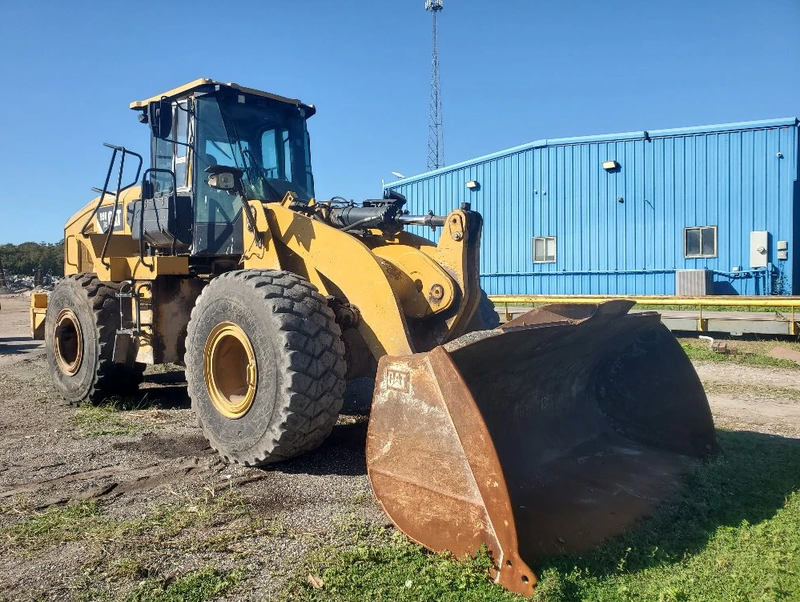
2014 CAT 950GC Wheel Loader: What to Check Before You Buy
TL;DR: The 2014 CAT 950GC pairs a Cat C7.1 engine with a 10,000–13,000+ lb operating payload class, making it a mid-size workhorse for yard, quarry, and material-handling work. Before buying a used unit, verify engine hours, hydraulic cylinder condition, tire wear, and service records. A clean paper trail matters more than a low sticker price.
By 2014, the 950GC had earned a reputation as Caterpillar's value-focused answer to the premium 950M — same frame class, fewer electronic frills, lower acquisition cost. That tradeoff makes it a popular pick for contractors who want proven Cat reliability without paying for features they won't use. But "popular" doesn't mean "safe to buy blind." Here's what separates a smart purchase from an expensive mistake.
See 2014 CATERPILLAR 950GC Wheel Loader.
What engine and specs does the 2014 CAT 950GC have?
The 950GC runs on a Cat C7.1 engine, rated for mid-size wheel loader duty cycles — yard work, aggregate handling, and light-to-medium site prep. It sits in the same general size class as the 950M, with a standard bucket configuration built for high-cycle loading. Confirm the exact bucket size and attachment configuration on the specific unit you're evaluating — sellers frequently swap buckets between sale and delivery, and advertised capacity doesn't always match what's attached.
How many hours is too many on a used 950GC?
There's no single cutoff — hours only tell half the story. A 2014 unit with 6,000 hours and a complete dealer service binder is a safer buy than a lower-hour machine with zero documentation. Ask for:
- Full service and maintenance records
- Fluid analysis reports, if available
- Undercarriage and tire inspection history
- Any warranty or extended-coverage transfer paperwork
No records means you're buying blind. Walk away or price in the risk.
What should you physically inspect before buying?
Don't take the listing photos at face value. Inspect these five areas in person or request a third-party inspection report:
- Hydraulic cylinders — check for scoring, leaks, or uneven wear on the lift and tilt rams.
- Tires — uneven wear signals alignment or loader-geometry issues, not just tire age.
- Articulation joint — excessive play here is expensive to fix and easy to miss on a quick walkaround.
- Engine compartment — look for oil residue, coolant staining, or recent gasket work that wasn't disclosed.
- Cab electronics — test every gauge, light, and control. GC-series trims cut some electronic features compared to the M-series, so confirm what's actually included before assuming parity.
If a seller won't let you run the machine yourself, treat that as a red flag, not a formality to skip.
Is a 2014 model year still a good value in 2026?
Age alone doesn't disqualify a machine — maintenance history does. A well-documented 2014 950GC can still deliver years of productive service, especially for buyers who don't need the latest telematics or emissions tier. Choose a 2014 GC-series unit if your priority is proven mechanical simplicity and lower upfront cost. Choose a newer M-series or higher-trim unit if you need advanced payload monitoring, updated operator-assist features, or longer remaining warranty coverage.
How do you avoid overpaying for a used wheel loader?
The fastest way to overpay is comparing price before you compare condition. Two machines listed at the same number can carry very different risk profiles once you factor in tire life, hydraulic wear, and deferred maintenance. Before you negotiate:
- Pull the full service history.
- Get an independent inspection, not just the seller's word.
- Compare hour count against documented maintenance — not against price alone.
- Price out near-term replacement costs (tires, cylinders, undercarriage) and subtract that from your offer.
A lower sticker price with a $20,000 hydraulic repair looming isn't a deal. It's a deferred expense with your name on it.
Buy with the facts, not the photos
A 2014 CAT 950GC can be a dependable, cost-effective addition to your fleet — if you verify condition instead of trusting a listing description. Pull the records, inspect the wear points, and price the machine against what it will actually cost you to keep running, not just what it costs to drive off the lot.
FAQ
What engine does the 2014 CAT 950GC use?
It's powered by the Cat C7.1 engine, built for mid-size wheel loader applications.
How does the 950GC differ from the 950M?
The GC trim shares the same general size and frame class as the M-series but includes fewer electronic and operator-assist features, which typically lowers acquisition cost.
What's the biggest risk when buying a used 950GC?
Buying without maintenance records. Hour count alone doesn't predict remaining machine life — documented service history does.
Should I get an independent inspection before buying?
Yes. A third-party inspection catches hydraulic, tire, and articulation wear that a visual walkaround or listing photos can miss.
Is a 2014 model still worth buying today?
It can be, if maintenance is documented and near-term repair costs are priced into your offer.