
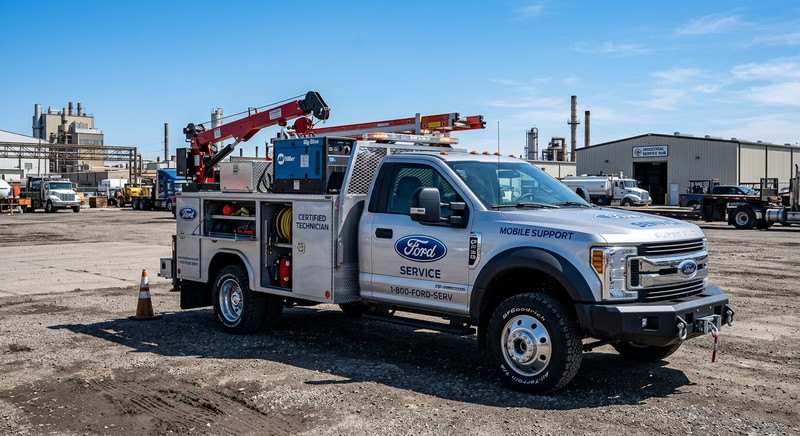
Ford Service Trucks: What Buyers Need to Know Before They Spec One
TL;DR: Ford service trucks are built on F-450/F-550 Super Duty chassis and outfitted with utility bodies, cranes, compressors, and welders for field repair work. The right spec depends on payload needs, PTO requirements, and body configuration — not just cab size or engine choice. Buyers who skip the spec sheet end up with a truck that can't carry its own equipment.
A service truck only earns its keep if it matches the job it's built for. Buy the wrong configuration and you're stuck with a rig that can't haul its own crane, can't run its air tools, or sits overweight the day it leaves the upfitter's lot.
Ford builds the Super Duty chassis. Everything else — the utility body, the crane, the compressor, the welder — comes from an upfitter or a used equipment lot. That means two trucks with the same "Ford F-550" badge can be completely different machines depending on what's bolted to the frame. Knowing what to check before you buy is the difference between a truck that pays for itself and one that costs you in downtime.
See 2018 FORD F-550 XL Service Truck.
What makes a Ford truck a "service truck"?
A Ford service truck starts as a cab-chassis — typically an F-450 or F-550 Super Duty — and gets fitted with a utility body designed to carry tools, parts, and job-specific equipment. The chassis provides the engine, transmission, and frame rating. The body provides the storage compartments, the mounting points for a crane or compressor, and the work deck.
This two-part build is why spec sheets matter more than trim level. The factory chassis tells you towing and payload capacity. The upfitted body tells you what the truck can actually do on a job site.
F-450 vs. F-550: which chassis do you need?
Choose the F-450 if you need a lighter, more maneuverable truck for light equipment and frequent driving between sites. Choose the F-550 if you're mounting a crane, compressor, or welder package that pushes total weight past what the F-450's frame and axles are rated to carry.
The F-550 has a heavier frame, larger rear axle capacity, and higher GVWR than the F-450, which is why it's the more common choice for fully loaded utility bodies. Confirm the exact GVWR and payload rating on the specific unit you're buying — these numbers change by model year and configuration, so don't assume last year's spec sheet still applies.
What engine options come on a Ford service truck?
Ford Super Duty trucks used as service truck platforms are typically built with either the Power Stroke diesel or a gas V8, depending on the model year and trim. Diesel engines are the standard choice for trucks running heavy PTO-driven equipment like air compressors or hydraulic cranes, since diesel platforms generally deliver higher torque for sustained mechanical loads.
Gas-powered chassis cost less upfront and require less specialized maintenance, which makes them a reasonable choice for lighter-duty service work that doesn't demand constant PTO operation. Choose diesel if your crew runs PTO equipment for hours at a stretch. Choose gas if the truck is doing more driving than wrenching.
What equipment comes standard on a service truck body?
No two service bodies are identical, but most utility bodies built for Ford chassis include some combination of the following:
- Lockable storage compartments along both sides of the bed for tools and parts
- A hydraulic or electric crane mounted behind the cab for lifting components too heavy to handle manually
- An air compressor for running pneumatic tools in the field
- A welder package, often PTO-driven off the truck's engine
- A work deck or headache rack for hauling pipe, lumber, or long equipment
Each addition adds weight. A crane alone can add 1,000 to 2,000 pounds depending on capacity, and a compressor and welder package add more on top of that. This is why payload math matters before you buy — a fully equipped body can eat most of an F-550's available payload before you've loaded a single tool.
Why payload capacity is the number that actually matters
The mistake most buyers make is shopping by chassis size instead of by remaining payload. A truck advertised as an F-550 with a "heavy-duty" body might have almost no payload left for tools, parts, and crew once the crane and compressor are mounted.
Ask for the truck's actual weight with the body and equipment installed, then subtract that from the GVWR to get real usable payload. If the seller can't produce that number, treat it as a red flag — not a detail to figure out later.
New vs. used: what changes in the buying decision?
A new Ford service truck comes with a factory warranty on the chassis and, in most cases, a separate warranty from the body upfitter. You know the truck's full history because there isn't one yet. That certainty costs more upfront.
A used service truck can save significant money, but the crane, compressor, and welder are mechanical systems with their own wear patterns separate from the engine and transmission. A truck with 60,000 miles and a well-maintained crane can be a better buy than a truck with 30,000 miles and a compressor that's never been serviced. Ask for maintenance records on the upfitted equipment specifically, not just the chassis.
What to inspect before buying a used service truck
- Chassis mileage and engine service history — standard due diligence on any Super Duty purchase.
- Crane cycle count or service log, if available — cranes wear based on use, not just age.
- PTO engagement and function — start the truck, engage the PTO, and confirm the compressor or welder actually runs off it.
- Body condition and compartment locks — rust and non-functioning latches are cheap to spot and expensive to ignore.
- Tire condition relative to load rating — a service truck that's been run overweight shows it in the tires first.
Skip any of these and you're buying on trust instead of evidence. Verify in person before you sign.
Choosing between crane capacity options
Crane capacity on a service truck body typically ranges from smaller units rated for a few hundred pounds up to heavier hydraulic cranes rated for several thousand pounds, depending on the boom length and mounting configuration. Choose a higher-capacity crane if your crew regularly lifts pumps, motors, or gearboxes in the field. Choose a lighter unit if your lifting needs are occasional and you'd rather preserve payload for tools and parts.
Oversizing the crane is a common overcorrection. A larger crane adds weight and cost without adding value if the job rarely requires it. Match crane capacity to your heaviest routine lift, not your heaviest hypothetical one.
Making the final call
A Ford service truck is only as good as the match between chassis, body, and job requirements. The chassis determines what the truck can legally and safely carry. The body determines what the truck can actually do once it's on site. Skipping either half of that equation is how buyers end up with a truck that looks right on paper and falls short in the field.
Get the GVWR, the as-equipped weight, and the maintenance records before you commit. Those three numbers tell you more than any trim badge on the tailgate.
Frequently asked questions
What's the difference between an F-450 and F-550 service truck?
The F-550 has a heavier-duty frame, higher GVWR, and greater payload capacity than the F-450, making it the more common choice for trucks carrying cranes, compressors, and welder packages. The F-450 suits lighter equipment loads and more frequent road driving.
How much payload does a fully equipped service truck lose to its own equipment?
It varies by configuration, but a crane, compressor, and welder package combined can consume a significant share of an F-550's rated payload. Always ask for the truck's as-equipped weight and subtract it from GVWR to find real usable capacity.
Is a diesel or gas engine better for a service truck?
Diesel is the stronger choice for trucks running PTO-driven equipment for extended periods, since diesel platforms typically deliver higher sustained torque. Gas engines cost less to buy and maintain, making them suitable for lighter-duty applications with less PTO use.
What should I check before buying a used Ford service truck?
Inspect chassis mileage and engine records, crane service history, PTO function, body and compartment condition, and tire wear relative to load rating. Ask for documentation on the upfitted equipment separately from the chassis.
How do I know what crane capacity I need?
Match crane capacity to your heaviest routine lift, not an occasional worst-case scenario. Oversizing the crane adds unnecessary weight and cost while reducing the payload available for tools and parts.