

Ford Utility Trucks: Chassis, Upfits, and Buying Guide

Ford utility trucks are not built in one single configuration. Ford supplies the chassis, cab, and powertrain, and an upfitter builds the body that actually makes the truck useful: the compartments, the crane, the dump bed, the ladder rack, the welder, the air compressor. Two trucks can wear the same Ford badge and share almost nothing else about how they earn money on a job site.
That distinction matters most to buyers. When you shop a used Ford service truck, you are really evaluating two separate assets bolted together. The chassis carries mileage, rust, engine hours, and a service history. The body carries its own wear, its own hydraulics, its own latches and slides, and its own resale value if you ever separate the two.
This guide walks through the Ford commercial lineup, the upfit bodies commonly mounted on it, how pricing tends to behave across the used market, and the checks that separate a truck that is ready to work from one that quietly becomes a project.
See 2018 FORD F-550 XL Service Truck.
What Counts as a Ford Utility Truck
Utility truck is a broad label, and in practice it sits right next to service truck in most marketplace filters. Commercial Truck Trader, for example, groups Ford Utility Truck and Service Truck into a single category rather than splitting them out. That overlap tells you something useful: buyers searching for one term usually want the other, and sellers list under both to stay visible.
In the real world, a Ford utility truck is typically a chassis cab or cutaway that has been sent to a second-stage manufacturer for a work body. Ford's own commercial lineup spans vans, passenger wagons, pickups, and cutaways, and the company markets the whole range under the Built Ford Tough name. Ford describes these vehicles around three broad jobs: hauling crucial equipment, delivering fragile goods, and transporting patients. Utility work sits squarely in the first category.
The practical definition buyers should carry into a search is this: if the truck was ordered as an incomplete chassis and finished by someone other than Ford, it is an upfit, and the upfit matters as much as the badge on the grille. Fuel economy, performance, and pricing for the base vehicles are published by Ford, but the numbers that decide whether a truck fits your crew come from the body builder.
Two more filters show up constantly on listing sites and are worth understanding before you start scrolling. One is vocation, which describes the work the truck was built for. The other is class, which describes the size and weight bracket of the chassis. Using both narrows a national inventory down to a short list quickly, and it also helps you compare apples to apples when two trucks look similar in photos but were specced very differently when new.
The Ford Chassis Cab Lineup Behind Most Utility Builds
Most Ford utility trucks start life as an incomplete vehicle: a cab, a frame, an engine, and a rear end with nothing behind the cab. Ford sells these specifically so a body builder can mount equipment without undoing factory work. That is why the Ford Pro Locator lets shoppers filter new work trucks and vans by body type before they ever see a specific unit, with service bodies, dump bodies, and service utility vans among the choices.
The heavy end of that range is where most serious utility builds live. Ford describes the F-550 Super Duty as engineered to be upfitted to match whatever commercial need you have, and cites a maximum towing capacity of 40,000 pounds for the truck. That combination of a factory chassis and a huge towing figure is exactly why the F-550 shows up so often under service bodies, cranes, and other heavy equipment.
Not every utility truck needs that much truck. The Ford Pro Locator lists job-ready cargo vans, passenger vans, and service trucks alongside the chassis cab models, and a service utility van body can be mounted on a van platform rather than a full frame. For a contractor running light tool loads around a metro area, that can be the more economical route. For a crew hauling a compressor, a welder, and a crane on the same truck, the chassis cab is the only realistic answer.
The Transit name also appears in used listings at the heavier end of van-based work. Equipment Trader showed a 2023 Ford Transit 350 listed in Kansas City, MO, which illustrates how a van chassis can be dressed out and priced as a commercial unit rather than a passenger vehicle. Buyers comparing a van-based utility truck against a chassis cab truck should weigh payload, towing, and access height rather than assuming one format is always better.
Upfit Bodies Commonly Mounted on Ford Chassis
The body is where the truck becomes a tool. Ford's work truck locator organizes new inventory by body type, and dealer inventory pages describe a similar spread of equipment. The table below outlines the common configurations and what each one is built to do.
| Body or configuration | What it provides | Typical use |
|---|---|---|
| Service body | Enclosed exterior compartments and interior shelving for tools, parts, and small equipment | Mechanics, electricians, plumbers, and field service crews |
| Service utility van | A van platform with organized storage built into the cargo area and body | Light service work, urban routes, and lower-clearance jobs |
| Dump body | A tipper bed with a hydraulic lift for loose material | Landscaping, aggregate hauling, and site cleanup |
| Crane truck | A mounted lifting arm for moving heavy components and materials | Heavy mechanical service and equipment installation |
| Cab chassis | A bare incomplete vehicle ready for a body to be added | Custom builds where the buyer specifies the upfit |
Dealer inventory pages list Ford cab chassis, crane trucks, dump trucks, and service trucks side by side, which reflects how buyers actually shop. A crew that needs to move material and carry tools may end up comparing a dump body against a service body and a trailer combination rather than picking one category outright.

Matching Truck Size to the Work
The single most expensive mistake in this market is buying a truck that is either too light for the load or heavier than the job requires. A chassis that is constantly at its limit costs money in brakes, tires, and downtime. A chassis that is far heavier than needed costs money at every fuel stop and makes tight job sites harder to work in.
Listing sites organize inventory by class for exactly this reason, and the class filter is one of the fastest ways to cut a national search down to a workable list. Combine it with the vocation filter, and a search that returned thousands of Ford units can shrink to a page or two of genuinely relevant trucks.
Before you fall for a body, confirm the numbers that actually govern the job. Those include the chassis gross vehicle weight rating, the payload left after the body and equipment are mounted, the towing capacity of the specific configuration, and the axle ratings. Body weight is the number buyers most often overlook. A heavy service body with a crane and a full set of drawers can consume a substantial share of the available payload before a single tool goes inside.
Ford publishes ratings and specifications for its commercial vehicles, and upfitters publish body weights and center-of-gravity guidance. Those two documents, read together, tell you whether a specific truck can legally and safely do your work. Treat any listing without that information as incomplete until you obtain it.
The F-550 Super Duty and Heavy Upfit Work
Ford positions the F-550 Super Duty specifically as an upfit platform, describing it as engineered to be upfitted to match whatever commercial need you have. The headline figure Ford cites for it is a maximum towing capacity of 40,000 pounds. Maximum figures always come with configuration conditions attached, so the number that applies to any particular truck depends on how it was built, but the capability class is clear.
That is why the F-550 turns up so often under the bodies that need real structure: cranes, heavy service bodies, large compressor and welder packages, and combination units that carry tools plus a lifting arm. A heavier chassis also tolerates repeated loading and unloading better than a lighter one, which matters for crews that work out of the truck all day rather than using it purely as transport.
When shopping a used F-550 utility truck, the chassis and the body should be evaluated separately and then checked together. Confirm the front and rear axle ratings, verify that the upfit was installed within the chassis manufacturer's guidelines, and ask who built the body. A well-documented upfit from a recognized builder is worth more than an undocumented one, even if the two trucks look identical in photographs.
What Used Ford Utility Trucks Cost
Pricing in this segment is driven by chassis year, mileage, engine, body configuration, body condition, and location. There is no single market number, and any article claiming one should be treated with suspicion. What is useful is understanding the range of asking prices that show up in real listings so you can judge whether a specific truck is in the neighborhood.
Two data points from current listings illustrate the spread. A 2023 Ford Transit 350 listed in Kansas City, MO carried an asking price of $85,000 among 793 Ford equipment listings on Equipment Trader. Separately, the Ford Pro Locator showed a new Ford work truck priced at $77,411. Those two figures sit in a similar band, which is a reminder that a late-model used unit with a good body is not automatically a bargain compared with new inventory.
Service truck inventory is deep. Comvoy listed 3,536 service and utility trucks across its service truck category, and its filters allow buyers to set a maximum price, a maximum mileage, and a make, model, and trim. That kind of filtering is essential in a category this large, because the top of the price range runs far higher than most buyers expect.
The practical approach is to set your budget range before you search, then sort by condition and documentation rather than by the lowest asking price. A truck priced below the surrounding market usually has a reason. Common ones include high chassis mileage, a worn hydraulic system, rust in the compartments, an undocumented upfit, or a body that no longer matches any job you actually do.
Prices, inventory counts, and available incentives change constantly, and regional pricing varies widely. Verify current figures directly with the seller or dealer before you make an offer or travel to inspect a truck.
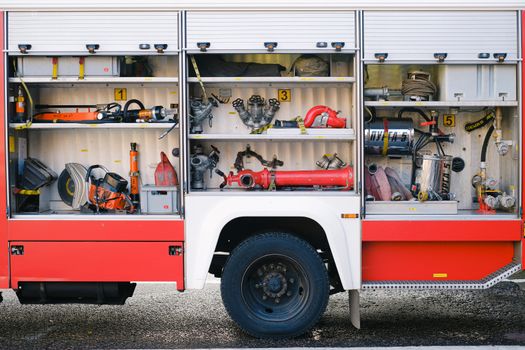
Where Ford Utility Trucks Are Listed for Sale
Ford utility trucks are sold through three main channels: franchised dealer commercial departments, national listing marketplaces, and independent marketplaces that handle used heavy equipment and work trucks.
Dealer commercial departments carry both new and used inventory and can often coordinate the upfit. The Ford Pro Locator is built for this, allowing shoppers to filter new work trucks and vans by body type including service body, dump body, and service utility van, and to search by ZIP code for local incentives and nearby dealers. Individual dealers maintain their own listings as well. Capital Ford of Raleigh, for example, lists commercial work trucks and states that it offers the largest parts inventory in the area, with the dealership located at 4900 Capital Blvd, Raleigh, NC, 27616. Parts availability is not a trivial consideration for a working truck.
National listing marketplaces carry enormous volume. Commercial Truck Trader showed 4,402 listings for Ford utility truck and service truck configurations at the time of writing, and 68 of those were in Michigan. Michigan specifically has a strong commercial truck market, with dealer inventory including Ford cab chassis, crane trucks, dump trucks, and service trucks. Equipment Trader is another major venue, with 793 Ford equipment listings at the time of writing.
Independent marketplaces round out the picture. Ironmartonline connects buyers and sellers of used heavy equipment, trucks, and machinery, with sellers listing across multiple platforms to reach a broad buyer audience and no contracts or hidden fees on the selling side. For buyers, the value of a marketplace like this is access to owner-operator trucks and fleet units that never pass through a dealer lot.
Inventory counts on all of these sites change daily. Use them to gauge the market and to set up saved searches, then verify each individual listing with the seller.
What to Inspect on a Used Ford Service Truck
A used utility truck has two lives to check, and buyers who only inspect one end up disappointed by the other. Work through this list methodically, and expect to spend more time on the body than you initially planned.
- Frame and chassis rails. Look for cracks, bends, welding repairs, and heavy rust, especially around the upfit mounting points.
- Rust in the body. Service body compartments trap moisture. Check the bottoms of compartments, the floor of the bed, and the wheel wells.
- Compartment doors and latches. Open and close every one. Sagging doors, broken latches, and worn hinges are common and add up quickly.
- Drawer slides and shelving. Heavy drawer units take abuse. Confirm the slides travel smoothly and lock properly.
- Hydraulics, if equipped. For a dump body or crane, check the cylinders, hoses, fittings, and controls for leaks, weeping, and slow operation.
- Crane documentation. Ask for load test records, service history, and the builder's rating information.
- Wiring and lighting. Upfit electrical work is often the weakest part of a used truck. Check every work light, beacon, and accessory circuit.
- Chassis mileage and engine hours. Verify against service records rather than trusting the odometer alone.
- Service records. A documented maintenance history on the chassis is worth real money at resale.
- Tires and brakes. On a truck that has been loaded heavily for years, both wear faster than on a comparable pickup.
- Towing and payload ratings. Confirm that the as-built configuration actually supports the loads you plan to carry.
- Upfit builder information. Knowing who built the body helps with parts, repairs, and resale.
Photographs hide almost everything that matters. Rust, hydraulic seepage, and wiring problems rarely show up in a listing image, and sellers naturally photograph the clean side of the truck. If you cannot inspect the unit in person, arrange for someone who can, and ask for specific close-up photographs of each item on this list.
Service Body Layout: Compartments, Drawers, and Payload
Two service bodies from different builders can be the same length and height yet hold completely different amounts of useful equipment. Layout matters more than raw dimensions for daily work, and it is the hardest thing to change after purchase. Changing a body is expensive; living with the wrong one is expensive too, just more slowly.
Start with access. Vertical compartments work well for tall items and long tools. Horizontal compartments with drawers suit small parts, fittings, and hand tools. A mix of both usually beats either extreme. Think about how your crew actually loads and unloads a truck during a shift, and whether the most-used items are the easiest to reach.
Then consider security and weather. Enclosed service bodies protect tools from rain, snow, and theft, which is a real advantage over an open bed with a toolbox. Latches, locks, and seals should be inspected carefully on any used body, because replacing them across an entire truck is a substantial cost.
Finally, weigh the payload math. Every drawer bank, crane, compressor, welder, and tank consumes payload before a single tool goes aboard. A heavily equipped body on a chassis that is already near its limit leaves little margin, and running at the limit shortens the life of brakes, springs, and tires. Build in headroom.

Matching the Body to the Trade
The body should follow the work, not the other way around. A mechanical service truck usually needs organized small-part storage, a compressor, and often a crane for lifting components. An electrical or plumbing truck needs long-item storage and easy access to frequently used fittings. A landscaping operation may want a dump body plus trailer capacity rather than a compartment body at all.
Municipal and utility fleets tend to specify trucks around crew size and response speed, favoring organized compartments and quick access. Heavy equipment service operations lean toward crane trucks and heavier chassis because the components they handle are large and heavy.
The useful exercise is to list everything the truck will carry on its heaviest normal day, add the weight of the body and mounted equipment, and compare that total against the available payload. If the total lands close to the limit, step up a chassis class. If it lands far below, consider dropping a class and saving money on fuel and purchase price.
Financing, Selling, and Moving a Truck
Financing availability affects both what you can buy and how quickly you can act on a good listing. Ironmartonline offers financing options for buyers, which matters in a market where the right truck can appear and sell within days. Having financing arranged before you start shopping puts you in a position to move when a well-documented unit shows up.
On the selling side, reach is everything. Ironmartonline lets sellers list equipment across nine platforms to reach millions of potential buyers, with no contracts and no hidden fees. For a fleet manager replacing several service trucks, or an owner-operator moving up to a heavier chassis, that kind of listing breadth shortens the time a truck sits idle instead of working.
Whichever side of the transaction you are on, documentation is the thing that protects value. Service records, upfit builder information, crane certifications where applicable, and clear photographs of the body and chassis all shorten negotiations and widen the pool of serious buyers.
Frequently Asked Questions
What is a Ford utility truck?
A Ford utility truck is a Ford chassis, usually a chassis cab or cutaway, fitted with a body built for service work. Upfitters mount service bodies with compartments, dump bodies, cranes, and similar equipment behind the cab. Ford's commercial range covers vans, passenger wagons, pickups, and cutaways, and the upfit is what turns any of those platforms into a utility truck.
How much does a used Ford utility truck cost?
Pricing moves with condition, mileage, body configuration, and location. A 2023 Ford Transit 350 listed in Kansas City, MO carried an asking price of $85,000 on Equipment Trader, while the Ford Pro Locator showed a new Ford work truck priced at $77,411. Treat any single listing as one data point and verify current pricing before making an offer.
Can a Ford F-550 Super Duty be upfitted with a service body?
Yes. Ford describes the F-550 Super Duty as engineered to be upfitted to match whatever commercial need you have, and cites a maximum towing capacity of 40,000 pounds for it. That makes the model a common base for service bodies, cranes, and other heavy upfits. Confirm the specific chassis and body combination with the upfitter and dealer before ordering.
Where can I find Ford utility trucks for sale?
Ford utility trucks appear on national listing marketplaces, dealer commercial inventory pages, and independent marketplaces such as Ironmartonline. Commercial Truck Trader showed 4,402 Ford utility truck and service truck listings overall and 68 in Michigan at the time of writing, and Comvoy listed 3,536 service and utility trucks. Inventory counts change daily, so confirm current availability.
What should I inspect on a used Ford service truck?
Check the chassis and the body separately. On the chassis, verify mileage, service records, frame condition, rust, and the towing and payload ratings you actually need. On the body, inspect compartment doors, latches, drawer slides, hydraulics, welds, and wiring. Ask for the upfit builder's information and any documentation showing when and how the body was installed.