
Table of Contents
- Why Selling a Used Caterpillar Dozer Demands a Strategy
- How to Determine Your Used Caterpillar Dozer Value
- Factors That Drive Used Dozer Resale Value
- Dozer Undercarriage Inspection: The Most Expensive Wear Item
- The Role of Used Dozer Maintenance Records in Buyer Confidence
- Heavy Equipment Listing Photos That Sell Dozers
- Repair or Sell As-Is? A Return on Preparation Analysis
- Choosing the Right Sale Channel for Your Dozer
- When Is the Best Time to Sell a Used Caterpillar Dozer?
- Frequently Asked Questions
Last Updated: October 17, 2026
Why Selling a Used Caterpillar Dozer Demands a Strategy
The global used construction equipment market topped USD 22.5 billion in 2024 and should reach USD 35.8 billion by 2030, according to Strategic Market Research's analysis of used construction equipment. That growth hides a hard truth: two identical Caterpillar dozers can sell for very different numbers. The gap rarely comes down to the machine. It comes down to how the seller prepared, priced, and positioned it.
Maximizing resale value on used Caterpillar dozers is a process, not a listing. This guide from Ironmartonline walks through the valuation, inspection, and sale-channel decisions that move real money.
So why use Ironmartonline Equipment Broker? Because a broker puts your machine in front of millions of buyers across nine web-based selling platforms, with no contracts and no hidden fees. That reach matters when the wrong channel costs you thousands.
The Difference Between Asking Price and Realized Sale Price
Asking price is what a seller hopes to get. Realized sale price is what the buyer actually wires.
Most sellers track the first number and ignore the second. Auction results, dealer retail, and private sales all produce different realized prices for the same machine. A dozer listed at a strong asking price can sit for months, then sell low out of frustration.
Why Use Ironmartonline Equipment Broker?
Selling heavy equipment yourself means fielding calls, vetting buyers, and chasing paperwork. A brokerage handles that work and widens your buyer pool at the same time.
- Nine selling platforms working at once
- No contracts and no hidden fees
- Global and local buyer reach
- A hassle-free process from listing to close
We built Ironmartonline to remove the friction that eats into a seller's net.
How to Determine Your Used Caterpillar Dozer Value
Used Caterpillar dozer value comes from evidence, not guesswork. Start with comparable sales, then adjust for condition, hours, and configuration.
The Comparable Sales Method for Accurate Valuation
The comparable sales method prices your machine against recent sales of similar dozers. Match on model, year, hours, and region, then adjust up or down for condition and attachments.
- Collect 5-10 recent sales of the same model family.
- Note hours, year, and undercarriage condition for each.
- Discard asking prices and keep only realized sale prices.
- Adjust your number for attachments, service history, and wear.
- Set an asking price slightly above your target to leave room to negotiate.
Factors That Drive Used Dozer Resale Value
Age and hours top the list, but configuration and attachments can swing a price just as far.
Operating Hours and Machine Age
Thompson Machinery's valuation guidance compares a 5-year-old Cat dozer with 4,000 hours against a 10-year-old model with 9,000 hours. The younger, lower-hour machine generally holds more value.
Hours tell buyers how much life is left. Age tells them how much technology has changed since the machine was built.
Model, Configuration, and Attachments
A standard track dozer and a low-ground-pressure build serve different buyers. Grade control, rippers, and winches add value only when the buyer needs them.
- Grade control and GPS: high demand in grading work
- Ripper attachments: valued in rock and compaction jobs
- Wide tracks: valued in soft ground
- Telematics: proof of hours and maintenance history
Dozer Undercarriage Inspection: The Most Expensive Wear Item
Undercarriage wear is the single biggest cost driver on a used dozer. Buyers know it, and they price it in. A Caterpillar dozer undercarriage can represent a substantial share of the machine's total value, so a buyer who sees worn components will discount the asking price by more than the cost of the parts.
Measuring Undercarriage Wear and Repair Economics
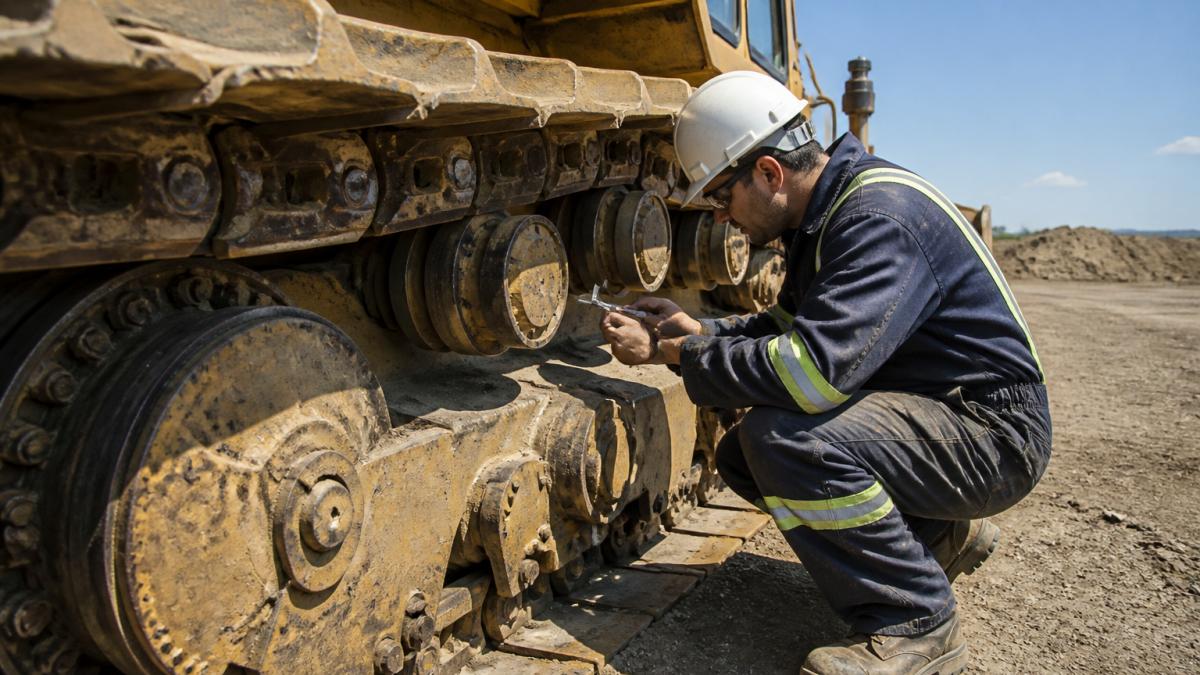
A dozer undercarriage inspection checks track shoes, rollers, idlers, sprockets, and bushings. Each part wears at its own rate, and the total tells a buyer what a rebuild will cost. Most practitioners measure wear with a track and bushing wear gauge, a depth gauge, and a straightedge, then compare readings against the manufacturer's wear limits for the specific model.
Track shoes. Measure grouser height from the shoe plate to the top of the grouser. New grousers typically stand about 1.5 to 2 inches tall depending on the model; when they wear down to roughly half that height, the shoes are due for replacement. Also check for bent or broken shoes and worn master links.
Bushings and pins. Measure the bushing outside diameter with a wear gauge or caliper. Internal pin and bushing wear shows up as track pitch elongation, the distance between pin centers grows as the bushings wear. When pitch elongation reaches the manufacturer's condemned limit (often around 2 to 3 percent of original pitch), the chain is worn out. A quick field check is to measure the distance across several track links and compare it to the specification for a new chain.
Rollers and idlers. Check for leaks, flat spots, and play. A roller with a worn tread diameter or a leaking seal will fail soon. Idlers should spin freely without bearing play or noise. Measure roller tread diameter against the wear limit; a roller worn past the limit transfers load to the track chain and accelerates bushing wear.
Sprockets. Inspect the tooth profile. A new sprocket has a rounded, symmetrical tooth; a worn one develops a hook shape and a sharp point. Measure tooth wear with a sprocket gauge or compare the tooth profile to a new sprocket. Worn sprockets chew up new chains, so replacing one without the other wastes money.
Repair economics. The decision rule is simple: estimate the cost to bring the undercarriage back to spec, then estimate the price increase that fresh undercarriage creates. If the repair cost is less than the price bump, do the work. If not, sell as-is and disclose the condition. A common pattern is that a full undercarriage rebuild, new chains, rollers, idlers, and sprockets, costs a meaningful fraction of the machine's value, so sellers often get a better net result by pricing the dozer to reflect the wear rather than absorbing the full rebuild cost. Buyers who plan to run the machine hard will pay for fresh undercarriage; buyers who need a machine for light work may prefer a discount.
| Component | What to Check | Measurement Method | Value Impact |
|---|---|---|---|
| Track shoes | Grouser height, bends, breaks | Depth gauge; compare to new height | High |
| Rollers | Leaks, flat spots, tread diameter | Caliper; compare to wear limit | Medium |
| Sprockets | Tooth profile, hooking | Sprocket gauge; visual profile | High |
| Idlers | Bearing play, seal leaks | Spin test; listen for noise | Medium |
| Bushings/pins | Internal wear, pitch elongation | Wear gauge; measure track pitch | High |
The Role of Used Dozer Maintenance Records in Buyer Confidence
Used dozer maintenance records turn claims into proof. A buyer who sees a service log trusts the hour meter and bids with confidence.
Boom & Bucket's resale guidance notes that proper maintenance and documentation are key to maximizing resale value when reselling Cat heavy equipment.
Keep these records ready:
- Oil and filter service logs
- Undercarriage replacement dates
- Repair invoices with part numbers
- Telematics hour reports
Heavy Equipment Listing Photos That Sell Dozers
Heavy equipment listing photos do more selling than any paragraph of copy. Buyers scroll photos first and read descriptions second.
- Shoot in daylight, never at dusk
- Photograph all four sides and the undercarriage
- Show the hour meter and serial plate clearly
- Include the cab interior and any damage
- Add short video of the machine running
Repair or Sell As-Is? A Return on Preparation Analysis
Repairs pay off only when the price bump beats the repair bill. Run the math before you spend.
Add up the repair cost, then estimate the price increase it creates. If the increase is larger, do the work. If not, sell as-is and disclose the issue.
- List every needed repair with a quote.
- Estimate the value each repair adds.
- Compare cost against added value.
- Fix only the repairs with a positive return.
- Disclose everything you skip.
Choosing the Right Sale Channel for Your Dozer
Auction, dealer, private sale, and broker each reach different buyers and take different cuts. The headline price is not the number that matters, net proceeds after fees, transport, and time are what land in your account.
ForConstructionPros' used dozer guidance notes that auctions can offer a lower cost than retail, though the saving is a possibility rather than a guarantee.
Sale-Channel Costs and Net Proceeds
Net proceeds matter more than headline price. A high offer with heavy fees can beat a low offer with none. Here is how the channels compare on the costs sellers actually face.
Auction. Auctions charge a seller commission plus listing and administrative fees, and the machine must often be transported to the auction yard at the seller's expense. The trade-off is speed and a public, competitive bidding process that can produce a strong realized price when demand is healthy. The risk is that a thin bidder pool on a given day produces a low result with no chance to negotiate. Ask the auctioneer for the full fee schedule and for recent realized prices on comparable models before committing.
Dealer. A dealer buys the machine outright or takes it on trade, which means the dealer's margin is built into the offer. The seller gets a fast, certain sale and avoids listing and transport headaches, but the offer reflects the dealer's need to resell at retail. Dealers are a good fit when speed and certainty matter more than squeezing out the last dollar.
Private sale. A private sale avoids commissions, but the seller absorbs the time cost of listing, fielding calls, vetting buyers, arranging inspections, and handling paperwork and payment. Transport is usually negotiated with the buyer. Private sales can produce the highest net when the seller has a clean, well-documented machine and the patience to wait for the right buyer.
Broker. A broker lists the machine across multiple marketplaces and handles buyer vetting and paperwork for an agreed fee. The value is reach and reduced friction; the seller should confirm the fee structure and what services are included before signing.
| Channel | Speed | Fee Structure | Transport | Best For |
|---|---|---|---|---|
| Auction | Fast | Seller commission plus listing and admin fees | Often seller-paid to yard | Quick sales, competitive bidding |
| Dealer | Medium | Dealer margin built into offer | Usually dealer-arranged | Certainty and trade-ins |
| Private sale | Slow | No commission; seller time cost | Negotiated with buyer | Patient sellers with clean machines |
| Broker | Medium | Agreed fee | Varies by agreement | Wide reach with less seller effort |
Running the net-proceeds math. For each channel, subtract the commission or fee, the transport cost to move the machine to the buyer or auction yard, and any repair or detailing spend from the expected sale price. Then compare the results. A channel that produces a higher gross price but adds transport and fees can net less than a lower offer with no deductions. Sellers should also weigh time-to-sale: a machine that sits for months ties up capital and accrues storage and insurance costs.
When Is the Best Time to Sell a Used Caterpillar Dozer?
Late winter and early spring bring the strongest demand, as contractors prepare for the building season. Himes Equipment's 2026 pricing data reports a 2.0% month-over-month rise in used crawler dozer auction values, so the market is moving.
Watch local project pipelines and competitor listings. A thin market with few comparable machines gives you pricing power.
Frequently Asked Questions
What factors affect the resale value of a used Caterpillar dozer?
The biggest factors are machine age and operating hours, undercarriage condition, maintenance and service history, model and configuration, and current market demand. A 5-year-old Cat dozer with 4,000 hours generally holds more value than a 10-year-old model with 9,000 hours, according to Thompson Machinery. Undercarriage wear is the costliest item to repair, so its condition carries significant weight. Documented maintenance records and brand reliability also influence buyer confidence and the final selling price.
How can I estimate what my used Cat dozer is worth?
Use the comparable sales method: gather recent auction results and dealer listings for the same model, similar hours, and comparable condition, then adjust for your machine's undercarriage wear, attachments, and service history. Distinguish asking prices from realized sale prices, since asking prices are frequently higher. Himes Equipment reported used crawler dozer auction values rose 2.0% month over month in 2026, so use the most current data available. A broker can help you benchmark against actual closed sales rather than optimistic listings.
Should I repair a used dozer before selling it?
Run a return-on-preparation analysis before spending money. Fixing safety items, replacing worn undercarriage components, and cleaning the machine often return more than they cost by widening your buyer pool. Major engine or transmission work rarely pays back in full on a used sale. Get quotes for the repair, estimate the value lift from comparable sales, and compare that to selling as-is at a discount. Sometimes a documented as-is sale nets more than an expensive repair.
When is the best time to sell a used Caterpillar dozer?
Timing depends on local market demand and your machine's hours. Auction values for used crawler dozers were rising in 2026, which favors sellers who list while demand is strong. Seasonal construction cycles matter too: many buyers shop ahead of busy building seasons. If your dozer is approaching a major undercarriage or component rebuild, selling before that expense can protect your net return. Track comparable auction results for your model and list when realized prices are trending up.
Selling a dozer takes time, buyer vetting, and the right audience. Ironmartonline handles that work with nine web-based selling platforms, no contracts, and no hidden fees. Our brokerage reaches millions of buyers locally and globally. Join our email list to get started and turn your surplus machine into a stronger net return.