
Table of Contents
- Why Use IronMartOnline as Your Equipment Broker
- Equipment Brokers Alternative: Quick Comparison Table
- How to Evaluate Equipment Broker Services
- Auction-Based Alternatives vs. Brokerage Models
- My Little Salesman: Multi-Industry Platform Option
- Ritchie Bros. Auctioneers and IronPlanet: Scale and Reach
- Best Ways to Sell Heavy Equipment Online
- Heavy Equipment Consignment: How It Works
- Commission Structures: What You Actually Pay
- Speed to Sale: Which Alternative Gets Cash Fastest
- Which Equipment Brokers Alternative Fits Your Situation
- Conclusion
Equipment Brokers Alternative: 2026 Comparison Guide
Last Updated: August 2, 2026
When you're sitting on surplus heavy equipment, excavators, dozers, trucks, or industrial machinery, the question isn't whether you can sell it. The question is how to get maximum value without wasting months on listings that go nowhere. This guide explores the ultimate equipment brokers alternative options available to construction contractors, fleet managers, agricultural business owners, and equipment rental companies looking to move machinery efficiently.
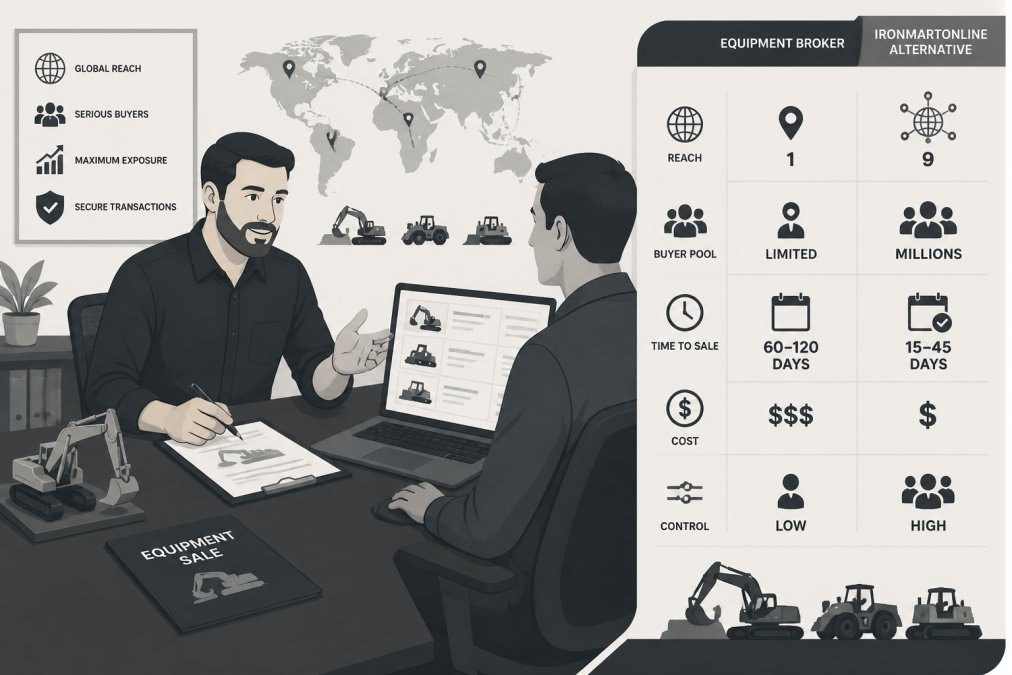
Why use Ironmartonline as your equipment broker? The answer lies in reach and simplicity. At Ironmartonline, we use nine specialized web-based selling platforms to connect your equipment with millions of potential buyers, globally and locally. Unlike scattered listings on single platforms, our multi-channel approach means your excavator or fleet of trucks gets exposure across multiple marketplaces simultaneously. There are no contracts locking you in, no hidden fees eating into your proceeds, and no requirement to commit to a long-term relationship. You maintain ownership until payment clears, and we handle the marketing, buyer screening, negotiations, and paperwork.
But here's what makes this relevant: the equipment brokerage landscape has fragmented. You can list on auction sites, marketplace platforms, consignment services, or work with individual brokers. Each model has trade-offs in speed, control, and net returns. Some take weeks to move equipment. Others charge you upfront fees whether the sale happens or not. Still others require you to surrender control of pricing and buyer communication.
Below, we'll show you exactly how different ultimate equipment brokers alternative approaches stack up, and which one actually fits your situation, your timeline, and your equipment type.
Why Use IronMartOnline as Your Equipment Broker
Choosing the right broker determines whether you're paid in weeks or months, and whether you pocket 85% or 65% of the sale price. Ironmartonline solves the core problem: equipment sellers need maximum exposure without maximum hassle.
The company operates nine separate web-based selling platforms, each targeting different buyer segments and equipment categories. This isn't a single marketplace where your dozer competes with 500 others for attention. It's strategic distribution, your machinery reaches construction firms, rental companies, fleet operators, and international buyers across multiple channels simultaneously. You retain full ownership and control until a buyer's payment clears, which eliminates the risk of consigning equipment to a broker who disappears or mishandles the sale.
The commission-based model means Ironmartonline profits only when you sell. There's no listing fee, no storage charge, no "failure fee" if the equipment doesn't move. The company handles everything: photography, detailed equipment descriptions, buyer qualification, price negotiations, and paperwork processing. For owner-operators with one or two machines, this means you're not paying upfront to list a truck. For fleet managers disposing of 20 end-of-lease units, it means coordinated marketing across all 20 machines without managing nine separate platform accounts.
What sets Ironmartonline apart from other brokers is transparency and scale. The broker then markets aggressively across its network, filters out tire-kickers, and brings you serious offers.
Equipment Brokers Alternative: Quick Comparison Table
| Option | Best For | Speed to Sale | Control Over Price | Upfront Cost |
|---|---|---|---|---|
| Ironmartonline Brokerage | Sellers wanting maximum reach + minimal hassle | 2-6 weeks | High (you approve all offers) | None |
| My Little Salesman | Dealers and small yards with multiple units | 4-8 weeks | Medium (marketplace listing) | $20-$2,000 depending on package |
| Ritchie Bros. / IronPlanet | Sellers comfortable with auction process | 1-3 weeks | Low (auction-driven pricing) | Commission 5-12% + buyer premium 10-15% |
| Direct Online Listing (Facebook, Craigslist) | Budget-conscious sellers with time | 6-12 weeks | High (but unqualified buyer traffic) | Free to minimal |
This table shows the trade-offs clearly. Speed, control, and cost rarely align perfectly, you choose which two matter most to your situation.
How to Evaluate Equipment Broker Services
Before listing your equipment with any broker, you need a framework for evaluation. The wrong choice costs you thousands in lost value or wasted time.
Start with reach verification. Ask the broker directly: "Which platforms do you use, and what's the monthly traffic to each?" A broker claiming "millions of buyers" should back that up with specifics. Ironmartonline's nine platforms represent verified traffic and buyer bases. A local broker claiming the same thing might operate on three platforms with limited geographic reach. The difference in your sale timeline could be weeks.
Next, examine commission transparency. Some brokers advertise "low commissions" but bury additional fees in the contract, storage fees, listing fees, photo fees, title transfer fees. Request a written breakdown before you commit. Know exactly what percentage of the sale price you'll keep. For a $50,000 excavator, a 2% difference in commission is $1,000 in your pocket or theirs.
Third, verify seller protection. Does the broker hold payment in escrow until title transfers? Can you withdraw the listing if you get a better offer elsewhere? What happens if a buyer defaults after you've already transferred the equipment? Ironmartonline's model, you keep ownership until payment clears, protects you from fraud and reduces your risk significantly compared to consignment models where the broker controls the equipment.
Finally, check turnaround on valuation and marketing launch. A broker that takes two weeks to photograph your equipment and post it online is already losing you money. The equipment depreciates daily. Ironmartonline's rapid multi-platform posting means your machinery is generating buyer interest while competitors are still uploading photos.
Auction-Based Alternatives vs. Brokerage Models
The auction model, represented by companies like Ritchie Bros. and IronPlanet, creates artificial urgency. Equipment goes live for a fixed bidding window (often 48 hours), and the highest bid wins. This generates fast sales cycles, sometimes just days from listing to sold.
But speed comes with trade-offs. Auction pricing is competitive, which can drive prices up, but only if demand is strong for your specific equipment. If you're selling a 1995 dozer in a slow market, the auction might attract only two bids, and you're forced to accept below-market pricing. You also have no control over the final sale price. The market sets it, and you take what comes.
Brokerage models like Ironmartonline work differently. Equipment stays active until you accept an offer. This means you're not locked into a 48-hour window. A serious buyer might take a week to arrange financing or coordinate logistics, but you're still negotiating. You can reject low offers and wait for better ones. You maintain pricing control.
The cost structure differs too. Auctions charge seller commissions (typically 5-12%) plus buyer premiums (10-15%). The buyer premium doesn't go to you, it's paid by the buyer on top of the hammer price. For a $100,000 piece of equipment, that buyer premium might add $10,000-$15,000 to the final transaction cost, which can suppress buyer interest. Brokerage commissions are typically lower and more transparent because the broker's only income is a percentage of what you receive.
Auction works best if you have multiple pieces of equipment to move and you're comfortable with market-driven pricing. Brokerage works best if you have fewer machines, want to maximize net proceeds, and have some flexibility on timing.
My Little Salesman: Multi-Industry Platform Option
My Little Salesman operates as a hybrid: part online marketplace, part print publication, part dealer management software. The platform serves construction, agriculture, forestry, mining, and transportation industries with both digital and print catalogs.
For dealers and rental companies with multiple units to move, My Little Salesman offers package deals. Individual listings run approximately $20 for 30 days, but package pricing ranges from $200 to $2,000 depending on how many units you're listing. The platform also sells dealer management software, CRM tools, and website creation services, so costs can escalate quickly if you're using multiple services.
The advantage is established industry presence. My Little Salesman has been operating since 1958, which means it has buyer credibility and search visibility. Buyers in the equipment space often check the platform as a routine part of their sourcing process.
The disadvantage is that you're one listing among thousands. Without aggressive marketing from the platform itself (which doesn't happen, you're responsible for driving traffic to your listing), your equipment competes on price and description alone. For small owner-operators, the package pricing might exceed what you'd pay a full-service broker. For large dealers moving dozens of units, the per-unit cost becomes reasonable.
Ritchie Bros. Auctioneers and IronPlanet: Scale and Reach
Ritchie Bros. is the auction industry heavyweight. The company operates global auctions with both in-person and online bidding, plus IronPlanet, a dedicated online marketplace for weekly auctions with condition reports.
The reach is undeniable. Ritchie Bros. auctions attract thousands of bidders across multiple continents. For sellers moving large quantities of equipment, a rental company liquidating 50 units or a municipality disposing of fleet vehicles, this scale generates competitive bidding and fast sales.
IronPlanet, the online division, offers weekly auctions with IronClad Assurance condition reports. This adds credibility for buyers and can drive higher bids because purchase risk is reduced. The company also provides ancillary services: financing, shipping, and equipment refurbishing.
However, auction fees are substantial. Seller commissions typically run 5-12%, and buyers pay an additional 10-15% buyer premium. For a $50,000 excavator selling at auction, the total fees might total $4,000-$7,000 combined. You also lose pricing control. If demand is weak that week, your equipment might sell below market value with no recourse.
Ritchie Bros. works best for high-volume sellers and for equipment with strong market demand. It doesn't work well for niche equipment or sellers with only one or two machines to move.
Best Ways to Sell Heavy Equipment Online
The modern equipment seller has multiple channels simultaneously available. The best approach combines them strategically rather than relying on a single platform.
Start with a full-service broker like Ironmartonline if you want hands-off management and maximum net proceeds. The broker handles everything, photography, descriptions, buyer screening, negotiations. You approve offers and collect payment. For most individual sellers and small operators, this is the lowest-stress option.
Layer in marketplace listings on platforms like My Little Salesman or specialized equipment sites if you want additional exposure without additional effort. Once a broker has your equipment in their system, they're typically marketing across multiple channels anyway. Adding one or two additional marketplace listings costs little and might generate direct buyer inquiries that bypass the broker entirely.
Consider auction platforms only if you're moving volume or if your equipment has strong market demand. The auction timeline works, but the fee structure and loss of pricing control make it suboptimal for single-unit sales.
Avoid direct-to-buyer channels like Facebook Marketplace or Craigslist unless you have significant time and sales experience. These channels generate tire-kickers, lowball offers, and no-shows. The time cost of managing inquiries often exceeds the savings from avoiding a broker commission.
For international sales, a broker with global reach like Ironmartonline becomes essential. Handling customs paperwork, currency conversion, and logistics across borders is complex. A broker with established international buyer networks absorbs this complexity for you.
Heavy Equipment Consignment: How It Works
Consignment is a specific brokerage model where you transfer physical possession of equipment to the broker, who then markets and sells it on your behalf. You retain ownership until sale, but the broker controls the equipment's location, condition, and presentation.
Consignment works like this: you deliver the equipment to the broker's facility or lot. The broker photographs it, lists it across their platforms, and waits for buyer interest. When a qualified buyer appears, the broker negotiates price, arranges inspection, and coordinates the sale. Once payment clears, the broker transfers title and equipment to the buyer. You receive your proceeds minus the broker's commission.
The advantage is professional presentation. The equipment sits on a broker's lot alongside dozens of other machines, creating a "destination" effect. Buyers visit the lot expecting to find quality equipment. The broker handles logistics, which matters for heavy machinery that's expensive and difficult to transport.
The disadvantage is loss of control and ongoing costs. If the equipment doesn't sell quickly, you might be charged storage or lot fees. You can't easily withdraw the equipment if a better opportunity appears. You're also dependent on the broker's marketing effort, if they're lazy about promoting your specific machine, it sits.
Consignment typically works best for high-value equipment ($50,000+) where professional presentation and buyer traffic justify the broker's involvement. For smaller equipment or owner-operators, consignment creates unnecessary friction.
Commission Structures: What You Actually Pay
Equipment broker commissions vary widely, and the difference between a 5% and 12% commission on a $100,000 sale is $7,000 in your pocket or the broker's.
Full-service brokers like Ironmartonline typically charge commission-only, with no upfront fees. The commission structure incentivizes the broker to maximize your sale price, they profit more if you profit more. This alignment of interests is powerful. A broker earning 8% commission on a $50,000 sale ($4,000) is motivated to negotiate aggressively for your benefit.
Marketplace platforms like My Little Salesman charge listing fees upfront, regardless of whether the equipment sells. This is a fixed cost, not a percentage. A $2,000 package might allow 10 listings for 30 days. If you sell nothing, you've lost $2,000. If you sell five units, your cost per sale is $400 plus your own time managing inquiries.
Auction platforms charge seller commissions (typically 5-12%) plus buyer premiums (10-15%). The buyer premium is sometimes negotiable, but the seller commission is fixed. These fees come directly out of your proceeds.
Direct sales (Facebook, Craigslist, your own website) have zero commission but maximum time cost. You're handling all inquiries, managing negotiations, arranging inspections, and processing paperwork yourself. For experienced equipment sellers, this might be worthwhile. For most sellers, the time cost exceeds the commission savings.
The real comparison isn't just commission percentage, it's total cost including your time, the speed of sale, and the final price achieved. A broker charging 10% commission who sells your equipment in three weeks for full market value might net you more than a 5% commission broker who takes eight weeks and achieves a lower price.
Speed to Sale: Which Alternative Gets Cash Fastest
Timeline varies dramatically by channel, and it matters more than most sellers realize. Equipment depreciates daily. A two-week delay in selling might cost you 1-2% in value.
Auction platforms are fastest. Equipment lists, bidding happens over 48 hours, and the sale closes within days. Ritchie Bros. and IronPlanet can move equipment from listing to payment in one to three weeks. This speed comes at the cost of pricing control and higher fees.
Full-service brokers like Ironmartonline typically close sales in two to six weeks. The timeline is longer than auctions because the broker is working to find the highest-value buyer, not just accepting the highest bid in a fixed window. For most sellers, this trade-off, slightly longer timeline for better pricing and more control, is worthwhile.
Marketplace platforms like My Little Salesman are slower. You're relying on organic buyer traffic to your listing, which might take four to eight weeks or longer. If the equipment doesn't attract immediate interest, you're stuck waiting.
Direct sales are unpredictable. Some equipment sells in days; some sits for months. You're dependent on your own marketing effort and sales ability.
For sellers who need cash quickly, perhaps to fund another equipment purchase or meet a deadline, auction platforms are the right choice despite lower net proceeds. For sellers with flexibility on timing, a full-service broker maximizes value.
Which Equipment Brokers Alternative Fits Your Situation
The right choice depends on four factors: equipment type, quantity, your timeline, and your tolerance for hands-on sales work.
If you're a construction contractor with one or two surplus excavators or dozers: Ironmartonline is your best option. You need maximum exposure without maximum effort. A full-service broker handles everything, and their multi-platform approach reaches the buyers most likely to purchase heavy construction equipment. Commissions are transparent, and you keep ownership until payment clears.
If you're a fleet manager disposing of 20-50 end-of-lease trucks: Ritchie Bros. or a similar auction platform might be faster, especially if you need to clear the lot quickly. The buyer premium is high, but the volume and speed might offset it. Alternatively, if you have time, Ironmartonline's multi-platform approach might achieve better pricing on individual vehicles, which compounds to significant savings across 20 units.
If you're an agricultural business owner selling used tractors or combines: My Little Salesman has established credibility in the ag space, so marketplace visibility is strong. However, a broker with agricultural specialization might outperform a generalist platform. Check whether Ironmartonline has strong agricultural buyer networks in your region.
If you're an equipment rental company with ongoing disposal needs: Build a relationship with a full-service broker like Ironmartonline. Consistent volume justifies the broker's attention, and you'll negotiate better commission rates. Avoid auction platforms for routine disposals, they're better for one-time liquidations.
If you're an owner-operator with one truck or small piece of equipment: Avoid consignment and marketplace listing fees. Use Ironmartonline's commission model, which costs you nothing unless the equipment sells. Your time is valuable; don't spend it managing multiple marketplace inquiries.
Conclusion
The ultimate equipment brokers alternative landscape has matured. You're no longer choosing between "list it yourself" and "hope an auctioneer finds a buyer." You have strategic options, each with clear trade-offs.
Ironmartonline stands out because it solves the core problem: maximum exposure without maximum hassle. Nine web-based platforms mean your equipment reaches millions of potential buyers. No contracts, no hidden fees, and no upfront costs mean you're not gambling with capital. You maintain ownership until payment clears, which protects you from fraud and gives you pricing control throughout the sale process.
Auctions work if you prioritize speed and accept lower net proceeds. Marketplace platforms work if you're a dealer with volume. Direct sales work if you have sales experience and time. But for most equipment sellers, contractors, fleet managers, rental companies, and owner-operators, a full-service broker with multi-channel reach and transparent commissions delivers the best outcome.
Frequently Asked Questions
What is the main difference between an equipment broker and an auction site?
An equipment broker actively markets your machinery to qualified buyers and handles negotiations on your behalf, while you retain ownership until payment clears. Auction sites conduct time-limited bidding events where buyers compete openly. Brokers typically work on commission; auctions charge seller fees plus buyer premiums. Brokers offer more control over the process and final pricing; auctions move faster but give you less say in the outcome.
How do heavy equipment consignment services differ from traditional sales?
Consignment means the broker lists your equipment but you keep ownership until it sells. You pay commission only when the sale closes, no upfront listing fees. This model protects sellers because the broker shares your risk; they don't get paid unless they find a buyer. Traditional sales may involve flat fees or percentage-based charges regardless of whether equipment sells. Consignment works well for owner-operators and smaller fleets with limited inventory.
What should I look for when choosing an equipment brokers alternative?
Evaluate reach (how many buyers see your listing), transparency (clear fee structure with no hidden charges), handling of paperwork and logistics, speed to sale, and track record with equipment like yours. Ask about their marketing channels, do they use multiple platforms to maximize exposure? Check if they work with international buyers if that matters to you. Request examples of recent sales and realistic timelines. Small owner-operators should confirm the broker accepts single-unit sales, not just fleet quantities.
How long does it typically take to sell equipment through a broker versus an auction?
Brokers typically take 30-90 days to sell depending on equipment type, condition, and market demand. Auctions move faster, sales conclude within days of the auction close, though preparation may take 2-4 weeks. Speed depends on equipment demand; popular items like newer trucks sell faster than specialty machinery. Brokers provide more realistic timelines upfront; auctions guarantee a sale date but not a price. Ask your broker for a valuation and timeline estimate within 24-48 hours of listing.
What platforms do equipment brokers use to reach buyers?
Leading brokers use multi-channel distribution across specialized marketplaces, social media, trade publications, and dealer networks. Some brokers connect listings to multiple platforms simultaneously, MachineryTrader, Machinio, Facebook Marketplace, and industry-specific sites. This maximizes exposure to serious buyers across different channels. Ask your broker to specify which platforms they use and how often they update listings. The more channels your equipment appears on, the faster you'll find qualified buyers willing to pay market rates.
Ready to move your equipment efficiently? Join Ironmartonline's email list to receive market insights, equipment valuation updates, and selling strategies delivered directly to your inbox. Get connected with serious buyers across our nine specialized platforms and see why we're one of the most trusted names in used heavy equipment sales and marketing.
This article was written using GrandRanker