

Last Updated: November 16, 2026
Quick Summary
To read tractor engine hour meters, note the whole-hour digits on the left and the tenths digit on the far right, so a display showing 1247 with a 6 in the last position means 1,247.6 hours. Confirm the meter type first, because RPM-based meters count engine revolutions at rated speed rather than clock time. Watch the meter tick to verify which digit is which before recording the reading.
- Mechanical meters show whole hours in black and tenths in white or red on the far right.
- An RPM-based meter logging one hour per 2,000 revolutions records 1,000 RPM for 60 minutes as 30 hours.
- A four-digit mechanical meter tops out at 9,999.9 hours, then rolls back to zero.
- Start the tractor and watch the meter advance to confirm it still counts.
- Log current hours at every service and track hours per week to estimate the next interval.
Table of Contents
- Why Accurate Hour Readings Matter When Buying or Selling
- How Tractor Hour Meters Work: What the Display Actually Counts
- How to Read Hour Meter 1/10 Digits and Whole Hours
- Using a Tractor Hour Meter Calculator for RPM-Based Readings
- How Engine Speed and PTO Speed Affect Recorded Hours
- Meter Rollover, Maximum Readings, and Broken or Replaced Meters
- How to Verify Used Tractor Hours Before You Buy
- Turning Engine Hours into a Maintenance Schedule
- List Your Tractor with Ironmartonline and Reach Serious Buyers
- Frequently Asked Questions
Why Accurate Hour Readings Matter When Buying or Selling
Learning how to read tractor engine hour meters starts with one hard truth: that display is the closest thing a used tractor has to a service history. The number tells you how much work the machine has done, and that number shapes both the asking price and the maintenance bill waiting for you. This guide from Ironmartonline walks through every meter type, the tenths digit, and the RPM math that most buyers skip.
Why use Ironmartonline as an equipment broker? Because a broker who reads meters correctly prices your machine correctly. We connect buyers and sellers of used machinery through nine web-based selling platforms, with no contracts and no hidden fees.
Here is the problem. An hour meter is not a stopwatch bolted to the dashboard. Yesterday's Tractors explains how to interpret hour readings and owner forums describe meters that count at a reference engine speed, not clock time. So the display shows a calculated value, not raw run time.
Below, we show you exactly how to read the digits, identify the meter type, and verify a used tractor before you hand over money.
How Tractor Hour Meters Work: What the Display Actually Counts
A tractor hour meter is a gauge that records engine use as a number, usually shown in hours and tenths of an hour. The key word is "records," because different designs record differently.
An engine hour is one unit of recorded operating time, and on most tractors it is tied to engine rotation rather than the clock on your wall. That distinction matters when you compare two machines with similar readings.
Most meters fall into three groups:
- Mechanical hour meters: driven by a cable or gear from the engine, with rolling number wheels.
- Electrical hour meters: run by a switched 12V source, often counting whenever the ignition is on.
- Electronic hour meters: digital displays fed by an engine or ECU signal.
The third type is the most precise, but it depends on a sensor being healthy. A dead sensor can freeze a digital display at a number that looks perfectly normal.
Elapsed-Time Meters vs. RPM-Based Meters
An elapsed-time meter counts clock hours while powered. An RPM-based meter counts engine rotations and converts them to hours at a rated speed. The first tracks time; the second tracks work.
Picture two tractors idling for an afternoon. The elapsed-time meter logs the full session. The RPM-based meter logs less, because the engine never reached its rated speed.
Neither meter lies. They simply answer different questions, and a buyer who confuses them misreads the machine.
How to Read Hour Meter 1/10 Digits and Whole Hours
Reading the display means separating whole hours from the tenths digit. On a mechanical meter, the black numbers are whole hours and the white or red number on the far right is tenths of an hour. So a display reading 1247 with a 6 in the last position means 1,247.6 hours.
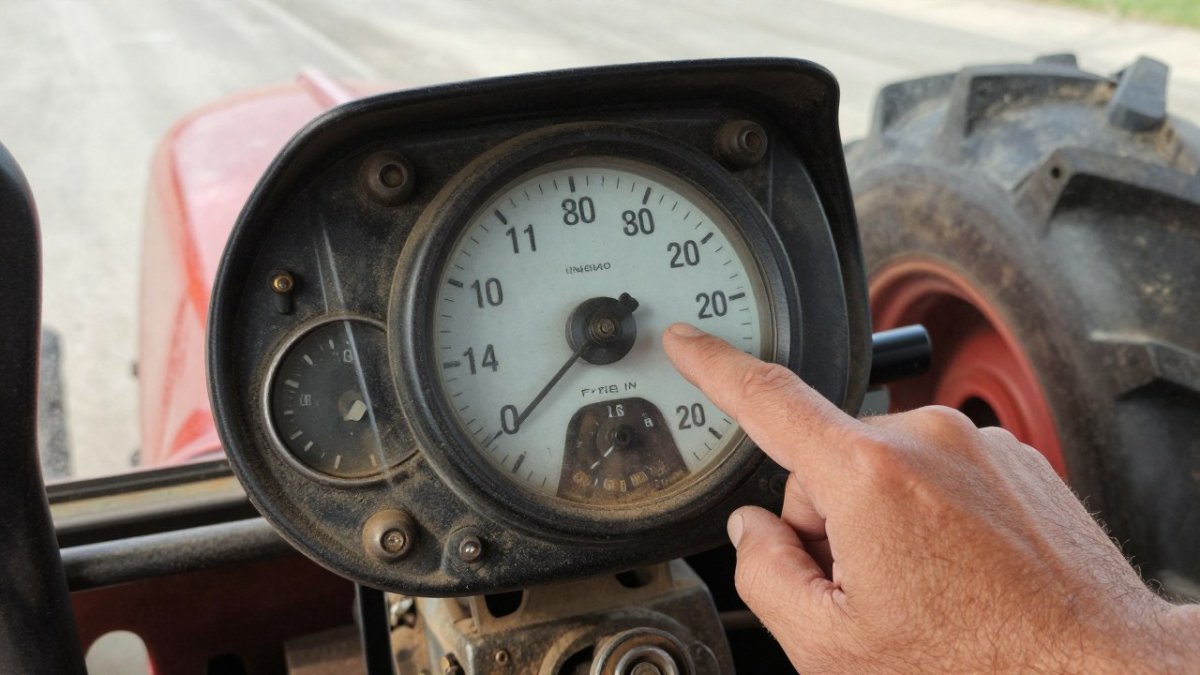
That single decimal place changes how you talk about a machine. "Twelve hundred hours" and "1,247.6 hours" sound similar but describe different wear.
Follow this sequence every time:
- Note the whole-hour digits on the left.
- Read the tenths digit on the right.
- Confirm which digit is which by watching the meter tick.
- Write the full reading down with the decimal.
A Visual Walkthrough for Common Displays
Most analog mechanical meters use a row of five or six number wheels. The rightmost wheel is the tenths digit and often has a different background color, white on black, or red on black. The wheel immediately to its left is the ones digit, then tens, hundreds, and thousands. When the tenths wheel rolls from 9 to 0, the ones wheel advances by one. Watch that transition for a minute and you will never misread the decimal again.
Digital and electronic displays vary more. Some show a decimal point (e.g., 1247.6), some show a separate small digit for tenths, and some toggle between total hours and other data such as PTO hours or trip hours. Before you record a number, confirm the display is showing total engine hours, not a resettable trip meter. A label or icon near the screen usually identifies the mode. Once the total-hour mode is confirmed, the reading can be compared with the diesel engine data plate to help verify that the engine is the correct fit for the tractor.
Reading Mechanical, Electrical, and Electronic Displays
Mechanical wheels roll slowly, so the tenths digit may sit between numbers. Electrical meters with a digital face are easier to read but can reset after a battery swap. Electronic displays sometimes toggle between hours and other data, so watch for a label or icon before you trust the number.
If a display shows dashes or blanks, the meter is not reporting. Treat that as unknown hours, not zero.
Watch out: On a mechanical meter, the tenths wheel may appear to sit on two numbers at once; trust the number that is more centered in the window, and confirm by watching the next rollover.
Here is the reading sequence to follow every time you check a display.
| Step | What to do |
|---|---|
| 1 | Note the whole-hour digits on the left |
| 2 | Read the tenths digit on the right |
| 3 | Confirm which digit is which by watching the meter tick |
| 4 | Write the full reading down with the decimal |
Using a Tractor Hour Meter Calculator for RPM-Based Readings
A tractor hour meter calculator converts engine revolutions into recorded hours. The math is simple: revolutions divided by rated speed, divided by 60, gives you hours at that rated speed.
Worked example. Suppose a meter is designed to log one hour per 2,000 engine revolutions at rated speed. An engine turning 1,000 RPM for 60 minutes produces 60,000 revolutions, which the meter records as 30 hours, not 60.
That is why low-speed work, like loader duty or idling in a barn, can understate real wear in clock terms while still adding hours on the display.
Run the numbers before you compare two tractors. A machine with higher hours may have spent them at rated speed, doing real work, while a lower-hour unit sat idling.
How Engine Speed and PTO Speed Affect Recorded Hours
Engine speed changes what the meter counts. At rated speed, an RPM-based meter tracks close to clock time. Below rated speed, it falls behind. That gap is the whole story behind mismatched readings.
PTO speed ties into the same logic. A 540 RPM PTO is a standard reference point, and implements are designed around it. When a tractor runs at rated engine speed to hit 540 RPM at the PTO, the meter and the clock stay close.
Run the PTO below spec and two things happen: the implement works slower, and the meter records less. Neither is a fault. Both are reasons to ask how a tractor was used, not just how many hours it shows.
Meter Rollover, Maximum Readings, and Broken or Replaced Meters
Rollover is the quiet one. A mechanical meter with four whole-hour digits tops out at 9,999.9 hours, then rolls back to zero. A tractor with 12,000 real hours can display 2,000.
Watch for these warning signs:
- A reading far below the wear on pedals, seat, and linkages.
- A meter that looks newer than the dashboard around it.
- Mismatched fasteners or tool marks near the gauge.
- Service records that jump backward in hours.
A replaced meter is not automatically a red flag. Owners swap failed gauges, and honest sellers keep the paperwork. What matters is whether the seller can explain the gap.
If the meter is broken, price the machine as unknown hours and inspect harder. If you suspect tampering, walk away or demand documentation.
How to Verify Used Tractor Hours Before You Buy
Verification means matching the display against physical evidence. A meter reading is a claim; wear is the proof. Use this structured checklist before you commit:
- Record the exact reading, including the tenths digit.
- Photograph the meter and the dashboard.
- Compare pedal pads, step treads, and seat condition to the hours.
- Check the hour reading against service records and oil change tags.
- Ask whether the meter was ever replaced or repaired.
- Confirm the meter type and how it counts.
- Look for rollover on four-digit mechanical meters.
- Start the tractor and watch the meter advance.
A common mistake is trusting a low reading without checking the meter type. Either way, the number alone proves little.
A Practical Verification Framework
Treat each clue as one data point, not proof. The strongest verification combines meter condition, service records, controls, tires, and machine wear. A tractor with 2,000 hours but worn pedals and a replaced seat may have more real hours than the display suggests. A tractor with 6,000 hours but fresh paint and new tires may have been refurbished, or the meter may have been replaced.
Start with the meter itself. Does it look original to the dashboard? Are the fasteners undisturbed? Does the lens match the age of the surrounding plastic? A meter that looks newer than the tractor is a conversation starter, not automatically a red flag.
Next, check the controls. Pedal pads, step treads, and seat cushions wear with use. A machine with low hours should show light wear. Heavy wear on a low-hour meter suggests either rollover or replacement.
Then review the paperwork. Service records, oil change tags, and inspection stickers often include hour readings. A record that jumps backward in hours is a warning sign. A record that shows a consistent progression builds confidence.
Finally, start the tractor and watch the meter advance. If it does not move after several minutes of running, the meter or its sensor may be faulty. Treat that as unknown hours.
When the Meter Is Broken, Replaced, or Suspected of Alteration
A replaced meter is not automatically a red flag. Owners swap failed gauges, and honest sellers keep the paperwork. What matters is whether the seller can explain the gap and document the replacement. Ask for the repair invoice, the date of replacement, and the reading at the time of replacement. If the seller cannot provide documentation, price the machine as unknown hours and inspect harder.
If you suspect tampering, mismatched fasteners, tool marks near the gauge, or a reading far below the wear, walk away or demand a professional inspection. Document everything you see. A seller who cannot explain a discrepancy is a risk you do not need to take.
For a fuller pre-purchase walkthrough, our guide on 7 tips for buying used farm tractors in 2026 covers engine inspection, hour verification, and the mistakes that cost buyers the most.
Turning Engine Hours into a Maintenance Schedule
Maintenance intervals run on engine hours, not calendar months. A tractor that works 40 hours a week needs service far sooner than one used seasonally, even if both sat in the same barn for a year.
Build your schedule from the reading:
- Log the current hours at every service.
- Track hours per week to estimate the next interval.
- Note the meter type so your math matches the gauge.
- Keep a written log in the cab.
If you are assembling a service kit, our guide to essential tools for farm tractor maintenance covers the wrenches, filters, and diagnostic gear that keep a machine running between intervals.
Watch out: skipping the log is the mistake that hurts most. Without a written record, a replaced meter or a rollover erases your entire service history.
List Your Tractor with Ironmartonline and Reach Serious Buyers
A clear photo of the meter, a written service log, and an honest note about any replacement build trust before a buyer ever calls.
That is where we come in. Ironmartonline puts your machine in front of buyers through nine web-based selling platforms, with no contracts and no hidden fees. Our reach is global and local.
You can browse the heavy trucks inventory to see how equipment is presented on our marketplace before you list.
Reading a tractor's hour meter correctly takes ten minutes and saves thousands. If you are ready to sell, let us handle the reach and the paperwork. Get started with Ironmartonline and put your tractor in front of buyers who check the meter before they make an offer.
Frequently Asked Questions
Do tractor hour meters measure engine-running time or key-on time?
It depends on the meter design. Many meters count while the engine runs, but some electrical meters are wired to a switched 12V source and can log time whenever the ignition is on, even with the engine off. That means a displayed reading is not always a direct count of clock hours with the engine running. Before you trust the number, confirm how the meter on that specific tractor is wired, and compare the reading against wear indicators like pedal wear and service records.
How do I read an hour meter that shows tenths of an hour?
On most displays, the digits to the left of the decimal point are whole hours and the final digit on the right is tenths of an hour. A reading of 1,250.4 means 1,250 whole hours plus four-tenths, or about 24 minutes of the current hour. When you log the reading for maintenance or a sale listing, record the full number including the tenths digit so the next owner can track intervals precisely.
Can a tractor hour meter be inaccurate or replaced?
Yes on both counts. Mechanical meters can wear, and replacement meters may start again from zero, so a low reading does not prove low wear. A forum example describes a tractor showing 1,100 hours alongside visible pedal wear, which is why buyers compare the display with physical condition. If a meter was replaced, ask for the service record showing the old reading and the replacement date so the true operating hours can be reconstructed.
How can you verify a tractor's hours when buying used equipment?
Start with the meter reading, then check the meter type to see whether it counts elapsed time or engine rotation. Compare the display against pedal wear, seat condition, and service records, and ask the seller for documentation of any meter replacement. On RPM-based meters, use a tractor hour meter calculator to convert recorded hours into a realistic estimate of engine run time. A practical checklist like this catches discrepancies that the number alone hides.
