
Table of Contents
- Why Use Ironmartonline Equipment Broker to Sell Surplus Parts
- How to Sell Surplus Construction Equipment Parts Online
- How to Price Used Construction Equipment Parts
- Construction Equipment Parts Listing Template
- Construction Equipment Parts Shipping and Logistics
- Grading, Testing, and Documenting Parts for Sale
- Negotiating with Buyers and Managing Inquiries
- Legal and Transaction Safeguards for Parts Sales
- Next Step: List Your Surplus Parts with Ironmartonline
- Frequently Asked Questions
Last Updated: November 5, 2026
Why Use Ironmartonline Equipment Broker to Sell Surplus Parts
The used construction equipment market was valued at USD 132.67 billion in 2026, according to Mordor Intelligence's used equipment market analysis. That is a lot of iron moving, and every machine carries a parts tail: spare buckets, hydraulic pumps, undercarriage assemblies, controllers, and attachments that pile up in the yard long after the machine sells.
So why use Ironmartonline as your equipment broker? Because surplus parts are a logistics and reach problem, not a listing problem. We run nine specialized web-based selling platforms with no contracts and no hidden fees, which puts your parts in front of a far wider buyer pool than a local lot. Contractors and fleet managers who try to sell surplus construction equipment parts alone usually reach a local audience and accept a local price.
The stakes are real. Medium-duty used inventory fell 13.24% in February 2026, per My-Equipment's U.S. used equipment market report, and 83% of contractors told Equipment World's 2026 purchase survey they plan to buy equipment this year. Demand is there. The question is whether buyers can find you.
Below, we walk through exactly how to sell surplus construction equipment parts: identifying inventory, choosing a channel, pricing, listing, shipping, and negotiating. The steps work whether you list with us or not. They work better with us. When a complete set is missing, the remaining parts can still hold value, so Find The Other Box before treating partial inventory as a loss.
How to Sell Surplus Construction Equipment Parts Online
Selling surplus construction equipment parts online means documenting each part, choosing a sales channel that matches the part type and lot size, pricing it against real market data, and shipping it safely to the buyer. The whole process runs on five steps:
- Identify and inventory every part
- Choose your sales channel
- Price against market data
- Build a listing that ranks and converts
- Ship and close the transaction
The man is American.
Step 1: Identify and Inventory Your Parts
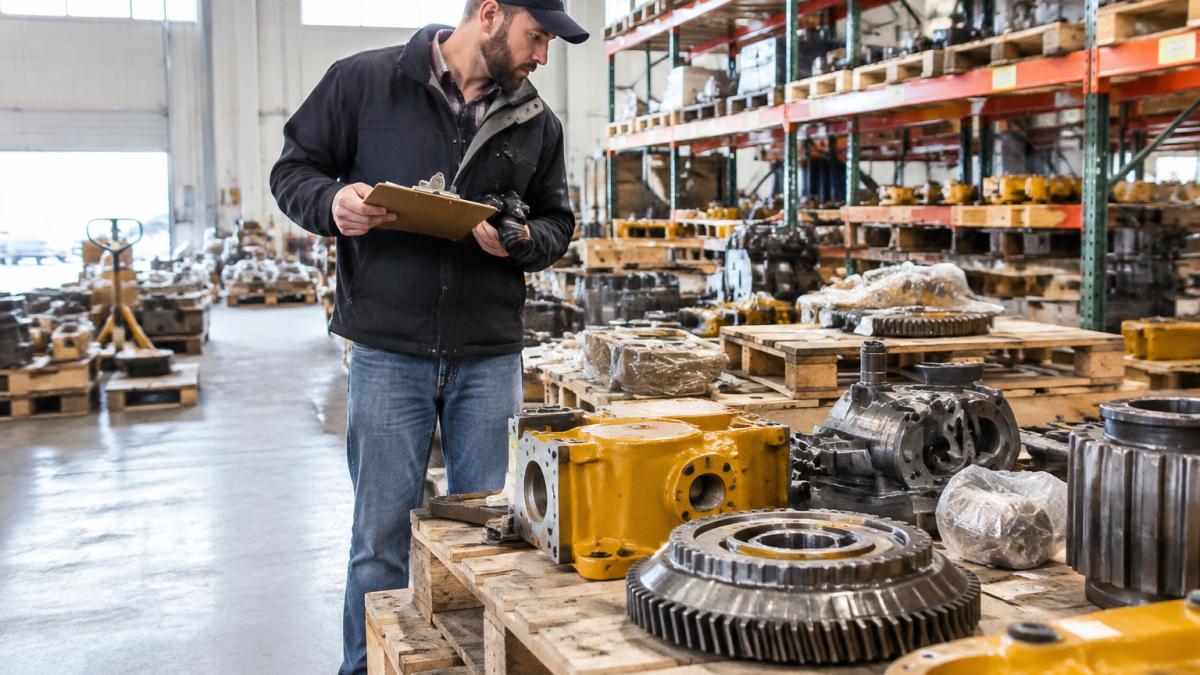
Start with part numbers, not guesses. Photograph the manufacturer plate, cast numbers, and any stamped codes on each item. Record the make, model, serial number, and the machines the part fits. Compatibility is the number one question buyers ask, and a part with no confirmed fitment sits unsold.
Build a simple inventory sheet with these fields:
- Part name and manufacturer part number
- Machine make, model, and year range it fits
- Condition grade and any known defects
- Quantity on hand and unit of measure
- Storage location and pallet or lot number
- Original purchase date and cost, if known
Group small items into lots. A single bracket rarely justifies freight. A pallet of mixed hydraulic fittings does.
Step 2: Choose Your Sales Channel
Four channels move surplus parts: online marketplaces, private sale, dealer trade-in, and auction or consignment. Each fits a different part type and lot size.
| Channel | Best For | Watch Out For |
|---|---|---|
| Online marketplace | Broad reach, common parts | Listing fees, tire-kickers |
| Private sale | High-value, known buyers | Slow, no reach beyond network |
| Dealer trade-in | Fast disposal, whole lots | Dealer margin eats your price |
| Auction/consignment | Mixed lots, uncertain value | Commission and timing risk |
Dealer trade-in deserves a warning. As Steffes Group's selling guide points out, a dealer's trade-in number leaves room for the dealer to resell, so you accept a discount for speed. If you have time, sell direct. If you need the yard cleared this month, trade-in earns its keep.
If you are still weighing platforms, our guide to trusted platforms to sell used heavy equipment online compares the options side by side.
How to Price Used Construction Equipment Parts
Price used construction equipment parts by benchmarking three things: recent sold prices for the same part number, current dealer new-part pricing, and the condition grade of your unit. Asking prices are noise. Sold prices are signal.
Valuation Methods and Market Data
The aftermarket parts market hit USD 22.1 billion in 2025 and is projected to reach USD 38.1 billion by 2034, per Dataintelo's aftermarket parts analysis. That growth means buyers are actively hunting used parts, which supports firmer pricing on clean, documented inventory.
Price each part by its condition tier relative to current dealer new price, and adjust for completeness and documentation.
Adjust down for missing hardware, rust, or unknown hours. Adjust up for OEM packaging and confirmed fitment. For high-value components, a professional equipment appraisal and valuation service gives you a defensible number and paperwork buyers trust.
Researching Comparable Sales
Most sellers guess. The better approach is to build a small comp sheet for each part number. Search completed listings on marketplaces like eBay (filter by "sold"), check dealer websites for new and remanufactured pricing, and call two or three dealers who stock the part to ask what they sell it for and what they pay for cores. Record the date, source, and price.
For parts with no recent comps, work backward from the new price and adjust for condition, completeness, and urgency.
Accounting for Obsolescence and Slow-Moving Inventory
Parts for older machines can be gold or dead weight. Check the manufacturer's parts catalog to see if the part is still in production. If it is discontinued, demand may spike from owners keeping old iron running, but the buyer pool is smaller. Price discontinued parts at a premium only if you can document that no new stock exists. Otherwise, price to move.
For slow-moving inventory, set a regular review date. If a part has not sold in several months, consider cutting the price or bundling it into a lot. Holding cost is real: storage, insurance, and tied-up capital.
Pricing Bulk and Mixed Lots
Small components rarely justify individual listings. Group them by system (hydraulic fittings, electrical connectors, filters) or by machine family. Price the lot below the sum of individual comps to reflect the buyer's sorting effort. For large inventories, consider a bulk liquidation to a dealer or reseller, which clears the yard in one transaction.
Watch out: pricing from asking prices instead of sold prices is the fastest way to sit on inventory. Always verify what buyers actually paid.
Construction Equipment Parts Listing Template
A strong listing answers the buyer's questions before they ask. Use this template for every part:
Title: [OEM Part Name] [Part Number] for [Machine Make/Model] - [Condition Grade]
Condition: [Grade] - [hours or usage if known]. [Defects noted honestly.]
Fitment: Fits [make/model/year range]. Verified against [source: dealer lookup, service manual].
Includes: [what ships in the box or on the pallet]
History: [machine it came from, reason for removal]
Shipping: [freight class, pickup or delivery terms]
Price: [asking price] or [make offer]
Photograph six to ten angles: overall, part number plate, wear points, and connections. Our guide on how to photograph heavy equipment for listing covers angles and lighting that make parts look sellable. Then optimize the title and description with our tips on optimizing heavy equipment listings for search visibility so buyers actually find the part.
Construction Equipment Parts Shipping and Logistics
Shipping construction equipment parts safely comes down to three decisions: packaging, freight class, and carrier. Get one wrong and the part arrives damaged or the freight bill eats your margin.
Packaging guidance for heavy parts: crate or palletize heavy items, strap components to a skid, bag and label small hardware separately, photograph the packed pallet before pickup, and use freight class based on density.
For anything crossing a border, customs paperwork and duties add real complexity. Our international heavy equipment shipping logistics guide walks through RoRo, customs clearance, insurance, and cost factors. Decide who handles customs before you quote a delivered price, not after.
Grading, Testing, and Documenting Parts for Sale
Condition grades drive price, and documentation defends the grade. Use a consistent condition grading scale and grade every part the same way. Grade every part the same way, every time.
Test what you can. Spin the pump, check the cylinder for leaks, meter the controller if you have the tool. Record results in writing and photograph the test. A part with a test sheet commands more than an identical part with a shrug.
Documentation that pays for itself:
- Photos of the part number and serial plate
- A written condition report signed and dated
- Test results or bench readings where applicable
- Service records showing the donor machine's history
What most sellers miss is that buyers are not paying for the part alone. They are paying for certainty. Documentation is how you sell certainty.
Negotiating with Buyers and Managing Inquiries
Negotiation starts before the first offer. Set a floor price in writing, know your freight cost, and decide your walk-away number. Then hold it.
Handle inquiries in this order:
- Answer fitment questions with documentation, not opinion
- Qualify the buyer's machine and timeline
- Quote the asking price with freight included or clearly excluded
- Counter once, then hold
- Move to payment terms only after price is agreed
A common mistake is negotiating against yourself. If a buyer goes quiet, do not chase with a discount. Follow up once with new information, such as another inquiry or a price adjustment across your inventory, and let the market respond.
Legal and Transaction Safeguards for Parts Sales
Protect the sale with clear terms. State the condition grade and sell "as-is" unless you offer a warranty in writing. Document the bill of sale with part numbers, serial numbers, price, and date. Confirm payment clears before the part leaves the yard.
Practical safeguards:
- Use tracked payment methods, not cash-by-mail arrangements
- Verify the buyer's business identity on larger transactions
- Keep copies of all photos, test sheets, and correspondence
- Disclose known defects in writing, every time
Watch out: skipping the written condition disclosure is how a routine parts sale turns into a dispute over a failed component. A one-page condition report costs you ten minutes and prevents most of them.
Next Step: List Your Surplus Parts with Ironmartonline
Selling surplus parts is a reach game. The parts are worth what buyers will pay, and buyers only pay what they can find. Nine specialized platforms, no contracts, and no hidden fees put your inventory in front of millions of potential buyers, local and global.
Our brokerage handles the listing, the buyer inquiries, and the logistics coordination so your team stays on the job site. We work with owner-operators and fleet managers alike.
Contact Ironmartonline to list your surplus construction equipment parts.
Frequently Asked Questions
How do I sell unused construction equipment parts?
Start by creating a detailed inventory of every part, including part numbers, condition, and quantity. Then choose a sales channel that matches your parts and lot size, such as an online marketplace, auction, or broker. Price your parts using recent sales data, write a clear listing with photos, and be ready to answer buyer inquiries quickly. A heavy equipment broker can handle the listing, buyer communication, and logistics if you want a hands-off process.
How should I price used construction equipment parts?
Check recent sold listings for the same part number and condition on marketplaces and auction results. Factor in wear, completeness, and whether the part has been tested. Demand for quality used parts is strong, so check recent sold results before setting your price. Set an asking price with a small negotiating buffer and adjust if you get no inquiries within a few weeks.
What information should I include in a parts listing?
Include the manufacturer, part number, machine compatibility, condition grade, quantity available, and clear photos from multiple angles. Add any testing or inspection details and note whether original packaging or documentation is included. A construction equipment parts listing template with fields for these details reduces back-and-forth with buyers. Also state your shipping terms, return policy, and accepted payment methods so qualified buyers can act quickly.
What is the best way to ship heavy or oversized equipment parts?
For heavy or oversized parts, use freight shipping rather than parcel carriers. Palletize the part securely, strap it down, and photograph the packaging before pickup. Get quotes from freight brokers and confirm whether the buyer or seller pays shipping. For international sales, customs clearance paperwork must be prepared in advance. Construction equipment parts shipping costs vary by weight, distance, and dimensions, so build those costs into your pricing or state them clearly in the listing.
The yard does not clear itself. Every month surplus parts sit, they lose value and take up space you could use. Ironmartonline connects your inventory to millions of buyers across nine selling platforms with no contracts and no hidden fees, and our team manages the listing, buyer communication, and logistics from first inquiry to sale proceeds. Get started with Ironmartonline and turn your surplus parts into working capital.
